Best Ecommerce Platforms in 2026: 8 Platforms Compared

How we put this together: we compare official feature and pricing pages, app store listings, privacy policies and public user reviews. Prices change, so check the provider's site before you pay.
Key takeaways
- Shopify remains the best all-round platform for most small businesses, with fast setup, a large app range and reliable checkout.
- WooCommerce suits WordPress users who want full ownership, while BigCommerce suits growing brands that need more built-in features.
- Wix and Squarespace suit beginners and brand-led stores that value design simplicity over deep commerce features.
- Ecwid and Square Online offer low-cost routes to start selling, especially for firms that already have a website or a shop.
- Watch transaction fees and app costs, not just the monthly subscription, since those extras often decide the real cost.
Quick comparison
| Name | Who it suits | Starting price | Free option | |
|---|---|---|---|---|
 Shopify | All-round small stores | $39 per month | Free trial | Visit |
 WooCommerce | WordPress stores | Free | Yes | Visit |
 BigCommerce | Growing brands | $39 per month | Free trial | Visit |
 Wix | Beginner stores | See website | Yes | Visit |
 Squarespace | Brand-led stores | See website | Free trial | Visit |
 Ecwid | Adding a store to a site | Free | Yes | Visit |
 Square Online | Shops selling online and in person | Free | Yes | Visit |
 Shift4Shop | Value-focused US stores | Free | Yes | Visit |
The best ecommerce platforms
We compared official pricing pages, transaction fees, design tools, app ranges, payment options and public reviews, with a focus on US small businesses selling online in 2026.

Shopify is our pick for most small businesses because it removes the technical work of selling online. You can launch a store in a day, add products, connect payments and shipping, and extend the store with thousands of apps for subscriptions, bundles, reviews and marketing. Checkout is reliable and familiar to shoppers, which helps conversion.
The catch is total cost. The base plan starts at $39 per month, but paid apps, themes and payment fees add up as a store grows. Checkout customisation is also limited unless you move to a higher plan. For a store that wants to launch fast and scale without hiring a developer, Shopify is still the safest choice.
- Fast setup and reliable checkout
- Huge app and theme range
- Strong payment and shipping tools
- Monthly cost plus apps can rise
- Checkout customisation is limited on lower plans
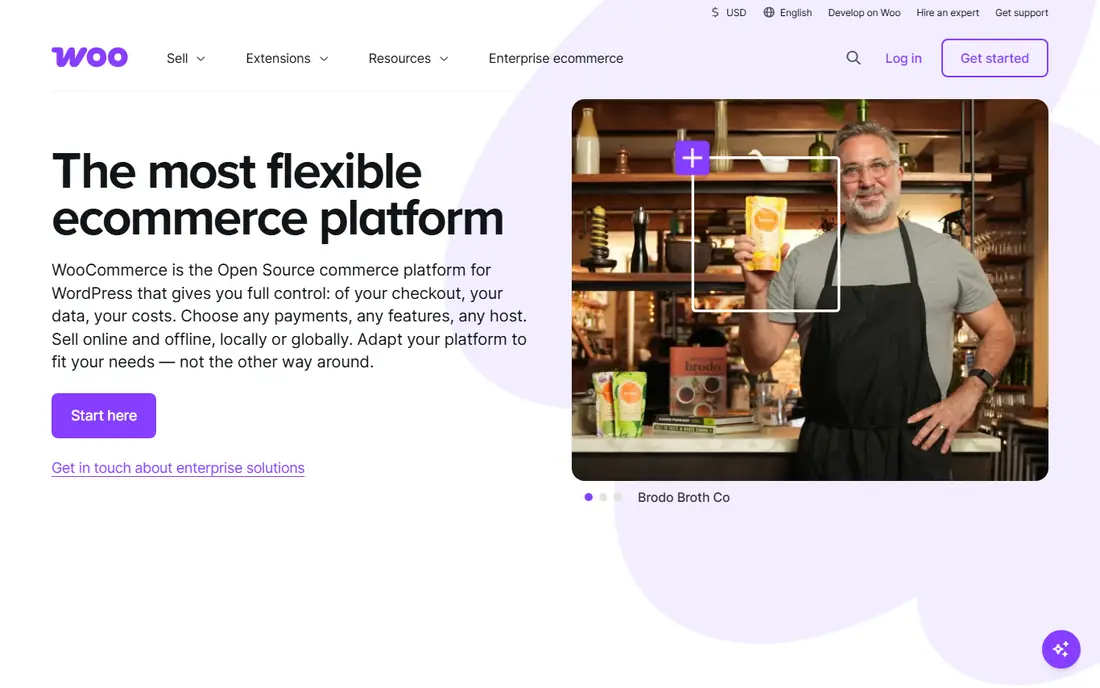
WooCommerce suits a business that already runs WordPress or wants full control over its store. The core plugin is free and open source, so you own your data, design and checkout, and thousands of WordPress plugins cover payments, shipping, subscriptions and marketing. Content marketing also sits naturally beside the store, since WordPress is built for publishing.
The catch is maintenance. You pay for hosting, handle updates and security, and troubleshoot plugin conflicts yourself or with a developer. That freedom costs time, and a poorly maintained store can break or slow down. For WordPress users with technical help, WooCommerce offers unmatched control at low entry cost.
- Free open-source plugin
- Full ownership of data and design
- Huge WordPress plugin range
- Hosting, security and updates are your job
- Costs rise with plugins and hosting
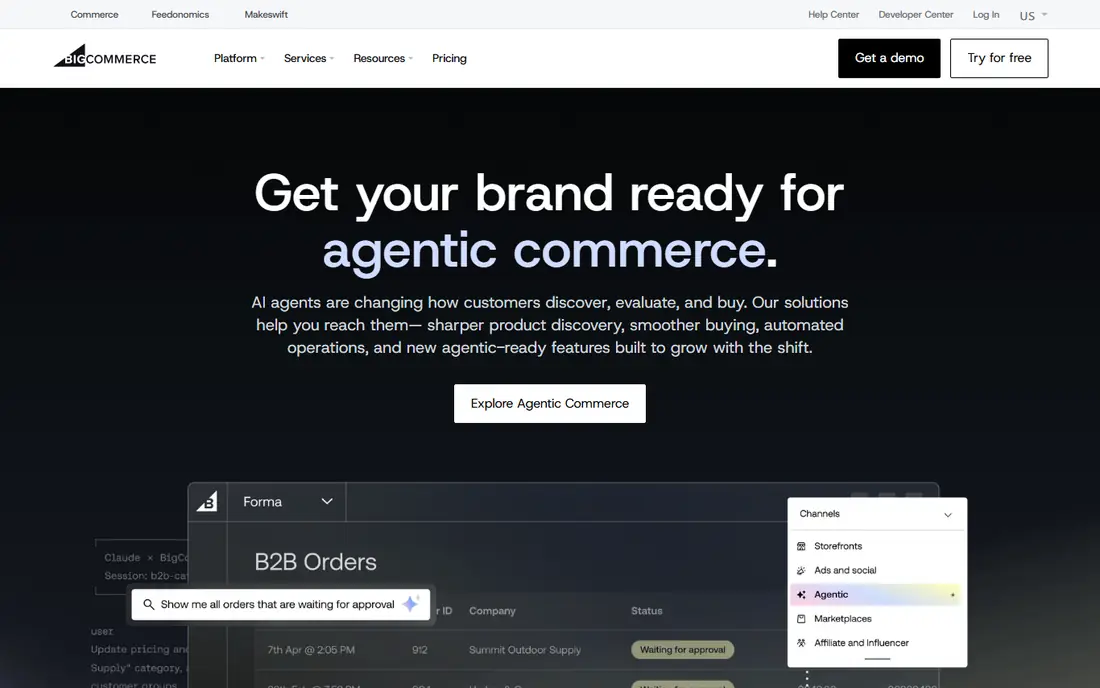
BigCommerce fits a growing brand that wants powerful commerce features without buying many apps. Multi-currency selling, product filtering, customer groups and B2B pricing are built in, and BigCommerce charges no extra platform transaction fee on top of payment processing. That built-in depth helps mid-size stores avoid app sprawl.
The catch is plan thresholds. Annual online sales above set levels can move a store to a higher-priced plan, so fast growth raises the subscription. The theme and app range is also smaller than Shopify. For a scaling brand that values built-in features, BigCommerce is a strong alternative to Shopify.
- More built-in features than Shopify
- No platform transaction fees
- Strong B2B tools
- Sales thresholds can push you to a higher plan
- Theme range is smaller than Shopify
Wix suits a beginner or small retailer who wants a good-looking store without learning commerce software. Drag-and-drop design, templates and built-in marketing tools make setup fast, and commerce plans add payments, shipping and product management. For a small catalogue and a brand-led site, Wix feels friendly from day one.
The catch is scale. Large catalogues, complex variants and advanced B2B needs stretch Wix further than Shopify or BigCommerce, and moving a store to another platform later takes effort. If you plan to stay small and design-led, Wix is a good fit. If rapid catalogue growth is likely, start with a commerce-first platform.
- Easy drag-and-drop design
- Commerce plans include payments and shipping
- Good for small catalogues
- Scaling to large catalogues is harder
- Switching platforms later takes work
Squarespace fits creators, artists and brand-led stores that want a beautiful site with selling built in. Templates look polished, blogging and portfolio tools sit beside the store, and setup needs no developer. For a small store where brand presentation matters as much as checkout, Squarespace is a pleasure to use.
The catch is commerce depth. Inventory management, advanced shipping rules and B2B features are thinner than Shopify or BigCommerce, and transaction fees apply on lower plans unless you use the platform payment system on a higher tier. For a design-first small store, Squarespace works well. For a catalogue-led business, a commerce-first tool fits better.
- Beautiful templates
- All-in-one site and store
- Good blogging and content tools
- Inventory and commerce depth is thinner
- Transaction fees apply on lower plans
Ecwid suits a business that already has a website and wants to add selling without rebuilding it. You embed a store into WordPress, Wix, Squarespace or a plain site, sell on social channels too, and start on a free plan with a small product limit. That low-friction start helps a service business test online sales.
The catch is design control. The embedded store looks consistent but offers less design freedom than a full platform store, and advanced features sit on paid plans. For a business testing ecommerce or selling a small range beside a main site, Ecwid is a smart, low-cost route.
- Free plan to start
- Adds a store to any existing website
- Multi-channel selling
- Design control is limited
- Advanced features need paid plans
Square Online fits a shop, cafe or market stall that already uses Square for in-person payments. Online and in-person inventory, orders and payments sync in one system, and a free plan covers a basic branded store. That single system saves time for businesses that sell both ways.
The catch is depth and branding. The free store carries Square branding, design options are simpler than Shopify or Squarespace, and advanced commerce features need paid plans. For a local shop adding online orders, Square Online is the simplest path. For a pure online brand, a dedicated platform fits better.
- Free plan for a basic store
- Syncs with Square POS and payments
- Simple setup
- Design and commerce depth is limited
- Paid plans needed to remove branding
Shift4Shop suits a US merchant who wants a full store without a monthly platform fee. The free plan, when paired with Shift4 Payments, includes built-in commerce features that other platforms charge for through apps, such as product options, discounts and SEO tools. For a budget-focused US store, that value is real.
The catch is polish and geography. The interface feels dated next to Shopify or Squarespace, and the free plan value is strongest for US merchants using Shift4 Payments. Support reviews vary, so test the platform with a small catalogue first. For value over design polish, Shift4Shop deserves a look.
- Free plan with Shift4 Payments for US merchants
- Built-in commerce features
- No monthly fee on that plan
- Interface feels dated
- Best value is US-focused
- Support quality varies
How we picked these
We compared official pricing pages, transaction fee terms, design and app ranges, payment options and public reviews. We favoured platforms that are actively maintained, publish pricing or a genuine free plan, and support US small businesses selling online. Where pricing could not be verified from the vendor page during this check, we wrote "See website".
How to choose an ecommerce platform without a costly migration
Migrating a store later costs time, lost search rankings and retraining, so choose with growth in mind.
Match the platform to your catalogue
A small, brand-led catalogue fits Wix, Squarespace or Square Online, while a large or fast-growing catalogue fits Shopify, BigCommerce or WooCommerce. Count products, variants and sales channels now, then add room for a year of growth. A platform that fits today but strains in a year is a costly choice.
Price the whole stack
Add the subscription, payment processing, platform transaction fees, paid apps and theme costs. A free plugin such as WooCommerce still needs hosting and paid extensions, while a $39 platform plan can reach $100 or more with apps. Run the maths on your expected order volume, not just the headline plan price.
Test checkout as a shopper
Place a test order, check mobile checkout speed, and confirm tax, shipping and discount behaviour before launch. A beautiful store with a confusing checkout loses sales that no marketing can recover. Keep the checkout short, show shipping costs early, and offer the payment methods your customers actually use.
Frequently asked questions
Which ecommerce platform is best for small business?
Shopify is the best all-round platform for most small businesses, thanks to fast setup, reliable checkout and a large app range. WooCommerce suits WordPress users who want ownership, while BigCommerce suits growing brands that need built-in features. The best choice depends on catalogue size, technical skill and growth plans.
What is the best ecommerce platform for beginners?
Wix and Squarespace are the easiest starts for beginners, with drag-and-drop design and all-in-one sites. Shopify is also beginner-friendly for commerce, with more selling depth when the store grows. Start with a free trial, build a small test store, and check checkout and shipping before committing to a paid plan.
What is the best free ecommerce platform?
WooCommerce is free as a plugin, though hosting and extensions cost extra, while Ecwid, Square Online and Shift4Shop offer free plans for small stores. Free plans usually limit products, branding or features, so check those limits before launch. A free start is ideal for testing demand, but a paid plan often pays for itself once orders grow.
Is Shopify or WooCommerce better?
Shopify is better for fast setup, managed hosting and reliable checkout without technical work, while WooCommerce is better for full ownership, WordPress content and custom design. Shopify costs more in subscriptions and apps, while WooCommerce costs more in time and hosting care. Choose Shopify for speed and WooCommerce for control.
What are the best ecommerce apps for selling on social media?
Shopify, Ecwid, Square Online and Wix all support selling on social channels such as Instagram and Facebook, with product sync and checkout links. Shopify offers the widest social and marketplace integrations, while Ecwid offers a low-cost route for an existing site. Check which channels your customers actually use before paying for multi-channel apps.
How much does an ecommerce platform cost per month?
Entry plans on Shopify and BigCommerce start at $39 per month, while WooCommerce is free before hosting, and Ecwid, Square Online and Shift4Shop offer free starting plans. Add payment processing, usually around 2.9 percent plus $0.30 per order, plus paid apps and themes. Price the full stack on your expected order volume for a fair comparison.
Sources we checked (8)

Online Jobs is an independent blog about careers, online work, learning new skills and the tools that help people earn. More about us.
Keep reading
All posts
Best Web Scraping Tools
Compare the best web scraping tools in 2026, from no-code Octoparse and Browse AI to Apify, Firecrawl, Bright Data, Zyte, ScraperAPI and free Scrapy, with prices.
Best Web Hosting Services
Find the best web hosting services for your site in 2026. We compare prices, speed, support and ease of use across eight leading hosting providers today.

Best Video Conferencing Software
Looking for the best video conferencing software? We compare 8 meeting apps on price, meeting limits, features, security and ease of use. Read the guide.