Best Delivery Route Planner App in 2026: 8 Apps Compared


Time windows and constraints · Starting price: $35 per driver per month
How we put this together: we compare official feature and pricing pages, app store listings, privacy policies and public user reviews. Prices change, so check the provider's site before you pay.
Key takeaways
- OptimoRoute is our pick for teams with time windows, vehicle limits, and multi-day schedules.
- Routific suits small local delivery teams that want simple dispatch and customer notifications.
- Route4Me fits larger operations that need territories, multi-depot planning, and deep customization.
- Solo drivers should start with a free planner such as Zeo or RoadWarrior before paying for a team platform.
- Price your team at peak size, since per-driver fees climb fast when seasonal staff join.
Quick comparison
| Name | Who it suits | Starting price | Free option | |
|---|---|---|---|---|
| OptimoRoute | Time windows and constraints | $35 per driver per month | Free trial | Visit |
 Routific | Small local delivery teams | $150 per month | Yes | Visit |
 Route4Me | Territories and multi-depot | See website | Free trial | Visit |
 Upper | Growing fleets moving off spreadsheets | See website | Free trial | Visit |
 Onfleet | On-demand courier operations | $599 per month | No | Visit |
 Zeo | Solo drivers and small routes | See website | Yes | Visit |
 RoadWarrior | Solo drivers and small teams | $49 per month | Free trial | Visit |
 Badger Maps | Field sales and visit routes | $58 per month | Free trial | Visit |
The best delivery route planner apps
A delivery route planner turns a list of stops into an efficient order, accounting for traffic, time windows, vehicle capacity, and driver shifts. Team platforms add dispatch, driver apps, customer notifications, and proof of delivery on top of the routing engine. We compared official pricing pages, feature pages, and public reviews to rank the apps that serve delivery teams best.
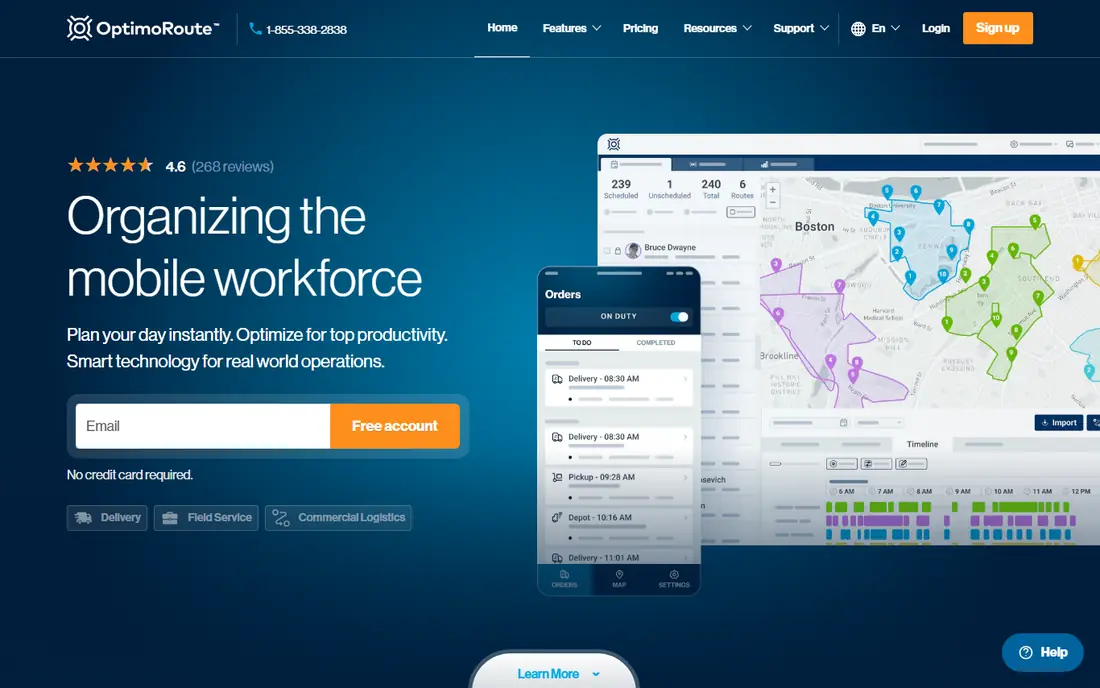
OptimoRoute is our pick for delivery and field service teams with real constraints. It sequences stops around delivery windows, vehicle capacity, driver skills, and working hours, and it balances workloads so one driver does not end up with twice the stops of another. Multi-day routing helps teams plan a week of visits in one pass.
Pricing starts at 35 dollars per driver per month, which stays fair for small teams but grows with headcount, so price at peak staffing, not current staffing. Setup for complex rules takes attention, and enterprise analytics trail larger suites. For constrained routing done well, OptimoRoute is hard to beat.
- Handles time windows, capacity, and driver skills
- Multi-day routing
- Workload balancing
- Per-driver pricing climbs with team size
- Setup takes care for complex constraints
- Reporting is simpler than enterprise suites
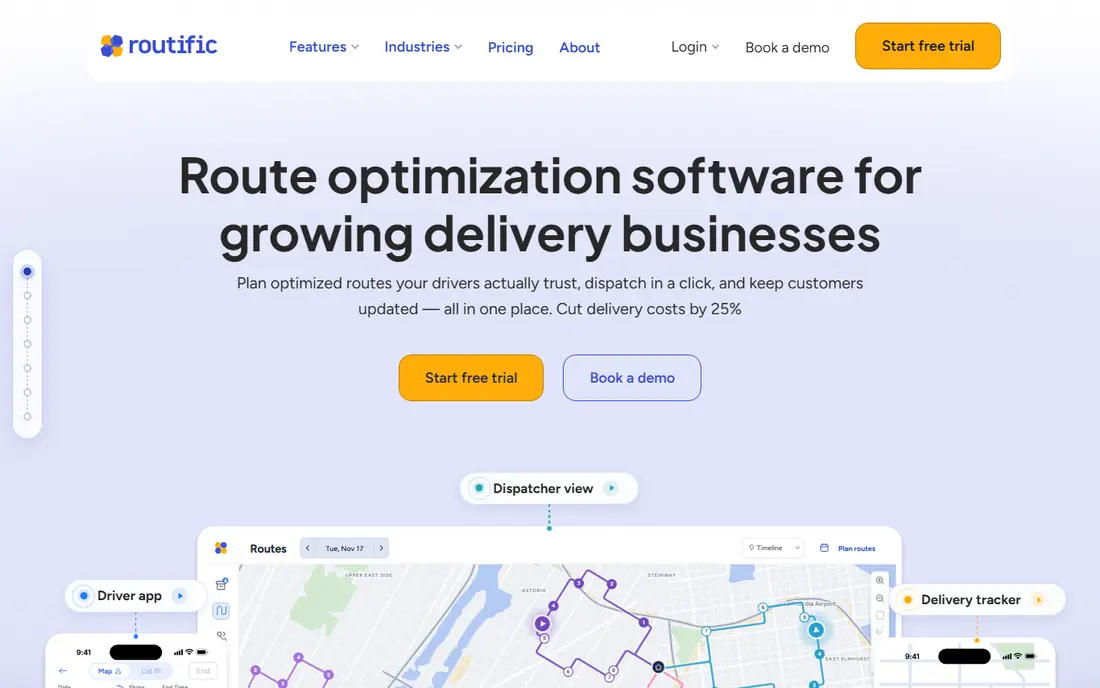
Routific suits small local delivery teams that want routing without a learning curve. The dispatcher view is clean, routes can be adjusted by dragging stops, and customers get notifications as deliveries approach. A free tier covering a limited monthly order volume lets tiny teams start at no cost.
Complex constraints such as vehicle capacity rules and multi-day schedules stretch Routific, and order caps on lower tiers force growing teams onto higher plans. Paid plans start at 150 dollars a month. For a local bakery, pharmacy, or meal service with straightforward routes, Routific hits the sweet spot.
- Simple dispatcher workflow
- Drag-and-drop route editing
- Customer notifications
- Limited for complex constraints
- Monthly order caps on lower tiers
- Fewer enterprise features
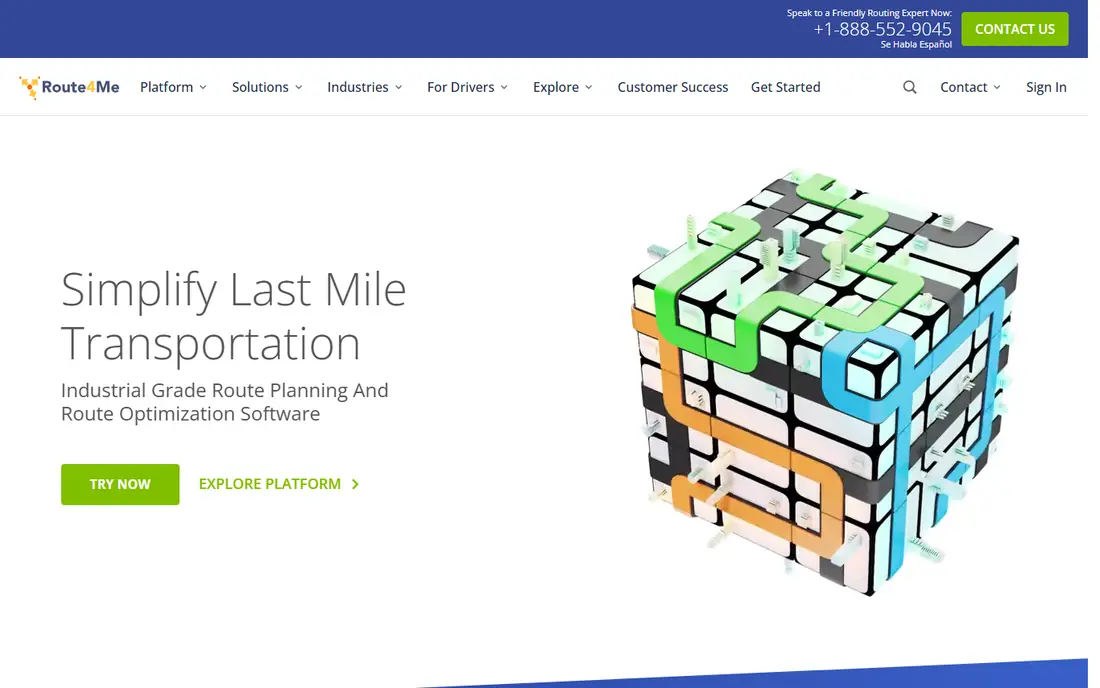
Route4Me fits operations that outgrow simple planners. Territory planning divides a region among drivers or depots, multi-depot routing handles fleets that start from several sites, and an add-on marketplace extends the platform for telematics, analytics, and customer messaging. API access helps teams connect routing to ordering and CRM systems.
Pricing for teams is quote-based, and add-ons make the total harder to predict, so get a written quote for your exact setup. The interface also feels busy next to Routific or OptimoRoute. For complex logistics with territories and depots, that depth is worth the complexity.
- Territory planning
- Multi-depot routing
- Large add-on marketplace and API options
- Pricing is quote-based for teams
- Add-ons complicate the bill
- Interface feels busy
Upper targets small and mid-size businesses moving from spreadsheets to automated routing. Importing addresses from a spreadsheet takes minutes, reusable templates speed up repeat routes, and proof of delivery plus live tracking keep dispatchers informed. The driver app is friendly, which matters when drivers adopt a new tool under time pressure.
Advanced constraint handling trails OptimoRoute, and pricing varies enough that you should confirm your plan price before committing. Enterprise analytics are thinner too. For a growing fleet that needs solid routing without enterprise complexity, Upper is a practical step up from manual planning.
- Spreadsheet import
- Reusable route templates
- Proof of delivery and live tracking
- Pricing varies by plan
- Fewer advanced constraints than OptimoRoute
- Enterprise features are thinner
Onfleet serves courier and on-demand delivery operations where orders arrive through the day and dispatch must react fast. Auto-dispatch assigns jobs to the best driver, customers track deliveries live, and proof of delivery closes the loop. The driver app is polished, and the platform scales to high daily volumes.
The starting price of 599 dollars a month puts Onfleet out of reach for small planned-route teams, and there is no permanent free tier. It earns that price only when dispatch speed and live customer tracking drive your business. For on-demand courier work, it is one of the strongest platforms available.
- Strong auto-dispatch
- Good driver app
- Customer tracking and proof of delivery
- High starting price
- Overkill for small planned routes
- No permanent free tier
Zeo is the best place for a solo driver to start. The free plan covers small routes, building a route takes minutes, and navigation handoff to a maps app keeps driving simple. Couriers, sales reps, and gig drivers who plan their own day get an efficient route without paying for dispatch features they will never use.
Team dispatch, live tracking, and proof of delivery are thinner than on team platforms, and the free plan caps stops per route. Check current limits before relying on it for a long day. For solo work, Zeo gives you most of the value of a paid planner at no cost.
- Free plan for solo drivers
- Simple route building
- Works well for small stop counts
- Team features are limited
- Stop limits on the free plan
- Less dispatch tooling than team platforms
RoadWarrior keeps route planning simple for drivers and small teams. Enter stops, optimize the order, and navigate with one tap per stop, with options to adjust the route as the day changes. It suits delivery drivers, field sales reps, and small route teams that want optimization without a dispatcher dashboard.
Team dispatch and analytics trail OptimoRoute and Onfleet, and paid plans start at 49 dollars a month. Drivers who plan their own routes will like the simplicity, while dispatch-led teams should look at Routific or Upper instead. For a small team that drives its own day, RoadWarrior is a solid, affordable pick.
- Simple route optimization
- One-tap navigation
- Good for delivery and sales routes
- Fewer team dispatch features
- Analytics are basic
- Pricing is per driver on higher plans
Badger Maps serves field teams whose stops are customer visits rather than parcel drops. Route optimization pairs with territory mapping, CRM integration, and check-in logging, so sales reps can plan a day of visits, record outcomes, and keep their pipeline data current. That sales focus sets it apart from pure delivery planners.
Parcel delivery features such as proof of delivery and customer notifications are basic, so courier teams should pick a delivery-first tool. Pricing starts at 58 dollars per user per month. For field sales and service visits, Badger Maps is the most fitting pick on this list.
- Territory and route tools for sales visits
- CRM integration
- Check-in and visit logging
- Built for sales visits, not parcel delivery
- Proof of delivery is basic
- Pricing is per user
How we picked these
We compared official pricing pages, feature pages, and public reviews for route planning apps available in the United States, and we favored tools with real routing engines, driver apps or navigation handoff, and published or quotable pricing. Each app had to optimize multi-stop routes, not just display them, and come from a vendor we could verify. We did not claim hands-on testing we did not do, and we treated third-party price summaries as signals, since vendors change plans and per-driver rates often.
How to choose a route planner
Start with your operating model. Solo drivers need a cheap, simple optimizer, planned-route teams need dispatch and proof of delivery, and on-demand couriers need auto-dispatch and live tracking. Then count your real constraints: time windows, vehicle capacity, driver skills, and multi-day schedules all push you toward OptimoRoute or Route4Me, while simple drop sequences suit Routific or Upper.
Next, price the whole team at peak size, including seasonal drivers, since per-driver plans climb fast. Run a trial on a real busy day, with your actual addresses and time windows, and compare planned miles and stops completed against your current method. Finally, check the driver app in the field: a routing engine is useless if drivers cannot follow it easily on a phone in sunlight with gloves on.
Proof of delivery and customer messages
Customers now expect a text when a delivery is near and a photo or signature at the door. If your business promises that experience, shortlist platforms with those features built in, such as Onfleet, Upper, or Routific, rather than bolting them on later. Confirm whether messaging credits cost extra, since they can add a noticeable monthly amount at volume.
Frequently asked questions
What is the best delivery route planner app?
OptimoRoute is our pick for constrained team routing, Routific suits small local teams, and Zeo suits solo drivers for free. Onfleet leads for on-demand courier work. The best app depends on team size, route complexity, and whether dispatch or driver planning drives your day.
What is the best free delivery route planner app?
Zeo offers a free plan for solo drivers with a limited stop count per route, and Routific offers a free tier up to a monthly order limit. Both suit small volumes. Larger teams will outgrow free tiers and should budget for a paid plan once order counts rise.
What is the best route optimization app for delivery drivers?
Solo drivers should start with Zeo or RoadWarrior, since both optimize stops and hand off navigation simply. Team drivers should use the driver app of their team's platform, such as OptimoRoute or Onfleet, so dispatch, tracking, and proof of delivery stay connected.
How much does delivery route planning software cost?
Solo apps start free or around 49 dollars a month, small team platforms run from 150 dollars a month, and per-driver plans start near 35 dollars per driver per month. On-demand platforms start near 599 dollars a month. Price your full team at peak size for a true comparison.
Does route planning software work with my existing tools?
Most team platforms offer integrations or APIs for ordering, CRM, and accounting systems, but depth varies. Confirm that your ordering source can feed addresses into the planner without manual retyping, and test the integration during a trial before committing to an annual plan.
Sources we checked (8)

Online Jobs is an independent blog about careers, online work, learning new skills and the tools that help people earn. More about us.
Keep reading
All posts
n8n Alternatives
n8n alternatives compared for 2026, with Zapier, Make, Activepieces, and more, covering visual builders, code steps, self-hosting, and pricing models.

ZoomInfo Alternatives
The best ZoomInfo alternatives in 2026, compared on price, free plans, data coverage, and which tool fits small teams or large sales teams best in detail.
Yotpo Alternatives
Find cheaper alternatives to Yotpo for reviews and loyalty, with Judge.me, Loox, Stamped, and more compared for Shopify stores in 2026, all in one guide.