Best Data Observability Tools in 2026: 8 Tools Compared


Large firms needing full observability · Starting price: See website
How we put this together: we compare official feature and pricing pages, app store listings, privacy policies and public user reviews. Prices change, so check the provider's site before you pay.
Key takeaways
- Data observability watches freshness, volume, schema, and values, so teams catch broken data before dashboards mislead users.
- Monte Carlo and Acceldata suit large estates, while Soda and Elementary suit teams that want code-first checks.
- Most enterprise tools are quote-based, while open source and Soda offer free starting points with real limits.
- Lineage matters as much as alerts, because a broken table is only useful to fix if you know what depends on it.
Quick comparison
| Name | Who it suits | Starting price | Free option | |
|---|---|---|---|---|
| Monte Carlo | Large firms needing full observability | See website | No | Visit |
 Acceldata | Large estates with infrastructure depth | See website | No | Visit |
 Bigeye | Teams wanting customizable quality checks | See website | Free trial | Visit |
 Soda | Code-first data contracts and checks | Free | Yes | Visit |
 Elementary | dbt teams wanting tests inside dbt | Free | Yes | Visit |
 Anomalo | Teams focused on anomaly detection | See website | Free trial | Visit |
 Sifflet | Firms needing lineage plus monitoring | See website | Free trial | Visit |
 Great Expectations | Engineering teams wanting validation rules | Free | Yes | Visit |
The best data observability tools
Data observability tools watch data pipelines for problems that a simple success message misses: a partial load, a schema change, a sudden drop in rows, or a shift in values. The eight tools below range from full platforms to code-first libraries, so a small dbt team and a large enterprise estate can both find a fit.
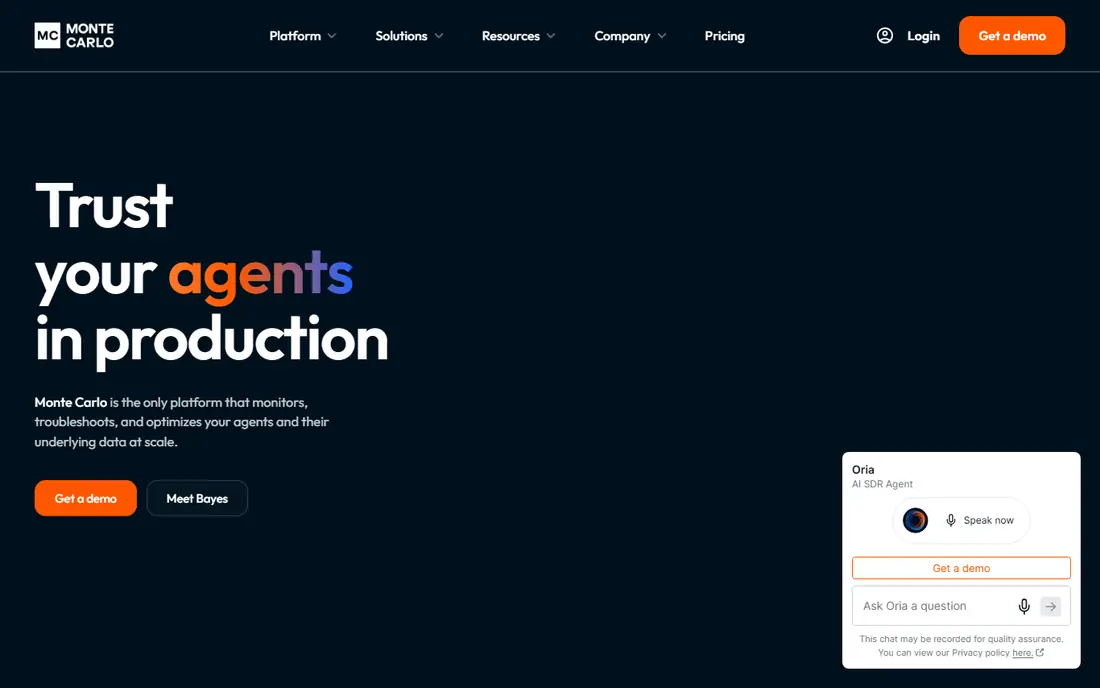
Monte Carlo is the best-known full data observability platform, covering freshness, volume, schema, and distribution checks across warehouses, lakes, and business intelligence tools. It learns normal patterns for each table, then alerts owners when data drifts from that baseline. Lineage views show what upstream change may have caused a downstream break.
Pricing is the main barrier. Monte Carlo uses credits and quote-based tiers, so small teams should get a clear estimate at their table and monitor count before committing. For a large estate with many sources and many dashboard users, that breadth is the point. For a small team with one warehouse, a lighter tool may cover the same core checks for less.
- Broad coverage across warehouses and lakes
- Learned anomaly detection
- Lineage views
- Quote-based and credit-based pricing
- Can be costly for small teams
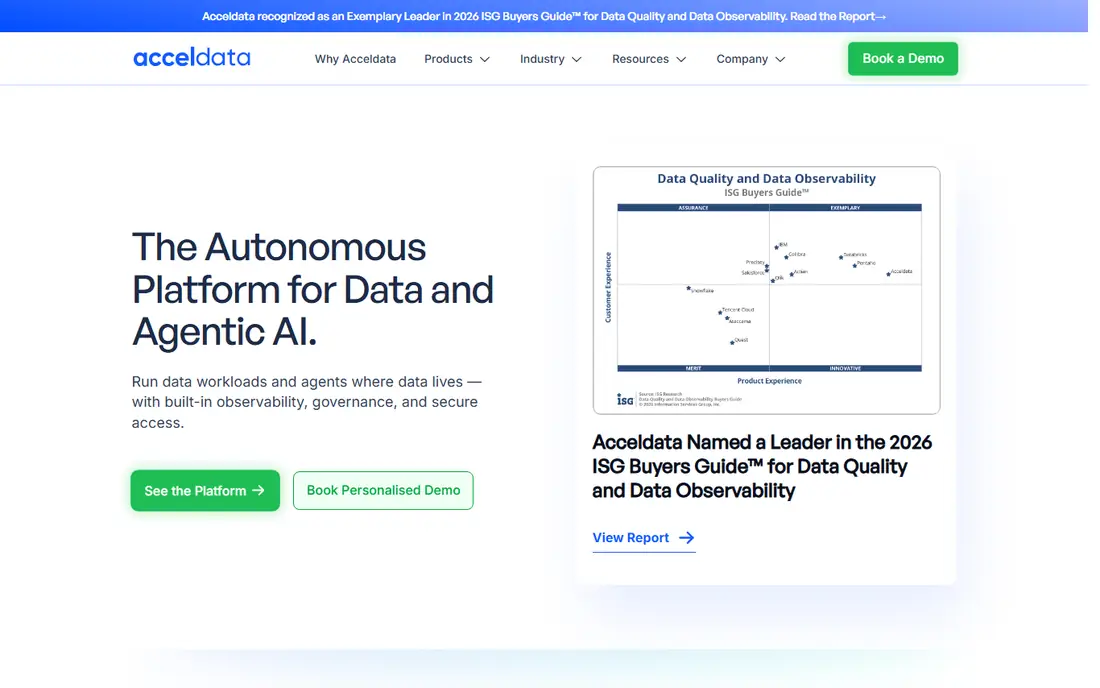
Acceldata covers data observability across multiple layers, including pipelines, compute, and data quality, which suits large firms with complex estates. It pairs anomaly detection with lineage and governance views, so platform teams can see both data health and infrastructure health in one place. That breadth helps firms where a pipeline failure and a compute problem look alike at first.
Setup and price are the trade-offs. Acceldata is an enterprise purchase with quote-based pricing and implementation planning, not a quick self-serve signup. Smaller teams may find the scope more than they need. Large platform teams managing many systems, though, may value the combined view over several separate tools.
- Multi-layer coverage from pipelines to compute
- Strong enterprise controls
- Lineage and quality checks
- Quote-based pricing
- Heavier setup than point tools
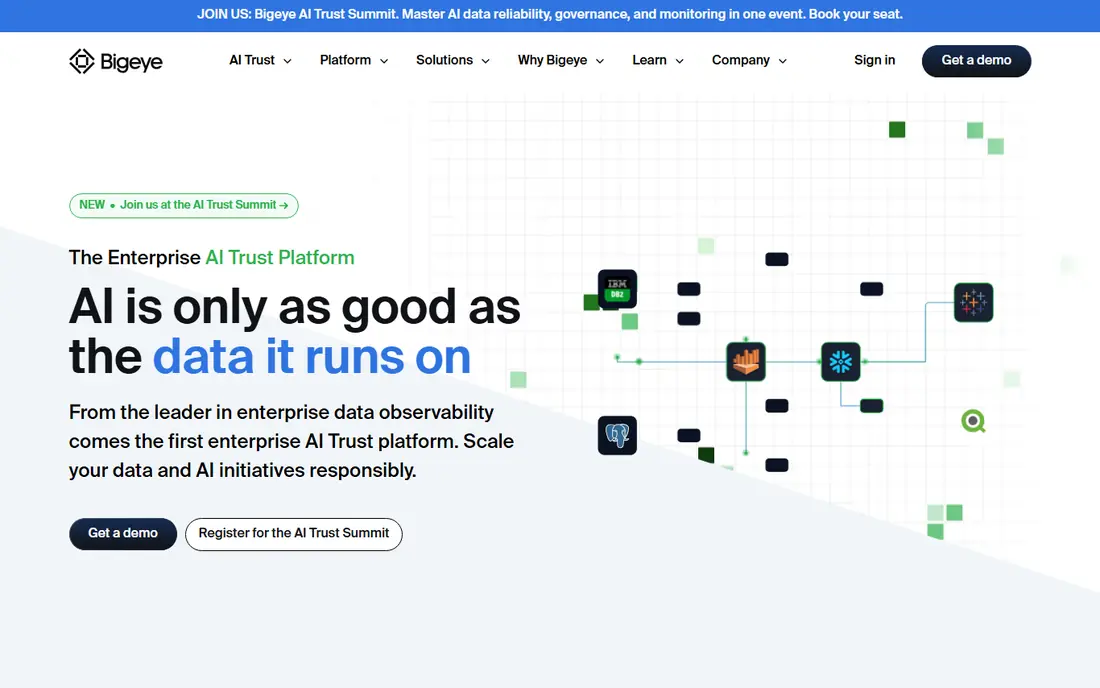
Bigeye focuses on customizable data quality monitoring, letting teams define checks that match their business rules rather than relying only on learned baselines. Anomaly detection adds coverage for problems nobody wrote a rule for, and lineage helps owners trace a break to its source. That mix suits teams with clear quality rules for critical tables.
As with other enterprise platforms, pricing is quote-based, so teams should confirm cost at their table count. Alert tuning also matters, because too many checks produce noise that owners learn to ignore. Teams that invest in tuning get a precise system. Teams that do not may prefer a simpler learned-baseline tool.
- Customizable monitoring rules
- Anomaly detection
- Lineage for key tables
- Quote-based pricing
- Needs tuning to avoid noisy alerts
Soda takes a code-first approach, with checks written in SodaCL and stored beside pipeline code. That makes data quality rules reviewable, versioned, and testable like other code, which appeals to engineering-led teams. Soda offers a free source-available plan, with a Team plan around $750 per month for managed features.
The learning curve is real. Teams must learn SodaCL and decide which checks belong in code versus in a managed platform. Soda also covers less of the full observability picture than Monte Carlo or Acceldata on its own, such as broad lineage across many systems. For teams that want contracts and checks in code, Soda is a strong and affordable base.
- Free source-available option
- SodaCL checks in code
- Data contracts for teams
- Paid Team plan starts around $750 per month
- Learning SodaCL takes time
Elementary adds observability inside dbt, with anomaly detection and test results reported where dbt teams already work. It monitors table freshness, volume, and schema changes, and sends alerts to channels such as Slack. Because it is open source and dbt-native, the starting cost is engineering time rather than a license fee.
The limit is scope. Elementary shines for dbt-centric teams, but it does not cover sources, business intelligence tools, or non-dbt pipelines as broadly as a full platform. Teams with a mixed estate may need another tool beside it. For a team that lives in dbt, Elementary is the lowest-cost way to add learned checks.
- Free and open source
- Anomaly tests inside dbt
- Alerting to common channels
- Limited outside dbt ecosystems
- Needs dbt expertise to run well
Anomalo focuses on finding anomalies in data without requiring teams to write many rules in advance. It learns patterns in tables, flags unusual shifts, and helps owners find the root cause, such as a broken join or a changed source field. That low rule burden suits teams that want coverage quickly across many tables.
The focus is also the limit. Anomalo is strongest on anomaly detection, while full platforms add broader lineage, governance, and infrastructure views. Pricing is quote-based, so teams should compare it with a full platform at their scale. Teams whose main problem is unexpected data shifts will get the most from Anomalo.
- Strong unsupervised anomaly detection
- Clear root cause views
- Low rule-writing burden
- Quote-based pricing
- Narrower focus than full platforms
Sifflet combines monitoring with end-to-end lineage, so teams can see how data flows from source to dashboard and where a break will spread. Anomaly detection covers freshness, volume, and value shifts, while lineage helps owners prioritize fixes by downstream impact. That combination suits firms where a single broken table affects many reports.
Pricing is enterprise-level and quote-based, which puts Sifflet out of reach for very small teams. Setup for a large estate also needs planning, including source connections and owner mapping. For firms that need lineage as a first-class feature, not an add-on, Sifflet is worth a close look.
- End-to-end lineage
- Anomaly detection
- Monitoring across sources
- Enterprise pricing
- Setup takes planning for large estates
Great Expectations
Who it suits: Engineering teams wanting validation rules
Great Expectations, often called GX, lets engineers write explicit expectations for data, such as row counts, value ranges, or uniqueness, then validate datasets against those rules. It is open source and free, with a strong Python ecosystem, which makes it easy to embed in pipelines. Teams that already write tests for code will find the model familiar.
GX alone is not a full observability platform. It does not provide learned anomaly detection or broad lineage without additional tooling, and it needs engineering time to maintain. For teams that want precise, code-defined validation and already run Python pipelines, GX is a powerful free base. Pair it with a monitoring tool when learned checks and lineage are also needed.
- Free and open source
- Explicit validation rules
- Strong Python ecosystem
- Needs engineering time to run and maintain
- No managed observability dashboard by itself
How we picked these
We compared official feature pages, pricing pages, and public documentation for data observability tools in 2026. We favored tools that monitor freshness, volume, schema, and values, provide lineage or root cause help, and alert owners in a usable way. We included full platforms, code-first tools, and open source options, because data teams range from small dbt teams to large enterprise estates. Prices shown are vendor-published where available, and we wrote See website where pricing is quote-based.
How to choose a data observability platform
Start with your critical tables, not your whole estate. Pick the ten tables that feed executive dashboards, customer reports, or machine learning features, and monitor those first. That focus gives quick value and shows whether alerts are useful before you pay to cover hundreds of tables. Expand coverage table by table, with an owner named for each one.
Alerts need owners, or they become noise
An alert without an owner is just noise, and noise trains teams to ignore real breaks. Assign each monitored table to a person or team, set alert channels they actually read, and tune thresholds after the first month. Learned baselines need time to settle, so expect early false alerts and adjust rather than turning the tool off. Review alert usefulness monthly, and remove checks that never lead to action.
Lineage decides how fast you fix a break
When a dashboard breaks, the first question is what changed upstream. Lineage answers that question by showing source tables, transformations, and downstream reports in one view. Without lineage, teams guess and check each pipeline by hand, which slows fixes and frustrates dashboard users. Test lineage on a real break during a trial, not on a demo dataset, because real estates have messy dependencies that demos hide.
Price by tables, monitors, and seats
Enterprise tools price by monitors, credits, tables, or seats, and those models produce very different bills at scale. Get a written estimate at your real table count, monitor count, and user count, and ask what happens when you add tables next quarter. Open source tools look free, but they cost engineering time for setup, tuning, and maintenance. Compare total cost, including that time, before choosing free over managed.
Frequently asked questions
What are the best data observability tools?
Monte Carlo and Acceldata lead for large estates, Bigeye and Sifflet suit firms wanting customizable checks plus lineage, and Soda, Elementary, and Great Expectations suit code-first and dbt teams. Anomalo is strongest for anomaly detection alone. Pick by estate size, stack, and whether you want a managed platform or code-first checks.
What is the best data observability platform?
Monte Carlo is the most complete managed platform in this guide, with broad coverage, learned detection, and lineage. Acceldata is a strong alternative for large estates with infrastructure depth. Smaller teams often prefer Soda or Elementary, because they start free and fit code-first workflows.
What is the best data observability software for dbt teams?
Elementary is built for dbt, with anomaly tests inside dbt and alerts to common channels. Soda also works well for dbt teams that want code-first contracts. Full platforms such as Monte Carlo and Sifflet can monitor dbt models too, but they cost more and add features a dbt-only team may not need.
How much do data observability tools cost?
Soda offers a free plan with a Team plan around $750 per month, while Elementary and Great Expectations are free and open source. Monte Carlo, Acceldata, Bigeye, Anomalo, and Sifflet are quote-based, with enterprise pricing that varies by tables, monitors, and seats. Get a written estimate before committing.
Do I need data observability if I already use dbt tests?
Yes, in most cases, because dbt tests check rules you wrote, while observability adds learned baselines for problems you did not predict, such as a partial load that still passes tests. Observability also sees sources and business intelligence tools outside dbt. The two work best together, with tests for known rules and observability for unknown shifts.
What is data lineage, and why does it matter?
Lineage is a map showing how data flows from sources through transformations to dashboards and reports. It matters because a break in one table can affect many downstream reports, and lineage shows which ones. Without it, teams waste time hunting for the source of a problem that lineage would show in seconds.
Sources we checked (8)

Online Jobs is an independent blog about careers, online work, learning new skills and the tools that help people earn. More about us.
Keep reading
All posts
n8n Alternatives
n8n alternatives compared for 2026, with Zapier, Make, Activepieces, and more, covering visual builders, code steps, self-hosting, and pricing models.

ZoomInfo Alternatives
The best ZoomInfo alternatives in 2026, compared on price, free plans, data coverage, and which tool fits small teams or large sales teams best in detail.

Yotpo Alternatives
Find cheaper alternatives to Yotpo for reviews and loyalty, with Judge.me, Loox, Stamped, and more compared for Shopify stores in 2026, all in one guide.