Best Data Governance Platforms in 2026: 8 Platforms Compared

How we put this together: we compare official feature and pricing pages, app store listings, privacy policies and public user reviews. Prices change, so check the provider's site before you pay.
Key takeaways
- Collibra leads for regulated enterprises that need formal policy, stewardship workflows, and audit trails.
- Alation suits analytics-driven firms that want analysts to actually use the catalog every day.
- Atlan is the strongest modern pick for cloud-native teams that want fast setup and active metadata.
- Microsoft Purview is the natural choice inside Azure and Microsoft 365 estates.
- Most enterprise platforms price by quote, so budget for implementation and services alongside the license.
Quick comparison
| Name | Who it suits | Starting price | Free option | |
|---|---|---|---|---|
 Collibra | Regulated enterprises | See website | Free trial | Visit |
 Alation | Analyst adoption | See website | Free trial | Visit |
 Atlan | Cloud-native data teams | See website | Free trial | Visit |
 Informatica | Hybrid and multi-cloud estates | See website | Free trial | Visit |
 Microsoft Purview | Microsoft ecosystems | See website | Free trial | Visit |
 BigID | Privacy and sensitive data | See website | No | Visit |
 Secoda | Small teams needing fast value | See website | Yes | Visit |
 OpenMetadata | Open-source control | Free | Yes | Visit |
The best data governance platforms
Data governance platforms help organizations find, understand, trust, and control their data. They combine catalogs, lineage, business glossaries, data quality checks, and policy workflows into one place. We compared official feature pages, pricing signals, and public reviews to rank the platforms that serve data teams best in 2026.
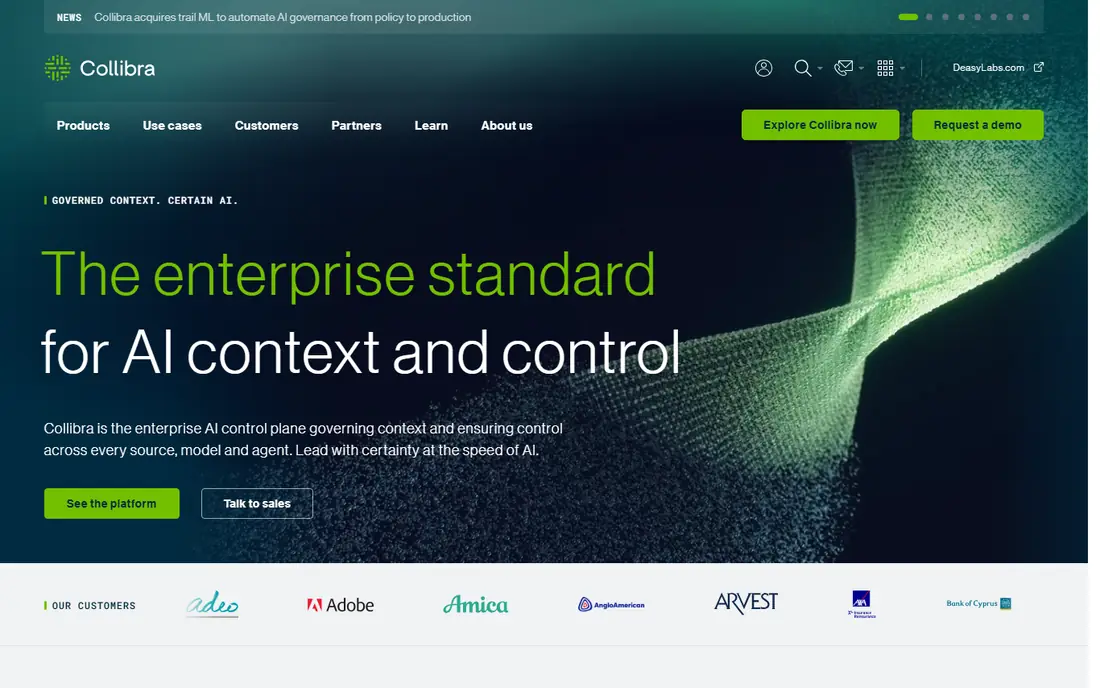
Collibra is the governance-first leader, built for banks, insurers, healthcare firms, and government teams that need formal control. Policy management, approval workflows, stewardship assignments, and audit trails sit at the core, and lineage and glossary tools tie definitions to real datasets. For regulated reporting, that rigor matters more than a slick search box.
The cost is enterprise-level and quote-based, implementation often takes many months, and administration is heavier than on modern cloud-native rivals. Teams without a mature governance operating model may find Collibra more than they can run. For regulated enterprises that need provable control, it remains the benchmark.
- Deepest stewardship and policy workflows
- Strong lineage and glossary
- Mature compliance reporting
- Quote-based enterprise pricing
- Long implementation
- Heavier administration than modern rivals

Alation takes a discovery-first approach: make data easy to find and trust, and governance follows adoption. Search, behavioral signals, and collaboration features help analysts find the right table, see who uses it, and understand its lineage, while BI integrations bring that context into the tools analysts already open. That focus on daily use drives higher adoption than steward-centric tools.
Pricing is quote-based at enterprise levels, and formal stewardship workflows are lighter than Collibra. Implementation still takes months for large estates. If your priority is getting analysts and engineers to actually use the catalog, Alation is the strongest enterprise pick.
- Analyst-friendly search and catalog
- Behavioral signals surface trusted data
- Strong BI integrations
- Quote-based pricing
- Stewardship workflows are lighter than Collibra
- Implementation still takes months
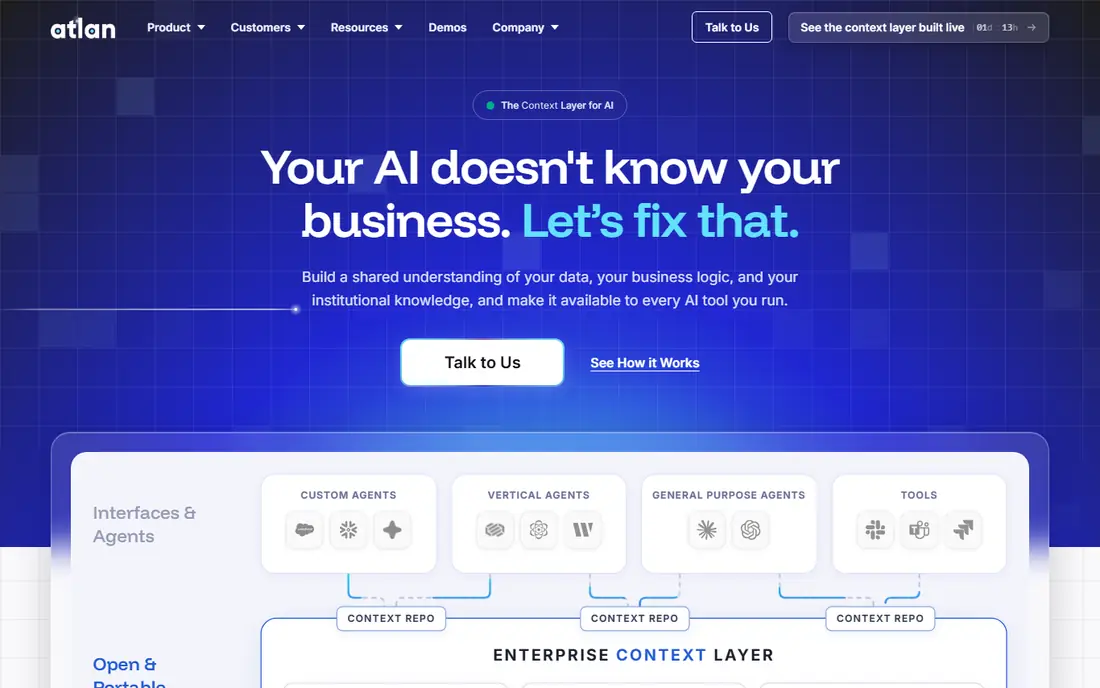
Atlan suits teams on a modern cloud data stack who want governance without a year-long rollout. Its interface feels current, active metadata keeps lineage and usage fresh, and setup typically runs in weeks rather than months. AI governance features address the new problem of governing data used by AI models and agents, not just dashboards.
Governance depth for heavily regulated workflows trails Collibra, and pricing is quote-based, so smaller teams should confirm entry pricing before assuming it fits. For cloud-native mid-size to large teams, Atlan balances usability, speed, and governance better than any rival here.
- Modern interface
- Active metadata and lineage
- Faster setup than legacy platforms
- Quote-based pricing
- Younger governance depth than Collibra
- Best on modern cloud stacks
Informatica Cloud Data Governance and Catalog serves enterprises with sprawling hybrid and multi-cloud estates. Its strength is breadth: catalog, governance, data quality, and integration come from one vendor with decades of enterprise data experience, and deployment covers cloud and hybrid setups. Teams already invested in Informatica or Salesforce get a natural extension.
The platform is complex, pricing is quote-based at enterprise levels, and implementation usually needs specialist services. Smaller teams will find it heavy. For large enterprises standardizing on Informatica for data management, its governance tools fit the existing stack well.
- Broad catalog and governance
- Strong data quality and integration heritage
- Hybrid deployment options
- Quote-based enterprise pricing
- Complex platform
- Implementation needs specialist help
Microsoft Purview is the natural governance choice for organizations already running on Azure and Microsoft 365. Its unified catalog scans Azure data sources and Microsoft 365 content, data maps show lineage across the estate, and compliance tools tie into the wider Microsoft security stack. Pricing is usage-based, which can start lower than a full enterprise suite.
Outside Microsoft estates, value drops, and specialist governance depth trails Collibra and Alation. Consumption pricing also varies with usage, so costs need monitoring. If your data already lives in Azure, Purview gives you a strong governance starting point without a second vendor.
- Native Azure and Microsoft 365 integration
- Unified catalog
- Usage-based pricing options
- Deepest value only inside Microsoft estates
- Governance depth trails specialists
- Pricing is consumption-based and variable
BigID focuses on the privacy side of governance: finding sensitive and personal data across sources, classifying it, and managing privacy workflows such as access requests and retention. That focus suits organizations facing strict privacy regulation or handling large volumes of customer data. Source coverage is broad, spanning databases, files, and cloud apps.
Catalog and stewardship features are secondary to privacy, so teams wanting a primary analyst catalog should pair BigID with another tool. Pricing is quote-based, and implementation takes months. For privacy-led governance programs, BigID is the specialist to shortlist.
- Strong sensitive-data discovery and classification
- Privacy compliance workflows
- Broad source coverage
- Quote-based pricing
- Catalog features are secondary
- Implementation takes months
Secoda suits small data teams that want value in days, not months. Setup is quick, AI-assisted search helps analysts find tables and definitions, and lightweight governance features cover ownership, documentation, and lineage without enterprise overhead. Published pricing and a free tier are rare in this category and make budgeting easier.
Enterprise governance depth trails the big suites, and the connector range is smaller, so large regulated estates may outgrow it. For a team of a few analysts and engineers that needs a catalog now, Secoda is the most accessible serious option here.
- Fast setup
- AI-assisted search
- Published pricing and free tier
- Lighter enterprise governance than Collibra or Alation
- Smaller connector range
- Best for small to mid-size teams
OpenMetadata is the open-source answer for engineering-led teams that want full control. The core platform is free to self-host, covers catalog, lineage, data quality, and data contracts, and its unified metadata graph suits teams building a data platform on their own terms. No license fee means no vendor lock-in on the core.
Self-hosting costs engineering time for deployment, upgrades, and support, and setup is hands-on compared with cloud services. Managed offerings exist for teams that want help. If your engineers can run infrastructure and you value control over convenience, OpenMetadata is a strong, cost-effective foundation.
- Free open-source core
- Unified metadata graph
- Data contracts and lineage
- Self-hosting needs engineering time
- Support comes from community or paid offerings
- Setup is hands-on
How we picked these
We compared official feature pages, pricing signals, and public reviews for data governance platforms available now, and we favored tools with real catalog, lineage, and policy capabilities, not just data quality or observability alone. Each platform had to serve governance programs specifically, cover common enterprise data sources, and come from a vendor we could verify. We did not claim hands-on testing we did not do, and we treated third-party price estimates as signals, since most enterprise vendors price by quote.
How to choose a governance platform
Start with your governance maturity, not the feature list. A team without data owners, definitions, and basic policies will struggle with any platform, and the tool people actually use beats the one with the longest feature list that everyone avoids. Pick the platform that matches your stack: Microsoft estates suit Purview, modern cloud stacks suit Atlan, and regulated enterprises suit Collibra.
Next, run a pilot on a limited set of critical datasets, and test connectors against your real systems, not a demo environment. Measure whether analysts find trusted data faster and whether stewards can complete approvals without workarounds. Finally, get the full first-year cost in writing, including licenses, implementation, and internal staff time, since services often rival the license fee for enterprise tools.
Governance for AI data use
AI models and agents consume data at a scale that changes governance. Check whether a platform tracks which datasets feed AI use cases, documents data quality and lineage for those datasets, and supports access controls for model training. Atlan, Collibra, and Alation all advertise AI governance features, but depth varies, so test them against your actual AI workloads during a pilot.
Frequently asked questions
What is the best data governance platform?
Collibra leads for regulated enterprises, Alation leads for analyst adoption, and Atlan leads for cloud-native teams. Microsoft Purview leads inside Microsoft estates. The best platform depends on your stack, regulatory pressure, and governance maturity.
What is the best data governance tool for small businesses?
Secoda and OpenMetadata are the strongest small-team picks. Secoda offers fast cloud setup with a free tier, while OpenMetadata offers a free open-source core for engineering-led teams that can self-host. Start with one critical dataset area and expand only after the team uses the catalog daily.
What is the best enterprise data governance platform?
Collibra, Alation, and Informatica are the established enterprise picks, each with different strengths: Collibra for formal governance, Alation for adoption, and Informatica for hybrid estates. All price by quote, so request proposals from at least two and compare implementation scope, not just license fees.
How much do data governance platforms cost?
Enterprise platforms commonly run into six figures per year, with implementation and services on top. Mid-market and cloud tools publish lower entry prices, and open-source options cost only infrastructure and engineering time. Always get a written quote at your data volume and user count.
Can I use more than one data governance tool?
Yes, but carefully. Some organizations pair a discovery catalog with a privacy tool such as BigID, or a governance suite with a data quality specialist. Tool sprawl creates its own governance problems, so keep clear boundaries between tools and consolidate where one platform covers both needs well.
Sources we checked (8)

Online Jobs is an independent blog about careers, online work, learning new skills and the tools that help people earn. More about us.
Keep reading
All posts
n8n Alternatives
n8n alternatives compared for 2026, with Zapier, Make, Activepieces, and more, covering visual builders, code steps, self-hosting, and pricing models.

ZoomInfo Alternatives
The best ZoomInfo alternatives in 2026, compared on price, free plans, data coverage, and which tool fits small teams or large sales teams best in detail.
Yotpo Alternatives
Find cheaper alternatives to Yotpo for reviews and loyalty, with Judge.me, Loox, Stamped, and more compared for Shopify stores in 2026, all in one guide.