Best Customer Data Platform in 2026: 9 Platforms Compared

How we put this together: we compare official feature and pricing pages, app store listings, privacy policies and public user reviews. Prices change, so check the provider's site before you pay.
Key takeaways
- Twilio Segment is the most accessible starting point, with a free Connections tier and a paid Team tier from $120 per month for smaller volumes.
- Tealium and mParticle suit large enterprises with complex data governance, tag management and identity needs, but pricing is quoted.
- Hightouch and RudderStack suit warehouse centred teams, with Hightouch syncing warehouse data out and RudderStack offering event pipelines plus open source options.
- The best customer data platform for a small team is not the same as for an enterprise, because volume, governance and engineering resources differ sharply.
- Model pricing on your real monthly users and events before buying, because CDP costs rise with volume and with add ons such as identity and journeys.
Quick comparison
| Name | Who it suits | Starting price | Free option | |
|---|---|---|---|---|
 Twilio Segment | Accessible CDP starting point | Free | Yes | Visit |
 Tealium | Enterprise governance and tags | See website | No | Visit |
 mParticle | Enterprise mobile data | See website | No | Visit |
 Hightouch | Warehouse to tools sync | $350 per month | Free trial | Visit |
 RudderStack | Event pipelines and warehouse | See website | Free trial | Visit |
 Bloomreach | Ecommerce personalisation | See website | No | Visit |
 Klaviyo Data Platform | Ecommerce customer profiles | Free | Yes | Visit |
 Treasure Data | Enterprise data and journeys | See website | No | Visit |
 Lytics | Audience building and insights | See website | Free trial | Visit |
The best customer data platforms
A customer data platform collects first party data from websites, apps, CRMs and other sources, resolves it into unified profiles, and sends it to marketing, analytics and service tools. That job sounds simple, but data quality, identity, privacy and volume make platform choice important. The nine below cover packaged CDPs, warehouse native options and ecommerce focused platforms.
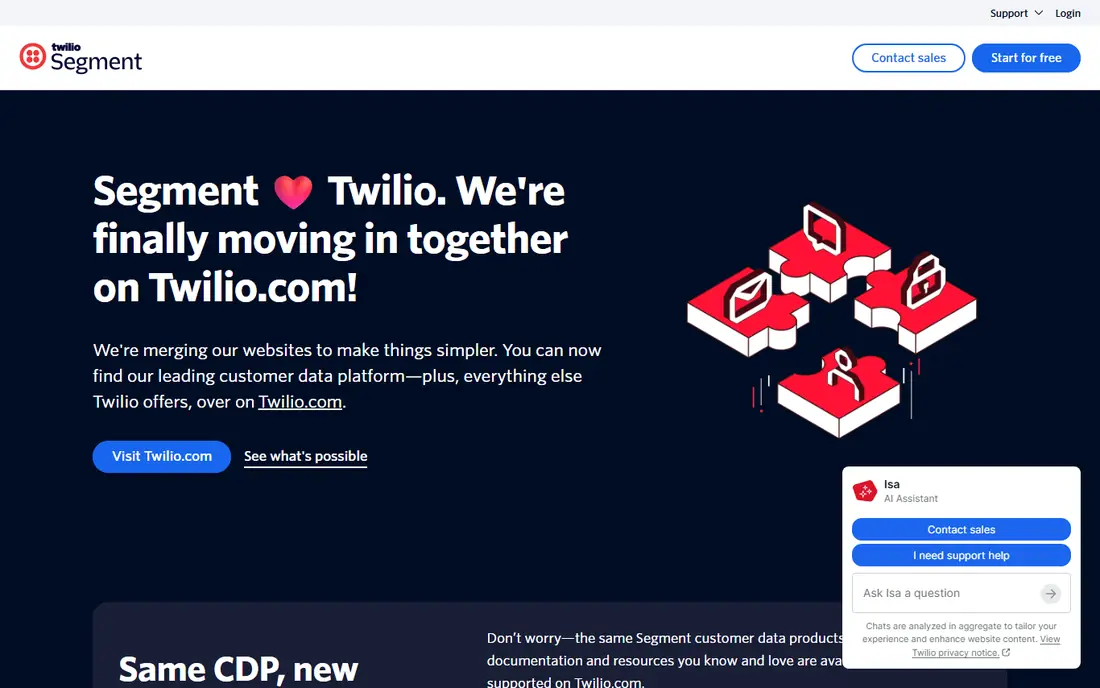
Segment, now part of Twilio, is the most common starting point for teams new to CDPs. Its Connections product collects events from websites and apps and sends them to many destinations, with a free tier for up to 1,000 monthly tracked users and two sources, and a Team tier from $120 per month for larger volumes. That published pricing makes it easier to start than enterprise only platforms. The full customer data platform, including Unify for identity resolution and Engage for audiences and journeys, needs a custom quote, so the free and Team tiers cover pipelines rather than the complete CDP. For teams that want to fix data collection first and add identity later, Segment is the best customer data platform to start with, and its integration catalogue is a major strength.
- Free Connections tier for small volumes
- Large integration catalogue
- Team tier from $120 per month for paid pipelines
- Full CDP with unified profiles needs a custom quote
- Costs rise with tracked users
Tealium combines tag management with its AudienceStream CDP, which builds unified profiles, enriches them with data, and activates them across marketing and analytics tools. That combination suits enterprises with many tags, complex consent rules and strict governance needs, because data can be controlled before it reaches downstream tools. Its hybrid tag and API approach also helps large sites with legacy tracking. Pricing is quoted, and implementation needs more planning than a self serve pipeline tool. Smaller teams may find it more than they need. For large enterprises where governance, consent and tag control matter as much as audience building, Tealium is one of the best customer data platforms available.
- Strong tag management and data governance
- AudienceStream for unified profiles
- Enterprise security and compliance tools
- Pricing is quoted
- Implementation is heavier than Segment for small teams
mParticle, now part of Rokt, is built for mobile and cross channel data, with a single SDK that reduces third party bloat in apps. Its data quality tools validate events, its identity resolution links anonymous and known profiles, and its governance controls help enterprises manage consent and data sharing. That focus makes it popular with large consumer brands with major mobile audiences. Pricing is quoted at every tier above trial, so smaller teams should request a proposal based on real monthly active users. For mobile heavy enterprises, mParticle is a strong best customer data platform solution, especially where app performance and data governance are priorities.
- Strong mobile SDK and data quality tools
- Identity resolution and governance
- Large enterprise customer base
- Pricing is quoted
- Best suited to larger teams with mobile apps
Hightouch takes a composable approach, which means it builds customer profiles and audiences from data already in your cloud warehouse, then syncs them to CRMs, ad platforms, email tools and other destinations. That avoids copying data into a separate CDP store and lets data teams use SQL and warehouse models they already trust. It supports over 200 destinations. It works best if you already have a warehouse such as Snowflake or BigQuery, so teams without one will need that investment first. Starting pricing from $350 per month also places it above entry pipeline tools. For warehouse centred teams, Hightouch is one of the best customer data platform solutions, because it turns warehouse data into activation without a separate data silo.
- Syncs warehouse data to many destinations
- Audience building from warehouse models
- Composable approach avoids data duplication
- Needs a cloud warehouse to work best
- Starting price is higher than Segment Team
RudderStack collects events from websites, apps and servers, and routes them to warehouses and downstream tools, with transformations and governance along the way. Its open source option lets teams self host the pipeline, which appeals to engineering led teams that want control over data infrastructure and costs. It also offers customer profiles and audience features on higher plans. Setup needs data engineering input, especially for self hosting and transformations, so non technical teams may prefer Segment. For engineering led teams that want a warehouse first pipeline with open source flexibility, RudderStack is a credible best customer data platform alternative, and its event based pricing suits high volume pipelines.
- Event streaming to warehouse and tools
- Open source self hosted option
- Data governance and transformations
- Full CDP features need higher plans
- Setup needs data engineering input
Bloomreach unifies real time customer and product data to personalise ecommerce experiences, from search and recommendations to email and onsite content. That ecommerce focus makes it different from general CDPs, because product data sits alongside customer data in the same profiles. Brands can build audiences based on browsing, purchase and product behaviour, then activate them across channels. Pricing is quoted, and it is best suited to ecommerce rather than general B2B data work. For online retailers that want personalisation driven by a CDP, Bloomreach is a strong best customer data platform reviews contender, especially where product discovery and merchandising matter.
- Unified real time customer and product data
- Ecommerce personalisation and search
- Journey and campaign tools
- Pricing is quoted
- Best suited to ecommerce, less so to general B2B data
Klaviyo Data Platform unifies marketing, commerce and service data into real time customer profiles, with identity resolution, segmentation and warehouse sync features. Because it sits inside Klaviyo, profiles can be activated immediately in email, SMS and service flows without a separate sync step. That integration is its main advantage for stores already using Klaviyo. It is less suited to teams that do not use Klaviyo marketing, because activation outside that ecosystem is thinner than in Segment or Tealium. For ecommerce stores already on Klaviyo, it is a practical customer data platform best choice, because it adds profile depth without a new vendor for activation.
- Free starting tier for small stores
- Real time profiles from marketing and commerce data
- Built in activation in Klaviyo marketing
- Best inside Klaviyo ecosystem
- Less suited to non ecommerce CDP use
Treasure Data is an enterprise CDP that collects, unifies and activates customer data, with journey orchestration, predictive features and industry solutions for sectors such as retail, automotive and media. Its data management tools handle large volumes and complex identity cases, which suits global brands with many sources and destinations. Governance and security controls are built for enterprise requirements. Pricing is quoted and implementation needs careful planning, so it is not a quick start tool for small teams. For large enterprises that need a full CDP with journeys and predictive audiences, Treasure Data is a serious option among the best customer data platform solutions.
- Enterprise CDP with journey orchestration
- Strong data management and identity
- Industry solutions for large brands
- Pricing is quoted
- Implementation needs enterprise planning
Lytics focuses on building audiences from first party data and understanding content affinity, which helps marketers target messages based on interests and behaviour, not just demographics. It integrates with marketing, advertising and analytics tools, so audiences built in Lytics can be used across campaigns. That focus suits media, publishing and B2B teams that care about content engagement. Its integration catalogue is smaller than Segment, and pricing varies by use case, so check the fit for your stack. For teams whose main CDP job is audience building and insight rather than full pipeline engineering, Lytics is a useful final entry in this list of the best customer data platforms.
- Audience building from first party data
- Insights and content affinity
- Integrations with marketing tools
- Smaller integration catalogue than Segment
- Pricing varies by use case
How we picked these
We checked official feature and pricing pages, plus public CDP comparisons and reviews. We only kept platforms that are active in 2026 and that offer real profile unification or activation, not just analytics or email tools. We mixed packaged CDPs, warehouse native options and ecommerce platforms, because CDP buyers range from small stores to global enterprises. We did not claim hands on implementation, and where pricing was quoted, we used See website.
Choosing the right CDP for your team
Start with your data sources and destinations, because a CDP is only useful if it connects both. List every source, from website and app to CRM and POS, and every destination, from email and ads to analytics and service tools. Then check identity needs, because linking anonymous browsing to known customers is harder than collecting events, and not every platform handles it the same way.
Governance, volume and team resources
Check privacy and consent controls, especially if you operate in regions with strict data rules, and confirm how the platform handles data deletion and access requests. Model volume carefully, because monthly users, events and profiles all affect price, and add ons for identity, journeys and predictions add cost. Finally, be honest about engineering resources, because warehouse native tools need data teams, while packaged CDPs need lifecycle marketers, and the wrong choice will sit unused.
Frequently asked questions
Which customer data platform is the best for a small business?
Segment is the best starting point for most small businesses, thanks to its free Connections tier and published Team pricing. Klaviyo Data Platform suits small ecommerce stores already using Klaviyo. Start with pipelines and profiles you actually need, rather than a full enterprise CDP.
What is the best customer data platform software for enterprises?
Tealium, mParticle and Treasure Data suit enterprises with complex governance, mobile data and large volumes. Hightouch suits enterprises with a strong warehouse. Enterprise pricing is quoted, so compare proposals on your real volume and governance needs.
How do CDPs differ from CRMs?
A CRM tracks known customer interactions and sales activity, while a CDP unifies first party data from many sources, including anonymous behaviour, into profiles that other systems can use. CDPs feed CRMs, marketing tools and analytics, rather than replacing a CRM.
Do I need a warehouse to use a CDP?
No, not for packaged CDPs such as Segment, Tealium or mParticle, which store profiles themselves. Warehouse native tools such as Hightouch and RudderStack work best with a cloud warehouse, so choose based on whether your team already uses one.
How much do customer data platforms cost?
Costs range from free tiers at Segment and Klaviyo to quoted enterprise pricing at Tealium, mParticle and Treasure Data. Segment Team starts from $120 per month for pipelines, while Hightouch starts from $350 per month. Model your monthly users, events and add ons before signing.
Sources we checked (9)

Online Jobs is an independent blog about careers, online work, learning new skills and the tools that help people earn. More about us.
Keep reading
All posts
n8n Alternatives
n8n alternatives compared for 2026, with Zapier, Make, Activepieces, and more, covering visual builders, code steps, self-hosting, and pricing models.

eBay Alternatives
Looking for ebay alternatives? We compared 9 marketplaces for sellers on fees, buyer reach, categories and ease of listing, to help you sell with confidence.

ZoomInfo Alternatives
The best ZoomInfo alternatives in 2026, compared on price, free plans, data coverage, and which tool fits small teams or large sales teams best in detail.