Best Courier Management Software in 2026: 8 Products Compared

How we put this together: we compare official feature and pricing pages, app store listings, privacy policies and public user reviews. Prices change, so check the provider's site before you pay.
Key takeaways
- Onfleet suits high-volume, on-demand delivery with auto-dispatch and strong proof capture.
- Routific suits small teams that need route optimisation at low cost, with a free tier for low order counts.
- Detrack and Track-POD suit couriers that need detailed proof of delivery and configurable delivery forms.
- OptimoRoute suits route-heavy teams that charge by driver and want multi-day planning.
- Pricing models differ sharply: per task, per driver, per order, and per stop all change the bill as a fleet grows.
Quick comparison
| Name | Who it suits | Starting price | Free option | |
|---|---|---|---|---|
 Onfleet | High-volume on-demand delivery | See website | Free trial | Visit |
 Routific | Small teams needing route optimisation | Free | Yes | Visit |
 Detrack | Small couriers needing proof of delivery | See website | Free trial | Visit |
 OptimoRoute | Route-heavy teams charging by driver | See website | Free trial | Visit |
 Track-POD | Fleets needing detailed proof and portals | See website | Free trial | Visit |
 DispatchTrack | Last-mile delivery at scale | See website | Free trial | Visit |
 Route4Me | Complex routing rules and territories | See website | Free trial | Visit |
 Bringg | Delivery orchestration for larger brands | See website | No | Visit |
The best courier management software
Courier management software covers dispatch, route planning, driver apps, live tracking, and proof of delivery. Some tools focus on routing, others on dispatch and proof, and others on full last-mile orchestration. The picks below cover each focus, so you can choose by fleet size and by the part of the day that causes most friction.
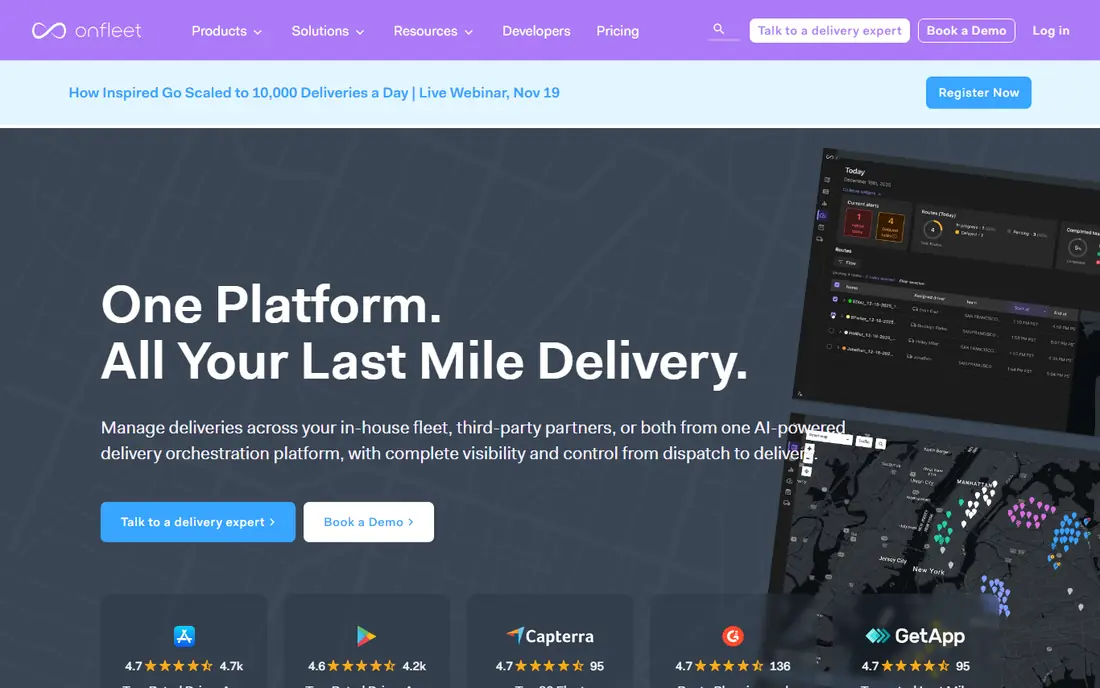
Onfleet is a last-mile delivery platform for retail, grocery, pharmacy, and courier operations that handle many tasks each day. It covers dispatch, route optimisation, driver apps, live tracking, and proof of delivery with photos, signatures, and barcode scanning. Auto-dispatch helps teams assign tasks as orders arrive, rather than planning every route by hand in advance.
Onfleet suits high-volume operations that can justify the starting price. Small couriers with a few dozen stops a day may find a per-driver or per-order tool cheaper. Buyers should check task limits, which proof features are included, and whether courier suite or telephony add-ons are needed for their workflow.
- Auto-dispatch and route optimisation
- Strong driver app and proof capture
- Customer tracking and notifications
- Starting price is high for small fleets
- Some features sit on higher tiers or add-ons
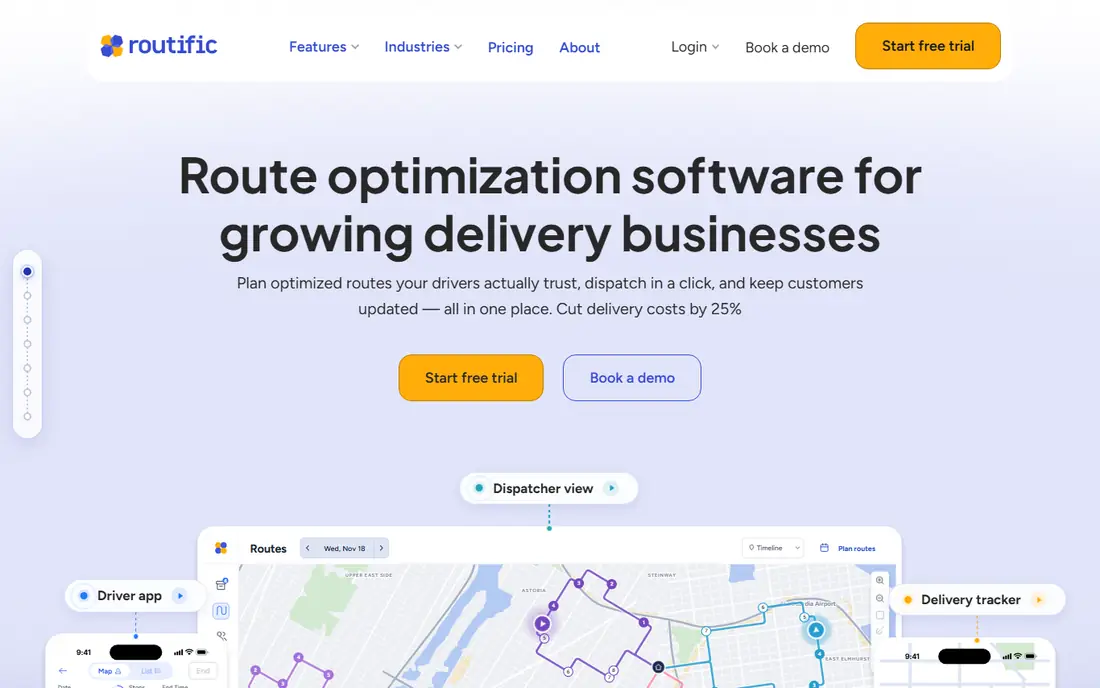
Routific is a route optimisation tool for planned daily routes, with a free tier covering a limited number of orders each month. Dispatchers can plan multi-stop routes, adjust stops during the day, and share tracking links with recipients. Drivers get a mobile route view with navigation, and proof of delivery covers signatures and photos.
Routific suits small and mid-size couriers whose main pain is route quality, not complex dispatch or client billing. The per-order pricing model means the bill follows delivery volume, not driver count, which helps seasonal teams. Check order limits, SMS pricing, and whether live route editing covers your dispatch style before scaling.
- Free tier for low order counts
- Strong route optimisation
- Unlimited drivers on paid plans
- No full client portal
- SMS costs may be separate
- Less dispatch depth than Onfleet
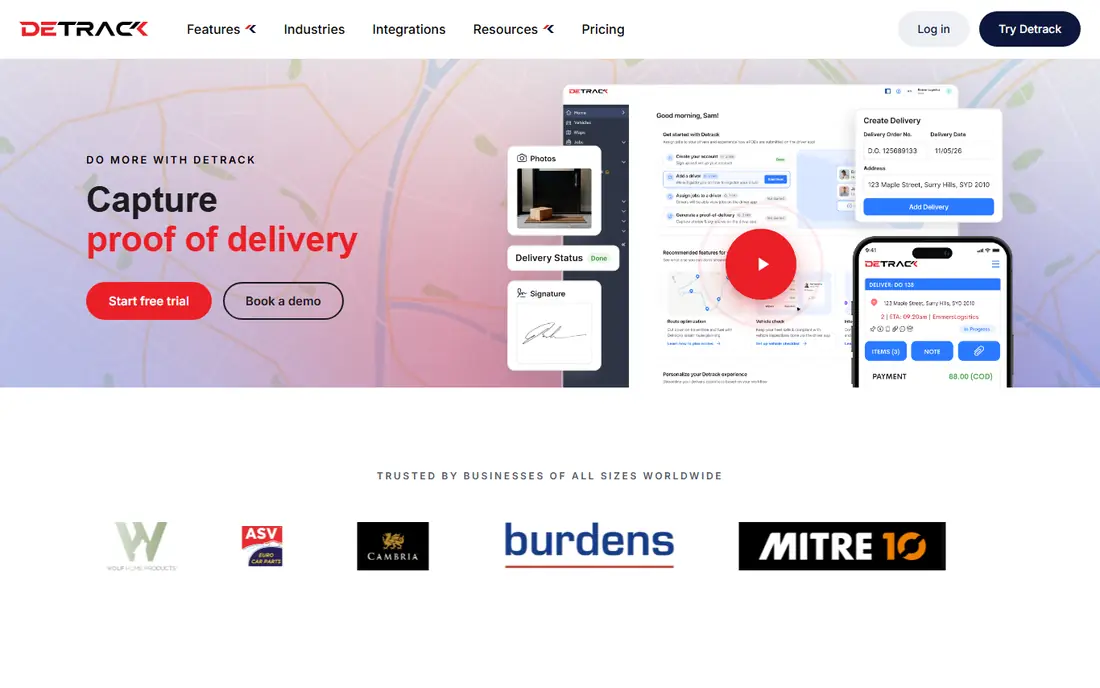
Detrack is a delivery management tool built around proof of delivery. Dispatchers can set required fields, photos, signatures, and status rules for each job, so drivers capture the right evidence at the door. It also covers dispatch, tracking links, and notifications, with per-driver pricing and unlimited office users.
Detrack suits small courier teams moving from paper to digital, where proof quality matters for disputes and client trust. The basic plan covers core proof, while advanced routing needs a higher tier. Buyers should test a delivery form on their most disputed job type, and check how proof files are stored and shared with clients.
- Configurable delivery forms
- Signature, photo, and location proof
- Simple per-driver pricing
- Advanced routing sits on a higher tier
- No full client portal
OptimoRoute is a route planning and dispatch platform for teams that run many multi-stop routes each week. It covers route optimisation, weekly planning, live tracking, and driver analytics, with per-driver pricing that suits teams with a stable driver count. Drag-and-drop re-optimisation helps dispatchers adjust routes when stops change during the day.
OptimoRoute suits route-heavy operations such as distribution, field service, and courier fleets with planned routes. Proof of delivery, including signature, photo, and barcode, sits on higher tiers, so buyers should confirm which tier covers their proof needs. Check weekly planning, driver analytics, and how route changes are communicated to drivers.
- Strong route optimisation and multi-day planning
- Driver analytics
- Per-driver pricing
- Proof features need higher tiers
- No full client portal
Track-POD covers the full delivery day, from route planning and barcode load checks to proof of delivery, customer tracking, and a portal for shippers. Proof templates can be customised by client or job type, with signatures, photos, PIN verification, and offline capture. That depth helps B2B distribution fleets and couriers that serve several shippers with different proof rules.
Track-POD suits fleets of ten or more vehicles that need proof quality and shipper visibility in one subscription. Smaller teams should compare the per-driver cost against simpler tools such as Detrack or Routific. Ask for a demo using two shipper profiles with different proof rules to see how clean the workflow stays.
- Customisable proof templates
- Offline capture
- Shipper portal and barcode checks
- Pricing varies by driver or order model
- Setup needs care for complex fleets
DispatchTrack is a last-mile delivery platform for larger fleets and delivery operations, covering dispatch, route optimisation, driver apps, live tracking, and proof of delivery. It also offers customer communication, delivery windows, and analytics for operations managers. That breadth helps companies that run many routes each day and need control over service levels.
DispatchTrack suits mid-size to large delivery operations rather than a small courier with a few vans. Buyers should ask for a quote based on fleet size and order volume, and for implementation time and support hours. A pilot on one depot or region will show whether the platform fits daily dispatch habits before a wider rollout.
- Last-mile dispatch and routing
- Live tracking and customer notifications
- Proof and analytics tools
- Pricing is by quote
- Implementation suits larger operations
Route4Me is a route planning platform with a wide set of routing rules, including territories, time windows, vehicle constraints, and commercial truck restrictions. It covers multi-stop planning, driver tracking, and mobile proof of delivery, with add-ons for more advanced needs. That flexibility suits operations with unusual constraints, such as franchise territories or truck-specific rules.
Route4Me suits teams whose routes do not fit a simple optimiser, and that need control over rules and territories. Buyers should check which plan includes the rules they need, since some features sit on higher tiers or add-ons. Test routing on your hardest territory, not just a simple route, to see whether the rules work as expected.
- Wide routing rules and constraints
- Territory and franchise support
- Mobile proof of delivery
- Pricing is often by quote for larger plans
- Add-ons can add cost
Bringg is a delivery management and orchestration platform for larger brands, retailers, and logistics providers. It helps orchestrate deliveries across owned fleets, third-party couriers, and partners, with customer tracking, notifications, and analytics. That orchestration focus suits companies that need to manage several delivery providers and service levels in one place.
Bringg is not a low-cost tool for a small courier. It fits brands and 3PLs that manage complex delivery networks and need visibility across partners. Buyers should ask for a quote based on order volume and partner count, and for examples of orchestration rules in their sector. A phased rollout by region or brand will reduce implementation risk.
- Delivery orchestration across fleets and partners
- Customer experience tools
- Analytics and dispatch control
- Pricing is by quote
- Best value for larger brands and networks
How we picked these
We reviewed official feature pages, pricing pages, and product documentation for courier and delivery platforms, plus public comparisons in 2026. We kept tools that are actively sold, that cover dispatch, routing, or proof of delivery for courier work, and that suit a clear fleet size. Where pricing is by quote or varies by task, driver, order, or stop, we wrote See website rather than repeating a third-party figure. That keeps the price column honest for a category where pricing models differ sharply.
Choosing by fleet size and pricing model
Start with fleet size, daily stops, and how you charge clients. A small courier with five drivers and 100 stops a day needs a different price model from a fleet with 50 drivers and thousands of stops. Per-driver pricing suits stable teams, per-order pricing suits variable volume, per-task pricing suits on-demand work, and per-stop pricing suits multi-shipper couriers. Model your bill at current volume and at double volume before choosing.
Test proof, tracking, and dispatch together
Proof of delivery, live tracking, and dispatch are linked. A tool with good routing but weak proof will create disputes, while a tool with good proof but weak dispatch will slow the day. Test a full day in a trial: plan routes, dispatch to drivers, handle a failed delivery, capture proof, and share tracking with a customer. That end-to-end test reveals gaps faster than a feature list.
Check driver app usability in the field
Drivers use the app all day, often with gloves, in bright light, or with poor signal. Check offline capture, barcode scanning, signature capture, and how easy it is to report a problem. A driver app that is hard to use will lead to missing proof and extra office calls, whatever the office features look like. Ask drivers to test the app on a real route before you buy.
Plan for client visibility and billing
Couriers that serve shippers need client portals, proof sharing, and billing by client or stop. Check how proof is shared, whether clients can track deliveries, and how billing data is exported. A tool with a strong client portal, such as Track-POD, can save office time and reduce client queries, which matters as shipper count grows.
Frequently asked questions
What is the best courier management software for small business?
Routific and Detrack are strong starting points for small couriers. Routific suits teams whose main need is route optimisation, with a free tier for low order counts. Detrack suits teams whose main need is proof of delivery, with simple per-driver pricing. Compare both on a real route before choosing.
What is the best delivery management software for high-volume couriers?
Onfleet and DispatchTrack suit high-volume delivery, because both cover auto-dispatch, live tracking, and proof at scale. Onfleet suits on-demand retail and grocery delivery, while DispatchTrack suits larger last-mile fleets. Both are priced by quote or tiered by volume, so request a quote based on your task count.
How much does courier management software cost?
Costs vary by pricing model. Per-driver tools often start at a set monthly rate per driver, per-order tools charge by order volume, and per-task tools charge by task count. Enterprise orchestration tools are priced by quote. Always model the bill at your current and expected volume, including SMS, add-ons, and proof storage.
What is proof of delivery and why does it matter?
Proof of delivery is evidence that a delivery happened, such as a signature, photo, location, timestamp, or barcode scan. It matters because it resolves disputes, proves service to shippers, and supports billing. A tool with configurable proof forms helps couriers capture the right evidence for each client and job type.
Can courier software integrate with order and warehouse systems?
Yes, most platforms offer APIs, integrations, or file imports for order, warehouse, and ERP systems. The depth varies, so check which systems are supported, how orders flow into dispatch, and how delivery status flows back. A clean integration reduces manual entry and keeps customer tracking accurate.
Do courier apps work offline?
Many driver apps offer offline capture for proof, signatures, and photos, with sync when signal returns. Offline support varies by tool and plan, so test it on a route with poor signal. Confirm which features work offline and how long data is stored on the device before sync.
Sources we checked (8)

Online Jobs is an independent blog about careers, online work, learning new skills and the tools that help people earn. More about us.
Keep reading
All posts
n8n Alternatives
n8n alternatives compared for 2026, with Zapier, Make, Activepieces, and more, covering visual builders, code steps, self-hosting, and pricing models.
eBay Alternatives
Looking for ebay alternatives? We compared 9 marketplaces for sellers on fees, buyer reach, categories and ease of listing, to help you sell with confidence.

ZoomInfo Alternatives
The best ZoomInfo alternatives in 2026, compared on price, free plans, data coverage, and which tool fits small teams or large sales teams best in detail.