Best Couple Budget App in 2026: 9 Apps Compared

How we put this together: we compare official feature and pricing pages, app store listings, privacy policies and public user reviews. Prices change, so check the provider's site before you pay.
Key takeaways
- Honeydue is our pick for most couples because it was built for two people, it is free to start, and each partner can choose what to share.
- Goodbudget suits couples who want to assign money before they spend it, while YNAB suits couples who want a stricter weekly planning habit.
- Monarch Money and Copilot give the clearest full-household view, but both are paid tools and work best when both partners check them regularly.
- A free plan is enough for many couples at first, so try the sharing controls and bank connection before paying for a premium plan.
Quick comparison
| Name | Who it suits | Starting price | Free option | |
|---|---|---|---|---|
 Honeydue | Couples who want simple shared tracking | Free | Yes | Visit |
 Goodbudget | Envelope budgeting for two | Free | Yes | Visit |
 YNAB | Strict zero-based planning | See website | Free trial | Visit |
 Monarch Money | Full household dashboard | See website | Free trial | Visit |
 Simplifi | Flexible spending plans | See website | Free trial | Visit |
 EveryDollar | Simple shared budgets | Free | Yes | Visit |
 PocketGuard | Seeing what is safe to spend | See website | Free trial | Visit |
 Copilot | Clean tracking on Apple devices | See website | Free trial | Visit |
 Spendee | Shared wallets and manual budgets | Free | Yes | Visit |
The best couple budget app
Shared money works best when both partners can see the same numbers without losing all privacy. The apps below were compared on sharing controls, budgeting method, bank connections, price, and how easy they are to keep using after the first month.
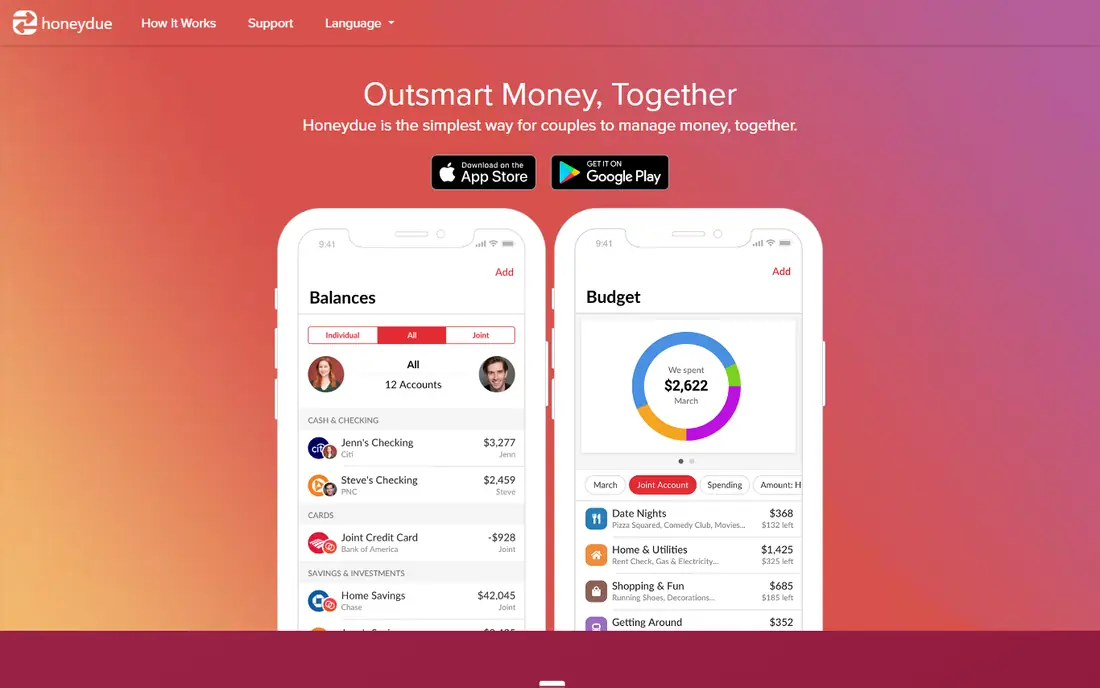
Honeydue starts with the problem most couples actually have. One partner pays a bill, the other partner does not see it until later, and a small question turns into a larger argument. Honeydue puts joint spending in one feed, lets each partner comment on a transaction, and sends reminders for upcoming bills. That shared view is the main reason it works well for couples who do not want a complex system.
The privacy controls matter just as much as the shared view. Each partner can connect accounts and decide what the other partner can see, so a joint account can be fully shared while a personal account stays private. That balance helps couples with a mix of joint and separate money. The catch is planning depth. If you want detailed forecasting, custom reports, or strict envelope rules, Honeydue will feel light. For day-to-day coordination, though, it asks for very little effort and gives a clear picture in return.
- Built for couples
- Each partner controls what to share
- Bill reminders and transaction chat are included
- Planning tools are lighter than YNAB
- Desktop experience is limited
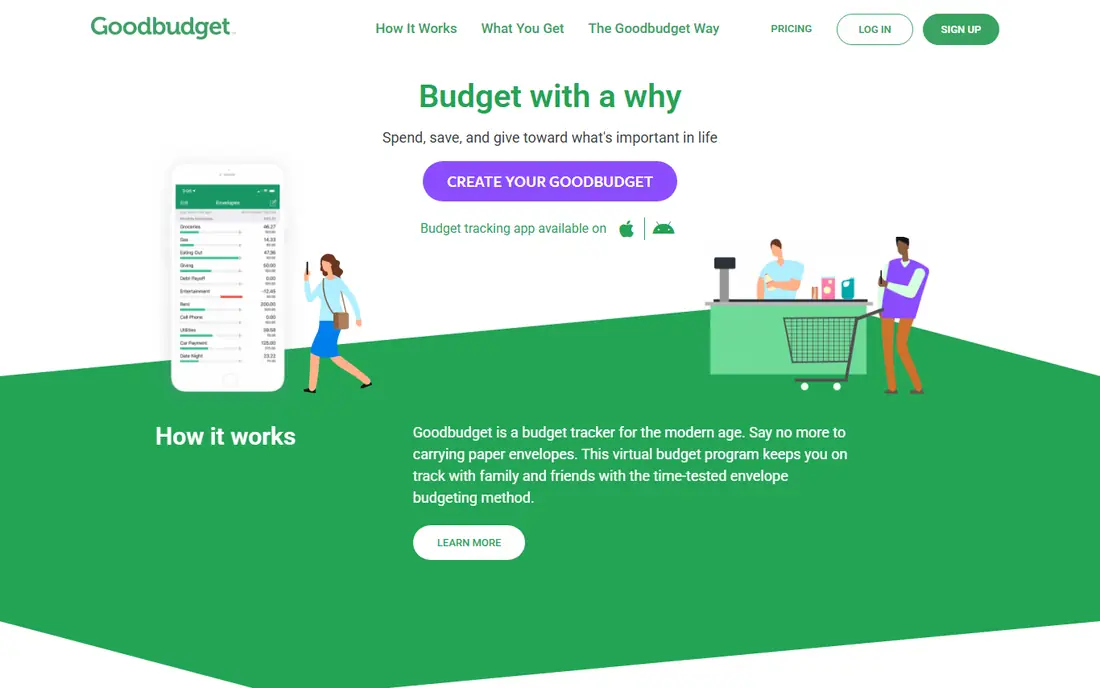
Goodbudget turns budgeting into a set of envelopes, and that simple idea fits couples well. You put money into envelopes for rent, food, transport, and fun, then you spend from those envelopes and watch the balance fall. When both partners use the same envelopes, there is less guessing about what is left. The method forces a short conversation before spending, not after it.
Manual entry is both the strength and the limit here. Entering spending by hand keeps both partners aware, but it takes discipline and it can slip during a busy week. The free plan covers a small number of envelopes and devices, which is enough to test the method. Couples who like the envelope habit and do not mind a little manual work often stay with Goodbudget for years. Couples who want automatic bank sync for every account may prefer Honeydue or Monarch Money instead.
- Clear envelope method
- Shared envelopes keep both partners on the same plan
- Works well with manual entry
- Free plan limits accounts and envelopes
- Bank sync is not the main strength
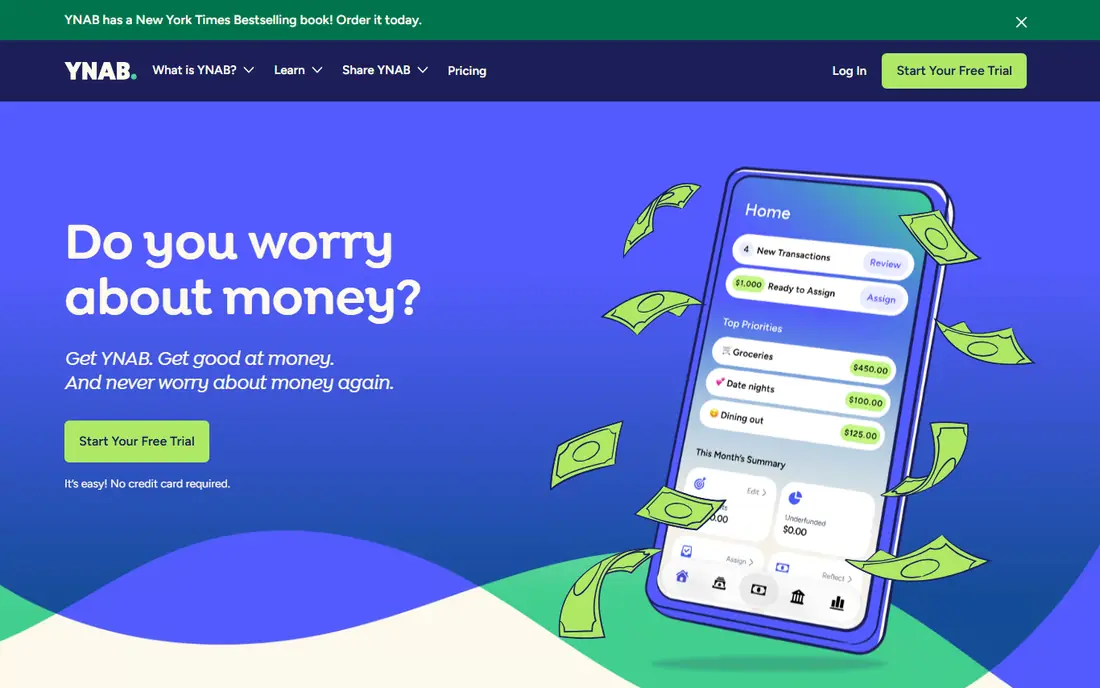
YNAB, short for You Need A Budget, asks couples to give every dollar a job before the month starts. That rule sounds strict, and it is, but it also ends the vague feeling that money just disappears. Couples set targets for bills, savings, and debt, move money between categories when plans change, and review the plan together. The app is built around that weekly check-in, not just around tracking past spending.
The price and the learning curve are the honest trade-offs. YNAB costs more than a free tracker, and both partners need to learn the method for it to work. If only one partner uses it, it becomes another spreadsheet that one person maintains. When both partners use it, even for ten minutes a week, it is one of the most effective tools in this list for paying down debt and building savings. Try the trial together before paying, and judge it on whether you both open it in week three, not week one.
- Strong method for assigning every dollar a job
- Good goal and debt tools
- Shared access for household members
- Higher price than most rivals
- Learning curve is real in the first two weeks
Monarch Money is the dashboard pick for couples who want everything in one place. Bank accounts, credit cards, investments, and loans can sit beside budgets, goals, and cash flow charts. That full view helps couples who are planning for a house deposit, retirement, or a career change, because the budget is not separated from the rest of their money. Filters and shared access make it easier to look at joint money, personal money, or the whole household.
The downside is scope. Monarch shows a lot, and couples who only want to track grocery spending may find the extra charts distracting. There is also no free plan to fall back on after the trial, so the cost is ongoing. Even so, for couples who already track investments or who want one home for all accounts, Monarch is a strong choice. Set up the dashboard together, hide the views you do not need, and keep the weekly review short.
- Wide account coverage
- Clear net worth and cash flow views
- Flexible views for joint and individual money
- No permanent free plan
- Can feel like a lot of data for couples who only want a budget
Simplifi, from Quicken, takes a middle path between a simple tracker and a strict budget. Its spending plan shows income, planned bills, and what is left to spend, without forcing every dollar into a rigid category first. Couples who find YNAB too strict and Honeydue too light often land here. Bill watchlists and subscription tracking also help couples spot costs that quietly grow over time.
Setup is straightforward, and the interface stays readable on phone and desktop. The honest catch is discipline. Because Simplifi is flexible, it will not stop a couple from overspending in a category. It shows the problem clearly, but the couple still has to act on it. For households that want a clear plan plus room to adjust, that flexibility is a benefit. For households that need hard limits, Goodbudget or YNAB may fit better.
- Clear spending plan view
- Watchlists for bills and subscriptions
- Good transaction tracking
- Less strict than YNAB for couples who need firm limits
- Pricing and trial terms can change
EveryDollar keeps budgeting as simple as possible. You list income, list planned spending by category, and track what you actually spend during the month. There is little to learn, which matters when one partner is less keen on finance apps. A couple can set up a first budget in one sitting and see, in plain numbers, where the month stands.
The free tier uses manual entry, so couples must add transactions themselves or upgrade for bank connections. That is fine for a small number of accounts, but it becomes work for a household with many cards. EveryDollar also lacks the deeper investment or net worth views found in Monarch Money. Still, for couples who want a shared monthly plan without a new system to learn, it is a practical and low-cost starting point.
- Very easy to start
- Clean monthly budget layout
- Free tier covers manual budgeting
- Bank connection and automatic imports sit behind the paid plan
- Reporting is basic
PocketGuard answers one question very well. After bills, goals, and planned spending, how much can we safely spend right now. That single number helps couples avoid the common trap of checking a bank balance that already has bills waiting to leave it. The app links accounts, tracks bills, and shows spending by category in a layout that is easy to read at a glance.
Couples who like detailed envelope control may find PocketGuard too simple. It is a spending guide more than a full planning system, and some of its best features sit behind a paid plan. Even with those limits, it is useful as a daily check tool. Use it alongside a monthly budget discussion, and let the safe-to-spend figure guide small choices during the week rather than replacing the larger plan.
- Clear safe-to-spend figure
- Bill and subscription tracking
- Simple layout
- Budget categories are less detailed than YNAB
- Some features need a paid plan
Copilot is the design-led pick in this list. Spending, budgets, and net worth are shown in a clean interface that makes patterns easy to spot. Categories adjust over time, recurring charges are easy to review, and the app feels calm to use rather than busy. For couples who both use Apple devices, that polish makes the weekly money check more likely to happen.
The main limit is platform. Copilot is built around Apple devices, so a mixed-device household will not get the same experience on both phones. It is also a paid app after the trial, with no free tier to keep using long term. Couples who value design, clear visuals, and a simple tracking habit will like it a lot. Couples who need Android support should look at Monarch Money or Simplifi instead.
- Polished design
- Smart categorisation
- Clear spending and net worth views
- Apple only for full mobile use
- No permanent free plan
Spendee works well for couples who want a shared wallet without linking every bank account. You create a wallet for joint spending, add both partners, and record income and spending in that wallet. Reports show where joint money goes, and separate wallets can cover personal spending or a savings goal. The visual style makes the reports easy to understand at a glance.
Bank sync is the variable to check before committing. Coverage differs by country and bank, so couples outside Spendee's strongest markets may rely on manual entry. That is not a flaw on its own, but it changes the daily effort involved. If manual entry suits you, or if your banks are supported, Spendee is a friendly and low-cost way to run a joint budget. If automatic sync for many accounts is essential, start with Honeydue or Monarch Money.
- Shared wallets for couples and groups
- Colourful and easy reports
- Manual entry works without bank links
- Bank sync coverage varies by country
- Advanced features need a paid plan
How we picked these
We compared official feature pages, pricing pages, app-store listings, privacy policies, and public reviews for apps that support shared use by two people. We kept only apps that are available now, that offer a clear way for both partners to view or manage a budget, and that handle everyday spending, bills, or goals. We left out single-user trackers with no sharing option, and we left out apps that had closed or stopped supporting couples features. Prices shown here are starting prices only, and vendors can change plans, so check the pricing page before you pay.
What to check before you choose
Start with how you share money
Some couples share everything, some share bills only, and some keep most money separate. Pick an app that matches that split. Honeydue and Monarch Money handle mixed joint and personal money well, while Goodbudget and Spendee work best when a shared pot is the main focus.
Agree on the weekly habit
An app only helps if both partners open it. Choose the simplest tool you will both use, set a ten-minute weekly check, and review bills, spending, and the next week together. A strict system that only one partner uses will fail faster than a simple system that both partners use.
Check bank support and privacy
Before paying, connect your main accounts on a trial or free plan and confirm transactions appear correctly. Read the privacy policy for how bank data is handled, turn on two-factor authentication, and agree on what stays private. A short note on safety: budgeting apps can show spending patterns, so use a strong unique password and review connected accounts from time to time.
Frequently asked questions
What is the best app for couples budgeting?
Honeydue is the best starting point for most couples because it is free, built for two people, and lets each partner control what to share. Goodbudget is better if you want envelope budgeting, and YNAB is better if you want a strict plan for debt or savings.
What is the best couples budget app for shared bills?
Honeydue and Spendee both handle shared bills well. Honeydue adds bill reminders and transaction chat, while Spendee uses shared wallets that make joint bills easy to separate from personal spending.
What is the best budgeting software for couples who want investments included?
Monarch Money is the strongest pick here because it combines budgets with accounts, investments, and net worth in one dashboard. Copilot also covers net worth well for Apple users, but Monarch covers more account types and platforms.
What is the best budgeting app for couples on a tight budget?
Start with Honeydue or the free tier of Goodbudget. Both let a couple test shared budgeting without paying, and both are useful enough that many couples never need to upgrade.
What is the best budget app for couples with separate finances?
Monarch Money and Honeydue handle this best, because each partner can keep personal accounts private while sharing joint accounts and bills. Agree in advance on which accounts are shared, so the setup matches how you actually live.
What is the best money management app for couples who hate manual entry?
Monarch Money, Simplifi, and Copilot all focus on automatic account connections and categorisation. Check that your banks are supported first, because sync quality matters more than any single feature list.
Sources we checked (9)

Online Jobs is an independent blog about careers, online work, learning new skills and the tools that help people earn. More about us.
Keep reading
All posts
Top AI Financial Software
Searching for top AI financial software? We compared 9 AI finance tools for AP, spend, close, forecasting and bookkeeping to help teams choose wisely.
Quicken Alternatives
Compare the best quicken alternatives for Mac, Windows, and small business owners, from Monarch Money and YNAB to Copilot, Tiller, and Banktivity in 2026.
QuickBooks Online Alternatives
Looking for quickbooks online alternatives? We compared 8 accounting tools on invoicing, bank feeds, payroll, pricing and fit for small businesses today.