Home / Competitive Intelligence
Best Competitive Intelligence Software in 2026: 8 Products Compared


Sales teams needing live competitor tracking · Starting price: See website
How we put this together: we compare official feature and pricing pages, app store listings, privacy policies and public user reviews. Prices change, so check the provider's site before you pay.
Key takeaways
- Crayon and Klue lead for formal competitive intelligence programs tied to sales enablement.
- Contify suits global teams that need broad market and competitor news in one hub.
- Similarweb and Semrush are best when traffic, search, and channel benchmarking matter most.
- SpyFu and Owler give smaller teams a lower-cost way to watch competitors without a large contract.
- Most full CI platforms are priced by quote, so usage, competitor count, and seat count drive the final price.
Quick comparison
| Name | Who it suits | Starting price | Free option | |
|---|---|---|---|---|
| Crayon | Sales teams needing live competitor tracking | See website | Free trial | Visit |
 Klue | Battlecards and win-loss insight | See website | Free trial | Visit |
 Contify | Global market intelligence hubs | See website | Free trial | Visit |
 Similarweb | Traffic and market benchmarking | See website | Yes | Visit |
 Semrush | SEO and paid search competitor insight | See website | Free trial | Visit |
 SpyFu | Affordable PPC and keyword history | See website | Free trial | Visit |
 Kompyte | Automated tracking for small CI teams | See website | Free trial | Visit |
 Owler | Company profiles and news alerts | Free | Yes | Visit |
The best competitive intelligence software
Competitive intelligence covers more than one job. Some teams need battlecards for sales calls, others need traffic estimates, and others need news and pricing changes. The tools below are grouped by that job, so you can shortlist by the question you need answered each week.
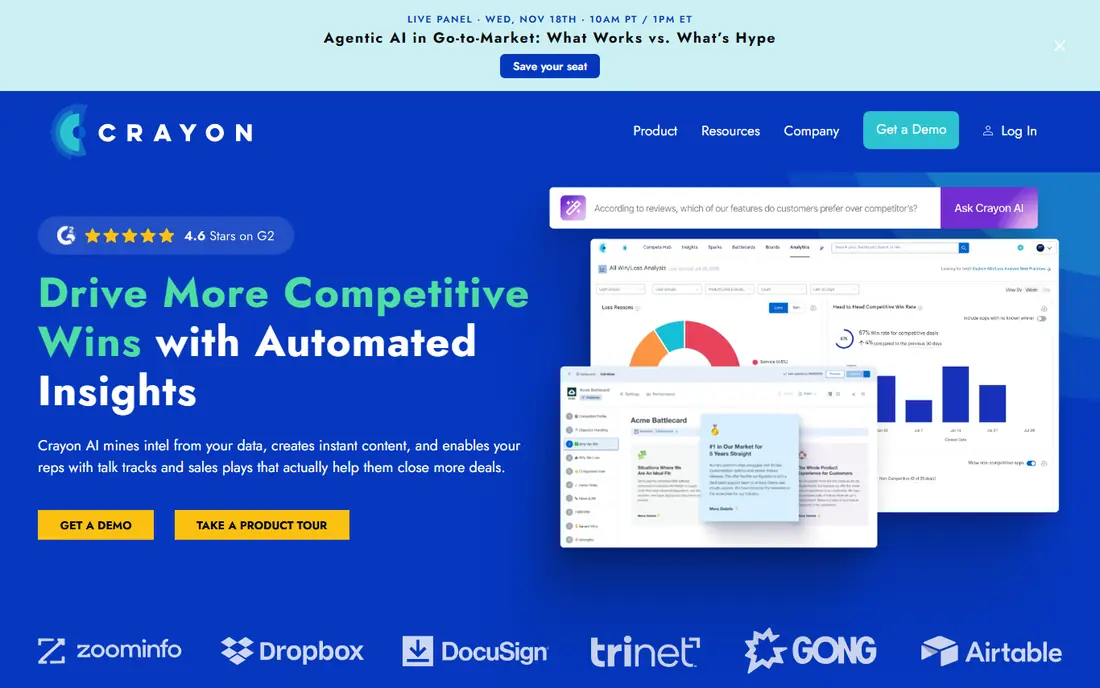
Crayon monitors competitor websites, pricing pages, product updates, messaging, and job postings, then turns the most relevant changes into sales-ready material. Battlecards can be shared where reps already work, which helps a team use insight during a live deal rather than in a quarterly report. That link between tracking and enablement is the main reason larger B2B teams choose it.
The platform works best when one owner curates alerts and keeps battlecards current. Without that role, a team can face alert overload and stop reading updates. Buyers should ask how many competitors and data sources are included, how alerts are filtered, and how usage by sales reps is measured.
- Real-time tracking of competitor sites and pricing
- Battlecard creation and distribution
- Integrations with common CRM and chat tools
- Pricing is by quote and can be high for small teams
- A formal program needs owner time to stay useful
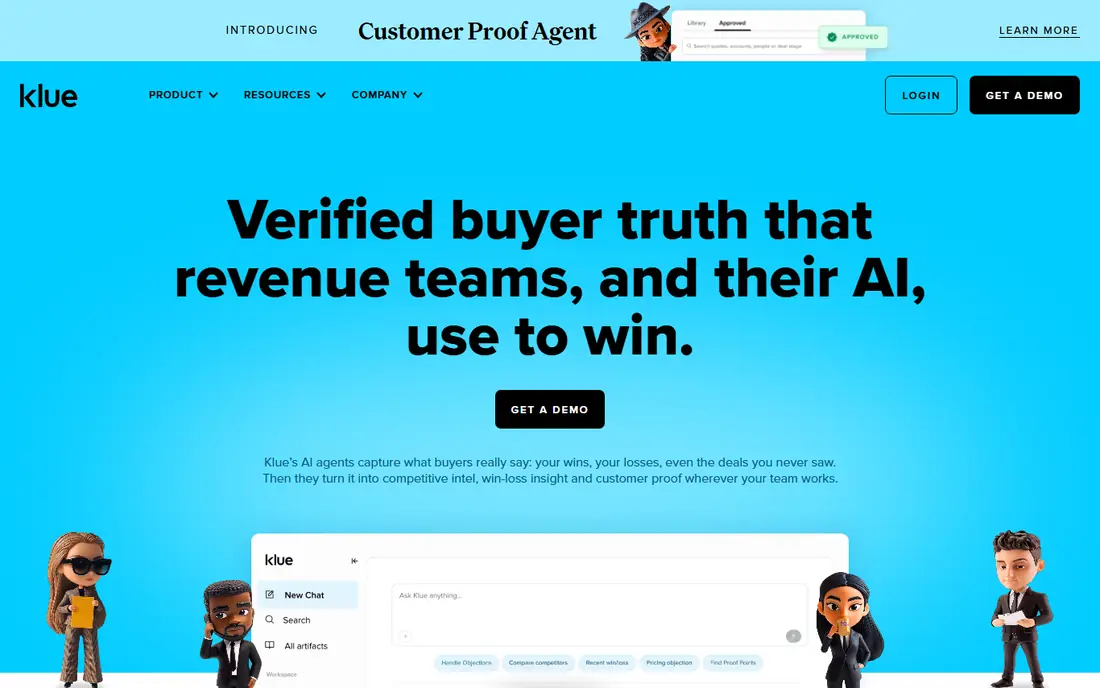
Klue combines competitor tracking with curated insight and win-loss research, so teams can learn why deals are won or lost and feed that back into sales material. Battlecards are built for use during deals, with guidance on positioning, objections, and proof points. Distribution into tools such as Salesforce and Slack helps reps find the right card without leaving their workflow.
Klue suits revenue teams that already run a structured sales process and want competitive insight inside it. A small team that only wants occasional website alerts may find the platform larger than needed. Ask for a sample battlecard, the win-loss interview process, and the time needed to launch with your top five competitors.
- Strong battlecard workflow
- Win-loss research features
- Distribution into CRM, chat, and sales tools
- Pricing is by quote
- Setup needs buy-in from sales leadership to succeed
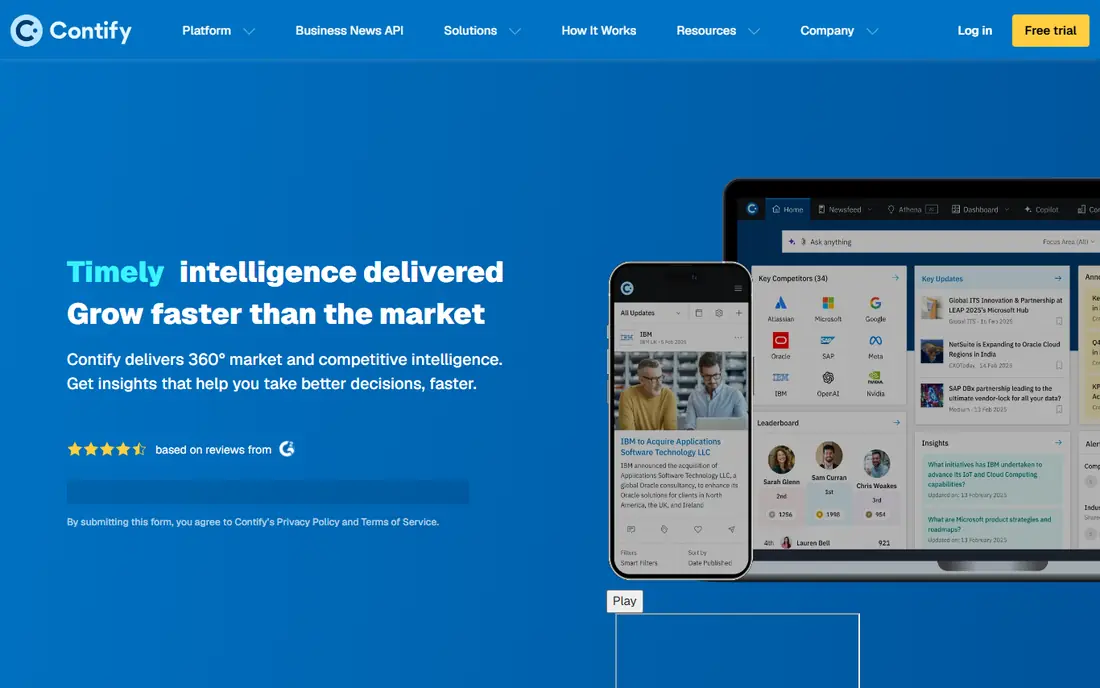
Contify is built as a market and competitive intelligence hub, pulling news, company updates, regulatory items, and industry signals into one workspace. That breadth helps strategy, product, and marketing teams that track many markets, languages, or sectors at once. Curated feeds and alerts reduce the need to check dozens of separate sources each morning.
The trade-off is focus. Contify is strong on breadth and curation, but a sales team that lives on battlecards may still need a dedicated enablement tool. It fits best when the main job is staying current across a market, not arming reps for a single deal. Check source coverage for your regions and whether alerts can be tuned by topic and competitor.
- Broad news and market coverage
- AI-assisted curation
- Multi-language and multi-market tracking
- Pricing is by quote
- Sales battlecard depth is less central than in Crayon or Klue
Similarweb estimates website traffic, audience behaviour, and channel mix for competitors, which helps teams size a market and spot shifts in referral, search, social, and paid traffic. It is useful for questions such as which competitor is gaining traffic, which channels drive that growth, and how your share compares within a segment. The free tier gives a basic view before a paid plan is needed.
Buyers should treat traffic numbers as directional estimates and cross-check them with search and sales data. Similarweb is not a substitute for a sales battlecard tool, but it adds a market view that battlecard tools do not provide. Ask which markets and devices are covered for your competitors, and how segment definitions are built.
- Competitor traffic and audience estimates
- Channel and keyword benchmarking
- Market segment views
- Traffic figures are estimates, not exact counts
- Deeper plans are priced by quote
Semrush is best known as an SEO platform, but its competitor tools are strong for search and paid insight. Teams can compare keyword rankings, find keyword gaps, review competitor ad copy, and check backlink profiles. That helps marketing teams answer why a rival ranks or wins clicks, and where there is room to compete.
For pure competitive intelligence, Semrush works best alongside a tracking or battlecard tool, rather than as a replacement for one. It answers search questions in depth, but it does not track every pricing page change or build sales battlecards in the same way. Buyers should confirm which limits apply to competitor projects, tracked keywords, and reports on their plan.
- Deep keyword, backlink, and ad research
- Competitor gap analysis
- Broad marketing toolkit
- The full toolkit can feel large if you only need CI
- Pricing rises with limits and seats
SpyFu lets teams look up the keywords and ads a competitor has used, including historical data that shows how a strategy changed over time. That history is useful for PPC and SEO planning, because it reveals which terms a rival has kept, dropped, or tested. The interface is simpler than enterprise CI suites, which helps small marketing teams get answers without a long setup.
The limit is scope. SpyFu does not replace a broad news tracker or a sales enablement platform. It fits best as a focused search intelligence tool for teams with a clear paid or organic search question. Check coverage for your country and niche before relying on it for a full competitor picture.
- Long history of competitor keywords and ads
- Lower price than enterprise CI tools
- Simple competitor comparisons
- Focus is search and ads, not full market intelligence
- Data depth varies by market
Kompyte tracks competitor websites, product pages, reviews, press, and job postings, then classifies changes and surfaces the ones most likely to matter. That automation helps a small product marketing team that cannot watch every competitor manually. Battlecards and alerts help turn tracked changes into material sales teams can use.
Kompyte sits between lightweight monitoring tools and large enterprise CI platforms. It suits a team that wants automated tracking plus enablement, but does not need the full program management of Crayon or Klue. Ask how change classification works, how false alerts are reduced, and which sources are tracked for your competitors.
- Automated competitor tracking across many sources
- Battlecard support
- CRM and chat integrations
- Pricing is by quote in most cases
- Interface and workflow take time to learn
Owler provides company profiles, news alerts, and basic competitive tracking, with a free tier that suits individuals and small teams. It is a practical starting point when you need to follow a set of competitors and get notified about funding, leadership, product, and press news. The low barrier to entry makes it easy to test whether regular competitor alerts change how your team works.
Paid plans add deeper data and more tracking capacity, but Owler is still not a full battlecard or traffic platform. Use it for company-level news and a first layer of tracking, and pair it with a search or sales tool when you need deeper insight. Check how many companies you can follow on the free tier and which alert types are included.
- Free company profiles and alerts
- Useful for basic competitor news
- Simple to start
- Depth is limited compared with paid CI platforms
- Advanced data sits behind paid plans
How we picked these
We reviewed official feature pages, pricing pages, and product documentation, plus public review summaries for competitive intelligence tools in 2026. We kept tools that are actively sold, that cover a clear CI job such as tracking, battlecards, traffic benchmarking, or search insight, and that have a current product presence. Where pricing is by quote or varies by plan, we wrote See website rather than repeating a third-party contract estimate. That approach keeps the price column accurate for tools that do not publish a single starting price.
Choosing the right type of competitive intelligence
Start with the decision the tool must support. A sales team needs battlecards and deal insight, a marketing team needs search and traffic data, and a strategy team needs market news and trends. One tool rarely does all three well, so many teams pair a tracking or battlecard platform with a search or traffic tool. That pairing is often cheaper and more useful than buying one large suite for every job.
Set up alerts people will actually read
Alert overload is the most common reason CI tools are abandoned. Limit tracking to a short list of direct competitors, set alert rules by change type, and assign one owner to review and curate updates each week. A weekly digest with three useful items beats a daily flood of minor website edits. Review the competitor list each quarter and remove rivals that no longer matter.
Check data quality before you buy
Traffic estimates, keyword data, and news coverage all vary by market and source. Run a test on two or three known competitors and compare the results with what you already know from sales calls, web analytics, and search data. If the tool misses major changes or overstates traffic, that gap will affect every report you build from it. Ask vendors how data is collected and how often it updates.
Measure use, not just coverage
A CI tool is only useful if sales and marketing teams open it. Track battlecard views, alert clicks, and use in deals, and ask reps which cards helped in real conversations. If use is low, the problem is usually distribution or card quality, not a lack of data. Fix the workflow first, then expand coverage or seats.
Frequently asked questions
What is the best competitive intelligence tool for sales teams?
Crayon and Klue are the strongest options for sales enablement, because both link competitor tracking to battlecards that reps can use during deals. Crayon leans toward real-time tracking, while Klue adds win-loss research. The better choice depends on whether your main gap is fresh tracking or understanding why deals are won and lost.
What is the best competitive intelligence platform for market research?
Contify suits broad market research, because it gathers news and signals across markets and languages into one hub. Similarweb adds a traffic and audience view that helps size a market. For a full picture, many strategy teams use both: Contify for news and signals, and Similarweb for digital market share.
How much does competitive intelligence software cost?
Prices vary widely. Lightweight tools and free tiers can start at no cost, while enterprise CI platforms are usually priced by quote based on competitors tracked, seats, and modules. Search tools such as Semrush and SpyFu publish tiered plans, but the exact cost depends on limits. Always ask for a written quote for your competitor count and team size.
Is Similarweb accurate for competitor traffic?
Similarweb traffic figures are modelled estimates, not exact visitor counts from the competitor. They are useful for trends, channel mix, and relative share, but they should not be treated as precise counts. Cross-check them with search data, public filings, and your own analytics where possible.
What is the difference between Crayon and Klue?
Both track competitors and support battlecards, but Crayon puts more weight on real-time monitoring and automated insight, while Klue puts more weight on win-loss research and deal-based insight. Teams that need fresh tracking first often lean toward Crayon, while teams that need to learn from lost deals often lean toward Klue.
Can small businesses use competitive intelligence tools?
Yes. Owler, SpyFu, and the free tiers of Similarweb give small teams a useful starting point without an enterprise contract. Start with a short competitor list, one clear question, and a weekly review habit. Expand to a paid CI platform only when the free tools no longer answer the questions that affect deals or marketing spend.
Sources we checked (8)

Online Jobs is an independent blog about careers, online work, learning new skills and the tools that help people earn. More about us.
Keep reading
All posts
n8n Alternatives
n8n alternatives compared for 2026, with Zapier, Make, Activepieces, and more, covering visual builders, code steps, self-hosting, and pricing models.
eBay Alternatives
Looking for ebay alternatives? We compared 9 marketplaces for sellers on fees, buyer reach, categories and ease of listing, to help you sell with confidence.

ZoomInfo Alternatives
The best ZoomInfo alternatives in 2026, compared on price, free plans, data coverage, and which tool fits small teams or large sales teams best in detail.