Best Coding Platforms for Beginners in 2026: 9 Products Compared

How we put this together: we compare official feature and pricing pages, app store listings, privacy policies and public user reviews. Prices change, so check the provider's site before you pay.
Key takeaways
- freeCodeCamp is the best free starting point for a full path, with projects and certifications that build a portfolio.
- Codecademy suits beginners who need guided, interactive lessons and a clear path through several languages.
- Khan Academy and CS50 suit learners who want concepts explained slowly, before heavy coding practice.
- The Odin Project suits self driven learners who want a project heavy web path with a community for help.
- The best platform is the one you finish, so pick one main path and use others only as supplements.
Quick comparison
| Name | Who it suits | Starting price | Free option | |
|---|---|---|---|---|
 freeCodeCamp | free full stack path with projects | Free | Yes | Visit |
 Codecademy | guided interactive lessons | $14.99 per month | Yes | Visit |
 Khan Academy | gentle concept first learning | Free | Yes | Visit |
 The Odin Project | project heavy web development | Free | Yes | Visit |
 Scrimba | interactive video coding lessons | See website | Yes | Visit |
 SoloLearn | short mobile lessons | Free | Yes | Visit |
 CS50 | university intro to computer science | Free | Yes | Visit |
 Exercism | practice with mentor feedback | Free | Yes | Visit |
 Coursera | university backed courses | See website | Free trial | Visit |
The best coding platforms for beginners
Learning to code as a beginner is less about finding the perfect language, and more about finding a path you can follow for months. We compared platforms that are live in October 2026, teach real coding in a browser or app, and suit a true beginner with no prior experience. The order follows learning style: full paths, guided lessons, concept first courses, and practice tools.
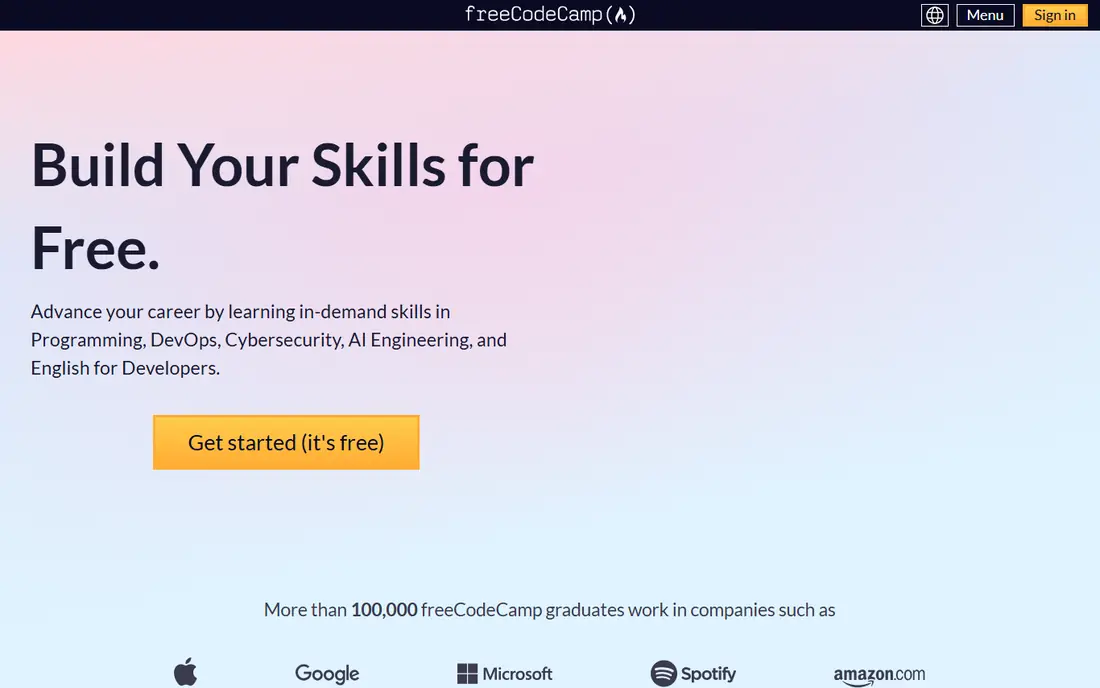
freeCodeCamp is the strongest free pick for a beginner who wants a complete path. The curriculum covers web design, JavaScript, front end libraries, data, and back end topics, and each certification requires projects that you can show in a portfolio. That project requirement is the key difference from platforms that only offer quizzes.
Discipline is the catch. There is no tutor chasing you, and the path is long, so learners who stall need a study habit or a study partner. Use the forum when you get stuck, build the projects even when they feel hard, and treat the certificate as proof of projects, not as a job guarantee on its own.
- Full curriculum is free, with no paid tier
- Certifications require real projects
- Large community and forum for help
- Self paced structure needs discipline
- Less hand holding than Codecademy for very new learners
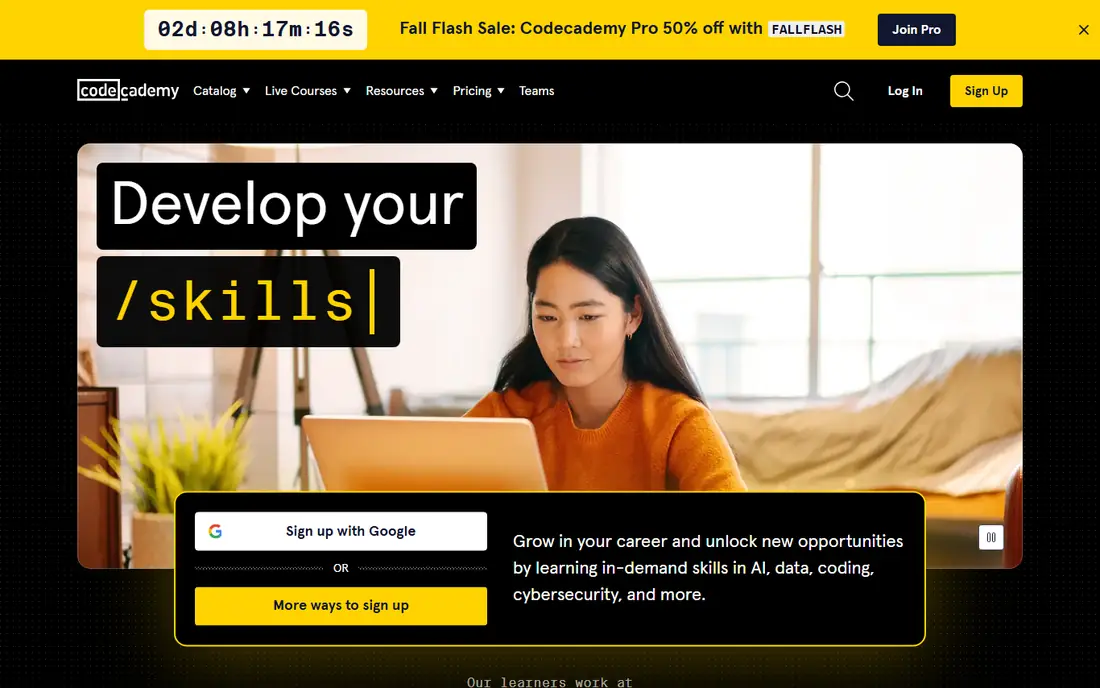
Codecademy suits beginners who need structure and quick wins. Lessons run in the browser, give instant feedback, and break topics into short steps, so a new learner can finish a lesson in a spare 20 minutes. Paths for Python, JavaScript, SQL, and web development help a learner pick a direction without guessing what to study next.
The free tier is a taster, not a full course. Plus starts at $14.99 per month on annual billing, with Pro at a higher price, so check the current page before budgeting. Use Codecademy to learn syntax and build confidence, then build larger projects on freeCodeCamp or The Odin Project to prove the skills.
- Interactive lessons in the browser with instant feedback
- Clear paths for Python, JavaScript, and web development
- Good for sampling languages
- Free tier covers only basics, with deeper paths behind a paywall
- Projects are less portfolio heavy than freeCodeCamp
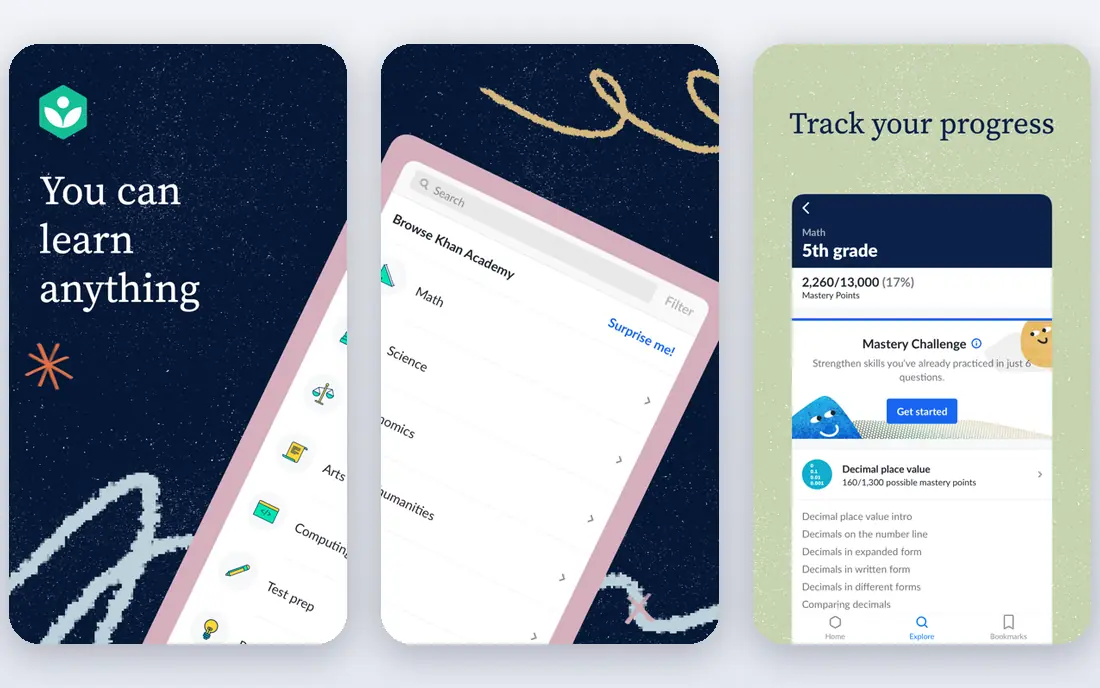
Khan Academy is the calmest entry point on this list. Its intro to JavaScript and SQL courses use short videos and interactive exercises that explain what code does, step by step, rather than rushing to a project. That pace suits learners who feel lost by fast tutorials, and younger learners who need a friendly start.
It is not a full job path. Use Khan Academy to understand loops, functions, and data, then move to freeCodeCamp or Codecademy for deeper practice and projects. For a learner who has tried coding before and quit early, Khan Academy is a good reset point.
- Free, gentle intro courses in JavaScript and SQL
- Talk through videos that explain concepts slowly
- Good for younger learners and complete beginners
- Coding practice is lighter than freeCodeCamp
- Not a full career path on its own
The Odin Project is a free, project heavy path for web development. You learn HTML, CSS, JavaScript, and back end topics by building real projects, not just completing lessons. The community on Discord helps when you get stuck, and the open source curriculum is updated by contributors who teach the same path.
It is demanding by design. You set up tools on your own computer, read docs, and solve problems with less step by step guidance than Codecademy. That difficulty is also the benefit, since it mirrors real developer work. Choose The Odin Project if you want web development and you are ready to build, not just watch lessons.
- Free, open source web curriculum in JavaScript or Ruby on Rails
- Project based learning with real builds
- Active community on Discord
- Self driven and demanding, with less guided hand holding
- Setup on your own machine can challenge very new learners
Scrimba blends video teaching with code you can edit. A teacher records a lesson, and you can pause at any point, change the code in the same screen, and run it to see the result. That format suits learners who like video teaching but get bored watching without typing.
Front end topics are the strongest area, with a solid free track for HTML, CSS, and JavaScript. Paid plans add more courses and features, so check the current pricing page. Use Scrimba as a main front end course, or as a supplement when a concept from another platform does not click in text form.
- Interactive screencasts you can pause and edit
- Strong front end track
- Free courses to test the format
- Paid plans vary and need a check
- Course depth is narrower than a full university path
SoloLearn fits learners who study on a phone in short bursts. Lessons are short, quizzes are quick, and the app covers many languages, so you can sample Python, Java, JavaScript, and SQL without committing to a long course. That low friction format helps build a daily habit.
Depth is the limit. SoloLearn teaches syntax and basics well, but it does not replace a project path for job skills. Use it for a daily habit, for revision, or for sampling a language, and use freeCodeCamp or The Odin Project for the main path and portfolio projects.
- Short, mobile friendly lessons for many languages
- Bite size quizzes and code challenges
- Good for daily habit building
- Lessons are shallow for deep topics
- Paid features and ads can interrupt free use
CS50, from Harvard, is widely regarded as one of the best first computer science courses. It teaches C, Python, SQL, and web topics through lectures and problem sets that build real understanding of how computers work. A learner who finishes CS50 will understand concepts that many short courses skip, such as memory, algorithms, and data structures.
It is demanding, and that is the point. Problem sets take time, and the pace can feel fast for a complete beginner. Audit the course for free, and pay only if you want a verified certificate through edX. Pair CS50 with a practical path such as freeCodeCamp, so theory and building grow together.
- Free Harvard intro to computer science, with lectures and problem sets
- Strong teaching of core concepts
- Certificate options through edX
- Pace and problem sets are demanding for a first course
- Certificate on edX is paid
Exercism is the practice gym for coding. After you learn basics elsewhere, you work through exercises in a language track, submit solutions, and get feedback from volunteer mentors. That feedback on style, clarity, and idiom is rare on free platforms, and it helps a learner move from code that works to code that reads well.
It is not a taught course, so complete beginners should start with Khan Academy, Codecademy, or freeCodeCamp first. Once you can write basic programs, Exercism builds fluency. Use it for a second language, for interview style practice, or for steady daily coding after your main course.
- Free practice tracks in many languages
- Human mentor feedback on solutions
- Good for building fluency after basics
- It is a practice tool, not a full taught course
- Mentor feedback can take time
Coursera suits learners who want a university style course with a certificate. Courses such as Python for Everybody, plus Meta and IBM career paths, offer structured video teaching, assignments, and a certificate at the end. Financial aid is available on many courses, which helps learners on a tight budget.
Subscription pricing varies by course and region, so check the current course page before enrolling. Many courses allow free preview, but full graded work needs payment or aid. Use Coursera for a focused topic or a certificate goal, and use freeCodeCamp for free project practice alongside it.
- University and company backed courses, such as Python for Everybody
- Certificates that employers recognise
- Financial aid on many courses
- Pricing is subscription based and varies by course
- Many courses are preview only without payment
How we picked these
We started with platforms that are live in October 2026, teach coding to true beginners, and let learners write and run real code. Each platform had to offer a structured path, course, or practice track, not just articles or videos with no coding. We checked vendor and course pages for free tiers, entry prices, and the main limits, and we used See website where pricing varied by course or plan.
We ranked by learning style fit, not by total course count alone. A platform with many courses but no clear beginner path can be worse than a focused path that a learner actually finishes. We left out bootcamps that cost thousands of dollars, platforms that only offer interview practice with no teaching, and tools we could not verify as live products.
How to learn without stalling
Most beginners do not fail for lack of talent. They fail because the path is vague, practice is thin, or the first hard week breaks the habit. Use this guide to stay on track.
Pick one main path for 90 days
Choose freeCodeCamp, Codecademy, or The Odin Project as your main path, and commit to it for 90 days. Use Khan Academy, Scrimba, or SoloLearn only when a concept does not click, not as a second full path. Switching platforms every week feels like progress, but it restarts the basics each time.
Code every day, even for 25 minutes
A short daily session beats a long weekend session for most learners. Set a fixed time, work through one lesson or one exercise, and build a small project each week. Track streaks in the platform or in a simple notebook, and forgive a missed day by returning the next day, not by quitting.
Build projects early, not just lessons
Lessons teach syntax, but projects teach problem solving. After the basics, build a personal page, a calculator, a to do app, and a small data project, and put them on GitHub. Employers and clients judge a portfolio of finished projects far more than a list of completed lessons.
Ask for help the right way
When you get stuck for more than 30 minutes, write down what you tried, what error you got, and what you expected. Post that note in the platform forum or community, and search for the same error first. Clear questions get faster help, and the habit of describing a bug is itself a developer skill.
Frequently asked questions
What is the best coding platform for beginners?
freeCodeCamp is the best free all round pick, because it offers a full path, real projects, and certifications at no cost. Codecademy is better if you need guided interactive lessons and can pay for Plus, while Khan Academy is better for a gentle concept first start. Pick one main path and finish it, rather than sampling many platforms.
Is freeCodeCamp really free?
Yes. freeCodeCamp has no paid tier, and its curriculum, projects, and certifications are free. It is funded by donations, so learners are not locked out of core content by a paywall. That makes it the safest first choice for learners on a tight budget.
How long does it take to learn coding as a beginner?
With consistent daily study of one to two hours, many learners reach a solid beginner to intermediate level in six to twelve months. That range depends on prior experience, study time, and whether you build projects. A single course alone does not make a learner job ready; a portfolio of projects plus practice does.
Should I learn Python or JavaScript first?
Python is often easier for general programming, data, and automation, while JavaScript is the best first choice for web development. If you want to build websites, start with JavaScript through freeCodeCamp or The Odin Project. If you want data, automation, or general programming, start with Python through freeCodeCamp, Codecademy, or Coursera.
Is Codecademy worth paying for?
Codecademy Plus can be worth it if guided lessons keep you moving and the free tier feels too limited. At $14.99 per month on annual billing, it costs far less than a bootcamp. If budget is tight, start with freeCodeCamp for free, and pay for Codecademy only if you stall on a self paced path and need more structure.
What is the best coding app for PC?
For PC learning, use a browser platform such as freeCodeCamp, Codecademy, or The Odin Project, with a code editor such as Visual Studio Code for projects. SoloLearn and other mobile apps are useful for revision and short lessons, but a PC path with real projects builds stronger skills for work.
Sources we checked (9)

Online Jobs is an independent blog about careers, online work, learning new skills and the tools that help people earn. More about us.
Keep reading
All posts
eBay Alternatives
Looking for ebay alternatives? We compared 9 marketplaces for sellers on fees, buyer reach, categories and ease of listing, to help you sell with confidence.

ZoomInfo Alternatives
The best ZoomInfo alternatives in 2026, compared on price, free plans, data coverage, and which tool fits small teams or large sales teams best in detail.
Zoom Alternatives
Zoom alternatives compared for 2026: Google Meet, Microsoft Teams, Webex, Jitsi and more for free calls, large meetings and webinars for teams and classrooms.