Best Cloud Security Platform Reviews in 2026: 8 Platforms Compared

How we put this together: we compare official feature and pricing pages, app store listings, privacy policies and public user reviews. Prices change, so check the provider's site before you pay.
Key takeaways
- Wiz and Orca Security lead for fast agentless visibility across multiple clouds, which suits teams that need a clear picture quickly.
- Microsoft Defender for Cloud is the natural starting point for Azure-heavy estates, since its basic tier covers foundational posture checks.
- Runtime defense and posture scanning are different strengths, so check whether a platform protects running workloads or mainly scans configuration.
- Most cloud security pricing is quoted by assets or workloads, so a pilot on your real accounts gives a better price than a sales estimate.
Quick comparison
| Name | Who it suits | Starting price | Free option | |
|---|---|---|---|---|
 Wiz | Multicloud CNAPP visibility | See website | Free trial | Visit |
 Orca Security | Fast agentless coverage | See website | Free trial | Visit |
 Palo Alto Cortex Cloud | Palo Alto estates | See website | Free trial | Visit |
 Microsoft Defender for Cloud | Azure-first teams | See website | Yes | Visit |
 CrowdStrike Falcon Cloud Security | Falcon endpoint customers | See website | Free trial | Visit |
 Sysdig Secure | Kubernetes runtime defense | See website | Free trial | Visit |
 Lacework FortiCNAPP | Fortinet-aligned teams | See website | Free trial | Visit |
 Check Point CloudGuard | Multi-cloud compliance | See website | Free trial | Visit |
The best cloud security platforms
We compared platforms on cloud coverage, agentless versus agent-based scanning, runtime protection, compliance reporting, and pricing transparency. The eight below cover the main CNAPP choices for 2026, from fast agentless scanners to full runtime platforms, so you can match a tool to your cloud mix rather than buying on brand alone.
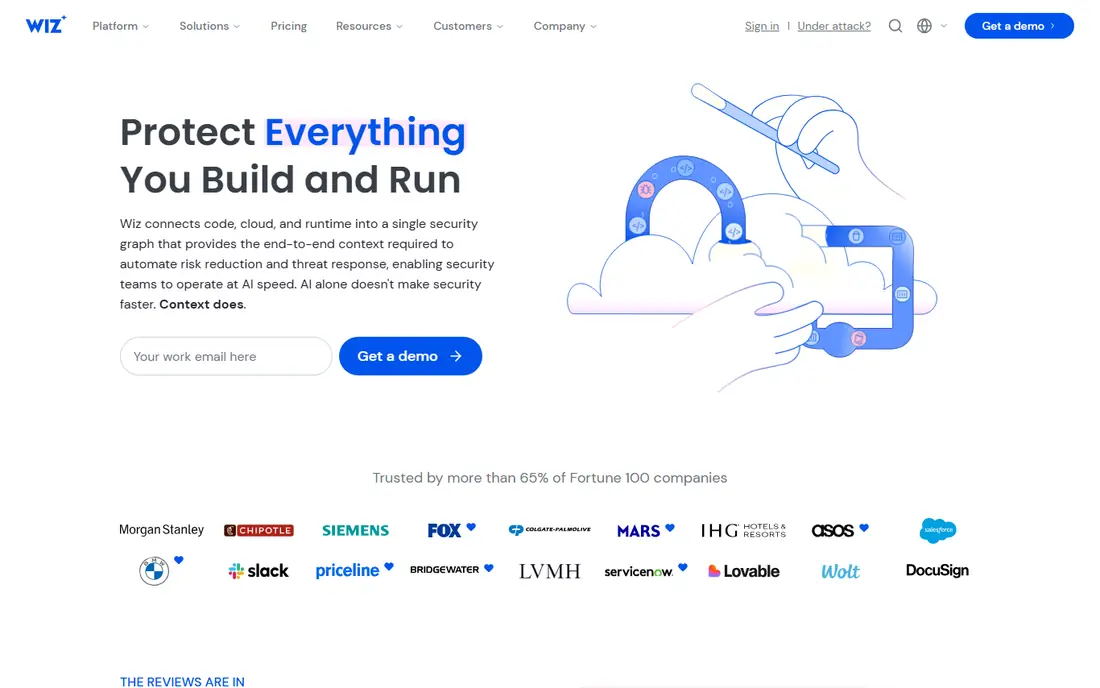
Wiz is our pick for most multicloud teams that want a clear risk picture without a long deployment. Its agentless approach scans cloud accounts and builds a graph of assets, vulnerabilities, identities, and exposures, then highlights the attack paths that actually matter. That context helps a small security team focus on a handful of critical fixes instead of a long list of low-risk findings.
The limit is runtime depth. Agentless scanning sees configuration and known vulnerabilities well, but live workload behavior needs optional sensors, so teams with heavy container or serverless runtime needs should test that part carefully. Pricing is also quoted, so run a pilot on your real accounts to learn what the bill will look like at your scale.
- Agentless scanning across AWS, Azure, and Google Cloud
- Attack-path analysis linking risks
- Broad compliance framework coverage
- Pricing is quoted by assets
- Runtime protection needs optional sensors for full depth
Orca Security is the closest rival to Wiz for teams that want fast, agentless coverage. Its side-scanning reads workload data without installing agents, which keeps deployment simple and avoids performance worries on production systems. For a team that needs visibility across mixed clouds this week rather than next quarter, that speed is a real advantage.
Runtime detection is the trade-off, since agentless data cannot match a live sensor for behavioral signals. Orca has added runtime options, but teams that need deep runtime defense should compare it head to head with Sysdig or CrowdStrike. As with Wiz, pricing is quoted, so a pilot matters more than a brochure price.
- Agentless deployment with quick time to value
- Side-scanning of workloads without agents
- Wide cloud and compliance coverage
- Runtime telemetry is lighter than sensor-based rivals
- Pricing is quoted
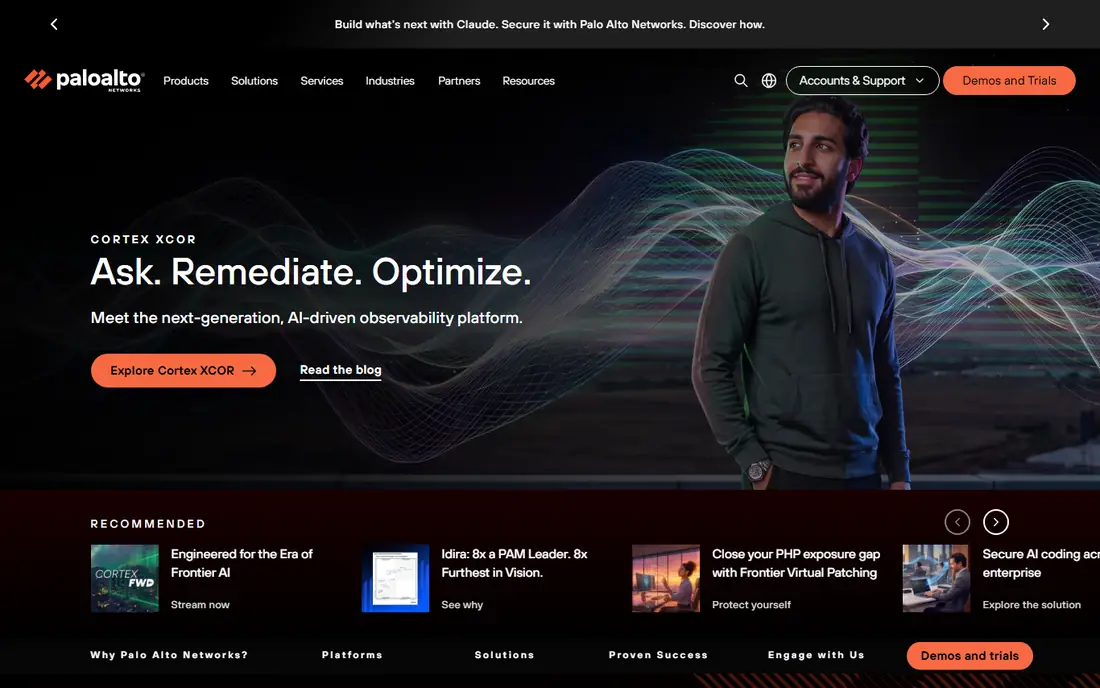
Cortex Cloud, formerly Prisma Cloud, is the broadest platform on this list for teams already invested in Palo Alto Networks. It covers code scanning, cloud posture, workload protection, and runtime defense, with agents that can block malicious behavior in containers and hosts. Large enterprises with complex compliance needs will find the framework coverage and policy controls extensive.
That breadth brings complexity. Scoping modules, deploying agents, and tuning policies take time, and teams outside the Palo Alto ecosystem may find simpler tools faster to run. Choose Cortex Cloud when you need its full range and already run Palo Alto products, not when you only need a posture scan.
- Broad code-to-cloud coverage
- Runtime protection with agents
- Deep integration with Palo Alto Networks products
- Module scoping and deployment can be complex
- Best value inside a Palo Alto estate
Microsoft Defender for Cloud is the obvious starting point for an Azure-heavy organization. Its foundational tier covers basic posture management, and paid Defender plans add workload protection, vulnerability assessment, and threat detection across cloud resources. Integration with Microsoft Sentinel and Entra ID keeps identity and incident context close together.
Multicloud teams should test the AWS and Google Cloud coverage carefully, since depth there is less uniform than on Azure. Paid pricing is per resource, so costs scale with your estate in a way that needs modeling. Even so, for a Microsoft-centered shop, it is hard to beat on fit and starting cost.
- Native Azure integration
- Foundational posture tier at no extra licence cost
- Links to Sentinel and Microsoft security tools
- AWS and Google Cloud depth is less uniform than Azure
- Paid plans are priced per resource
CrowdStrike Falcon Cloud Security
Who it suits: Falcon endpoint customers
CrowdStrike Falcon Cloud Security extends the Falcon endpoint platform into cloud workloads, containers, and posture management. Teams already running Falcon get a single agent story and shared threat intelligence across endpoints and cloud, which shortens investigation when an incident spans both. Runtime detection is a genuine strength here, not an add-on.
The catch is commitment. Getting full value means rolling out sensors and living inside the Falcon platform, which is a bigger decision than adding a posture scanner. If you do not already use CrowdStrike, compare its total platform cost with a standalone CNAPP before deciding.
- Endpoint-to-cloud continuity for Falcon customers
- Strong runtime detection
- Threat intelligence from the Falcon platform
- Sensor rollout adds deployment work
- Pricing is quoted and tied to the Falcon platform
Sysdig Secure is the pick when Kubernetes and containers are the main risk. Built on the open source Falco project, it watches runtime behavior inside containers, flags anomalous activity, and gives deep visibility into what workloads actually do. Teams running large Kubernetes estates will find its runtime depth stronger than agentless-only tools.
For estates centered on virtual machines and cloud configuration, Sysdig is narrower than Wiz or Cortex Cloud. It is best used as the runtime layer in a stack, possibly alongside a posture tool, rather than as the only cloud security product. Test it against your real clusters, since runtime value shows only under real workload behavior.
- Deep Kubernetes and container runtime visibility
- Falco-based detection
- Strong fit for container-heavy teams
- Less suited to VM-centered estates
- Posture features are narrower than full CNAPP rivals
Lacework, now FortiCNAPP under Fortinet, takes a behavior-based approach to cloud security. It builds baselines of normal cloud activity and flags anomalies, which can catch threats that signature or configuration checks miss. Posture and workload coverage round out a platform that suits teams already aligned with Fortinet products.
Pricing is quoted at enterprise level, and the platform has a smaller public footprint than the leading CNAPP names, so reference checks matter. Teams that value behavioral detection and Fortinet integration should pilot it, while teams that want the largest ecosystem may prefer Wiz or Orca.
- Anomaly detection based on cloud activity baselines
- Posture and workload coverage
- Fortinet integration
- Pricing is enterprise and quoted
- Smaller community footprint than Wiz or Orca
Check Point CloudGuard covers posture management, compliance, and workload protection across AWS, Azure, and Google Cloud, drawing on Check Point's long network security history. Compliance reporting is a particular strength, with policy packs for common frameworks and the ability to track drift over time. Organizations with strict compliance duties will find that reporting useful.
Setup feels enterprise-grade, which means more configuration than the fastest agentless tools. Smaller teams may prefer a simpler scanner, while larger firms with compliance teams will get more from CloudGuard's depth. As with the rest of this list, a pilot on your own accounts is the only reliable way to judge finding quality.
- Multi-cloud posture and compliance reporting
- Network security heritage
- Workload protection options
- Interface and setup feel enterprise-heavy
- Pricing is quoted
How we picked these
We compared official product documentation, published pricing models, and public comparison material, and we favored platforms that are actively sold and supported in 2026. We treated posture scanning, runtime defense, and compliance reporting as separate strengths, since no single platform leads on all three. Where pricing is quoted, we say so rather than repeating third-party estimates as fact.
How to choose a cloud security platform
Start with your cloud mix
An Azure-only estate, a multicloud estate, and a Kubernetes-heavy estate need different tools. Shortlist by your actual accounts, not by a vendor's headline cloud count.
Pilot on real accounts
Connect a representative set of production accounts, not a clean demo account, and compare finding quality, false positives, and remediation guidance. A pilot also reveals the real price at your asset count.
Separate posture from runtime
Posture tools find misconfigurations. Runtime tools catch live attacks. Most teams need both, whether from one platform or two, so budget for the gap rather than assuming one purchase covers it.
Frequently asked questions
What is the best cloud security platform?
The best cloud security platform depends on your estate. Wiz and Orca lead for fast multicloud visibility, Defender for Cloud leads for Azure-heavy teams, and Sysdig leads for Kubernetes runtime defense.
What are the best cloud security tools for compliance?
Wiz, Orca, Cortex Cloud, and CloudGuard all offer broad compliance framework coverage and reporting. Compare the frameworks you actually need, and check whether reporting is included or sits on a higher tier.
What is the best cloud security platform comparison method?
Run the same pilot accounts through each finalist, compare critical findings and false positives, and price each option at your real asset count. That comparison beats feature checklists, since finding quality varies more than marketing suggests.
What is the best cloud security software for small teams?
Defender for Cloud is a strong start for small Microsoft-centered teams, since its foundational tier costs nothing extra. Small multicloud teams should trial Wiz or Orca, but confirm quoted pricing fits a small budget first.
What are the best tools for cloud security runtime protection?
Sysdig Secure and CrowdStrike Falcon Cloud Security offer the deepest runtime protection on this list, with live workload sensors. Agentless tools add runtime options, but sensor-based detection remains stronger for container behavior.
Which cloud security platform is best for AWS, Azure, and Google Cloud together?
Wiz, Orca, and Cortex Cloud all cover the three major clouds with posture and workload scanning. Test each one on your own accounts, since coverage depth for a specific service can differ even when the cloud list looks the same.
Sources we checked (8)

Online Jobs is an independent blog about careers, online work, learning new skills and the tools that help people earn. More about us.
Keep reading
All posts
Best Cyber Security Software
Compare the best cyber security software for 2026, with antivirus suites, VPN and password tools, free options, and protection for home users. for homes
Best Application Security Testing Tools
Compare the best application security testing tools in 2026, covering SAST, DAST, and SCA testing from Snyk and Checkmarx to Burp Suite and pricing details

n8n Alternatives
n8n alternatives compared for 2026, with Zapier, Make, Activepieces, and more, covering visual builders, code steps, self-hosting, and pricing models.