Best Car Buying App in 2026: 8 Apps Compared

How we put this together: we compare official feature and pricing pages, app store listings, privacy policies and public user reviews. Prices change, so check the provider's site before you pay.
Key takeaways
- No single app lists every car, so searching two or three apps gives a fuller picture than relying on one.
- CarGurus is our pick for price transparency, because its deal ratings compare a listing with similar cars.
- Carvana is our pick for a fully online purchase, because it handles pricing, financing, and delivery in one flow.
- Always check a vehicle history report and arrange an independent inspection before paying, since a listing alone cannot prove condition.
Quick comparison
| Name | Who it suits | Starting price | Free option | |
|---|---|---|---|---|
 CarGurus | Price transparency | Free | Yes | Visit |
 Cars.com | Broad dealer listings | Free | Yes | Visit |
 Autotrader | Large marketplace | Free | Yes | Visit |
 Carvana | Fully online buying | Free | Yes | Visit |
 CarMax | No-haggle used cars | Free | Yes | Visit |
 Kelley Blue Book | Price checks and values | Free | Yes | Visit |
 Edmunds | Reviews and pricing research | Free | Yes | Visit |
 Facebook Marketplace | Private sellers and local deals | Free | Yes | Visit |
The best car buying apps
Car shopping apps differ in what they actually sell. Some are marketplaces that list dealer and private cars, some are retailers that sell their own stock, and some are research tools that help you judge a price. The best approach is usually to research on one or two tools, search listings on two or three marketplaces, and only then talk to a seller. The eight apps below cover that full journey.
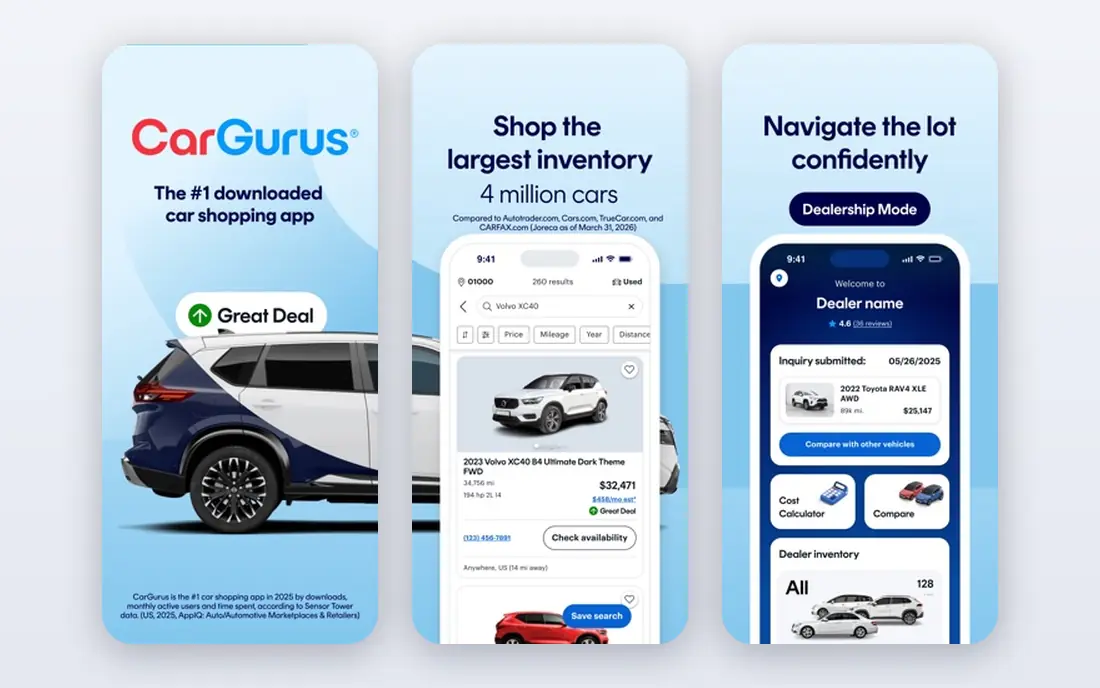
CarGurus earns its top spot for buyers who worry about overpaying. Its deal rating labels a listing as a great, good, fair, or overpriced deal based on similar cars, which gives a quick sense check before you contact a dealer. You can filter by price, mileage, location, and features, and save searches with alerts for new matches.
The limits matter. CarGurus does not list private seller cars, so its inventory is dealer-focused, and its deal rating is a model estimate, not a promise about condition or final fees. Always confirm the out-the-door price, including dealer fees, tax, and registration, before you judge a deal. For price research, though, CarGurus is the first app to open.
- Deal ratings compare listings with similar cars
- Large dealer inventory
- Price history on many listings
- No private seller listings
- Deal ratings are guidance, not a guarantee
- Some dealers add fees later
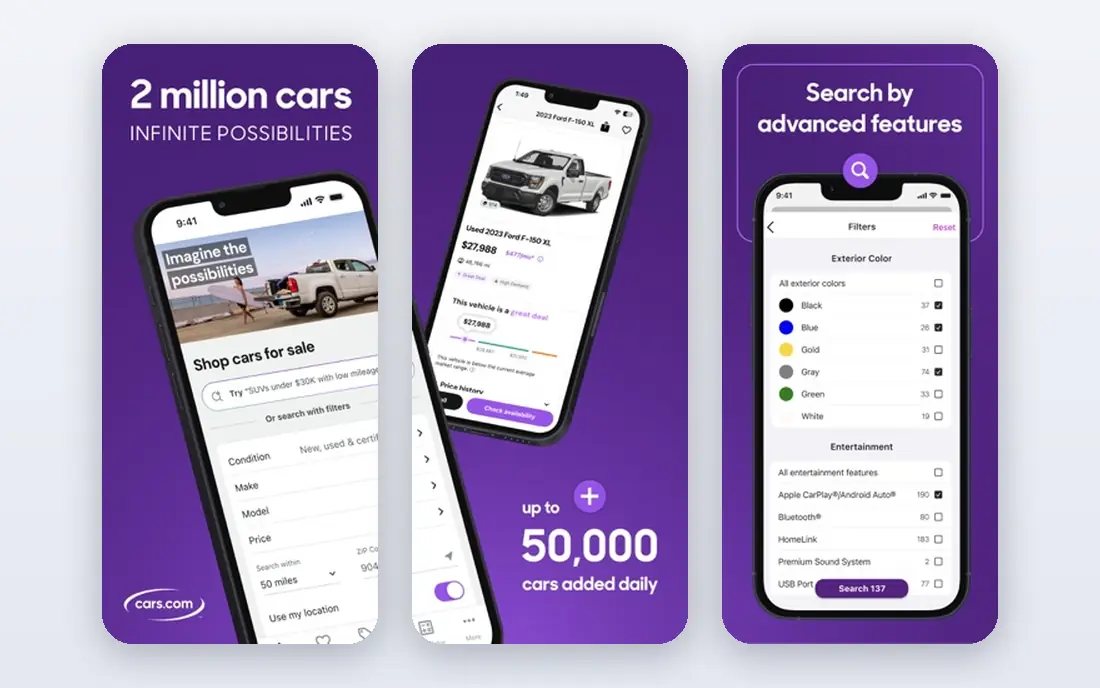
Cars.com is a broad marketplace with a large dealer roster, plus private seller listings, which makes it a good second search after CarGurus. Its filters cover body style, drivetrain, fuel type, and features, and dealer reviews help you judge who you are dealing with before you visit. Price tools also help you compare a listing with similar cars in your area.
Because many dealers list the same car on several marketplaces, you will see duplicates across apps, which is normal. The value of Cars.com is coverage: a car that appears only here, or a private listing that suits your budget, can be easy to miss elsewhere. Use it to widen the search, not as your only source.
- Large dealer inventory
- Dealer reviews
- Useful filters and price tools
- Listings overlap with other marketplaces
- Private sale fees can apply through partners
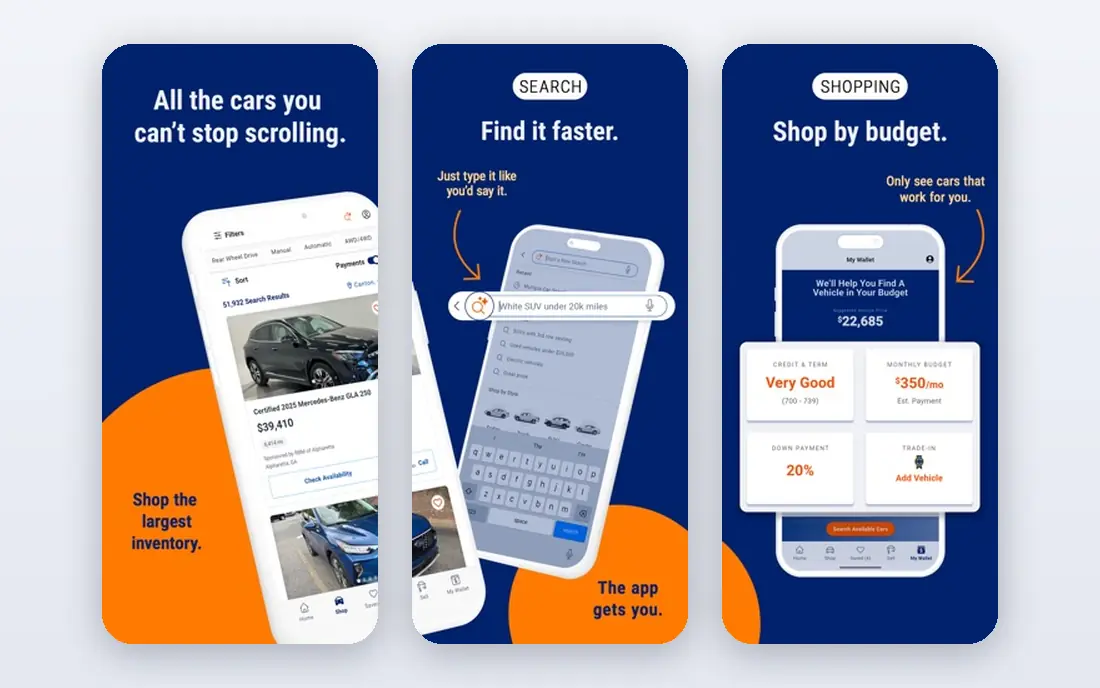
Autotrader is one of the oldest and largest car marketplaces in the US, with dealer and private listings across new and used cars. Its search filters are detailed, and its private seller exchange adds a structured way to buy from an individual, with payment and title handling in some cases. For buyers who want the widest net, Autotrader belongs in the search routine.
Stale listings are the main frustration, since some cars stay listed after they sell, so always confirm availability before travelling. Private sale fees also vary by transaction type, so read the terms for the exchange before committing. As a discovery tool, Autotrader is excellent; as a final check, it still needs a history report and an inspection.
- Very large listing pool
- Strong search filters
- Private seller exchange options
- Some listings are stale
- Private sale transaction fees can apply
Carvana is different from the marketplaces above, because it sells its own used cars rather than listing other sellers' stock. You can search, get a price, arrange financing, and schedule delivery or pickup without visiting a dealer lot. That convenience suits buyers who dislike haggling and want a clear, no-negotiation price with a return window.
The trade-off is choice and price. You only see Carvana's stock, not the whole market, and its prices can be higher than a private sale for a similar car. Delivery fees also vary by location, though pickup at a vending machine or hub is often free. If convenience matters more than finding the absolute lowest price, Carvana is the easiest online route.
- End-to-end online purchase
- Delivery or pickup options
- Return window on many purchases
- Prices can be higher than a private sale
- Inventory is Carvana-owned only
- Delivery fees vary by area
CarMax is another retailer, not a marketplace, and it appeals to buyers who want a fixed price and a straightforward process. Its used inventory is large, cars can often be transferred between stores, and warranty options are available at purchase. Appraisal and trade-in tools also let you value your current car in the same flow.
As with Carvana, you pay for convenience: CarMax prices are often higher than a private sale, and you cannot negotiate the listed price down. That is a fair trade for many buyers, especially first-time buyers who want a inspected, warrantied car without haggling. Compare its price with CarGurus deal ratings before you decide, so you know what the convenience costs.
- No-haggle pricing
- Large used inventory
- Transfer between stores
- Warranty options
- Prices can be higher than private sales
- Stock is CarMax-owned only
- Haggling is not an option
Kelley Blue Book, known as KBB, is the research tool to open before you make an offer. It gives value ranges for new and used cars, including trade-in, private-party, and dealer retail figures, based on mileage, condition, options, and location. That range helps you judge whether a listing is fair, and it gives you a calm number to quote in a negotiation.
Values are estimates, and condition matters more than many buyers expect: a car graded as excellent versus good can shift the range by a meaningful amount. Be honest about condition, mileage, and options, and use KBB alongside CarGurus and Edmunds, not alone. For price research, KBB remains the standard reference most sellers also know.
- Trusted value ranges
- Trade-in and private-party values
- Large listing links
- Values are estimates, not offers
- Condition grading affects the result heavily
Edmunds combines reviews with pricing research, which makes it useful at the shortlist stage. Its expert reviews cover driving feel, interior quality, and safety, while owner reviews add long-term reliability notes. Its true market value tool estimates what buyers in your area actually pay, which complements KBB and CarGurus deal ratings.
Edmunds is a research tool first, not the largest marketplace, so use it to choose a model and judge a price, then search marketplaces for actual cars. Its comparison tool is also handy when you are torn between two models, since it lines up price, features, and running costs side by side. For a careful buyer, Edmunds saves more money than it costs, which is nothing.
- Detailed expert and owner reviews
- True market value pricing
- Useful comparison tools
- Listing inventory is smaller than pure marketplaces
- Values are estimates
Facebook Marketplace is where many private sellers list cars, and it can offer lower prices than dealer stock, especially for older or budget cars. You can search locally, message sellers directly, and see seller profiles and history, which helps judge trustworthiness. For a buyer comfortable with private sales, it is worth checking alongside dealer marketplaces.
Private sales carry more risk: no dealer protections, a higher chance of title problems, and more scam listings. Never pay in advance, meet in a safe public place, check the title matches the seller and the vehicle identification number, and arrange an independent inspection for any car you are serious about. With those checks, Marketplace can be a good source; without them, it is a gamble.
- Large local private inventory
- Often lower prices
- Direct seller contact
- Higher scam and title risk
- No dealer protections
- Listings vary widely in quality
How we picked these
We compared official app listings, marketplace pages, and pricing tools for car buying apps that serve US buyers in 2026, and we included marketplaces, retailers, and research tools, since buying a car uses all three. We favoured apps with free buyer access, large inventory or trusted pricing data, and clear listing terms. Where a fee applies, such as a private sale transaction fee, we note it rather than quoting a single figure that varies by state and deal type.
How to buy safely with an app
Start with research, not with a visit. Pick two or three models that fit your budget, check KBB and Edmunds values, and set a firm out-the-door budget that includes tax, registration, and insurance. Then search CarGurus, Cars.com, and Autotrader for the same model, and save alerts so new listings reach you quickly.
History, inspection, and paperwork
Get a vehicle history report for any used car you are serious about, and arrange an independent pre-purchase inspection by a mechanic you choose, not one the seller recommends. Check the title for liens, salvage branding, and odometer issues, and confirm the seller's identity matches the title. A clean listing photo cannot replace those checks, and skipping them is how most costly mistakes happen.
Financing and total cost
Get a financing pre-approval from your bank or credit union before you shop, so you can compare dealer financing against a known rate. This article is not financial advice, and loan terms, fees, and insurance costs vary by buyer and state. Compare the monthly payment, the total interest, the loan term, and the out-the-door price together, since a low monthly payment can hide a long, costly loan.
Frequently asked questions
What is the best app for buying used cars?
CarGurus is our pick for used car research, because its deal ratings help you judge price quickly, while Cars.com and Autotrader give broader listing coverage. Carvana and CarMax suit buyers who want a retailer experience with fixed pricing. For the best result, search at least two marketplaces and check KBB values before offering.
What is the best car shopping app for new cars?
Cars.com, Autotrader, and Edmunds all list new cars and help you compare dealer pricing, while KBB and Edmunds help you judge fair prices. CarGurus also lists new dealer stock with deal ratings in many areas. Since dealer inventory and incentives vary by region, searching two marketplaces gives a fuller picture of local new-car pricing.
Is Carvana a good place to buy a car?
Carvana suits buyers who want a fully online purchase with fixed pricing, delivery or pickup, and a return window, without haggling. Its prices can be higher than a private sale, and its inventory is limited to its own stock. Compare its price with CarGurus and KBB before buying, and check delivery fees for your area.
Can I buy a car safely on Facebook Marketplace?
Yes, with careful checks. Meet in a safe public place, verify the title and seller identity, get a vehicle history report, and arrange an independent inspection before paying. Never pay in advance or accept unusual payment methods, and walk away if the seller pressures you or the paperwork does not match the car.
Which app is best for checking car prices?
Kelley Blue Book is the standard reference for value ranges, Edmunds adds true market value and reviews, and CarGurus adds deal ratings on live listings. Using all three together gives a stronger price picture than any one alone, since each uses a different method and data set. Always confirm the out-the-door price, not just the listed price.
Sources we checked (8)

Online Jobs is an independent blog about careers, online work, learning new skills and the tools that help people earn. More about us.
Keep reading
All posts
Best Used Car App
The best used car app options in 2026, compared on price checks, inventory, delivery, and return terms, so you can shop with more confidence and less guesswork.

n8n Alternatives
n8n alternatives compared for 2026, with Zapier, Make, Activepieces, and more, covering visual builders, code steps, self-hosting, and pricing models.

eBay Alternatives
Looking for ebay alternatives? We compared 9 marketplaces for sellers on fees, buyer reach, categories and ease of listing, to help you sell with confidence.