Best Apps to Buy Cars in 2026: 9 Products Compared

How we put this together: we compare official feature and pricing pages, app store listings, privacy policies and public user reviews. Prices change, so check the provider's site before you pay.
Key takeaways
- CarGurus is the strongest pick for price checks, because deal ratings show at a glance whether a listing looks high, fair, or low.
- Carvana and CarMax suit buyers who want a set price, delivery, and a return window, rather than a negotiation.
- Autotrader and Cars.com give the widest dealer and private seller search, which helps when you know the exact model you want.
- TrueCar, Kelley Blue Book, and Edmunds are best used as research tools beside a marketplace, not as the only place to search.
- Every app here is free for buyers to browse, but the car price, fees, delivery, and history report terms still vary by listing.
Quick comparison
| Name | Who it suits | Starting price | Free option | |
|---|---|---|---|---|
 Carvana | fully online buying with delivery | Free | Yes | Visit |
 CarGurus | price ratings and deal checks | Free | Yes | Visit |
 Cars.com | comparing local dealer listings | Free | Yes | Visit |
 Autotrader | wide nationwide search | Free | Yes | Visit |
 CarMax | no haggle buying with a return window | Free | Yes | Visit |
 TrueCar | seeing what others paid nearby | Free | Yes | Visit |
 Kelley Blue Book | valuation and financing guidance | Free | Yes | Visit |
 Edmunds | research and True Market Value pricing | Free | Yes | Visit |
 Facebook Marketplace | local private seller deals | Free | Yes | Visit |
The best apps to buy cars
Buying a car on a phone now covers the full job for many buyers, from search and price checks to financing, delivery, and trade in. We focused on apps that are live in the United States in October 2026, free for buyers to use, and useful for new or used cars. The right pick depends on whether you want the lowest price, the widest choice, or the simplest purchase.
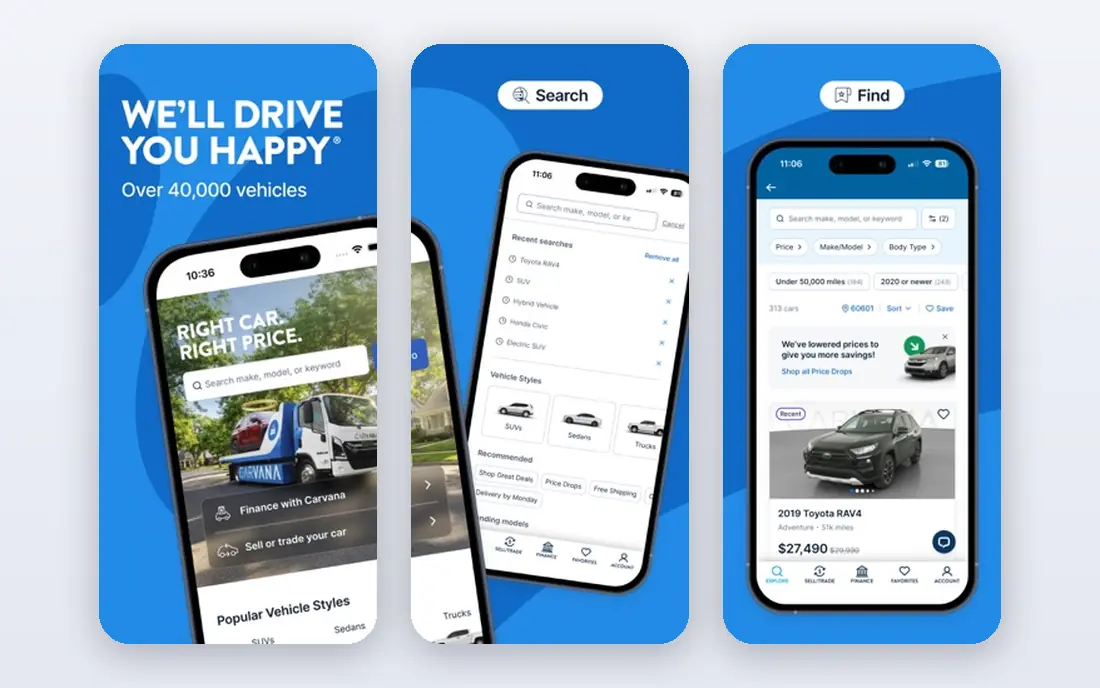
Carvana is the closest thing to buying a car like an online order. You search its own stock, see 360 degree photos, arrange financing and trade in, and schedule delivery or pickup. For buyers who dislike haggling and dealer visits, that structure removes the worst parts of the process.
The trade off is choice and price. You buy only from Carvana stock, not from every dealer in your area, and convenience can cost more than a sharp private negotiation. Read the return terms and delivery fee for your address before you commit, and still run a history check and an independent inspection when the terms allow it.
- Set prices with no dealer negotiation
- Home delivery or pickup in many areas
- 7 day return window on most purchases
- Prices can run higher than a negotiated private deal
- Inspection standards and delivery fees vary by location
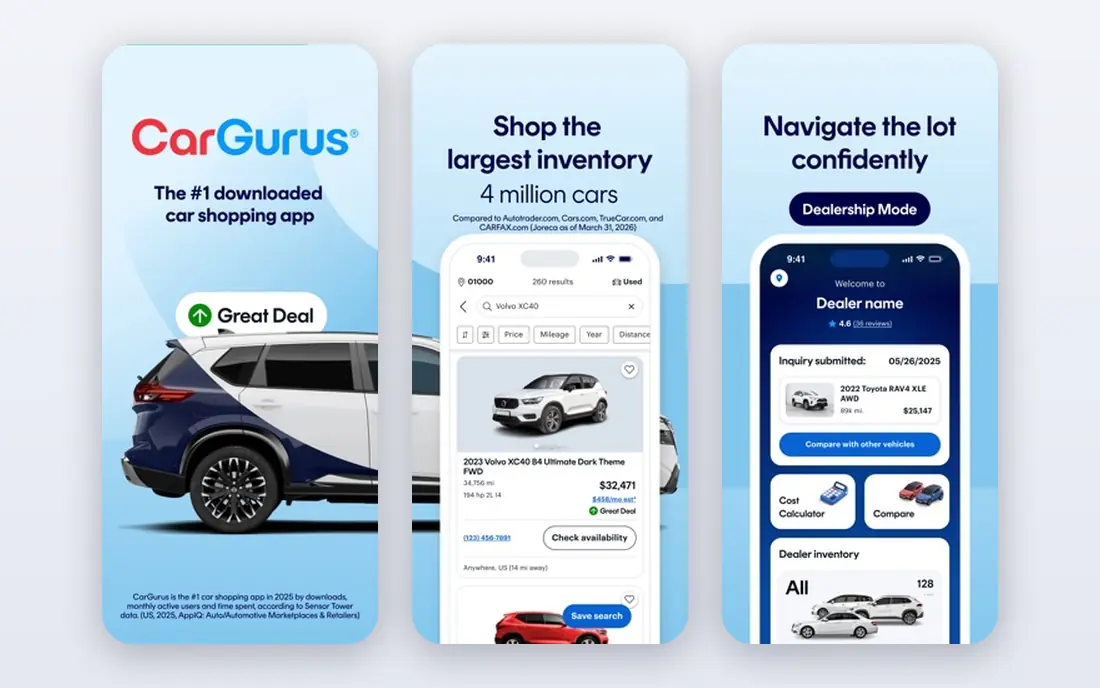
CarGurus earns its place as a research first marketplace. Each listing carries a deal rating that compares the asking price with similar cars, which helps a buyer spot an overpriced car in seconds. Filters for budget, mileage, body style, and features are clear, and saved searches with alerts cut down daily checking.
You still buy from a dealer or private seller in most cases, so the final experience depends on that seller. Use CarGurus to shortlist and price check, then contact the seller, confirm the car is still available, and ask for a history report and inspection. That two step habit avoids most marketplace disappointment.
- Deal ratings on most listings
- Strong filters for price, mileage, and features
- Price history on many cars
- It is a marketplace, so buying terms depend on the seller
- Some listings may be outdated
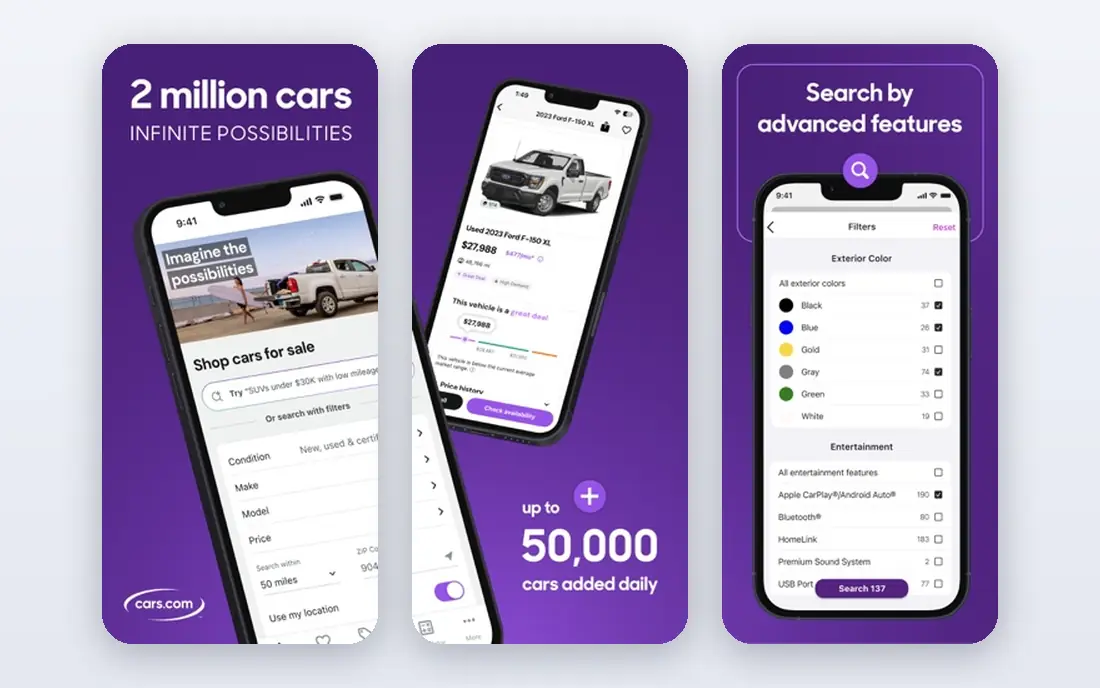
Cars.com suits buyers who want to compare several local cars at once. The comparison view, dealer ratings, and research articles help a buyer move from a shortlist to a test drive with fewer surprises. Many listings include photos, feature lists, and dealer contact details in one place.
Check the history report position on each listing, since coverage is not uniform. If a report is missing, ask the dealer for one or run your own check before paying a deposit. Cars.com is strongest as a local comparison tool, and it pairs well with a valuation check on Kelley Blue Book or Edmunds.
- Large dealer inventory
- Side by side comparison tools
- Editorial reviews and buying guides
- Private seller choice is thinner than dealer stock
- Some listings include a free history report and some do not
Autotrader is the wide net option. If you know the exact trim, engine, colour, and feature set you want, its filters will narrow a national search faster than most rivals. Dealer and private listings sit side by side, and the wallet style budgeting tool helps buyers set a monthly payment target before they fall for a car outside their range.
Volume is the catch. A broad search returns a long list, so save a tight filter set and use alerts rather than scrolling daily. Confirm availability early, since popular cars move fast, and treat any listing with thin photos or vague history as a reason to ask more questions.
- Very large dealer and private inventory
- Precise model and feature filters
- Financing budget tools in the app
- Some features sit behind paid options for sellers, which can affect listing detail
- Volume can overwhelm a casual browser
CarMax appeals to buyers who want a store visit without a negotiation battle. Prices are set, cars can be moved between stores in many cases, and financing and trade in can be handled in one visit or online. The return window gives buyers time to check the car in daily use, which lowers the fear of a rushed decision.
As with Carvana, the cost of that calm process can be a higher price than a private seller deal. Compare the same model on CarGurus before you buy, and check transfer fees and return terms for your state. For buyers who value certainty over the lowest possible price, CarMax is a sound pick.
- Set no haggle prices
- Large own stock with transfer between stores
- Return window on most purchases
- Prices may be higher than a negotiated deal
- Choice is limited to CarMax stock
TrueCar helps answer the question every buyer asks first: what did other people pay for this car near me. That context is useful for new cars in particular, where dealer discounts and fees can hide the real price. The app connects buyers with dealers that share pricing, which can shorten the negotiation.
Treat TrueCar as a pricing guide, not a promise. Fees, add ons, and trade in values still change the final bill, so get an out the door figure in writing before you travel. Used car coverage also varies, so pair TrueCar with CarGurus or Autotrader when shopping used.
- Local price context for new and used cars
- Dealer pricing transparency
- Simple quote and contact flow
- Dealer coverage varies by area
- The price shown is a guide, not a binding offer
Kelley Blue Book is best used beside a marketplace, not instead of one. Its valuation tools show where an asking price sits against market value, which gives a buyer a firm basis for an offer. The financing tools also help buyers build an offer around a monthly payment target, rather than a headline price alone.
Listing depth is thinner than Autotrader or Cars.com, and history report coverage varies. Use Kelley Blue Book to value a car you found elsewhere, check trade in value before a dealer visit, and keep the valuation page saved when you negotiate. That paper trail is worth more than a vague sense that a price feels high.
- Trusted valuation ranges for trade in and purchase
- Compare up to six listings at once
- Financing offer tools on listings
- It is not a full marketplace in its own right
- Full history reports are not included on every listing
Edmunds is the research desk of this list. True Market Value aims to show what buyers actually paid, not just what sellers asked, which is a useful check before an offer. Reviews cover running costs, reliability themes, and trim differences, so buyers can avoid a trim that looks cheap but costs more to run.
If you want to buy in the same app, Edmunds is less direct than Carvana or CarMax. Use it to choose a model, set a fair price range, and check ownership costs, then search for that car on a marketplace. That split keeps research honest and stops a slick listing from setting your budget.
- True Market Value based on transaction data
- Expert reviews and owner feedback
- Strong price and cost tools
- Buying options are limited compared with a marketplace
- Inventory search is secondary to research
Facebook Marketplace can produce the lowest price, because many sellers are private owners with no dealer overhead. Local search, filters, and direct messaging make it easy to arrange a viewing fast. For buyers on a tight budget who know cars well, it is worth checking daily.
Risk is the other side of that low price. There is no standard return window, history reports are not built in, and seller claims need checking. Always meet in a safe public place, run a history check, arrange an independent inspection for any car that costs real money, and never pay in advance for a car you have not seen. With those rules, Marketplace is a useful extra search, not a first and only source.
- Large local private seller stock
- Often the lowest asking prices
- Direct messaging with the seller
- No standard buyer protection for most car sales
- Scams and misdescribed cars are a real risk
How we picked these
We looked for apps that let a buyer search, compare, and contact a seller or complete a purchase from a phone in October 2026. Each app had to be live, free for buyers to browse, and useful for new or used cars in the United States. We checked product pages and marketplace descriptions for the core features, return terms where offered, and the main limits, and we used See website in other articles where a price was not a simple buyer fee.
We ranked by buyer job, not by total listing count alone. A huge marketplace with poor price tools can be worse than a smaller seller with a clear return window, and a research tool can be more valuable than another listing site. Apps that only sell parts, only offer financing, or only list cars in one small region did not make the list.
What to check before you pay
A good app does not remove the need for basic checks. Use this guide on every car, even one bought from a large seller with a return window.
Get the history and an inspection
Ask for a vehicle history report and check for title issues, accidents, and mileage flags. For any car above a bargain price, pay for an independent pre purchase inspection. A clean listing photo set is not proof of a clean car, and a short inspection often saves far more than it costs.
Get the out the door price in writing
Ask for the full price including fees, taxes, delivery or transfer charges, and any dealer add ons. Compare that figure, not the headline listing price, across sellers. If a seller will not give a written total, treat that as a reason to walk away.
Check the return and delivery terms
Carvana and CarMax offer return windows on most purchases, while private sellers on Marketplace usually offer none. Read the time limit, mileage limit, and condition rules before you pay. Delivery fees and transfer times also vary, so confirm the date and cost in writing.
Test drive with a checklist
Drive at low and highway speed, test brakes, steering, heating, air conditioning, and every electronic feature you plan to use. Listen for noises, check tyre condition, and look under the car where possible. A short careful drive tells you more than a long list of seller claims.
Frequently asked questions
What is the best app to buy a used car?
CarGurus is the best all round starting point for used cars, because deal ratings and filters make price checks fast. Autotrader gives a wider search when you know the exact model, while Carvana and CarMax suit buyers who want a set price and a return window. Use more than one app, since no single app lists every car.
Are car buying apps free for buyers?
Yes, browsing, searching, and contacting sellers is free on every app in this list. Sellers and dealers pay for listings or leads, and buyers pay for the car, taxes, fees, and any delivery or transfer charges. A history report or inspection may also cost extra, depending on the listing.
Is it safe to buy a car on Facebook Marketplace?
It can be safe with strict checks, but it carries more risk than a large dealer seller. Meet in public, run a history check, get an independent inspection, and never pay before seeing the car. If a deal looks far below market value or the seller pressures you to pay fast, walk away.
Should I use Carvana or CarMax?
Pick Carvana if you want a fully online purchase with home delivery, and CarMax if you prefer a store visit with a set price. Both offer a return window on most purchases, but stock, fees, and delivery terms differ by location. Compare the same model on CarGurus first to judge whether the set price is fair.
How do I know if a used car price is fair?
Check the same car on CarGurus for a deal rating, on Kelley Blue Book for a valuation range, and on Edmunds for True Market Value. If all three point to a similar range, the asking price is likely fair. If a listing sits well above that range with no clear reason, use the data to negotiate or move on.
Do I need a history report for every car?
Yes, for any car that costs more than a small amount. A history report can reveal title problems, reported accidents, and mileage issues that photos hide. Pair it with an independent inspection, since a report only covers events that were reported to its data sources.
Sources we checked (9)

Online Jobs is an independent blog about careers, online work, learning new skills and the tools that help people earn. More about us.
Keep reading
All posts
n8n Alternatives
n8n alternatives compared for 2026, with Zapier, Make, Activepieces, and more, covering visual builders, code steps, self-hosting, and pricing models.

eBay Alternatives
Looking for ebay alternatives? We compared 9 marketplaces for sellers on fees, buyer reach, categories and ease of listing, to help you sell with confidence.

ZoomInfo Alternatives
The best ZoomInfo alternatives in 2026, compared on price, free plans, data coverage, and which tool fits small teams or large sales teams best in detail.