Best Apps for Kids to Learn English in 2026: 9 Apps Compared


Free all-round early learning · Starting price: Free
How we put this together: we compare official feature and pricing pages, app store listings, privacy policies and public user reviews. Prices change, so check the provider's site before you pay.
Key takeaways
- Khan Academy Kids and Duolingo ABC are the best free starting points, with no ads in the core apps and clear age ranges for young learners.
- Lingokids and ABCmouse suit families who want a fuller curriculum and are happy to pay after testing the free version.
- Studycat and Buddy.ai focus more on listening and speaking, which helps children who already know some words but need confidence saying them.
- For kids apps, safety matters as much as lessons, so we favoured apps with no open chat, clear parental controls and ad-free or ad-limited design.
Quick comparison
| Name | Who it suits | Starting price | Free option | |
|---|---|---|---|---|
| Khan Academy Kids | Free all-round early learning | Free | Yes | Visit |
 Duolingo ABC | Phonics and early reading | Free | Yes | Visit |
 Lingokids | Play-based English for ages 2 to 8 | $13.49 per month | Yes | Visit |
 ABCmouse | Structured Pre-K to grade 2 path | $14.99 per month | Yes | Visit |
 Studycat English | Speaking and listening games | See website | Free trial | Visit |
 Buddy.ai | Speaking practice with an AI tutor | See website | Free trial | Visit |
 LearnEnglish Kids: Playtime | Listening, songs and stories | See website | Yes | Visit |
 Todo English | Complete beginner programme | See website | Free trial | Visit |
 Monkey Junior | Structured listening, speaking, reading and writing | See website | Yes | Visit |
The best apps for kids to learn english
Learning English as a young child works best in short, playful sessions with lots of listening, repetition and praise. The apps below cover different ages and skills, from first letters to fuller sentences, and most are designed for ages 2 to 8, with a few stretching to older primary children. Parents should still supervise use, check privacy settings, and keep sessions short, especially for younger children.
Khan Academy Kids is the free app we would try first for ages 2 to 8. It offers books, phonics games, language activities and early maths in one place, with animated guides and paths that adapt to the child. Because it is free with no ads or subscriptions in the core app, parents do not need to manage trial dates or in-app purchase prompts during lessons.
The breadth is both a strength and a limit. A child who needs focused English speaking practice will not get live conversation here, and older children may outgrow the content sooner than a paid English specialist. For a safe, free daily habit, though, it is hard to beat, and it pairs well with a speaking-focused app below.
- Completely free with no ads
- Books, phonics and maths in one app
- Personalised learning paths
- Broader than English alone
- No live tutor for speaking practice
Duolingo ABC focuses on the building blocks of reading: letter sounds, sight words, spelling and simple stories. Lessons are short, bright and game-like, with pronunciation and handwriting tasks that help children connect sounds to letters. The app is free, which makes it easy to try without a subscription decision.
It is narrower than a full English course. Children will build reading confidence, but they will still need listening, speaking and vocabulary work from school, conversation or another app. Duolingo ABC is best as a daily reading habit for ages 3 to 7, especially for children who are just starting to read in English.
- Free with no ads in the kids app
- Short phonics and reading lessons
- Handwriting and pronunciation practice
- Focused on early reading, not full conversation
- Age range is mainly 3 to 7
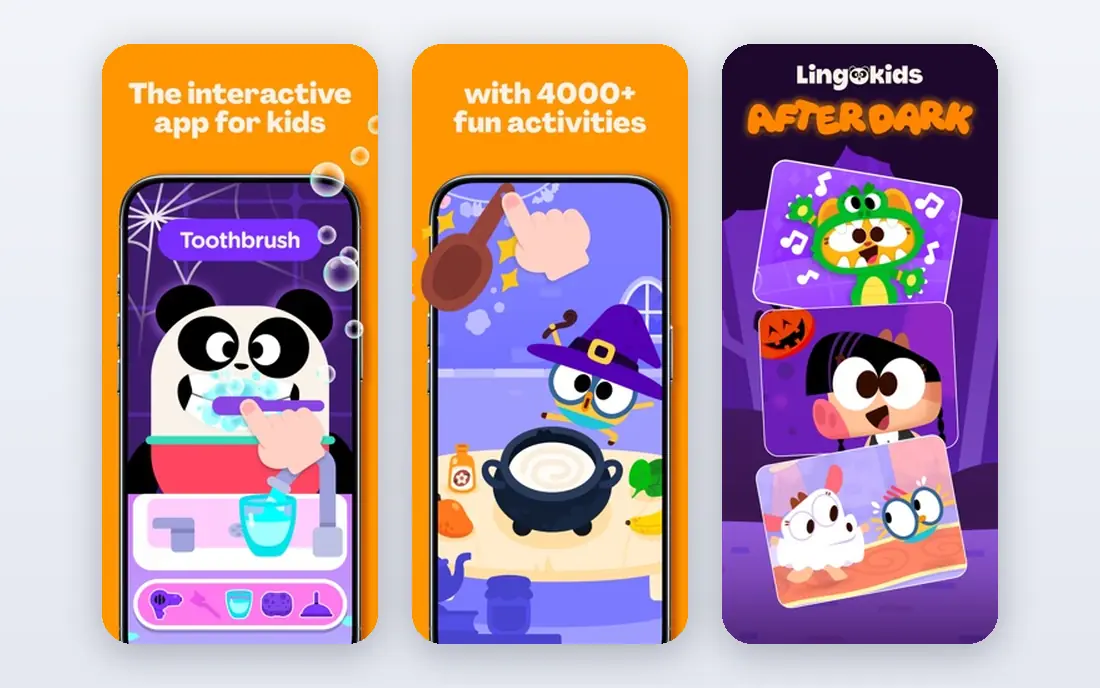
Lingokids turns English into play, with games, songs, videos and stories built around everyday vocabulary. Children earn rewards as they play, and parents can follow progress through reports rather than watching every session. The free version allows a limited number of activities per day, which is enough to test whether your child enjoys the style.
Full access requires a subscription, listed at $13.49 per month or $161.88 per year on the vendor help pages checked in October 2026, with app store prices sometimes differing. Lingokids is best for ages 2 to 8 and for families who want a fun daily routine. If your child is already reading confidently, check the upper levels first before paying.
- Songs, games, videos and stories in one place
- Parent progress reports
- Ad-free learning environment
- Paid plan needed for full access
- Older children may find it too easy
ABCmouse offers a structured learning path for ages 2 to 8, covering reading, maths, science, art and music through thousands of activities. Children follow a step-by-step route, earn tickets and customise avatars, which suits children who like clear progress. Premium access covers multiple children and removes activity limits.
The basic free tier allows up to 10 activities per day for one child, which is useful for testing, but full access costs $14.99 per month on monthly billing, with an annual plan listed at $79.99 per year on the vendor support site. ABCmouse fits families who want a school-like structure at home. If your child prefers open play, Lingokids or Khan Academy Kids may hold attention longer.
- Large guided curriculum across reading and maths
- Up to three child profiles on premium
- Ad-free premium environment
- Subscription needed for full access
- Path can feel long for children who want free play
Studycat English, also listed as Learn English by Studycat, focuses on listening and speaking for ages 3 to 8. Children play games, sing songs and repeat words, with voice recognition giving feedback on pronunciation. That speaking focus helps children who understand words but are shy about saying them aloud.
A limited free version and a trial let you test the style, but continued access needs a subscription, so check the current price in the app store or on the vendor site before you commit. Studycat works best as a speaking supplement beside a reading app such as Duolingo ABC, rather than as the only English app for a complete beginner.
- Voice-based games with pronunciation feedback
- Songs and stories
- Parent progress tracking
- Subscription needed after trial
- Content range is narrower than ABCmouse
Buddy.ai gives children a voice-based tutor to talk with, which is different from tapping answers on screen. Children practise speaking in short activities, hear modelled pronunciation, and get responses that keep the conversation moving. For children who need more speaking time than a classroom can offer, that regular practice can build confidence.
Because it uses voice input and an AI tutor, parents should review the privacy policy, microphone permissions and parental controls before first use, and supervise early sessions. A free trial is available, with a subscription needed for continued access. Buddy.ai fits children who are ready to speak in simple sentences and who enjoy talking to a character, not children who are still learning first letters.
- Voice-based practice with an AI tutor
- Regular short speaking sessions
- Adaptive difficulty
- Subscription required after trial
- Parents should review voice and privacy settings first
LearnEnglish Kids: Playtime
Who it suits: Listening, songs and stories
LearnEnglish Kids: Playtime comes from the British Council, which gives it a clear educational base. Animated stories, songs and listening games help children aged 6 to 11 hear natural English pronunciation and build comprehension, with activities that follow the stories rather than isolated drills. The free download lets families test the style before paying for extra content.
It is less of a full curriculum than ABCmouse, and it suits older primary children better than toddlers. Use it when your child already knows basic words and needs listening practice, songs and stories to stretch vocabulary. Parents should still check which features need a subscription in their app store, since offers vary.
- Animated stories and songs from the British Council
- Native speaker pronunciation
- Listening games for ages 6 to 11
- Less structured than ABCmouse
- In-app subscription details vary by store
Todo English aims to give beginners a complete route, combining phonics, vocabulary, grammar and speaking in ordered lessons. That structure helps parents who want a clear plan instead of picking games each day, and it suits children who are starting English from the beginning rather than topping up school lessons.
A seven-day trial is listed in several guides, with a subscription needed after that period, so confirm the current price and trial terms on the vendor site or store listing. Todo English fits families who will use it daily and who want one app to follow, not families looking for a free occasional game.
- Step-by-step phonics, vocabulary, grammar and speaking
- Clear beginner route
- Daily lesson structure
- Subscription after trial
- Less free content than Khan Academy Kids
Monkey Junior offers structured courses that cover listening, speaking, reading and writing, which makes it useful for school-age learners who need more than vocabulary games. Lessons follow levels, so parents can see where a child sits and what comes next, and the free download lets you test the approach before buying course content.
Full courses need in-app purchases, so check the total cost for the level your child needs, not just the download price. Monkey Junior is best for children who can follow a lesson structure and who need balanced skill practice, while younger children may prefer the play-first style of Lingokids or Khan Academy Kids.
- Structured courses across four skills
- Free download with in-app purchases
- Clear levels for school-age learners
- Paid content needed for full courses
- Interface is less playful than Lingokids for very young children
How we picked these
We compared official app pages, app store listings, privacy policies, age guidance and public reviews for apps that teach English to children and were available in October 2026. We favoured apps with clear age ranges, no open chat or contact with strangers, parental dashboards or controls where available, and ad-free or ad-limited design for young children. We did not include apps that rely on live video with strangers without clear safeguarding information, or apps whose main content is not English learning. Prices are starting prices where the vendor or store lists them, and they can vary by store, region and promotion, so check before you subscribe.
Keeping kids safe while they learn
Check ads, chat and purchases before first use
Open the parent settings first. Turn off or review in-app purchases, check whether the app shows ads, and confirm there is no chat with other users. The safest apps on this list have no open chat and keep children inside the learning content.
Match the age range, not just the download age
An app rated for ages 2 to 8 can still be too easy or too hard inside that range. Try the first levels together, watch whether your child can follow instructions without help, and move up or switch apps if lessons are consistently too easy or frustrating.
Keep sessions short and mix in real talk
Short daily sessions work better than long weekend sessions for young learners. Pair app time with real conversation, reading aloud and songs away from the screen, so English becomes something children use, not only something they tap.
Frequently asked questions
What is the best app for kids to learn English for free?
Khan Academy Kids and Duolingo ABC are our top free picks. Khan Academy Kids covers early learning broadly, while Duolingo ABC focuses on phonics and reading, and both are free with no ads in the core kids apps.
Which app is best for a 5 year old learning English?
Lingokids, Khan Academy Kids and Duolingo ABC all suit many 5 year olds, with Lingokids best for play, Khan Academy Kids best for free all-round learning, and Duolingo ABC best for early reading. Try the free versions first and watch which style your child returns to.
Are English learning apps safe for kids?
The apps on this list were chosen partly for safety practices, including no open chat in most cases, parental controls or dashboards, and ad-free or ad-limited design. Parents should still review privacy policies, set purchase controls, and supervise voice features in apps such as Buddy.ai.
How much time should kids spend on an English app each day?
Short sessions of about 15 to 20 minutes work well for young children, with breaks and offline play in between. Longer sessions can help older primary children, but regular short practice usually beats occasional long sessions.
Should I pay for Lingokids or ABCmouse?
Pay only after your child has tried the free version and you know they will use it regularly. Lingokids suits play-based learners, while ABCmouse suits children who like a structured path, and both offer a limited free tier to test first.
Sources we checked (9)

Online Jobs is an independent blog about careers, online work, learning new skills and the tools that help people earn. More about us.
Keep reading
All posts
Best Tools for Virtual Tutoring
Compare the best tools for virtual tutoring, from one-to-one tutor marketplaces to free self-paced learning, with pricing, subjects and honest limits.
Best Study Apps for Young Children
Compare the best study apps for young children in 2026, from Khan Academy Kids and ABCmouse to Reading Eggs, Starfall, Duolingo ABC and PBS Kids, with prices.
Best Study Apps for Kids
Looking for the best study apps for kids? We compare Khan Academy Kids, ABCmouse, Prodigy, IXL and more on age, safety, price and subjects for home learning.