Best App to Learn Mandarin in 2026: 9 Apps Compared

How we put this together: we compare official feature and pricing pages, app store listings, privacy policies and public user reviews. Prices change, so check the provider's site before you pay.
Key takeaways
- HelloChinese is our pick for most beginners because it covers tones, speaking, characters and grammar in one structured path.
- Duolingo works best as a daily habit builder, not as a complete course on its own.
- Character learners should pair a course app with Skritter, which focuses on writing and recall.
- Audio learners who study while driving or walking get the most from Pimsleur.
- Free plans are useful for testing an app, but full courses and offline lessons usually sit behind a paid plan.
Quick comparison
| Name | Who it suits | Starting price | Free option | |
|---|---|---|---|---|
 HelloChinese | Most beginners | See website | Yes | Visit |
 Duolingo | Daily habit building | Free | Yes | Visit |
 Rosetta Stone | Immersive picture based learning | See website | No | Visit |
 Pimsleur | Speaking and listening on the go | See website | Free trial | Visit |
 LingoDeer | Grammar explanations in short lessons | See website | Yes | Visit |
 Skritter | Writing and remembering characters | See website | Free trial | Visit |
 SuperChinese | Short daily lessons with AI review | See website | Yes | Visit |
 ChineseSkill | Game based beginner practice | See website | Yes | Visit |
 Yoyo Chinese | Video lessons with clear explanations | See website | Yes | Visit |
The best app to learn Mandarin
Mandarin rewards steady, short practice and clear feedback on tones. We compared official feature pages, app store listings, pricing pages and public reviews, and we kept only apps that teach Mandarin as a real course or a focused skill. Our pick for most people is HelloChinese, with Duolingo and Pimsleur as strong partners for habit and speaking practice.
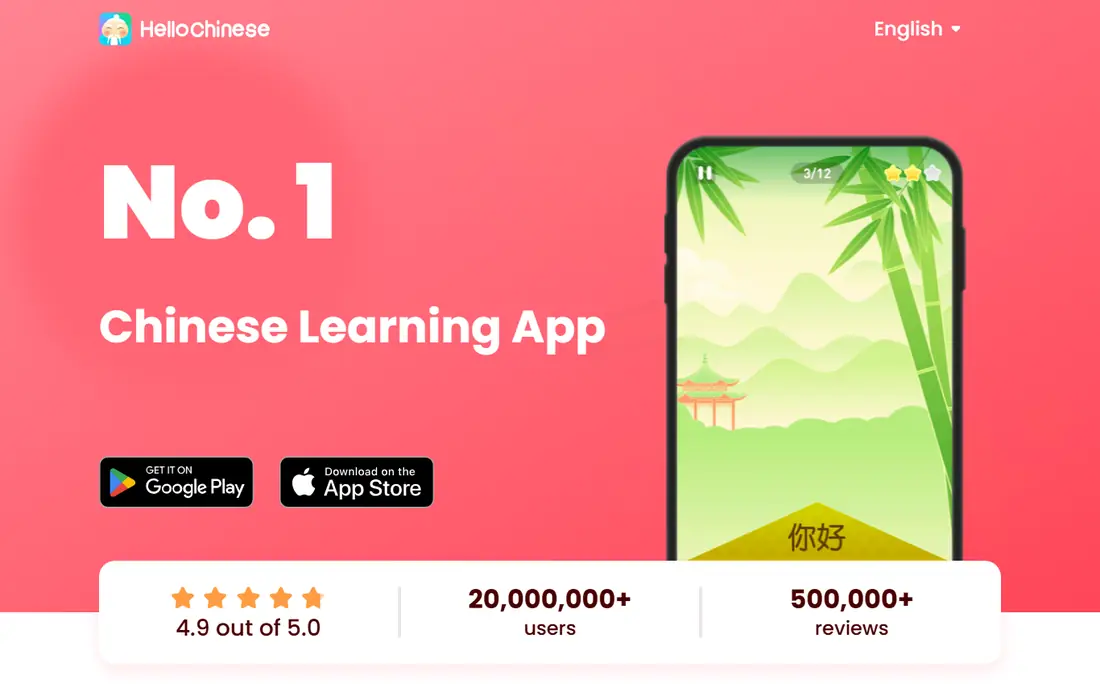
For a first app, HelloChinese covers the parts that matter most in Mandarin. Lessons move through pinyin, tones, vocabulary, grammar, listening and speaking in small steps, so a new learner does not have to guess what to study next. The speech recognition gives direct feedback on pronunciation, which matters because a tone change can change meaning. Character writing practice adds stroke order guidance, which helps reading later.
The catch is depth at higher levels. HelloChinese is strongest from the first steps through intermediate material, and learners who reach advanced reading and conversation will need reading apps, tutors or native material next. That is a normal limit for a course app, not a reason to skip it. Start here if you want one app that teaches the language in order, then add a tutor or reading practice when lessons start to feel easy.
- Structured Mandarin only curriculum
- Speech recognition for tones and pronunciation
- Handwriting practice with stroke order
- Advanced content is thinner than beginner content
- The best tools sit behind a paid plan
Duolingo wins on consistency. Lessons take only a few minutes, the format is familiar, and the free plan lets a new learner test Mandarin without paying first. That low friction is valuable when the hardest part is showing up every day. Vocabulary and basic sentence patterns build slowly, and the app is easy to open on a phone between other tasks.
Depth is the trade off. Duolingo does not explain grammar or tones in the same detail as a Mandarin focused course, and advanced learners will outgrow it. Use it as a warm up or a second app, not as your only course. Pair it with HelloChinese for structure, or with a tutor for speaking, and the daily habit starts to pay off.
- Short game like lessons that are easy to keep up
- Free core course
- Streaks and reminders help daily practice
- Grammar explanations are light
- Speaking and character depth are limited
Rosetta Stone teaches by showing, not by translating every word. Learners match pictures, sounds and text, which can help them start thinking in Mandarin instead of translating from English in their head. The method is calm and steady, and the speech tool checks pronunciation as lessons progress. For learners who dislike heavy grammar study at the start, this approach feels natural.
Some learners want a plain explanation when a pattern is unclear, and Rosetta Stone gives less of that than LingoDeer or Yoyo Chinese. The lessons can also feel repetitive if you already know the vocabulary. It fits best as a main course for patient beginners, or as a second course for listening and reading reinforcement.
- Context based lessons with images and audio
- Speech recognition built in
- Polished lessons for beginners and intermediate learners
- Little direct grammar explanation in English
- Repetition can feel slow for some learners
Pimsleur is built for people who learn by listening and speaking. Each lesson asks you to respond out loud, recall phrases from earlier lessons, and build sentences step by step. That active recall is useful for tones and common phrases, and it works without looking at a screen. Commuters, walkers and drivers often finish more lessons here than in a text heavy app.
Reading is the gap. Pimsleur includes some reading material in higher levels, but it is not a character course, so pair it with Skritter or a course app if reading matters to you. The pace can also feel slow if you already know basic phrases. Choose Pimsleur when speaking confidence is your first goal, and add reading practice alongside it.
- Audio first lessons built around speaking
- Spaced recall prompts answers out loud
- Works well while commuting or walking
- Reading and character study need a separate tool
- Lessons follow a fixed pace
LingoDeer suits learners who want to know why a sentence works. Grammar notes explain particles, word order and measure words in plain terms, and lessons stay short enough for a daily routine. The app was built with Asian languages in mind, so pinyin, characters and pronunciation get proper attention instead of feeling like an afterthought.
It is not the longest Mandarin course on this list, and advanced learners may need extra reading or tutoring sooner. For beginners who get frustrated by apps that teach phrases without explanation, though, LingoDeer removes a common barrier. Try the free material first, and check whether its lesson order matches how you like to learn.
- Clear grammar notes alongside lessons
- Structured paths for Asian languages
- Offline lessons on paid plans
- Mandarin course depth is narrower than HelloChinese at higher levels
- Some features need a paid plan
Skritter does one job well, and that focus is its strength. It teaches characters through writing practice and spaced repetition, so learners recall strokes, meanings and readings over time instead of forgetting them after one lesson. You can study lists tied to textbooks, courses or proficiency levels, which makes it easy to match Skritter to what you are learning elsewhere.
On its own, Skritter will not teach you to hold a conversation. It assumes you have sentences and grammar from another source. That pairing is exactly how most serious learners use it, as a daily character drill beside HelloChinese, LingoDeer or a tutor. If characters are your weak point, Skritter is the most direct fix on this list.
- Focused character writing practice
- Spaced repetition for long term recall
- Vocabulary lists matched to common courses and exams
- Not a full conversation course
- Best used alongside a main course app
SuperChinese is a good fit for learners who want ten focused minutes a day rather than a long study session. Lessons are short, review is driven by what you got wrong, and the app covers listening, speaking and characters without forcing a long course structure. That design helps learners who have tried longer apps and stopped after a few weeks.
The trade off is scale. SuperChinese does not have the same depth of extra material, stories and community content as HelloChinese or Duolingo. Learners who want a lot of reading material may need a second app. If short, regular practice is what keeps you going, SuperChinese deserves a trial week before you commit to a longer course.
- Bite sized lessons that fit busy days
- AI driven review of weak points
- Listening, speaking and character practice in one app
- Less well known than the leaders, so community resources are thinner
- Advanced content is still growing
ChineseSkill takes a game based approach to the first stages of Mandarin. Lessons mix listening, speaking, reading and writing, with pinyin and tone practice built in from the start. The free core content makes it easy to test whether the style suits you, and the short lesson format works well for learners who want a light daily routine.
Advanced learners will move past it quickly, and the app does not offer the same depth of grammar or reading material as the leaders. That limit is clear, and it does not spoil its role. Use ChineseSkill as a friendly first step, or as a low pressure second app for review, then move to a fuller course when you are ready for longer lessons.
- Playful lessons for beginners
- Speaking, listening, reading and writing in one place
- Free core content to start
- Content is strongest at beginner level
- Design feels simpler than newer apps
Yoyo Chinese feels closer to a classroom than to a game. A teacher explains each point on video, with examples, pronunciation guidance and cultural context that help phrases make sense. That teacher led style suits learners who struggle with app only lessons that move on without explaining why an answer was wrong.
It is less playful than HelloChinese or Duolingo, and learners who need streaks and points to stay motivated may miss those features. Character writing also needs extra practice elsewhere. Choose Yoyo Chinese if you learn best from clear explanations and structured video courses, and pair it with a writing or speaking app for full coverage.
- Video lessons explain tones, grammar and culture clearly
- Structured beginner to intermediate courses
- Useful for learners who prefer a teacher led style
- Less game like than app only courses
- Character writing practice is lighter than Skritter
How we picked these
We compared official feature pages, pricing pages and app store listings, plus public reviews, and we kept only apps that still offer a Mandarin course or a focused Mandarin skill in 2026. We looked for tone and pronunciation feedback, character support, grammar explanation, lesson structure, offline access and price transparency. Apps that teach many languages but treat Mandarin as a thin add on did not make the list unless their Mandarin course was strong on its own.
We did not claim hands on testing that did not happen. Our comparison rests on what vendors publish and what reviewers report in public. Prices change by region and billing period, so check the vendor checkout page before you pay, and use a free plan or trial to test tone feedback and lesson style first.
What to check before you pay
Start with tones, not vocabulary lists
Tones change meaning in Mandarin, so an app with speech feedback or a tutor matters more than a large word list. Test pronunciation feedback in the free tier, and record yourself on a few tone pairs before you commit to a year.
Match the app to your weak skill
A course app covers breadth, while Skritter fixes characters and Pimsleur fixes speaking confidence. Most learners do better with one main course plus one focused tool than with five general apps competing for attention.
Check offline access and lesson length
If you study on a commute, offline lessons and ten minute sessions matter. Check whether offline access needs a paid plan, and whether lessons fit the time you actually have each day.
Frequently asked questions
What is the best app to learn Mandarin for beginners?
HelloChinese is our pick for most beginners because it teaches tones, speaking, characters and grammar in order. Duolingo is a good second app for daily habit building, but it does not replace a structured Mandarin course on its own.
What is the best Chinese learning app for speaking?
Pimsleur is strongest for speaking confidence because lessons require spoken answers and recall. HelloChinese also gives pronunciation feedback, and a tutor adds real conversation that no app can fully replace.
Can I learn Mandarin with a free app?
Yes, up to a point. Free plans from HelloChinese, Duolingo, LingoDeer and ChineseSkill cover beginner lessons, but full courses, offline access and advanced tools usually need a paid plan. Start free, then pay for the app you actually open every day.
How long does it take to learn Mandarin with an app?
It depends on daily time, prior language experience and whether you add speaking practice. Short daily lessons over months build a useful beginner level, while reading and fluent conversation take longer and usually need tutors, reading material and real conversation.
Do I need a separate app for Chinese characters?
Many learners do. Course apps teach characters, but Skritter gives focused writing and spaced repetition that a general course cannot match. If reading is a priority, pair your main course with Skritter from the start.
Is HelloChinese or Duolingo better for Mandarin?
HelloChinese is better as a main Mandarin course because it is built only for Chinese and explains tones, grammar and characters in more depth. Duolingo is better for building a daily habit and for light review, and it works well alongside HelloChinese.
Sources we checked (9)

Online Jobs is an independent blog about careers, online work, learning new skills and the tools that help people earn. More about us.
Keep reading
All posts
Best Tools for Virtual Tutoring
Compare the best tools for virtual tutoring, from one-to-one tutor marketplaces to free self-paced learning, with pricing, subjects and honest limits.

Best Study Apps for Young Children
Compare the best study apps for young children in 2026, from Khan Academy Kids and ABCmouse to Reading Eggs, Starfall, Duolingo ABC and PBS Kids, with prices.

Best Study Apps for Kids
Looking for the best study apps for kids? We compare Khan Academy Kids, ABCmouse, Prodigy, IXL and more on age, safety, price and subjects for home learning.