Best Apps to Learn Japanese in 2026: 8 Apps Compared

How we put this together: we compare official feature and pricing pages, app store listings, privacy policies and public user reviews. Prices change, so check the provider's site before you pay.
Key takeaways
- No single app covers speaking, grammar, kanji and reading well, so most learners pair two apps that cover different skills.
- Duolingo is the easiest free start, while LingoDeer gives clearer grammar and sentence structure for serious beginners.
- WaniKani leads for kanji, Bunpro leads for grammar review, and Anki leads for custom flashcards.
- italki and HelloTalk add real conversation practice that no drill app can replace.
- A daily habit of 15 to 30 minutes beats a large app collection that you open rarely.
Quick comparison
| Name | Who it suits | Starting price | Free option | |
|---|---|---|---|---|
 Duolingo | Free beginner start | Free | Yes | Visit |
 LingoDeer | Structured grammar | See website | Free trial | Visit |
 WaniKani | Kanji mastery | $9 per month | Yes | Visit |
 Bunpro | Grammar review | See website | Free trial | Visit |
 Anki | Custom flashcards | Free | Yes | Visit |
 Busuu | Speaking with feedback | See website | Yes | Visit |
 italki | Live tutoring | See website | No | Visit |
 HelloTalk | Language exchange | Free | Yes | Visit |
The best apps to learn Japanese
We compared official feature pages, pricing pages, app store listings and public reviews, and we favoured apps that are actively maintained and teach real Japanese skills, not just phrase lists.
Duolingo is the best free app to learn Japanese if you want to start today with no payment and no plan. Lessons are short, streaks and points keep a daily habit alive, and the course covers hiragana, katakana, basic vocabulary and simple sentences. For a curious beginner, that low barrier matters more than depth.
The catch is that Duolingo alone will not carry you far. Grammar is taught mostly by example, kanji appears late, and speaking practice stays basic. Use Duolingo to build a habit and basic words, then add a grammar or kanji app once the habit sticks. As a first step, it is hard to beat for free.
- Free core course
- Short gamified lessons
- Teaches hiragana, katakana and basic words
- Grammar explanations are thin
- Kanji teaching arrives late and stays light

LingoDeer suits a beginner who wants to understand why a sentence works, not just repeat it. Each lesson explains grammar points, builds sentences step by step and uses native audio, which gives a firmer base than a purely gamified course. The structured path also helps learners who like to know what comes next.
The catch is cost and scope. Full access needs a paid plan, and speaking practice is still limited compared with tutoring or exchange. Pair LingoDeer with a conversation app if speaking is a goal. For grammar-first beginners, it is the strongest structured course in this list.
- Clear grammar explanations
- Sentence building with native audio
- Structured path
- Paid plans needed for full access
- Speaking practice is limited
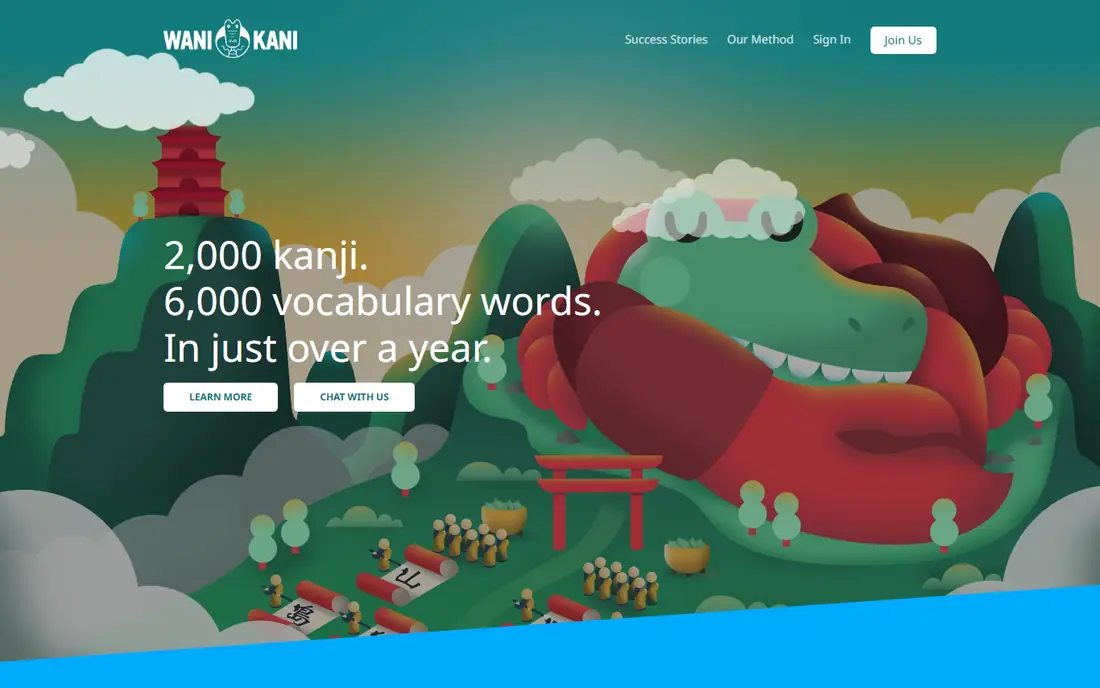
WaniKani is the best Japanese learning app for kanji, and it is not close. It teaches radicals first, then kanji built from those radicals, then vocabulary that uses each kanji, all with memorable mnemonics and spaced repetition. That structure turns a daunting set of 2,000 characters into a steady daily routine.
The catch is narrow scope. WaniKani teaches reading and vocabulary, not grammar, listening or speaking, so it must sit beside another app. Reviews also pile up if you skip days, which can feel heavy. For learners who want to read manga, signs and menus, WaniKani is worth the monthly cost.
- Structured kanji path with mnemonics
- Spaced repetition scheduling
- First levels free
- Reading only, with little grammar or speaking
- Daily reviews demand consistency
Bunpro does for grammar what WaniKani does for kanji. It organises more than 900 grammar points from JLPT N5 to N1, explains each one, and drills it with fill-in-the-blank sentences on a spaced repetition schedule. Links to textbooks such as Genki help learners follow a class or self-study book in the same order.
The catch is that Bunpro drills grammar, it does not teach conversation. Learners who add many points at once can also face a large review pile, so a modest daily limit works better. For JLPT preparation or for learners past the Duolingo stage, Bunpro is the best grammar tool in this list.
- Grammar points organised by JLPT level
- Spaced repetition for grammar
- Textbook links
- Little speaking or listening practice
- Adding too many points at once creates review overload
Anki suits a learner who wants full control over flashcards. You can build decks for vocabulary, kanji, sentences or JLPT lists, share decks with other learners, and tune review intervals to your own pace. Desktop use is free, and the system is proven for long-term memory across many subjects.
The catch is setup. Anki is a tool, not a course, so a beginner needs to choose or build a good deck before it helps. The iOS app is paid, while Android and desktop versions are free. For learners who know what they want to drill, Anki is the most flexible flashcard app available.
- Free on desktop
- Fully custom decks
- Powerful spaced repetition controls
- Setup takes time
- IOS app is paid
- Quality depends on the deck you choose
Busuu fits a learner who wants speaking practice with feedback, not just multiple-choice drills. Lessons include reading, writing and speaking tasks, and native speakers can correct written and spoken answers. That human feedback catches mistakes that an automated checker would miss.
The catch is depth. Busuu Japanese is solid for beginners and lower intermediates, but it does not match the grammar depth of Bunpro or the kanji depth of WaniKani. Use Busuu for speaking confidence and structured progress, then add a specialist app for grammar or kanji as you advance.
- Structured lessons with speaking tasks
- Feedback from native speakers
- Clear progress path
- Japanese course is less deep than major European languages
- Full access needs a paid plan
italki is the best app for learning Japanese speaking skills, because it connects you with real teachers for live video lessons. You can choose a professional teacher for structured lessons or a community tutor for conversation, set your own schedule, and focus on topics you actually need, from travel phrases to JLPT speaking practice.
The catch is cost and choice. Lessons are paid per session, so regular tutoring adds up, and teacher quality varies. Book trial lessons with two or three teachers before committing to one. For speaking, no drill app replaces a live conversation, so italki is worth the cost for serious learners.
- One-to-one lessons with real teachers
- Flexible scheduling
- Lesson prices vary by teacher
- Cost per lesson adds up
- Quality varies by teacher, so trial lessons matter
HelloTalk suits a learner who wants real conversation without paying for tutoring. You chat with native Japanese speakers who are learning your language, correct each other, and practise in text or voice. That exchange gives exposure to natural phrasing that textbook drills rarely offer.
The catch is partner quality and safety. Exchange partners vary in reliability, and chatting with strangers needs care: keep personal details private, use the app reporting tools if a conversation feels wrong, and move to a tutor if you want structured lessons. Used with care, HelloTalk is a useful free complement to a course.
- Free language exchange with native speakers
- Text, voice and correction tools
- Large community
- Quality of partners varies
- Safety and moderation need care with strangers
How we picked these
We compared official feature pages, pricing pages, app store listings and public reviews, and we favoured apps that are actively maintained and teach a distinct skill. We checked that each homepage belongs to the named app, and we wrote "See website" for prices that could not be verified from the vendor page during this check. No app was included on the basis of a single review or a marketing claim alone.
How to build a Japanese learning stack that actually works
Most learners fail not from a bad app, but from trying to use too many apps at once. Keep the stack small and the habit daily.
Start with hiragana and katakana
Learn the two kana scripts first, since they support pronunciation and basic reading. A free guide or a kana app can cover both scripts in a week or two of short sessions. Avoid courses that rely only on romaji, since romaji slows reading progress later.
Pair one course with one drill
Use one main course, such as Duolingo or LingoDeer, plus one drill app for your weakest skill, such as WaniKani for kanji or Bunpro for grammar. Add conversation only after the basics feel steady, through HelloTalk for free exchange or italki for tutoring. Review the stack monthly and drop any app you have not opened in two weeks.
Set a realistic daily target
Aim for 15 to 30 minutes a day, with reviews first and new material second. Spaced repetition works only when reviews happen on schedule, so protect review time before adding new lessons. A small daily habit maintained for a year beats a large burst that fades in a month.
Frequently asked questions
What is the best free app to learn Japanese?
Duolingo is the best free starting app, with a full beginner course, short lessons and kana teaching at no cost. Anki on desktop and HelloTalk for exchange are also free and cover flashcards and conversation. Free apps still leave gaps in grammar depth and kanji, so add Bunpro or WaniKani when you are ready to go deeper.
What are the best apps for learning Japanese for beginners?
Duolingo and LingoDeer are the strongest beginner pair, with Duolingo for habit and basic words and LingoDeer for clearer grammar. Add WaniKani once you can read hiragana and katakana, since kanji learning is easier after kana. Avoid buying many paid apps at the start, since a habit matters more than a large toolkit.
What is the best Japanese learning app for kanji?
WaniKani leads for kanji, thanks to its radical-first path, mnemonics and spaced repetition schedule. Anki is a strong free alternative if you prefer custom decks or already have a kanji list. Kanji apps teach reading, so pair them with a grammar course and speaking practice for balanced progress.
Is Duolingo good for learning Japanese?
Duolingo is good for starting Japanese and building a daily habit, but it is not enough alone for fluency. Grammar explanations are thin and kanji teaching is light, so most learners outgrow it as a main course within a few months. Keep it as a supplement or a warm-up, and add LingoDeer, Bunpro or WaniKani for depth.
How long does it take to learn Japanese with an app?
Progress depends on daily time, prior language experience and whether you add speaking practice, so no app can promise a fixed timeline. A daily 30-minute habit can build basic conversation and reading within a year, while JLPT N2 or business fluency usually takes several years. Consistency, reviews and real conversation matter more than the app brand.
Do I need a tutor to learn Japanese?
A tutor is not required to start, but live conversation becomes important once you can form basic sentences. italki offers structured lessons, while HelloTalk offers free exchange with native speakers. If speaking is a goal, add one of them after a few months of course and drill work, rather than waiting until you feel ready.
Sources we checked (8)

Online Jobs is an independent blog about careers, online work, learning new skills and the tools that help people earn. More about us.
Keep reading
All posts
Best Spanish Learning Apps
Looking for the best Spanish learning app? We compared eight leading apps for beginners, travelers, and serious learners to help you choose with confidence.

Best Quizlet Alternatives
Quizlet alternatives compared for 2026, including free options, learn mode, spaced repetition and classroom tools, with pros, cons and honest pricing notes.

Best Online Learning Platforms
We compared 9 best online learning platforms on price, certificates, and free access, so you can learn a new skill fast without paying for the wrong plan.