Best App to Learn Chinese in 2026: 8 Apps Compared

How we put this together: we compare official feature and pricing pages, app store listings, privacy policies and public user reviews. Prices change, so check the provider's site before you pay.
Key takeaways
- HelloChinese suits complete beginners who want a structured course with tones, grammar and speaking practice.
- Duolingo suits daily habit building, but its Chinese course is shallow for learners past the early stages.
- Pleco is the dictionary almost every learner ends up using, with lookup, flashcards and reading tools.
- Du Chinese suits reading practice, while Skritter suits character writing and italki suits live speaking.
- No single app covers everything, so most learners combine a course, a dictionary and a speaking or reading tool.
Quick comparison
| Name | Who it suits | Starting price | Free option | |
|---|---|---|---|---|
 HelloChinese | Structured beginners | See website | Yes | Visit |
 Duolingo | Daily habit building | See website | Yes | Visit |
 Pleco | Dictionary and lookup | See website | Yes | Visit |
 LingoDeer | Grammar and structure | See website | Yes | Visit |
 Du Chinese | Graded reading | See website | Yes | Visit |
 Skritter | Character writing | See website | No | Visit |
 italki | Live speaking practice | See website | No | Visit |
 Pimsleur | Audio and listening | See website | No | Visit |
The best app to learn chinese
Chinese rewards a mix of tools: tones need listening, characters need writing and reading, and speaking needs real conversation. The best apps to learn chinese below cover each skill, so you can build a stack that fits your level and your daily time. Most offer a free way to start, which makes it easy to test two or three before paying.
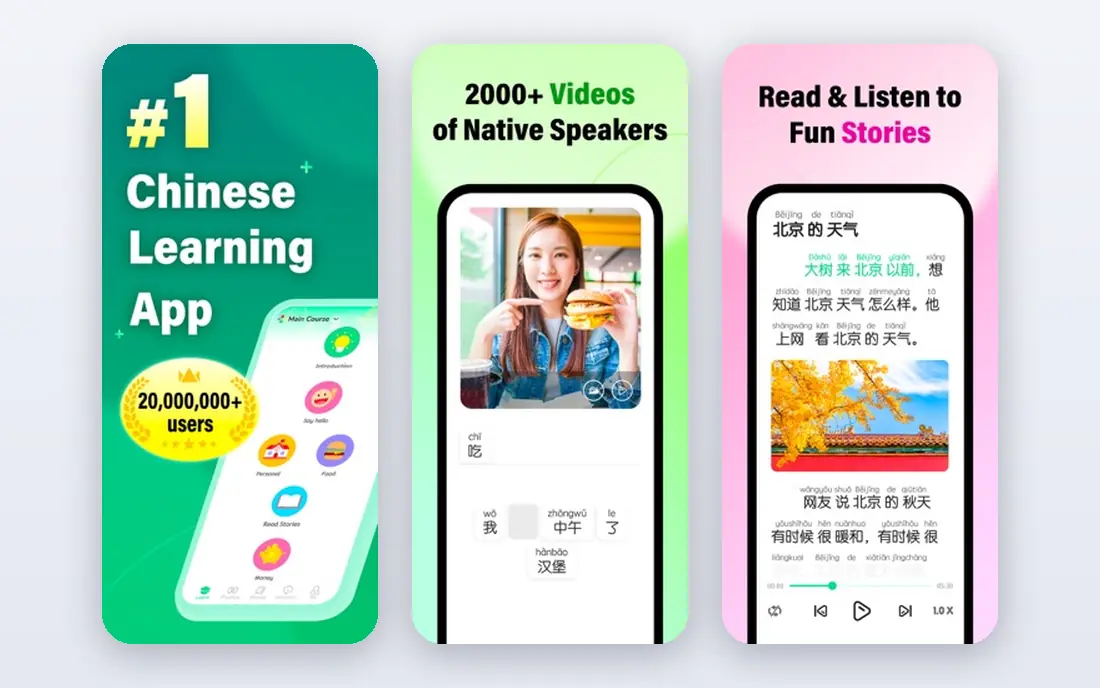
HelloChinese is the best app to learn chinese for a complete beginner. Its lessons start with pinyin and tones, then build vocabulary, grammar, reading and speaking in a clear order. Speech recognition gives feedback on pronunciation, and character writing practice helps you learn stroke order from the start. That structure removes the guesswork of what to study next.
The limit is level. HelloChinese covers beginners well and reaches into intermediate material, but advanced learners will need reading, listening and speaking tools beyond it. Use HelloChinese as your first course for several months, then add Du Chinese for reading and italki for speaking as you progress. For a first app, its balance of structure and practice is hard to beat.
- Structured curriculum from zero
- Tone and speaking practice
- Grammar explanations and character writing
- Content thins out at higher levels
- Advanced learners will outgrow it
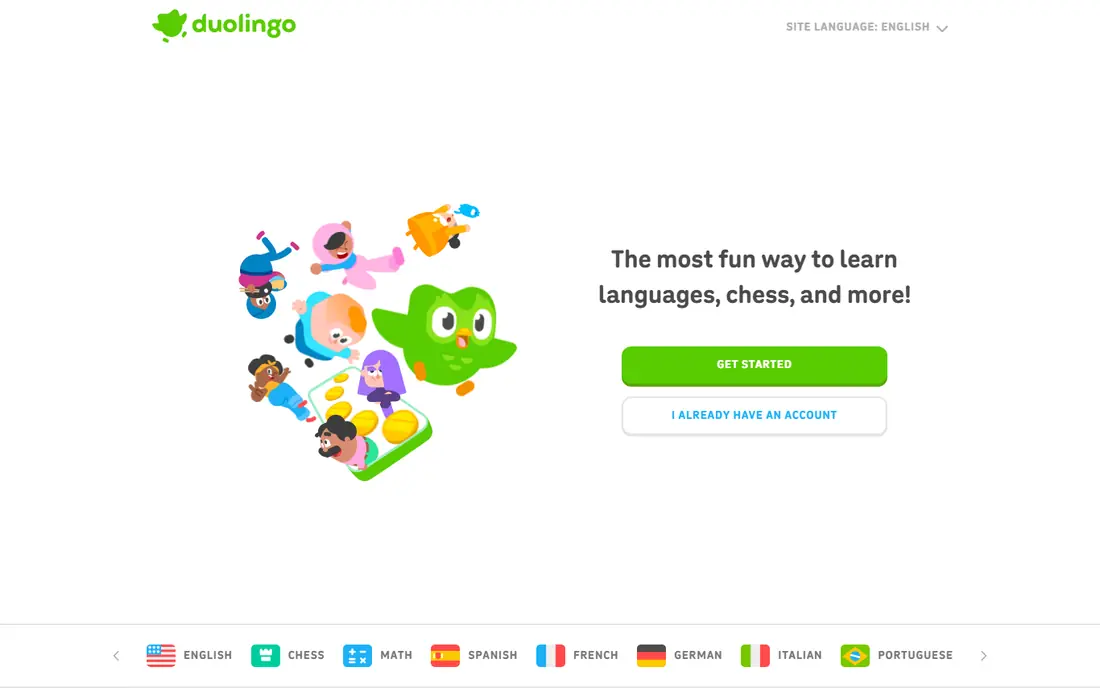
Duolingo is the easiest way to start a daily Chinese habit. Its short, game-like lessons fit into five minutes, its streak system keeps you returning, and its free tier covers the basics. For a first month of pinyin, tones and simple phrases, Duolingo gives a friendly and low-pressure start.
Its Chinese course is thinner than HelloChinese for grammar, character learning and real conversation. Learners who stay only with Duolingo often stall at a basic level. Use Duolingo as a habit tool alongside a structured course, or as a warm-up before a HelloChinese lesson. If Duolingo is the app that gets you practising daily, that habit alone makes it worth keeping.
- Free and fun daily lessons
- Streaks keep you coming back
- Good for pinyin and basic words
- Shallow grammar and character depth
- Weak for intermediate and advanced learners
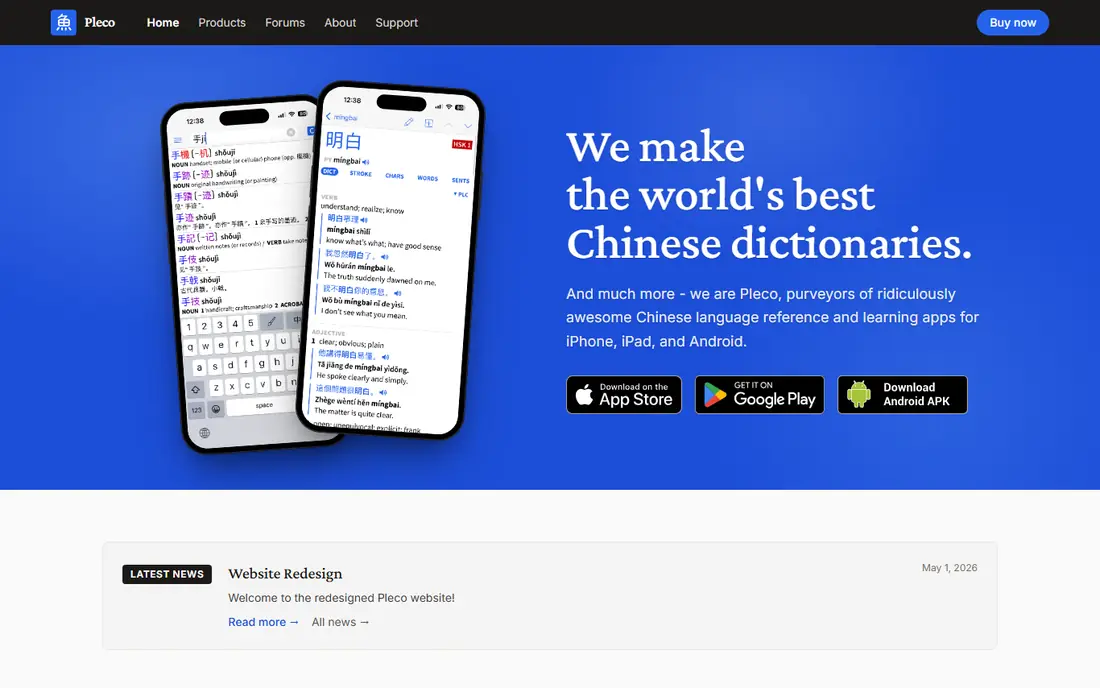
Pleco is not a course, but it is the tool almost every serious learner installs. It is a fast dictionary with handwriting input, camera lookup for characters on signs and menus, stroke order animations and audio pronunciation. When you meet a new word in a lesson, a book or a conversation, Pleco tells you what it means in seconds.
Paid add-ons extend Pleco into flashcards and a document reader, which make it useful well into advanced study. Pleco suits every level, from a beginner checking a first character to an advanced learner reading a novel. Install it alongside whatever course you choose, since a good dictionary saves more time than any single lesson app.
- Best Chinese dictionary app
- Handwriting and camera lookup
- Flashcards and reader add-ons
- Not a course
- Paid add-ons needed for full flashcard and reader features
LingoDeer suits learners who want grammar explained clearly rather than absorbed by repetition alone. Its Chinese lessons introduce sentence patterns, particles and tones with notes that help you understand why a sentence works. That approach appeals to learners who like to see the rules before they practise them.
LingoDeer is less well known than Duolingo, and its community and extra content are smaller. It works well as a main course for beginners to intermediate learners, or as a grammar companion to HelloChinese. If you have tried Duolingo and felt lost on grammar, LingoDeer is a strong next test.
- Clear grammar explanations
- Structured lessons
- Speaking and listening practice
- Smaller community than Duolingo
- Content depth varies by level
Du Chinese is the best platform to learn chinese reading skills at your level. Its graded stories are written for learners from beginner to advanced, and you can tap any character to see its meaning, pinyin and audio. A listening mode lets you hear the story while you read, which links characters to sound.
Reading alone will not teach speaking or grammar, so Du Chinese works best as a second app. Pair it with HelloChinese or LingoDeer for structure, and use it daily for ten minutes of reading. Over months, graded reading builds vocabulary and character recognition faster than flashcards alone, because words appear in context.
- Graded readers by level
- Tap any character for meaning and audio
- Listening mode included
- Reading only
- Needs a course or speaking tool alongside it
Skritter is the best chinese learning software for handwriting. It teaches stroke order, gives feedback as you write on screen, and uses spaced repetition to bring characters back just before you forget them. For learners who want to read and write by hand, not just recognise characters, Skritter fills a gap that most course apps leave open.
Skritter is a specialist tool, not a full course. It does not teach conversation or listening in depth, and it needs a paid plan after the trial. Use Skritter for fifteen minutes a day alongside a course, focusing on the characters from your current lessons. Writing characters by hand also helps memory, since the act of writing forces attention to each part of a character.
- Best character writing practice
- Stroke order feedback
- Spaced repetition for vocabulary
- No free plan beyond a trial
- Focused on writing rather than conversation
italki connects you with native Chinese tutors and professional teachers for one-to-one video lessons. That live practice is the fastest way to improve tones, listening and natural speech, since a tutor can correct you in real time. You can choose a tutor by price, availability and teaching style, and book lessons around your schedule.
The cost adds up if you take several lessons a week, so many learners use italki once a week or once a fortnight alongside app study. Read tutor reviews and take a trial lesson with two or three tutors before committing. italki suits learners who have basic vocabulary and want to turn app knowledge into real conversation.
- One-to-one lessons with native tutors
- Flexible scheduling and pricing
- Choice of professional teachers and tutors
- Costs add up with regular lessons
- Quality varies by tutor
Pimsleur is an audio course that builds listening and speaking through repeated prompts and responses. Its lessons suit commutes, walks and other times when you cannot look at a screen. By forcing you to answer out loud, Pimsleur builds the reflex of producing Chinese without translating in your head first.
Pimsleur does not teach characters or reading, so it works best as a companion to a visual course. Use it for audio practice while HelloChinese or Skritter covers reading and writing. Pimsleur suits learners whose main study time is away from a desk, and who want to arrive at a conversation able to listen and respond, not just read.
- Audio lessons build speaking reflexes
- Good for commuting
- Tone-aware listening practice
- Does not teach reading or characters
- Subscription cost for full access
How we picked these
We shortlisted apps that cover the main skills in Chinese learning: structured courses, dictionaries, reading, writing, speaking and listening. We favoured established tools with a clear level range and a free or trial way to start, and we checked each official site for its current focus. Prices vary by plan and region, so we list them as See website.
How to choose the best app to learn chinese
Start with your level and your time. Complete beginners should start with HelloChinese for structure, plus Pleco as a dictionary. Add Duolingo only if it helps you practise daily. Once you can read simple sentences, add Du Chinese for reading and Skritter if you want to write characters. When you can hold a basic conversation, add italki for live speaking.
Next, build a small daily routine you can keep. Fifteen minutes of course study, ten minutes of reading, and a few minutes of character review beats a long session once a week. Test an app for two weeks before paying, and check whether it teaches the skill you actually need next. The best app to learn mandarin for you is the one that fits your level today, not the one with the longest feature list.
Frequently asked questions
What is the best app to learn chinese for beginners?
HelloChinese is the strongest beginner course, with structured lessons covering pinyin, tones, grammar and speaking. Duolingo suits a lighter daily habit, while LingoDeer suits learners who want clearer grammar explanations. Try HelloChinese first, then add Pleco as your dictionary.
What are the best apps to learn chinese for free?
Duolingo, HelloChinese, Pleco, LingoDeer and Du Chinese all offer free tiers or free lessons. Free plans usually limit advanced lessons or features, but they are enough to test an app and build a basic habit. Pleco's free dictionary alone is useful at every level.
What is the best chinese app for speaking practice?
italki suits live speaking with a native tutor, while Pimsleur suits audio speaking practice on the move. HelloChinese also includes speaking practice with speech recognition, but live conversation gives feedback that an app cannot match. Combine app practice with regular tutor lessons for the best progress.
Can an app alone teach me Chinese?
An app can teach a lot, but most learners need a mix: a course for structure, a dictionary for lookup, reading for vocabulary, and speaking practice for conversation. No single app covers all of those well. A stack of two or three apps, used daily, gives a more complete path than any one app alone.
How long does it take to learn Chinese with an app?
It depends on daily time, level goal and whether you practise speaking. A daily routine of twenty to thirty minutes can build basic conversation within months, while reading and advanced fluency take longer. Consistency matters more than speed, so choose apps you will open every day.
Sources we checked (8)

Online Jobs is an independent blog about careers, online work, learning new skills and the tools that help people earn. More about us.
Keep reading
All posts
Best Udemy Alternatives
Explore the best Udemy alternatives for 2026, including Coursera, Skillshare, and LinkedIn Learning, with pricing, certificates, and who each platform suits.

Best Tools for Virtual Tutoring
Compare the best tools for virtual tutoring, from one-to-one tutor marketplaces to free self-paced learning, with pricing, subjects and honest limits.

Best Study Apps for Young Children
Compare the best study apps for young children in 2026, from Khan Academy Kids and ABCmouse to Reading Eggs, Starfall, Duolingo ABC and PBS Kids, with prices.