Best App for Scanning Sports Cards in 2026: 8 Products Compared

How we put this together: we compare official feature and pricing pages, app store listings, privacy policies and public user reviews. Prices change, so check the provider's site before you pay.
Key takeaways
- CollX and Ludex are the most direct sports card scanners, with camera identification, collection tracking, and value estimates in one app.
- Cardbase and Center Stage suit collectors who want a catalogue and portfolio view, with manual entry alongside scanning where needed.
- Sports Card Pro, Card Ladder, and PSA tools suit value research and grading context, rather than quick scanning alone.
- Scan values are estimates, not sale prices. Condition, grading, and the exact parallel can change value a lot, so check recent sales before buying or selling.
- Free tiers often limit scans or features, so test scan accuracy on your own cards before paying for a subscription.
Quick comparison
| Name | Who it suits | Starting price | Free option | |
|---|---|---|---|---|
 CollX | All-round sports card scanning | See website | Yes | Visit |
 Ludex | Sports and trading card scanning | See website | Yes | Visit |
 Cardbase | Collection cataloguing | See website | Yes | Visit |
 Center Stage | Sports card collection tracking | See website | Yes | Visit |
 Sports Card Pro | Price research for sports cards | See website | Yes | Visit |
 Card Ladder | Portfolio and sales tracking | See website | Free trial | Visit |
 PSA | Grading and card verification | See website | Yes | Visit |
 Beckett | Price guides and grading context | See website | Yes | Visit |
The best app for scanning sports cards
We compared apps that identify sports cards from a camera scan, track a collection, or research values. The list favours apps that are currently offered in 2026 and cover major sports such as baseball, basketball, football, hockey, and soccer.
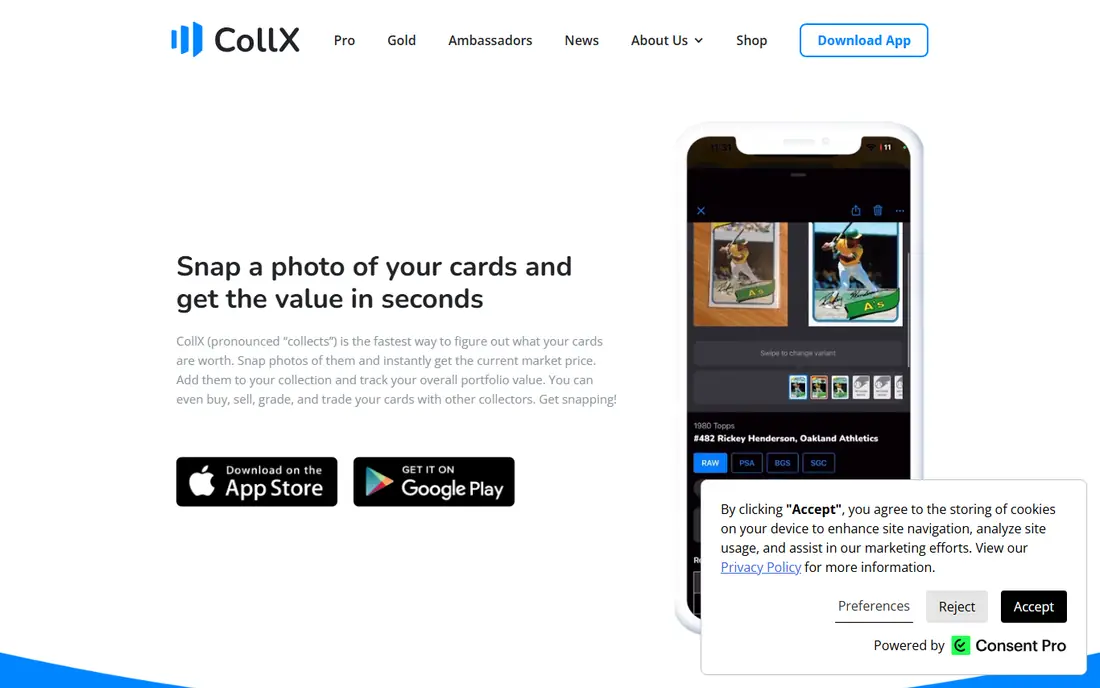
CollX lets you point your phone camera at a sports card and identify it, with an estimated market value and a place to save it in your collection. It covers baseball, basketball, football, hockey, soccer, and other sports, plus some trading card games, and it can identify graded cards and parallels. A built-in marketplace lets you buy and sell cards without leaving the app.
The free tier limits scans and features, and the value shown is an estimate from aggregated data, not a promise of what a buyer will pay. For a first pass through a collection, CollX is fast and practical. For a high-value card, check recent sales for the exact card, grade, and parallel before you price it.
- Camera scanning for many sports
- Large card database
- Built-in marketplace
- Free scans are limited
- Value estimates are not guaranteed sale prices
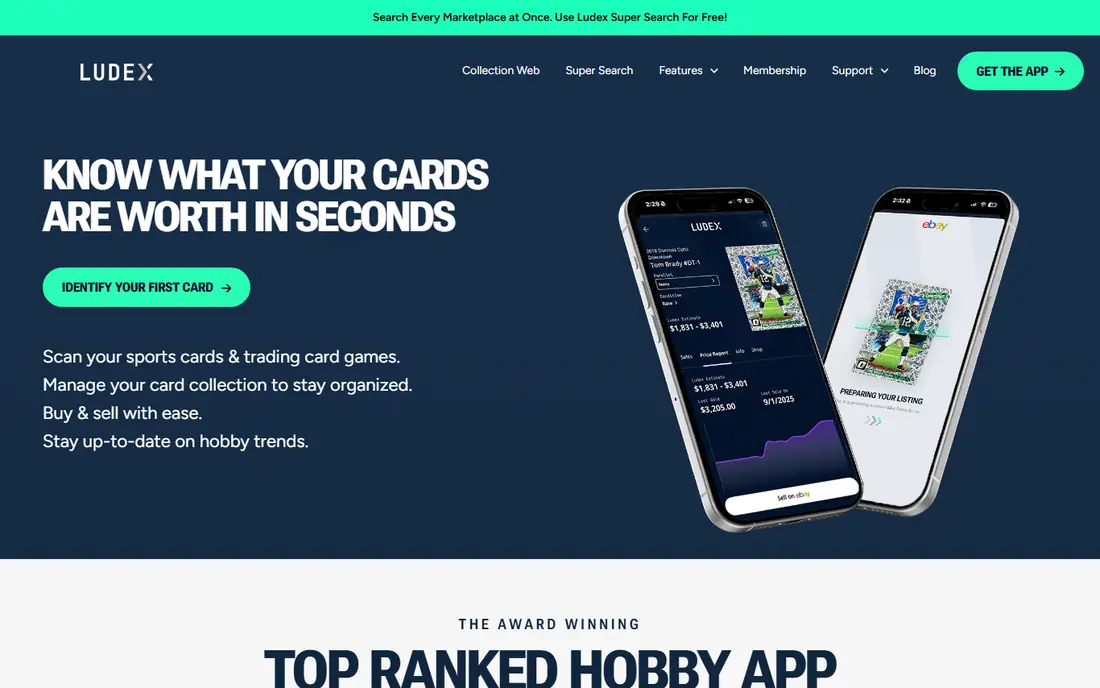
Ludex scans sports cards and trading cards, identifies them, and adds them to a collection with a portfolio total. That dual coverage suits collectors who hold both sports cards and trading card games and want one app for both. The scan flow is simple, and the collection view helps you see what you own at a glance.
As with CollX, the value figure is an estimate, and grade-specific prices may be less detailed than a dedicated sales database. Ludex Premium adds more features, so check the current plan page for scan limits and premium tools. For casual collectors with mixed collections, Ludex is a clean, single-app option.
- Sports and trading card coverage
- Portfolio totals
- Simple scan flow
- Value data is aggregated
- Premium features need a subscription
Cardbase focuses on cataloguing a collection, with set tracking, collection totals, and value overviews. You can build a collection card by card, track sets you are completing, and see how your collection value changes over time. That catalogue focus suits collectors who care about organisation as much as scanning.
If your main job is fast camera scanning of a large unsorted box, CollX or Ludex may be faster for the first pass. Cardbase earns its place when you want a tidy, searchable collection after identification, with sets and duplicates handled clearly. Test the free tier with a small set before moving a full collection over.
- Collection and set tracking
- Value overview
- Simple organisation
- Scanning is not as central as in CollX
- Some features need a plan
Center Stage is a sports card collection app with card search, collection tracking, and a portfolio view. It suits collectors who want to log cards, follow values, and keep a searchable record without a marketplace-first design. The interface focuses on the collection itself, which helps for long-term tracking.
The audience and database are smaller than the largest scanners, so scan or search coverage may vary by sport and set. If your collection is mainly mainstream baseball, basketball, and football cards, coverage is likely good. For niche sets, test a few cards first to confirm identification works for your collection.
- Collection tracking
- Card search
- Portfolio view
- Smaller audience than CollX
- Feature range varies by sport
Sports Card Pro focuses on price research and collection tracking for sports cards, with tools to look up cards and follow values. It suits collectors who want to research a card before buying, selling, or grading, rather than just scanning a box quickly. The collection view ties research to the cards you own.
Because it is research-first, the flow is less camera-led than CollX. You may need to search or enter details for some cards, which takes longer for a large unsorted collection. Use Sports Card Pro as a second check on value, alongside a scanner, when a card matters enough to price carefully.
- Price research tools
- Collection tracking
- Sales data focus
- Less of a camera-first scanner
- Research takes more manual steps
Card Ladder tracks sports card collections as a portfolio, with sales history, value trends, and analytics. It suits collectors and sellers who want to follow what they paid, what a card has sold for, and how a collection changes over time. That data focus helps for larger collections where tracking by hand is no longer practical.
Full features sit behind a paid plan, so check the trial terms before you import a large collection. Card Ladder is less of a quick scanner for a shoebox of cards, and more of a portfolio tool once cards are identified. Pair it with a scanner for the first pass, then use it for tracking and sales research.
- Portfolio tracking
- Sales history
- Collection analytics
- Paid features for full use
- Less suited to quick casual scanning
PSA, or Professional Sports Authenticator, is the grading company many collectors use for authentication and grading. Its app and site offer population reports, price guide context, and verification for graded cards, which helps you judge scarcity and value for a graded card. For a high-value card, a PSA grade often shapes the price more than any scan estimate.
PSA is not a general camera scanner for raw, ungraded cards in the same way as CollX. Grading also costs money and takes time, so it suits cards where the grade is likely to affect value enough to justify the fee. Use PSA data as a check on scarcity and graded value, not as a substitute for scanning a raw collection.
- Grading authority
- Population reports
- Card verification tools
- Grading costs extra
- App is not a general scanner for raw cards
Beckett has published sports card price guides for decades, and its site and app offer price guide data, grading, and hobby checklists. That history makes it useful for identifying sets, checking guide values, and understanding a card's place in a set. For older cards and sets, Beckett checklists are a helpful reference.
Guide prices are not the same as recent sale prices, and full guide access often needs a subscription. Use Beckett for set context and guide values, then check recent sales on a marketplace for a current market figure. That two-step check avoids overpricing a card based on a guide alone.
- Long-running price guides
- Grading services
- Hobby news and checklists
- Guide prices are not live sale prices
- Full guides need a subscription
How we picked these
We checked official app pages, app store listings, and vendor sites for sports card scanning and collection apps offered in 2026. We kept apps with a live product, a sports card focus, and a clear scanning, cataloguing, or value research function, and we left out general marketplace apps without a card identification or collection feature. We compared scan coverage, sports covered, collection tools, value data, grading context, and free versus paid features, using vendor pages and app listings rather than claimed accuracy figures.
How to scan and value a collection wisely
A scanner gives you a fast first pass, but value decisions need more care. Condition, grading, and exact version matter, and a small difference in a card can mean a large difference in price.
Scan in good light, one card at a time
Use even light, a plain background, and a straight, full view of the card front. Glare, shadows, and angled photos reduce identification accuracy, especially for parallels and foil cards. If a scan looks wrong, try again with better light before you accept the result.
Confirm the exact card before you trust a value
Check the set, year, player, card number, parallel, and condition against the scan result. A base card and a rare parallel can look similar in a quick scan but sell for very different amounts. For graded cards, check the grade and grading company as well.
Use scan values as a starting point
Treat an app value as an estimate, then check recent sales for the same card in the same condition. For a card you plan to sell, look at completed sales, not just asking prices. For a card you plan to grade, compare graded and raw sales to judge whether grading is worth the cost.
Keep a backup of your collection data
Export your collection where the app allows it, and keep photos of valuable cards. That backup protects you if you change apps, lose a phone, or need proof of ownership for insurance or a sale dispute.
Frequently asked questions
What is the best app for scanning sports cards?
CollX is the strongest all-round scanner for sports cards, with Ludex close behind for mixed sports and trading card collections. Cardbase and Center Stage suit collection tracking after scanning, while Card Ladder suits portfolio tracking. Test scan accuracy on your own cards before paying.
What is the best football card scanner app?
CollX and Ludex both cover football cards alongside other major sports, with camera identification and collection tracking. For a football-only collection, test both on a few cards from different sets, since accuracy can vary by set and parallel.
Are sports card scanner values accurate?
Scan values are estimates based on aggregated data, not guaranteed sale prices. They are useful for sorting a collection and spotting cards worth a closer look. For a valuable card, always check recent sales for the exact card, grade, and parallel before buying, selling, or grading.
Can I scan graded sports cards?
Yes, many scanners can identify graded cards, including by barcode or label in some cases. PSA and Beckett tools also help verify graded cards and check population data. Always confirm the grade and grading company, since those details affect value.
Do sports card apps work for all sports?
Most apps in this list cover baseball, basketball, football, hockey, and soccer, with varying depth by sport. Niche sports and older sets may have thinner coverage. Test a sample from each sport in your collection before you commit to one app.
Should I pay for a sports card scanner?
Pay when you scan often, need bulk scanning, or want full portfolio and price history features. For a small collection or a one-time sort, a free tier may be enough. Check scan limits, export options, and whether the paid plan adds value for your collection size.
Sources we checked (8)

Online Jobs is an independent blog about careers, online work, learning new skills and the tools that help people earn. More about us.
Keep reading
All posts
n8n Alternatives
n8n alternatives compared for 2026, with Zapier, Make, Activepieces, and more, covering visual builders, code steps, self-hosting, and pricing models.

eBay Alternatives
Looking for ebay alternatives? We compared 9 marketplaces for sellers on fees, buyer reach, categories and ease of listing, to help you sell with confidence.

ZoomInfo Alternatives
The best ZoomInfo alternatives in 2026, compared on price, free plans, data coverage, and which tool fits small teams or large sales teams best in detail.