Best AI Tools for Email Marketing in 2026: 8 Platforms Compared

How we put this together: we compare official feature and pricing pages, app store listings, privacy policies and public user reviews. Prices change, so check the provider's site before you pay.
Key takeaways
- Klaviyo suits ecommerce brands that want predictive data and AI-built campaigns tied to store sales.
- Mailchimp suits small teams that want an easy start with AI drafts, subject lines and send-time help.
- Brevo suits budget teams that want email plus SMS on a free tier with low paid entry.
- ActiveCampaign suits teams that need deep automation, while HubSpot suits teams already using its CRM.
Quick comparison
| Name | Who it suits | Starting price | Free option | |
|---|---|---|---|---|
 Klaviyo | Ecommerce AI campaigns | Free | Yes | Visit |
 Mailchimp | Small business AI drafts | $13 per month | Yes | Visit |
 Brevo | Budget multichannel | $9 per month | Yes | Visit |
 ActiveCampaign | Deep automation | $15 per month | Free trial | Visit |
 HubSpot | CRM-linked AI marketing | See website | Yes | Visit |
 Omnisend | Ecommerce stores | $11.20 per month | Yes | Visit |
 GetResponse | All-in-one with webinars | $19 per month | Yes | Visit |
 Customer.io | Behaviour-based messaging | $100 per month | Free trial | Visit |
The best AI tools for email marketing
AI in email marketing is most useful when it saves time on drafts, timing and targeting, not when it only writes subject lines. The tools below differ in how far AI goes: some draft full campaigns, some predict send times, and some use store data to predict who will buy next. Pick by the job that takes most of your time today.
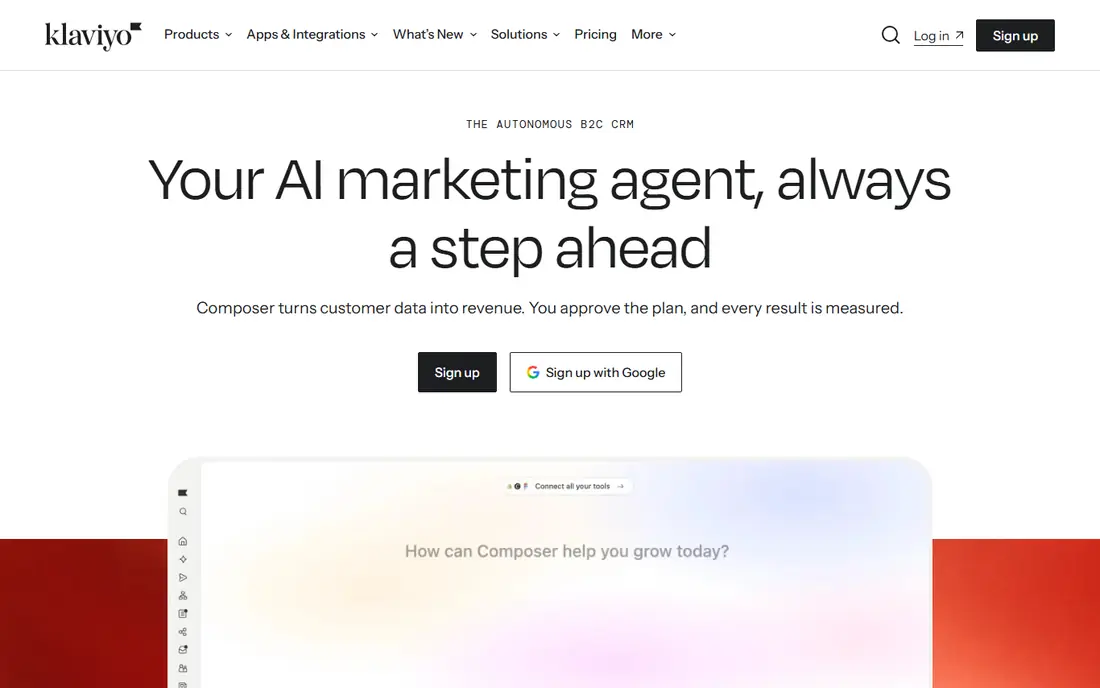
Klaviyo is the strongest AI choice for online stores. It pulls purchase, browse and cart data into segments, then uses predictive measures such as lifetime value and churn risk to guide who receives a campaign. Newer AI features can draft a full campaign, including segment, copy and design, for a human to review before sending.
That power comes with a price that rises with list size, and the flow builder takes time to learn. For a store with regular sales, the link between email revenue and store data is worth that effort. For a small newsletter with no store, Klaviyo may be more tool than the job needs.
- Strong ecommerce data and predictive analytics
- AI campaign drafting
- Deep Shopify links
- Paid pricing rises with contacts
- Learning curve for advanced flows
- SMS adds cost
Mailchimp remains the easiest entry point for AI-assisted email. Its AI tools draft email copy from a short prompt, suggest subject lines, and help choose send times based on subscriber behaviour. Templates and a simple builder make it possible to send a decent campaign without design help.
The limit appears as lists and flows grow. Automation is less deep than ActiveCampaign or Customer.io, and AI personalisation does not use purchase history as fully as Klaviyo. For small businesses, creators and consultants sending regular campaigns, Mailchimp gives a good balance of ease and AI help.
- Easy setup
- AI content drafts and subject help
- Send-time optimisation
- Many templates
- Automation depth is limited at higher volumes
- Pricing rises with contacts
- AI personalisation is lighter than Klaviyo
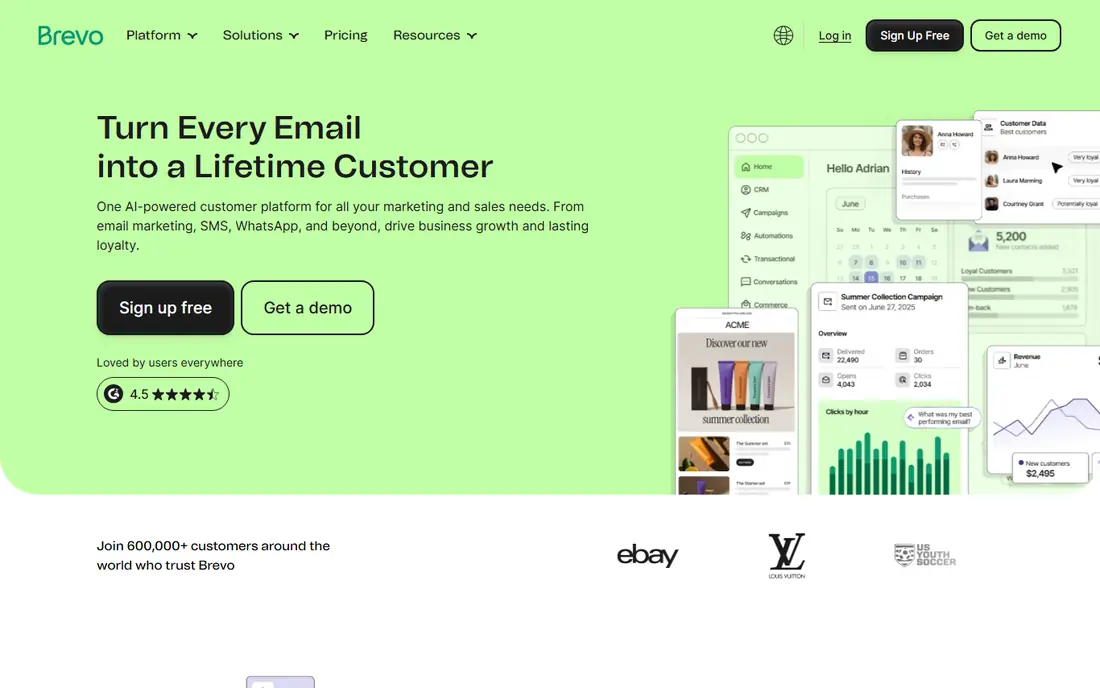
Brevo, formerly Sendinblue, suits teams that want multichannel marketing without a high entry price. The free tier covers a daily email limit, and paid plans start low while keeping contacts unlimited in many cases. AI tools help with subject lines and send-time prediction, which covers the most common AI needs for a small team.
Brevo does not match Klaviyo on ecommerce prediction or ActiveCampaign on automation depth. Its design tools are also simpler. For a small business that sends email and SMS, wants a usable free tier, and needs to keep costs down, Brevo is a practical and honest choice.
- Low paid entry
- Email plus SMS and chat
- AI subject lines and send-time prediction
- Unlimited contacts on paid plans
- AI depth is lighter than Klaviyo
- Design tools are simpler
- Deliverability depends on list hygiene
ActiveCampaign suits teams whose main problem is complex journeys, not writing a single email. Its automation builder handles branching flows, lead scoring and CRM updates, while predictive sending chooses a good time per contact. That depth helps B2B teams and SaaS companies with long nurture sequences.
Setup is the cost. You need a clear map of your flows before you build, or the builder can become tangled. There is no free plan, only a trial, so test a real flow before paying. For teams that live in automation, ActiveCampaign offers more control than Mailchimp or Brevo.
- Strong automation builder
- Predictive sending
- CRM built in
- Many automation recipes
- No free plan
- Setup takes time
- Pricing rises with contacts and features
HubSpot makes sense when email is part of a wider CRM system. Its AI tools use contact, deal and website data to draft emails, summarise records and suggest next steps, rather than working from email data alone. That CRM link helps B2B teams send messages that match where a contact sits in a sales process.
The drawback is cost and scope. Marketing Hub tiers rise quickly, and the full AI set sits in higher plans. A team that only needs email will find cheaper tools in this list. A team already using HubSpot CRM will get more value from its AI than from a standalone email tool.
- CRM data feeds AI tools
- Breeze AI agents help draft and summarise
- Strong reporting across sales and marketing
- Full marketing tiers are costly
- AI features vary by tier
- Setup is wider than email alone
Omnisend is built for online stores, with ready flows for abandoned carts, browse abandonment and post-purchase follow-up. AI helps with segmentation and product recommendations, which suits stores that want relevant emails without building flows from scratch. Email, SMS and push notifications sit in one system, which helps small ecommerce teams.
It is less suited to B2B lead nurture or long content sequences, where ActiveCampaign or HubSpot offer more depth. Pricing also rises with contacts, so model the cost at your list size. For Shopify and WooCommerce stores that want ecommerce email done well, Omnisend is a strong mid-priced choice.
- Ecommerce flows for cart and browse abandonment
- AI segmentation and product picks
- Email, SMS and push in one
- Less suited to B2B nurture
- Pricing rises with contacts
- Design flexibility is moderate
GetResponse bundles email with landing pages, automation and webinar hosting, which suits solo operators and small teams that want one platform. Its Perfect Timing feature sends to each contact at a predicted good time, a quiet AI feature that can lift opens without extra work.
The AI story is less central than Klaviyo, and the interface is less modern than Mailchimp. Webinar hosting is the feature that sets it apart in this list, so it suits trainers and creators who run live sessions. If webinars are not part of your plan, compare it closely with Brevo and Mailchimp on price and ease.
- Email plus landing pages and webinars
- Per-contact send-time optimisation
- Automation builder
- Interface feels dated in places
- AI tools are less central than Klaviyo
- Pricing rises with list size
Customer.io suits product and SaaS teams whose messages depend on what a user just did. It triggers emails from real-time events, such as a trial start or a feature use, and AI-assisted segmentation helps choose who should receive each message. That event focus makes it more precise than list-based tools for product messaging.
The entry price is high, and setup needs technical help to connect events and data. A simple newsletter team will not use its depth. For a SaaS team that needs timely, behaviour-based emails at scale, Customer.io offers control that simpler tools cannot match.
- Real-time event-based messaging
- AI-assisted segmentation
- Strong data and API options
- High entry price
- Needs technical setup
- Not suited to simple newsletters
How we picked these
We looked for tools that are live in October 2026, that offer AI features as part of email marketing rather than as a separate copy tool, and that cover distinct needs: ecommerce, small business, budget, automation, CRM and product messaging. We checked vendor pricing pages for current entry prices and free tiers, and we marked quoted or tier-dependent pricing as such.
We also judged AI by its job, not its label. Send-time prediction, segmentation and predictive analytics tend to affect results more than a clever subject line alone, so tools that use data well scored higher. Where AI drafts a campaign, we noted that a human should still review copy, offers and compliance before sending.
Choosing the right AI email tool
Start with your data, not the AI demo
A tool can only predict well if it has good data. Stores need purchase data, SaaS teams need event data, and B2B teams need CRM data. Choose the tool that already connects to your store, product or CRM, since a strong AI demo on poor data will disappoint.
Test one flow end to end
Build one real campaign or flow during the trial, from segment to send to report. Check whether AI drafts match your voice, whether send-time tools work for your list, and whether reports show revenue or conversions, not just opens. A trial that only tests templates will not reveal automation limits.
Watch pricing at your list size
Email prices rise with contacts, sends and features, so a low entry price can grow quickly. Model the cost at your current list size and at double that size, and include SMS if you plan to use it. A tool that is cheap at 500 contacts may be costly at 10,000.
Keep a human in the loop
AI drafts still need review for tone, claims, pricing and legal compliance. Set a rule that no AI campaign sends without a human check, especially for offers, health claims and financial claims. That check protects your brand more than any speed gain from full automation.
Frequently asked questions
What are the best AI email marketing tools?
Klaviyo suits ecommerce, Mailchimp suits small businesses, Brevo suits budget teams, ActiveCampaign suits deep automation, and HubSpot suits CRM-linked marketing. Omnisend, GetResponse and Customer.io suit ecommerce, all-in-one and product messaging needs. The best pick depends on your data and your main email job.
What is the best AI email marketing platform for ecommerce?
Klaviyo is the strongest ecommerce pick, because it links store data, predictive analytics and AI campaign drafting in one system. Omnisend is a strong lower-priced alternative for stores that mainly need cart, browse and post-purchase flows. Both price by contacts, so compare costs at your list size.
What is the best AI email marketing software for small businesses?
Mailchimp suits most small businesses, with easy setup, AI drafts and send-time help at a low entry price. Brevo suits teams that want email plus SMS at a lower cost, while GetResponse suits teams that also need landing pages and webinars. Test the free tier before you commit.
Do AI email tools write the whole campaign?
Some tools, such as Klaviyo, can draft a full campaign for human review, while others mainly help with subject lines, copy and timing. Even full drafts need a human check for tone, offers and accuracy. Treat AI as a drafting aid, not as a sender that works without review.
How much do AI email marketing tools cost?
Entry prices in this list range from free tiers to $100 per month for Customer.io, with most small-business tools starting between $9 and $19 per month. Prices rise with contacts, sends and features, so check the cost at your actual list size and send volume before you choose.
Is AI email marketing worth it for a small list?
For a small list, AI subject help and send-time tools can save time, but deep prediction needs more data to work well. A free or low-cost tool such as Mailchimp or Brevo often gives enough AI help at that stage. Upgrade when your list, flows or store data make deeper AI useful.
Sources we checked (8)

Online Jobs is an independent blog about careers, online work, learning new skills and the tools that help people earn. More about us.
Keep reading
All posts
n8n Alternatives
n8n alternatives compared for 2026, with Zapier, Make, Activepieces, and more, covering visual builders, code steps, self-hosting, and pricing models.

ZoomInfo Alternatives
The best ZoomInfo alternatives in 2026, compared on price, free plans, data coverage, and which tool fits small teams or large sales teams best in detail.
Yotpo Alternatives
Find cheaper alternatives to Yotpo for reviews and loyalty, with Judge.me, Loox, Stamped, and more compared for Shopify stores in 2026, all in one guide.