Best AI Software Testing Tools in 2026: 9 Tools Compared

How we put this together: we compare official feature and pricing pages, app store listings, privacy policies and public user reviews. Prices change, so check the provider's site before you pay.
Key takeaways
- mabl and Tricentis Testim lead on self-healing UI tests, but both are quote-based, so ask for pricing against your real test volume.
- Katalon and LambdaTest offer the clearest published pricing for teams that want web, mobile, API and device testing in one place.
- Applitools is the specialist pick for visual testing, while Functionize suits teams that want plain-language test creation at a low entry price.
- AI testing still needs human review, especially for business logic, accessibility and edge cases that automated checks can miss.
Quick comparison
| Name | Who it suits | Starting price | Free option | |
|---|---|---|---|---|
 mabl | Low-code tests with self-healing | See website | Free trial | Visit |
 Tricentis Testim | Enterprise web UI testing | See website | Yes | Visit |
 Applitools | Visual regression testing | $667 per month | Free trial (14 days) | Visit |
 Katalon | Web, mobile, API and desktop testing | $70 per seat per month | Yes | Visit |
 Functionize | Plain-language test creation | $20 per month | Yes | Visit |
 LambdaTest | Device grid plus AI authoring | $15 per month | Yes | Visit |
 BrowserStack | Widest device and browser coverage | $29 per month | Free trial | Visit |
 Sauce Labs | Enterprise device cloud and analytics | $39 per month | Free trial | Visit |
 testRigor | Plain-English tests for non-coders | See website | Yes | Visit |
The best AI software testing tools, compared
AI testing tools promise less maintenance, faster test creation and fewer flaky failures. In practice, the best tool depends on what you test most: web UI, mobile apps, APIs, visual design or all of them. The tools below cover those needs, from low-code platforms to device clouds with AI authoring help.
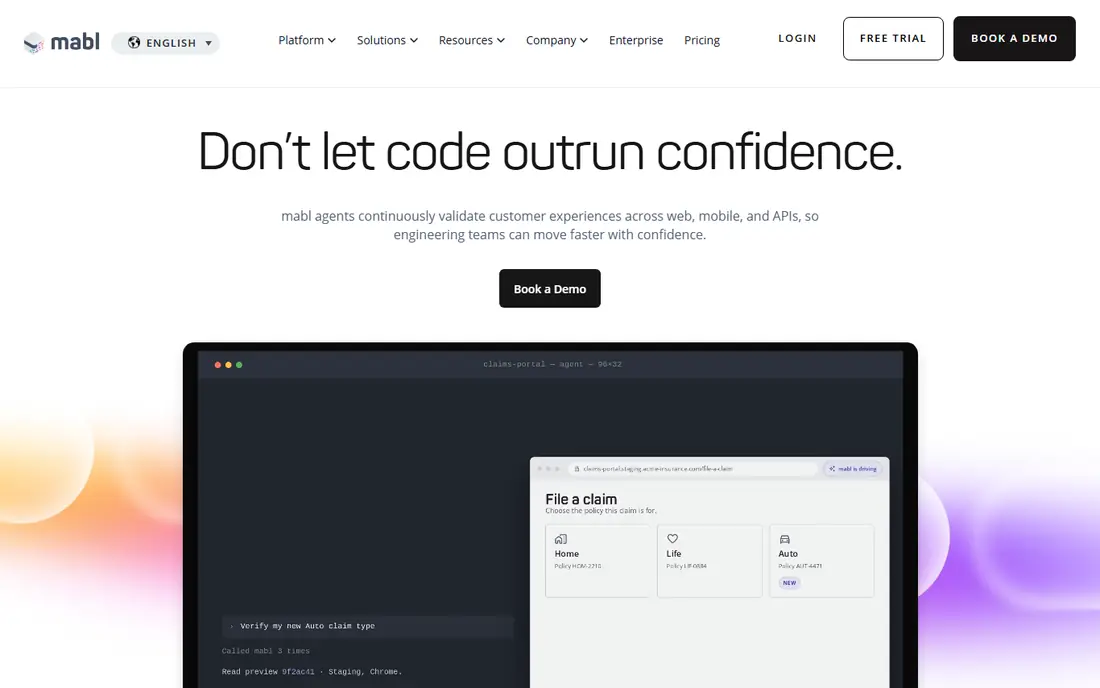
mabl is built for agile teams that spend too much time fixing broken UI tests. Tests can be created with low-code flows, recorded in the browser and run in the cloud, with AI features that adapt when buttons, labels or layouts change. Failure insights, screenshots and diagnostics help testers find the cause faster, rather than just seeing a red test result. The main drawback is pricing transparency. mabl is quote-based with credit-metered cloud runs, so teams must model their run volume before signing. Smaller teams may also find the platform larger than they need for a few simple tests. For teams with frequently changing UIs and heavy test maintenance, mabl is one of the strongest AI testing platforms available.
- Low-code test creation for web, mobile and API
- Auto-healing for changing UI elements
- Cloud runs with detailed failure insights
- Quote-based pricing
- Credit-based runs need careful volume planning
Tricentis Testim focuses on stable web UI automation, using Smart Locators that use multiple attributes to find an element, so a small UI change does not break the whole test. AI-assisted authoring helps create and maintain tests faster, and the platform is widely used for Salesforce and other complex enterprise web applications. A Community tier gives smaller teams a way to start. Enterprise pricing is by quote, and the full value is clearest for teams already using Tricentis tools or testing complex web apps at scale. Teams with simple web tests may find Testim more than they need. For enterprises that need resilient UI tests across large web applications, Testim is a leading choice.
- Smart Locators for stable UI tests
- AI-assisted authoring
- Strong fit for Salesforce and enterprise web apps
- Quote-based enterprise pricing
- Best value inside the Tricentis suite
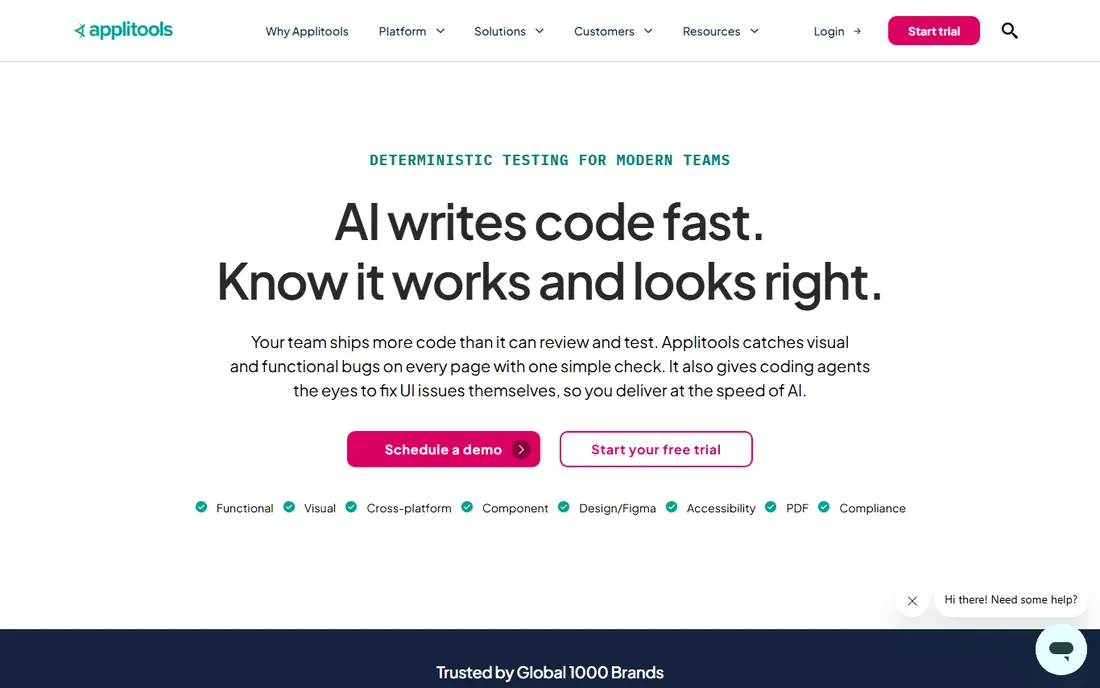
Applitools Eyes uses visual AI to compare what users actually see, rather than just comparing pixels or DOM text. That approach reduces false positives from minor rendering shifts, while still catching layout breaks, missing elements and style changes that functional tests miss. It works across browsers, devices and screen sizes, and integrates with common test frameworks. The Starter plan starts at $667 per month on annual billing, which puts Applitools out of reach for many small teams, and it is a visual layer rather than a full test execution platform. Teams that need visual confidence across many screens, especially for customer-facing web and mobile apps, will find that price easier to justify. For visual regression at scale, Applitools is the specialist to beat.
- Visual AI that reduces false-positive diffs
- Cross-browser and cross-device visual checks
- Integrates with many test frameworks
- High starting price
- Not a complete test execution platform on its own
Katalon suits mixed QA and engineering teams that test more than one surface. Web, mobile, API and desktop tests can live in one platform, with record-and-playback, scripting, AI-assisted authoring and self-healing locators to reduce maintenance. Published pricing from $70 per seat per month on annual billing makes budgeting clearer than with quote-only rivals. The breadth is also a drawback, because teams must learn which Katalon modules they actually need and avoid paying for unused depth. Smaller teams may prefer a simpler tool for web-only testing. For organisations that want one testing platform across surfaces, with a free tier to start, Katalon is a practical and well-priced choice.
- One platform for web, mobile, API and desktop
- AI-assisted authoring and self-healing
- Published per-seat pricing
- Breadth can add complexity
- Advanced analytics need higher plans
Functionize stands out for pricing transparency in a market where most vendors hide prices. Paid plans start at $20 per month with a free tier, and tests can be created in plain language rather than code, with AI agents that help maintain tests as the application changes. That makes it accessible to QA teams without deep coding skills. The platform is less widely adopted than mabl, Testim or Katalon, so community resources and integrations may be thinner in some areas. Teams with very complex enterprise needs should test it against their hardest workflows first. For teams that want agentic testing without an enterprise sales call, Functionize is an appealing and affordable option.
- Natural-language test creation
- Agentic test maintenance
- Low entry price with a free tier
- Enterprise features need higher plans
- Less well known than larger rivals
LambdaTest, now also known as TestMu AI, combines a cross-browser and real-device cloud with AI test authoring. Teams can run manual and automated tests across browsers and devices, generate tests with natural-language help, and run tests in parallel through its execution platform. Live testing plans start at $15 per month, which undercuts several device-cloud rivals. AI authoring depth depends on plan, and heavy parallel testing can raise costs quickly, so teams should model run volume. For budget-conscious teams that need both a device grid and AI help with test creation, LambdaTest offers strong value in one subscription. It is especially useful for web and mobile teams that test across many devices.
- Real device and browser grid
- AI test authoring through KaneAI
- Low entry price for live testing
- AI features vary by plan
- Large parallel runs raise costs
BrowserStack is best known for device and browser coverage. Teams can test on real devices and browsers without maintaining their own lab, run automated tests in CI, and check visual and accessibility issues across combinations that would be hard to cover locally. Live plans start at $29 per month, with higher plans for automation and parallel runs. AI features are present, but BrowserStack is primarily an infrastructure platform rather than an AI test authoring tool. Teams that want AI to write and heal tests may prefer mabl, Katalon or Functionize as their authoring layer, with BrowserStack as the execution grid. For coverage alone, BrowserStack remains a leading choice.
- Very wide real device and browser coverage
- Live, automated and visual testing
- Strong CI integrations
- AI authoring is less central than on mabl or Katalon
- Costs rise with parallel sessions
Sauce Labs offers a real device and browser cloud with analytics, error reporting and enterprise controls for regulated teams. Live plans start at $39 per month on annual billing, with automation and enterprise plans for larger suites. Its analytics help teams spot flaky tests, slow runs and failure patterns across a large test suite. The entry price is higher than LambdaTest, and large suites need careful setup to get value from analytics. Smaller teams may find Sauce Labs larger than they need. For regulated enterprises that need compliance, audit trails and deep test analytics alongside device coverage, Sauce Labs is a solid enterprise-grade choice.
- Real device and browser cloud
- Analytics and error insights
- Compliance and enterprise controls
- Higher entry price than LambdaTest
- Setup takes time for large suites
testRigor lets testers write tests in plain English, such as clicking a button by its visible label, rather than writing code or managing complex selectors. That approach suits manual testers, product managers and business analysts who want to automate without learning a scripting language. The platform covers web, mobile, desktop and API tests, with AI help for maintenance. Pricing is not fully public, so teams must ask for a quote against their test volume and user count. Portability of tests, if you leave the platform, also needs checking before a long commitment. For teams with non-technical testers and a need for readable, maintainable tests, testRigor is a strong and accessible option.
- Tests written in plain English
- Covers web, mobile, desktop and APIs
- Low-code maintenance for changing UIs
- Pricing is not fully public
- Test portability needs checking before commitment
How we picked these
We compared official feature and pricing pages, documentation and public reviews for AI testing tools that are still offered in October 2026. We favoured tools with a clear AI role, such as self-healing locators, AI test generation or visual AI, plus real execution, reporting and CI integration, rather than tools that only add a chatbot to a traditional suite. Where pricing is quote-based, we wrote See website instead of guessing a figure.
Choosing the best AI testing tool
Start with your biggest testing pain. If UI tests break every release, shortlist mabl and Testim. If visual bugs slip through, shortlist Applitools. If you test web, mobile and API in one team, shortlist Katalon and LambdaTest. If non-coders need to write tests, shortlist Functionize and testRigor.
Test with your hardest screens, not your easiest
Run a trial against your most change-prone screens, your largest test suite and your slowest CI jobs. Check how many tests heal themselves, how clear failure reports are, and how long a full run takes. A tool that looks good on a demo app may struggle on a real app with dynamic content, iframes or third-party widgets.
Keep humans in the loop
AI testing tools reduce maintenance, but they do not replace exploratory testing, business logic checks or accessibility review. Keep a human review step for high-risk flows such as payments, account changes and data exports, and track flaky test rates over time. The goal is faster, more reliable testing, not testing with no oversight.
Frequently asked questions
What is the best AI testing tool for beginners?
Katalon and Functionize are good starting points for beginners, because both offer free tiers and low-code or plain-language test creation. LambdaTest is also accessible for teams that need device testing alongside AI authoring. Start with a small suite, learn the authoring flow, and expand only when the first tests run reliably in CI.
What are the best AI tools for software testing at enterprise scale?
mabl, Tricentis Testim, Applitools, BrowserStack and Sauce Labs are the strongest enterprise options, with scale, analytics, compliance controls and wide integrations. The right enterprise pick depends on whether your main need is UI stability, visual testing, device coverage or analytics. Enterprise buyers should ask for pricing against the same test volume and parallel run count.
Do AI testing tools replace human testers?
No, AI testing tools handle repetitive creation and maintenance work, but human testers remain essential for exploratory testing, business logic, usability and edge cases. The best teams use AI to free testers for higher-value work, such as risk analysis, test design and user journey checks. Treat AI output as a draft that needs review, especially for critical flows.
What is the best AI tool for testing software applications on mobile?
Katalon, LambdaTest and Sauce Labs are strong for mobile, with real-device testing plus AI authoring or analytics. mabl also covers mobile web and app testing in its low-code platform. Choose based on whether you need real devices, emulators, app store builds or mobile web coverage, and test on the devices your users actually use.
How much do best AI testing platforms cost?
Costs range from free tiers on Katalon, Functionize, LambdaTest and testRigor, through $15 to $70 per month or per seat on published plans, to $667 per month for Applitools Starter and quote-based pricing for mabl and Testim. Credit-based and parallel-run pricing can raise totals, so model cost against your test count, run frequency and device needs before signing.
Sources we checked (9)

Online Jobs is an independent blog about careers, online work, learning new skills and the tools that help people earn. More about us.
Keep reading
All posts
Replit Alternatives
Replit alternatives for 2026 compared: browser coding, AI app builders and team workspaces, with free plans, limits and honest trade-offs for developers.
Docker Alternatives
Compare Docker alternatives for 2026, with Podman, Rancher Desktop, OrbStack, containerd, Colima, Finch, Portainer and Kubernetes on cost, fit and licensing.
Custom AI Agent Tools Best Practices
Learn custom ai agent tools best practices with tools for building custom AI agents, from frameworks to low-code builders, plus safety and testing notes.