Best AI Search Visibility Checking Software in 2026: 8 Tools Compared

How we put this together: we compare official feature and pricing pages, app store listings, privacy policies and public user reviews. Prices change, so check the provider's site before you pay.
Key takeaways
- Otterly.AI has the lowest entry price in this group, at $29 per month, while Profound now sells mainly through a custom enterprise plan after a free trial.
- Peec AI is the strongest mid-price pick for teams that want daily prompt tracking on three models of their choice with unlimited users.
- Goodie stands out for shopping and product visibility, while Scrunch AI adds site audits and crawler data that mention-only trackers do not offer.
- Prices in this young category change often, so confirm the current plan limits on the vendor site before you pay.
Quick comparison
| Name | Who it suits | Starting price | Free option | |
|---|---|---|---|---|
 Otterly.AI | Lowest-cost entry point | $29 per month | Free trial (7 days) | Visit |
 Peec AI | Daily tracking for SEO teams | $95 per month | No | Visit |
 Profound | Enterprise reporting depth | See website | Free trial (7 days) | Visit |
 Goodie | Shopping and product visibility | $295 per month | Free trial (7 days) | Visit |
 Scrunch AI | Audits plus share of voice | $250 per month | Free trial (7 days) | Visit |
 AthenaHQ | Broad engine coverage with a free tier | Free | Yes | Visit |
 Semrush AI Visibility Toolkit | Teams already using Semrush | $99 per month | No | Visit |
 Ahrefs Brand Radar | Search data behind AI prompts | See website | No | Visit |
The best AI search visibility checking software
AI answers now shape what people buy and which brands they trust, and these tools show how often your brand appears in those answers. We compared official pricing pages, engine coverage, and published plan limits, and we left out tools that have closed or moved to quote-only sales without a usable self-serve plan.
Otterly.AI is the easiest place to start if you want a real number for AI visibility without an enterprise budget. The Lite plan covers 15 prompts across ChatGPT, Google AI Overviews, Perplexity, and Microsoft Copilot, with daily tracking and scheduled reports. That is enough for a small business to learn which questions trigger a mention and which ones hand the answer to a rival.
The catch is coverage. If Claude or Gemini matter to your buyers, you will pay for add-ons or move to Standard at $189 per month. Otterly.AI also suits monitoring more than fixing problems, so plan to do the content work yourself. For a first purchase in this category, though, its price and simplicity are hard to beat.
- Low entry price
- Daily tracking
- Unlimited team members on listed plans
- Claude, Gemini, and Google AI Mode are paid add-ons
- API access starts higher up
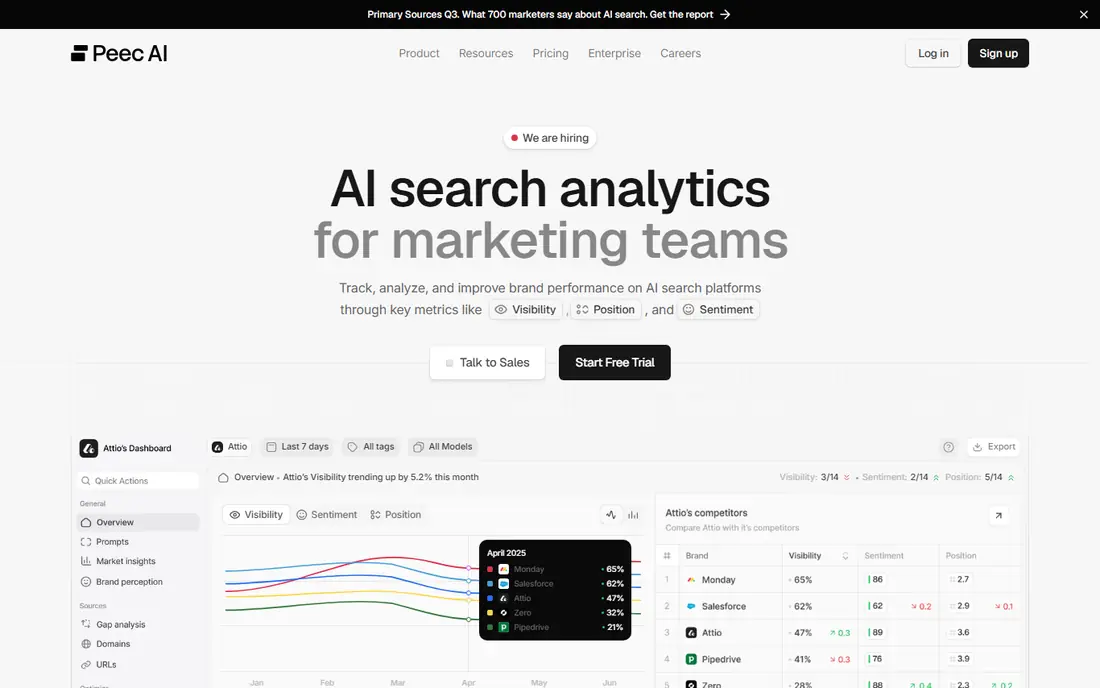
Peec AI gives SEO teams a familiar workflow applied to AI answers. Starter tracks 50 prompts daily on three models of your choice, and Pro at $245 per month raises that to 150 prompts with sentiment analysis included. Unlimited users on every plan means an agency or a larger marketing team does not pay per seat, which keeps the total predictable.
What Peec AI does less well is hand you finished fixes. It shows visibility, citations, and competitor positions, then leaves content changes to your team. It also lacks a free tier, so use the trial period carefully and check whether your preferred models are included before you commit. For teams that already live in prompt lists and competitor reports, it is a natural fit.
- Daily prompt tracking
- Unlimited users
- Sentiment analysis on higher plans
- Prices are shown in euros on some pages
- API access is enterprise only
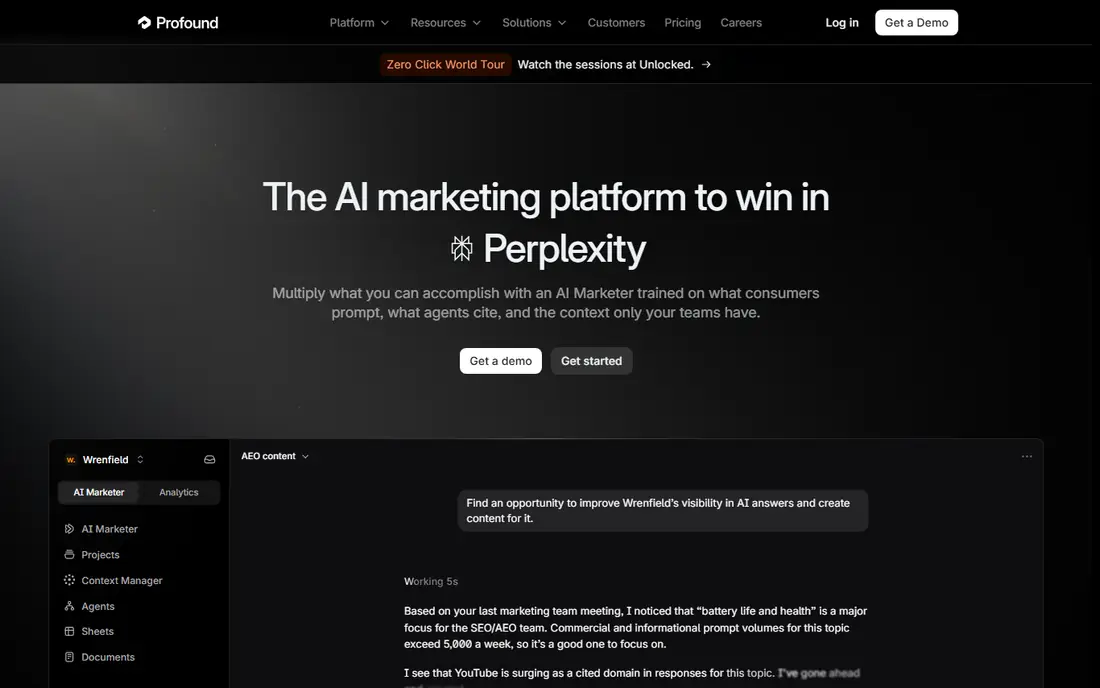
Profound is the best-known name in this space, and its enterprise platform tracks up to nine answer engines, including ChatGPT, Perplexity, Claude, Gemini, Google AI Mode, Microsoft Copilot, DeepSeek, Exa Search, and Google AI Overviews. Its prompt volume data, drawn from real user conversations, helps large teams decide which questions deserve content investment. Compliance features such as SSO and SOC 2 also matter when security review decides the purchase.
The trade-off is access. Profound withdrew its $99 Starter and $399 Growth self-serve plans in September 2026, and brands now start with a free 7-day trial covering three engines and 50 prompts daily, then move to a custom enterprise quote. Small teams will find that frustrating. Large brands with several markets and a real budget will get the depth they need, but they should expect a sales process rather than a card payment.
- Broad engine coverage on enterprise plans
- Prompt volume data
- Strong compliance options
- No published self-serve price for brands
- Enterprise pricing requires a sales conversation
Goodie is built for brands that sell products, not just ideas. Its Agentic Commerce Suite tracks how AI shopping experiences surface individual products across ChatGPT Shopping, Perplexity Shopping, Google AI Mode Shopping, Alexa for Shopping, and Walmart Sparky. Core at $295 per month covers five models, 110 prompts, and 50 optimization actions a month, with a strategist included for support.
That shopping focus is also its limit. If you run a services business with no product catalog, much of the Pro tier at $999 per month will go unused. Entry pricing is high for a small team, and Claude, Meta AI, DeepSeek, and Grok coverage sits on the enterprise tier. For ecommerce teams, though, no other tool here ties visibility to product pages this directly.
- SKU-level shopping visibility
- Strategist support on listed plans
- Unlimited seats
- High entry price
- Full model coverage needs the enterprise tier
Scrunch AI looks at both sides of a citation: the answer an AI gives, and the crawl data showing which bots visited the pages behind it. Core at $250 per month tracks 125 prompts on ChatGPT, Perplexity, Google AI Overviews, and Copilot, with up to five seats. That combination suits teams that already work with server logs and want to know why a page is cited, not only whether it is.
The price puts Scrunch AI above the budget tier, and full engine coverage requires higher plans. Its audit features also reward teams with someone able to act on technical findings. If your main need is a simple mention count, a cheaper tool will do. If you want diagnostics behind the count, Scrunch AI earns its place.
- Site audits and crawler data
- Share-of-voice reporting
- Agency plans available
- Higher entry price than budget trackers
- Some engines need higher tiers
AthenaHQ is the best way to test this category before spending. Its free tier gives a usable read on brand visibility with source-level citation attribution, so you see which pages get cited rather than only which domains appear. Paid plans start at $295 per month and cover a broad set of models, including Claude on a self-serve plan, which several rivals gate behind enterprise contracts.
The honest catch is the credit model. Capacity is measured in credits, so a heavy month of prompts can burn through an allowance faster than a flat prompt count would suggest. Model the month you actually plan to run before choosing a tier. For a team that wants to prove the problem exists before asking for budget, the free tier makes AthenaHQ the obvious first stop.
- Free tier with real reporting
- Source-level citation attribution
- Broad model list
- Paid plans start at $295 per month
- Credit-based pricing can be hard to forecast
Semrush AI Visibility Toolkit
Who it suits: Teams already using Semrush
Semrush AI Visibility Toolkit makes sense only if you already pay for Semrush, but for those teams it is convenient. It adds AI visibility tracking for ChatGPT, Gemini, Perplexity, Google AI Overviews, and AI Mode to the keyword, audit, and backlink tools a team already uses. At $99 per month per domain, billed annually, it avoids a second login and a second vendor contract.
The limit is scope. The entry allowance is modest next to dedicated trackers, and teams that want deep prompt-level work across many engines will outgrow it. It is also an add-on cost, so a team not already on Semrush should compare the combined price, not the add-on alone. For existing Semrush users, it is the lowest-friction way to add AI visibility.
- Sits inside a full SEO suite
- AI Overviews and AI Mode coverage
- Familiar reporting
- Priced per domain on top of a Semrush plan
- Prompt allowance is modest at entry level
Ahrefs Brand Radar bolts AI citation tracking onto the SEO platform many teams already trust. Its prompt index is built from search data, which helps teams pick prompts that reflect real demand rather than guesses. Coverage includes ChatGPT, Perplexity, Gemini, Copilot, Grok, Google AI Overviews, and AI Mode, and it sits next to backlink and keyword data in the same workspace.
The catch is that Brand Radar is an add-on, priced per index on top of a base Ahrefs plan, so the total cost depends on your existing subscription. It also does not track Claude, which matters if your audience uses it heavily. For Ahrefs loyalists, it is a strong addition. For teams starting from scratch, a standalone tracker may be cheaper.
- Prompts grounded in search data
- Strong backlink and SEO data alongside
- Trusted interface
- Sold as an add-on to an Ahrefs subscription
- Pricing varies by index
How we picked these
We compared official pricing pages, published plan limits, and engine coverage as listed in October 2026, and we favored tools with a current self-serve plan or a clear trial path. We excluded tools that have closed, merged without a working product, or hide all pricing behind a sales form with no trial. Prices change often in this category, so treat every figure here as a starting point and confirm it on the vendor site before you buy.
What to check before you pay
Match engines to your buyers
List the AI tools your customers actually use, then check the entry tier, not the headline tier. Several vendors advertise broad coverage that only arrives on enterprise plans, and add-ons for Claude or Gemini can change the real price by a large margin.
Count prompts honestly
A prompt is one question tracked on one engine in most plans, so a list of 50 questions across four engines can consume far more capacity than it first appears. Start with your most commercial questions, such as comparisons and best-of lists, and expand only after a month of data shows which ones move.
Decide who acts on the data
A tracker that only reports will disappoint a team with no one to update pages, add FAQs, or fix technical issues. If no one owns content changes, pick a tool with guided actions or strategist support, such as Goodie or AthenaHQ, rather than the cheapest dashboard.
Frequently asked questions
What is AI search visibility checking software?
It tracks how often your brand, products, or pages appear in answers from AI tools such as ChatGPT, Perplexity, Gemini, and Google AI Overviews. Most tools run a set of prompts daily, record mentions and citations, and compare your share with competitors.
How many prompts do I need to start?
Most small teams can start with 15 to 50 prompts covering their main products, top comparisons, and common buyer questions. A larger brand with several product lines or markets will usually need 150 or more, plus room for competitor prompts.
Do I need to track every AI engine?
No. Track the engines your buyers use most, and add others only when the data shows a gap. Paying for ten engines when your customers use two wastes budget that could fund content fixes.
Can these tools improve my visibility on their own?
No. They measure and diagnose, but visibility improves when you publish clearer pages, add structured FAQs, earn citations from trusted sources, and fix technical problems that block AI crawlers. Treat the tool as a compass, not a fix.
Is a free plan enough?
A free tier such as AthenaHQ is enough to prove whether AI answers mention you at all. Ongoing tracking, competitor comparison, and reporting across many prompts usually need a paid plan.
How often should I check the data?
Weekly checks suit most teams, with daily tracking running in the background. AI answers shift when models update, so watch trends over several weeks rather than reacting to a single day of change.
Sources we checked (8)

Online Jobs is an independent blog about careers, online work, learning new skills and the tools that help people earn. More about us.
Keep reading
All posts
n8n Alternatives
n8n alternatives compared for 2026, with Zapier, Make, Activepieces, and more, covering visual builders, code steps, self-hosting, and pricing models.

ZoomInfo Alternatives
The best ZoomInfo alternatives in 2026, compared on price, free plans, data coverage, and which tool fits small teams or large sales teams best in detail.

Workday Alternatives
We compared the best workday alternatives for HR, payroll, and global hiring, from BambooHR and Gusto to Rippling, Deel, and HiBob for growing teams in 2026.