Best AI Platform for Industrial Engineering in 2026: 8 Platforms Compared


Factory-wide digital twins · Starting price: See website
How we put this together: we compare official feature and pricing pages, app store listings, privacy policies and public user reviews. Prices change, so check the provider's site before you pay.
Key takeaways
- The best AI platform for industrial engineering depends on your starting point: design data, factory data, or both.
- Digital twin and simulation tools help before production, while predictive maintenance and quality tools pay off once machines are running.
- Data plumbing matters more than model choice at first, because factory data is often split across machines, historians and spreadsheets.
- Most industrial platforms are priced on request, so budget for integration, sensors and change management, not just software licences.
Quick comparison
| Name | Who it suits | Starting price | Free option | |
|---|---|---|---|---|
| Siemens Industrial AI | Factory-wide digital twins | See website | No | Visit |
 NVIDIA Omniverse | Simulation and digital twins | See website | Free trial | Visit |
 Synera | Engineering workflow automation | See website | No | Visit |
 InfinitForm | Design for manufacturability | See website | No | Visit |
 Databricks | Industrial data and analytics | See website | Free trial | Visit |
 Litmus | Factory data connectivity | See website | Free trial | Visit |
 AVEVA PI System | Plant data and operations | See website | No | Visit |
 Guidewheel | Machine monitoring for factories | See website | Free trial | Visit |
The best AI platforms for industrial engineering
Industrial engineering covers design, simulation, production planning, maintenance and quality. No single platform does all of it well, so we grouped tools by the problem they solve first, and noted where they connect to the rest of your stack.
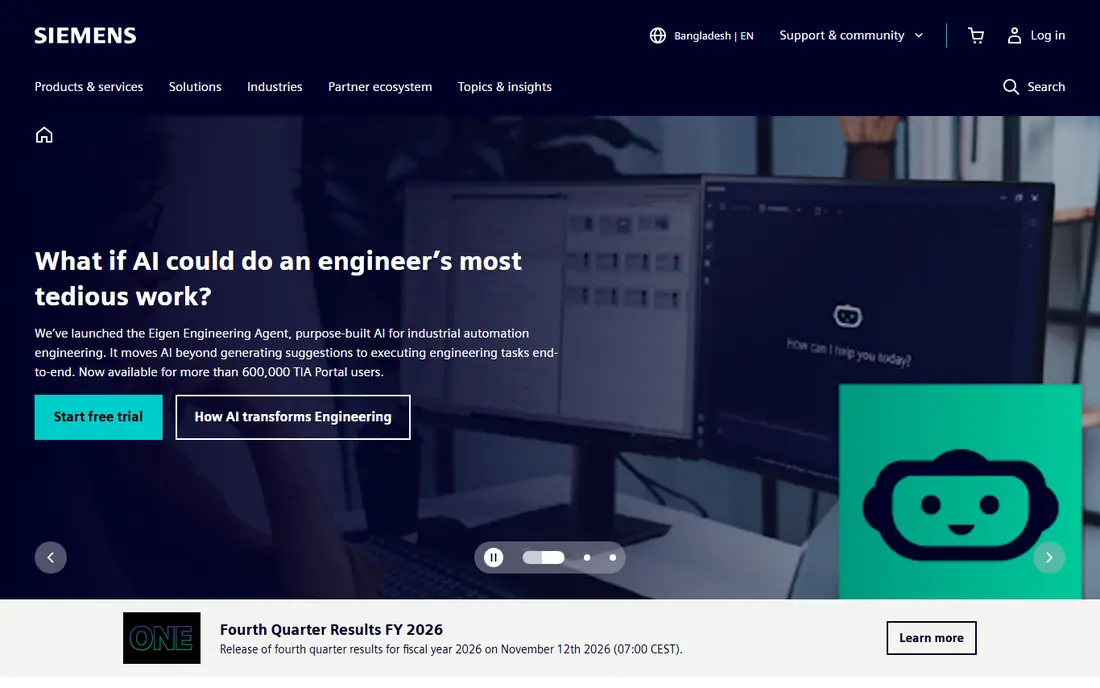
Siemens is the broadest pick on this list, because its industrial software spans design, automation, simulation and operations. For a plant that already uses Siemens controllers or software, adding AI for inspection, planning or predictive work is less of a rebuild than starting with a point tool. The digital twin approach also lets teams test a production change in software before they change a physical line.
The catch is scale and complexity. Siemens suits larger operations with engineering and IT support, and smaller factories may find the sales process and integration work heavy. If you run a single line and need one clear win, start with a focused monitoring or quality tool, then consider a wider platform once the data foundations are in place.
- Broad factory software portfolio
- Digital twin tools
- Strong automation links
- Pricing is sales-led
- Deployment can be complex for smaller plants
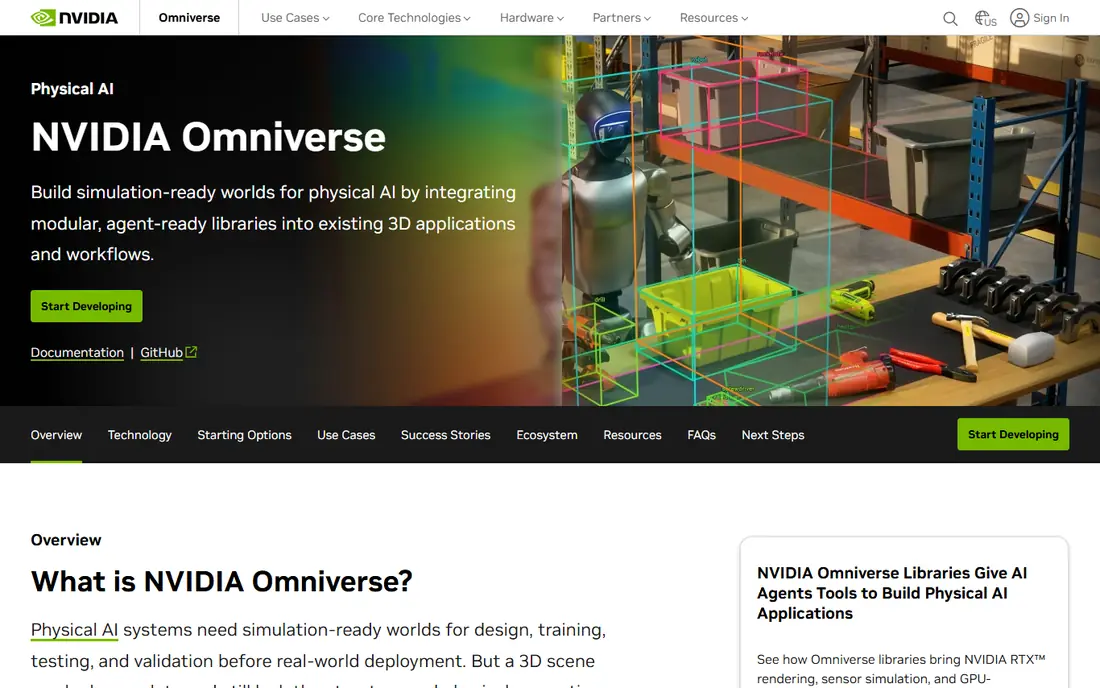
NVIDIA Omniverse is built for simulation first. Teams can build a virtual copy of a factory, test layouts and robot paths, and generate training data for inspection systems before physical parts exist. That last point matters for quality, because inspection models often stall while teams wait for enough real defect examples.
The limit is practical. Omniverse work benefits from strong graphics hardware and clean 3D models, and a team without CAD or simulation skills will need help to get value. For plants planning a new line, a layout change or robot automation, it is a strong shortlist item. For a plant that only needs downtime alerts, it is more than you need.
- Strong 3D simulation
- GPU-accelerated models
- Links to factory planning tools
- Needs capable hardware
- Best value when 3D data already exists
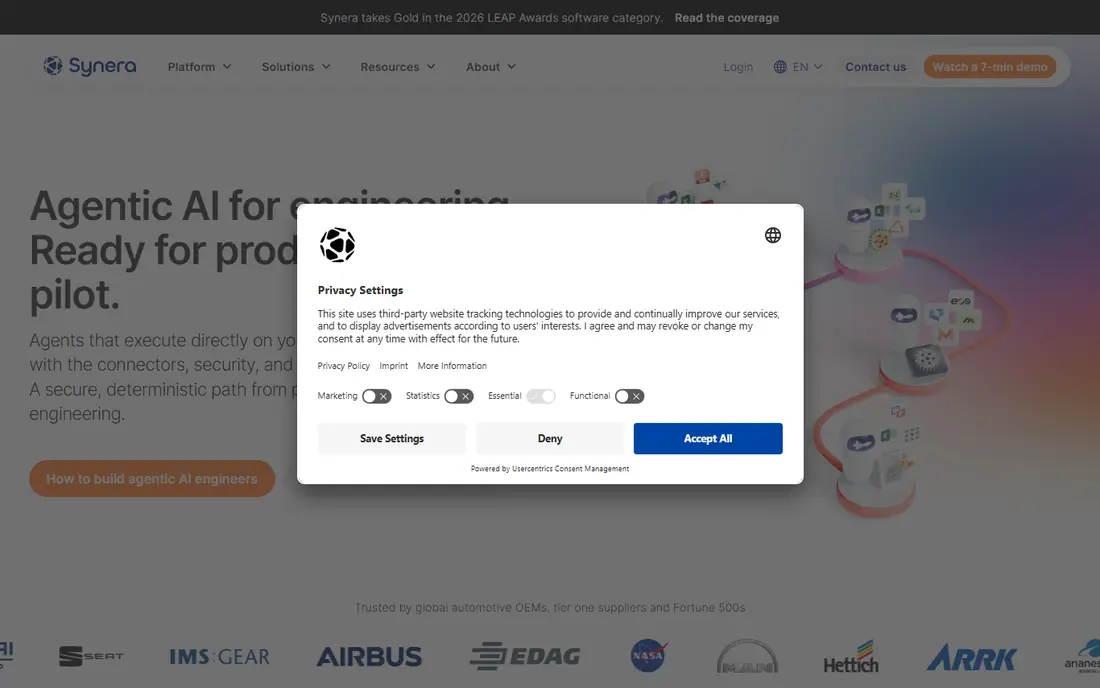
Synera focuses on the messy middle of engineering: moving work between CAD, simulation and optimisation tools without constant manual handoffs. Its AI agents can run routine engineering workflows, prepare simulation inputs and track results, which frees engineers for design decisions rather than file handling. The platform lists integration with many hardware engineering tools, and on-premise deployment helps firms with strict data rules.
The trade-off is that automation only helps if the workflow is clear. Teams should map one repeatable process, such as a design check or a simulation run, before expanding. Synera is not a general chatbot for engineers. It is a workflow platform, and its value grows with each standard process you move onto it.
- Connects many engineering tools
- AI agents for design and simulation tasks
- On-premise option
- Enterprise pricing
- Setup needs engineering process mapping
InfinitForm targets a familiar pain: a design that looks good in CAD but is costly or hard to make. Its platform checks designs for manufacturability across traditional methods, not just additive manufacturing, and helps engineers weigh performance against cost early. That early check can prevent late redesigns, which are often the most expensive kind.
Because it is a newer vendor, buyers should ask for a pilot on their own parts and methods, not just a demo on sample geometry. The fit will depend on whether your production methods match the platform's checks. For design-heavy firms with repeatable parts, a pilot is worth the time. For one-off custom work, the benefit may be smaller.
- Manufacturing-first design checks
- CAD workflow links
- Cost and performance trade-offs
- Newer vendor
- Fit depends on your manufacturing methods
Databricks is the data platform pick. Many industrial AI projects fail because sensor, quality and production data live in separate systems, and Databricks gives data teams one place to clean, join and model that data. From there, teams can build predictive maintenance models, quality models and production dashboards on the same foundation.
It is not a plug-and-play factory app. You still need data engineering, clear data ownership and a plan for getting data out of machines and historians. If your team already has data skills, Databricks is a strong core. If not, pair it with a connectivity tool or a managed service, or the platform will sit unused.
- Unified data and AI work
- Scales across plants
- Strong analytics tooling
- Needs data engineering skill
- Not a factory-floor control system
Litmus solves the first step that many AI plans skip: getting reliable data off the floor. It connects to machines, sensors and industrial systems, processes data at the edge, and sends clean data to analytics, cloud or plant systems. Without that layer, AI models work on stale or partial data, and results stay unreliable.
The honest limit is that connectivity alone does not improve a process. You need a use case, such as downtime tracking or quality alerts, and a team ready to act on the data. Litmus is best bought as part of a named project with a clear owner, not as a general data purchase. Once the data flows, other tools on this list become much easier to use.
- Connects shop-floor data sources
- Edge processing
- Links to cloud and analytics tools
- Pricing varies by deployment
- Still needs a downstream analytics plan
AVEVA PI System is a long-standing plant data platform, now part of AVEVA, and it remains common in process and manufacturing plants. It collects time-series data, supports operations views and gives engineers a shared record of what happened on a line. For AI work, that history is valuable, because models need past runs, failures and quality outcomes to learn from.
The catch is that a PI deployment is an enterprise system, not a quick trial. Older installs may need upgrades, data cleanup and access controls before AI teams can use them well. If your plant already runs PI, building on it is sensible. If you are starting fresh, compare it with a lighter connectivity plus analytics stack before committing.
- Long plant data history
- Operations dashboards
- Wide industrial adoption
- Enterprise pricing
- Older deployments may need modernisation work
Guidewheel is the most focused factory pick here. It monitors machines, shows downtime and utilisation, and helps teams see which machines or shifts lose the most time. That clarity often leads to simple fixes, such as changeover, staffing or maintenance changes, before any complex AI model is needed.
The scope is also the limit. Guidewheel will not design parts, run simulations or replace a full data platform. It is a good first AI-adjacent step for a factory that does not yet trust its production numbers, because it turns machine activity into a shared, visible record. Once that record is trusted, predictive and quality projects have a much stronger base.
- Fast machine monitoring setup
- Downtime and utilisation views
- Factory-floor focus
- Focused scope
- Larger analytics may need another platform
How we picked these
We compared official feature pages, pricing pages, vendor announcements and public reviews for industrial AI platforms, and we favoured tools with a clear industrial use case, current availability and a stated deployment model. We grouped them by design, data, simulation and operations, rather than ranking a single winner for every factory. We did not claim hands-on testing, and where pricing is sales-led we wrote See website instead of guessing a figure.
How to choose the right industrial AI platform
Start with one measurable problem, not with a platform. A good first problem has a clear owner, a clear cost and data you can already access, such as unplanned downtime, scrap rate or design rework. If the data does not exist yet, start with connectivity and monitoring, even if that feels less exciting than a full digital twin.
Next, check who will run the system after the pilot. Industrial tools need maintenance, sensor checks, model updates and user training, and a pilot that only works while the vendor is on site will fade fast. Ask for a pilot on your own data and parts, a clear data ownership agreement, and a plan for security and network access on the shop floor. Finally, compare total cost, including integration, hardware and staff time. The licence is often the smallest part of an industrial project, and the cheapest platform can become the most expensive if it needs a rebuild to fit your machines.
Frequently asked questions
What is the best AI platform for industrial engineering?
There is no single best platform, because design, simulation, factory data and operations are different jobs. Use Synera or InfinitForm for engineering workflows and design checks, Litmus or AVEVA PI System for plant data, and Siemens or NVIDIA Omniverse for digital twins and simulation.
What are the best AI platforms for industrial engineering teams on a small budget?
Start with a focused monitoring tool such as Guidewheel, or a connectivity tool that fits your machines, and prove one use case before buying a wide platform. Small teams often get more value from downtime and quality visibility than from a large suite they cannot staff.
Do industrial AI platforms replace engineers?
No, they change where engineers spend time. Automation can handle routine checks, data gathering and repeat simulations, but design judgement, safety decisions and process changes still need experienced engineers. Treat AI output as a draft or a flag to check, not as an automatic approval.
How long does an industrial AI pilot take?
A focused pilot often takes weeks to a few months, depending on data access, sensor work and integration. Pilots that need new sensors, network changes or major data cleanup take longer, so agree the scope, data sources and success measure before work starts.
Is factory data safe in cloud AI platforms?
It depends on the platform, the deployment and your controls. On-premise and edge options exist for sensitive data, and many vendors offer private deployment, access controls and audit logs. Check data residency, network access and who can see raw machine data before signing.
What skills does a team need for industrial AI?
You need a mix of process knowledge, data skills and IT support. Process engineers know what matters on the line, data staff clean and model the data, and IT staff handle networks, security and system upkeep. A project without process ownership often produces neat dashboards that nobody acts on.
Sources we checked (8)

Online Jobs is an independent blog about careers, online work, learning new skills and the tools that help people earn. More about us.
Keep reading
All posts
n8n Alternatives
n8n alternatives compared for 2026, with Zapier, Make, Activepieces, and more, covering visual builders, code steps, self-hosting, and pricing models.

ZoomInfo Alternatives
The best ZoomInfo alternatives in 2026, compared on price, free plans, data coverage, and which tool fits small teams or large sales teams best in detail.

Yotpo Alternatives
Find cheaper alternatives to Yotpo for reviews and loyalty, with Judge.me, Loox, Stamped, and more compared for Shopify stores in 2026, all in one guide.