Best AI Novel Writing Software in 2026: 8 Products Compared

How we put this together: we compare official feature and pricing pages, app store listings, privacy policies and public user reviews. Prices change, so check the provider's site before you pay.
Key takeaways
- Sudowrite suits most novelists who want fiction-specific drafting, rewriting, and story help in one tool.
- Novelcrafter suits series writers who need a strong codex and control over which AI model they use.
- NovelAI suits writers who want flat-fee generation and fewer content limits on adult or dark fiction.
- Squibler suits writers who want structured drafting and fast manuscript creation.
- ChatGPT, Claude, ProWritingAid, and WordWriter work best as helpers for brainstorming, feedback, and editing, not as a full novel system alone.
Quick comparison
| Name | Who it suits | Starting price | Free option | |
|---|---|---|---|---|
 Sudowrite | Fiction drafting and story help | See website | Free trial | Visit |
 Novelcrafter | Worldbuilding and model control | See website | Free trial | Visit |
 NovelAI | Flat-fee fiction generation | See website | Free trial | Visit |
 Squibler | Structured drafting and fast manuscripts | Free | Yes | Visit |
 ChatGPT | Brainstorming and general drafting help | Free | Yes | Visit |
 Claude | Feedback and long document editing | Free | Yes | Visit |
 ProWritingAid | Manuscript editing and revision | See website | Free trial | Visit |
 WordWriter | Fiction research, planning, and drafting | See website | Free trial | Visit |
The best ai novel writing software
A novel needs more than word generation. It needs plot logic, character consistency, world rules, voice, and pacing across tens of thousands of words. The tools below are judged on how well they support that long-form work, not just on how fast they can produce a paragraph. Fiction-specific tools lead, while general assistants and editors play supporting roles.
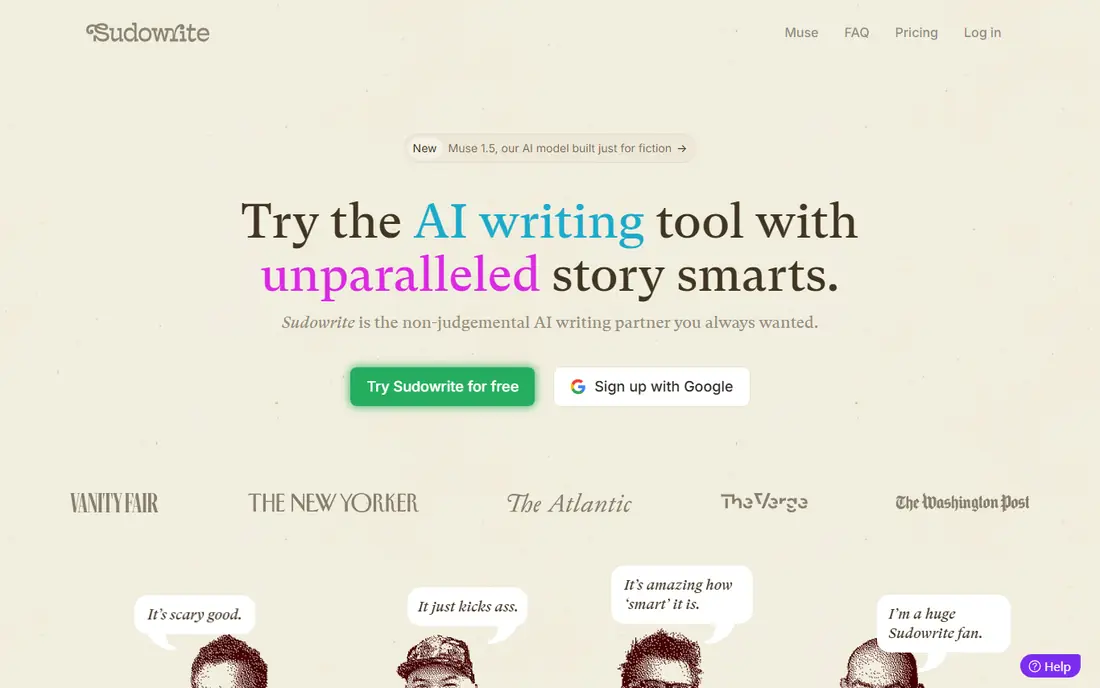
Sudowrite is built for fiction writers, with tools for drafting, expanding scenes, rewriting in your voice, describing settings, and brainstorming plot turns. Its Story Bible helps the model remember characters, plot points, and world details while drafting, which matters when a novel grows beyond a few chapters. That story awareness is the main reason Sudowrite leads for most novelists.
Sudowrite runs on monthly credits, so writers should check how credits are used by drafting, rewriting, and brainstorming before choosing a plan. It suits writers who want a creative partner at the sentence and scene level, not just a blank chat box. Try a trial on a real chapter to see whether the prose and story tools fit your voice.
- Fiction-tuned drafting and rewriting
- Story Bible for continuity
- Brainstorming and description tools
- Credit-based pricing needs monitoring
- Long novels need careful story management
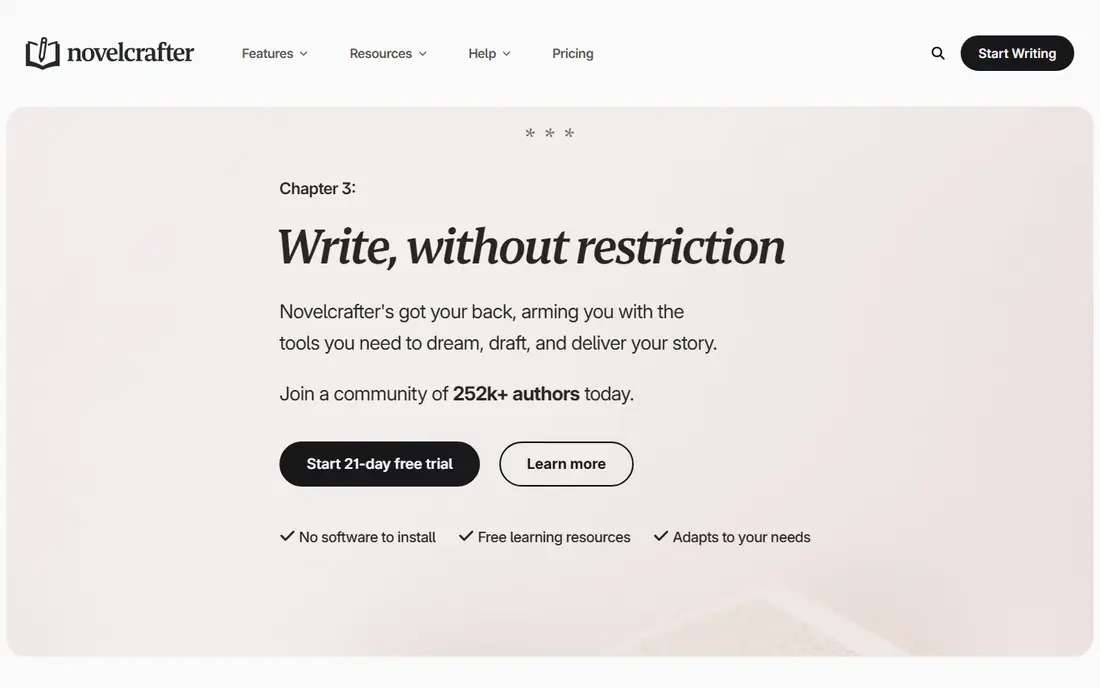
Novelcrafter is built for writers who plan complex novels, especially series, fantasy, and science fiction with heavy lore. Its Codex stores characters, locations, magic systems, timelines, and other world details, and feeds relevant entries to the AI while drafting. Writers can also choose which AI model to use by connecting their own API key, which gives control over cost and style.
Novelcrafter suits a writer who is willing to invest an hour in setup to gain long-term continuity. The trade-off is complexity: a writer who wants to start drafting in minutes may prefer Sudowrite. Check the current plan tiers, what the Codex includes, and how API costs are billed, since those costs sit outside the Novelcrafter subscription.
- Strong Codex for characters, lore, and world rules
- Bring-your-own model key
- Structured novel planning
- Setup takes time
- API costs are separate from the subscription
- Learning curve is steeper
NovelAI is a fiction generation platform with a flat monthly fee, which suits writers who generate a lot of text and want predictable costs. Its lorebook helps keep world details consistent, and its approach to content limits makes it a common choice for romance, horror, and dark fantasy writers who face refusals in general assistants. The platform also supports image generation for characters and scenes.
NovelAI is less strong on structured planning and story management than Novelcrafter or Sudowrite. It fits best as a drafting engine for writers who already know their plot and want to generate prose without credit anxiety. Check the current plan tiers and generation limits, since flat-fee plans still have fair-use and model limits.
- Flat monthly fee with generous generation
- Fewer content limits for adult and dark fiction
- Lorebook for world details
- Planning tools are thinner than Novelcrafter
- Interface takes time to learn
Squibler helps writers plan and draft books with structured chapters, scenes, and notes, plus AI tools for drafting and outlining. It suits writers who want a clear structure before they write, and who want to move from outline to full manuscript without switching tools. The free tier makes it easy to test the workflow on a short project before paying.
Squibler is not as deep on fiction-specific prose generation as Sudowrite, and its planning tools are simpler than Novelcrafter's Codex. It fits best for writers who value structure and speed, and who want a simple path from idea to draft. Test the chapter and scene workflow on a real outline to see whether it matches how you plan a novel.
- Structured book and chapter planning
- Fast draft creation
- Free tier for starting out
- AI depth is thinner than Sudowrite
- Advanced features need paid plans
ChatGPT is a useful general assistant for novelists, even though it is not built for novels. It helps brainstorm plots, develop characters, outline chapters, rewrite scenes, and give feedback on a draft. Writers often use it for stuck moments, dialogue ideas, and structural questions, then move the best material into a fiction tool or document.
ChatGPT lacks a built-in story bible or codex, so continuity across a long novel depends on the writer pasting context and tracking details manually. That makes it a helper, not a full novel system. Use it for brainstorming and feedback, and pair it with Sudowrite or Novelcrafter when you need story-aware drafting across many chapters.
- Strong brainstorming and outlining
- Flexible drafting help
- Free tier for everyday use
- No built-in novel memory or codex
- Long novels need manual continuity work
- Adult content limits apply
Claude suits novelists who need thoughtful feedback on a long draft. It can read a chapter or a full manuscript section, point out pacing issues, flag inconsistent character behaviour, and suggest structural fixes in a clear, structured way. Writers also use it for brainstorming, outlining, and rewriting, especially when tone and nuance matter.
Claude does not replace a fiction tool with a story bible, since it has no built-in codex for long-term world tracking. It works best as a second reader and editor, alongside a drafting tool. Use it for developmental feedback after a draft exists, rather than as the sole engine for generating a whole novel from scratch.
- Strong long-document handling
- Careful feedback and developmental notes
- Good for revision
- No built-in novel codex
- Web freshness is less relevant for fiction
- Best features need a paid plan
ProWritingAid is an editing tool for writers, with reports on grammar, style, readability, pacing, dialogue, and overused words. Novelists use it after a draft is complete, to catch errors, tighten prose, and prepare a manuscript for beta readers or submission. It integrates with tools such as Scrivener, Google Docs, and Word, so editing can happen where the manuscript already lives.
ProWritingAid is not a drafting tool, and it should not be judged as one. Its value appears at the revision stage, when a writer needs a systematic pass over a long text. Check which reports are included on the free tier versus paid plans, and run a sample chapter through it before buying, since report depth varies by plan.
- Deep grammar, style, and readability analysis
- Manuscript reports
- Integrations with common writing tools
- It edits, it does not draft a novel
- Full reports need a paid plan
WordWriter is a fiction writing platform that combines research, planning, drafting, and style matching for novelists. It suits writers who want genre-specific tools and a single workspace for moving from idea to manuscript, rather than juggling separate research and drafting apps. Style matching helps keep prose closer to a chosen voice or genre pattern.
WordWriter is newer than Sudowrite and Novelcrafter, so writers should test it on a real project before committing to a long novel. Check the current plan, what drafting and planning features are included, and how exports work. It fits best as a primary workspace for writers who value an all-in-one fiction workflow.
- Fiction-focused research and drafting
- Genre tools and style matching
- Planning and manuscript workflow
- Newer and less proven than Sudowrite
- Feature depth varies by plan
How we picked these
We reviewed official feature pages, pricing pages, and product documentation for AI novel writing tools, plus public comparisons for fiction writers in 2026. We kept tools that are actively sold, that support fiction drafting, planning, or editing, and that have a current product presence. Where pricing is credit-based, tiered, or varies by plan, we wrote See website rather than repeating a third-party figure. We did not claim hands-on testing, and we focused on documented features, plan structure, and fit for long-form fiction.
Choosing by stage: planning, drafting, or editing
A novel has stages, and different tools suit each stage. For planning and worldbuilding, Novelcrafter and Squibler lead. For drafting prose, Sudowrite and NovelAI lead. For feedback, ChatGPT and Claude help. For editing, ProWritingAid leads. Many writers use two tools: one for drafting and one for editing. That stack is often better than searching for one tool that does every stage well.
Protect voice, continuity, and ownership
AI drafting can flatten voice if a writer accepts every output without revision. Keep a style guide, a character sheet, and a plot outline outside the AI tool, and revise generated prose in your own voice. Check each tool's policy on training data and ownership, since policies vary and matter for unpublished work. Avoid pasting a full unpublished manuscript into a tool you have not reviewed for privacy.
Budget for credits and API costs
Credit-based tools and bring-your-own-key tools have different cost patterns. Sudowrite credits depend on how much you generate and rewrite, while Novelcrafter API costs depend on the model you choose and how much text you send. Track usage for a month on a real chapter before choosing a plan size. A flat-fee tool such as NovelAI may be cheaper for high-volume drafting, even if its planning tools are thinner.
Test on a real chapter, not a prompt
A short demo prompt will not show whether a tool keeps continuity across chapters. Test each shortlisted tool on one real chapter: draft a scene, rewrite a paragraph, add a character detail, and check whether the next scene remembers it. That test reveals story memory, voice control, and workflow friction better than any feature list. Keep the tool that survives that test, not the one with the most features.
Frequently asked questions
What is the best AI tool for writing novels?
Sudowrite is the best single choice for most novelists, because it combines fiction drafting, rewriting, and story continuity in one tool. Novelcrafter is better for complex series worldbuilding, while NovelAI is better for high-volume, flat-fee drafting. The best tool depends on whether your main need is prose quality, world tracking, or predictable cost.
What are the best AI tools for novel writing for beginners?
Squibler and Sudowrite are good starting points for beginners. Squibler offers a free tier and a structured workflow, while Sudowrite offers a trial and fiction-specific help that guides drafting. Start with a short story or a single chapter, and learn one tool well before adding a second tool to the stack.
Can AI write a whole novel for you?
AI can draft scenes and chapters, but a publishable novel still needs human editing for voice, plot logic, pacing, and emotional depth. Writers who publish AI-assisted work usually revise heavily, check continuity, and rewrite key scenes themselves. Treat AI as a drafting partner, not as a replacement for the author.
Which AI novel writing tool is best for fantasy and worldbuilding?
Novelcrafter is the strongest choice for fantasy and worldbuilding, thanks to its Codex for characters, lore, magic systems, and timelines. Sudowrite also helps with story continuity through its Story Bible. For a long series, a codex tool is more important than raw generation speed, since continuity errors grow with each book.
Do AI novel tools train on my writing?
Policies vary by tool and plan, so check the privacy policy and terms for each product before uploading an unpublished manuscript. Some tools state that user content is not used for training, while others have different rules for free versus paid tiers. When in doubt, avoid pasting a full manuscript into a tool until you have confirmed its policy.
What is the best free AI tool for writing novels?
Squibler offers a free tier for structured drafting, while ChatGPT and Claude offer free tiers for brainstorming and feedback. Those free tiers can cover early planning and short drafts, but a full novel usually needs a paid fiction tool for story memory and sustained drafting. Start free, then upgrade when a limit affects real writing progress.
Sources we checked (8)

Online Jobs is an independent blog about careers, online work, learning new skills and the tools that help people earn. More about us.
Keep reading
All posts
n8n Alternatives
n8n alternatives compared for 2026, with Zapier, Make, Activepieces, and more, covering visual builders, code steps, self-hosting, and pricing models.

eBay Alternatives
Looking for ebay alternatives? We compared 9 marketplaces for sellers on fees, buyer reach, categories and ease of listing, to help you sell with confidence.

ZoomInfo Alternatives
The best ZoomInfo alternatives in 2026, compared on price, free plans, data coverage, and which tool fits small teams or large sales teams best in detail.