Best AI Mode SEO Analysis Software in 2026: 8 Products Compared

How we put this together: we compare official feature and pricing pages, app store listings, privacy policies and public user reviews. Prices change, so check the provider's site before you pay.
Key takeaways
- AI Mode SEO analysis is wider than rank tracking: it should connect AI mentions to content, technical issues, and classic rankings in one view.
- SE Ranking, Semrush, and Ahrefs give the broadest analysis for teams that already do classic SEO, while Surfer and Clearscope focus on content analysis.
- Moz Pro and Peec AI suit teams that want authority or prompt analysis without a very large suite, but check AI Mode coverage per plan.
- Because AI surfaces change fast, treat any analysis feature as current only if the vendor site names AI Mode on the plan you buy.
Quick comparison
| Name | Who it suits | Starting price | Free option | |
|---|---|---|---|---|
 SE Ranking | All-round AI SEO analysis | See website | Free trial | Visit |
 Semrush | Broad suite analysis | See website | Free trial | Visit |
 Ahrefs | Link and content analysis | See website | Free trial | Visit |
 Surfer SEO | On-page content analysis | See website | Free trial | Visit |
 Moz Pro | Authority-led SEO analysis | See website | Free trial | Visit |
 Profound | Enterprise AI analysis | See website | Free trial | Visit |
 Peec AI | Prompt and gap analysis | See website | Free trial | Visit |
 Clearscope | Content briefs and grading | See website | Free trial | Visit |
The best ai mode seo analysis software
We compared official feature pages, pricing pages, and public reviews for tools that analyze SEO performance in AI search, not just track a single rank.
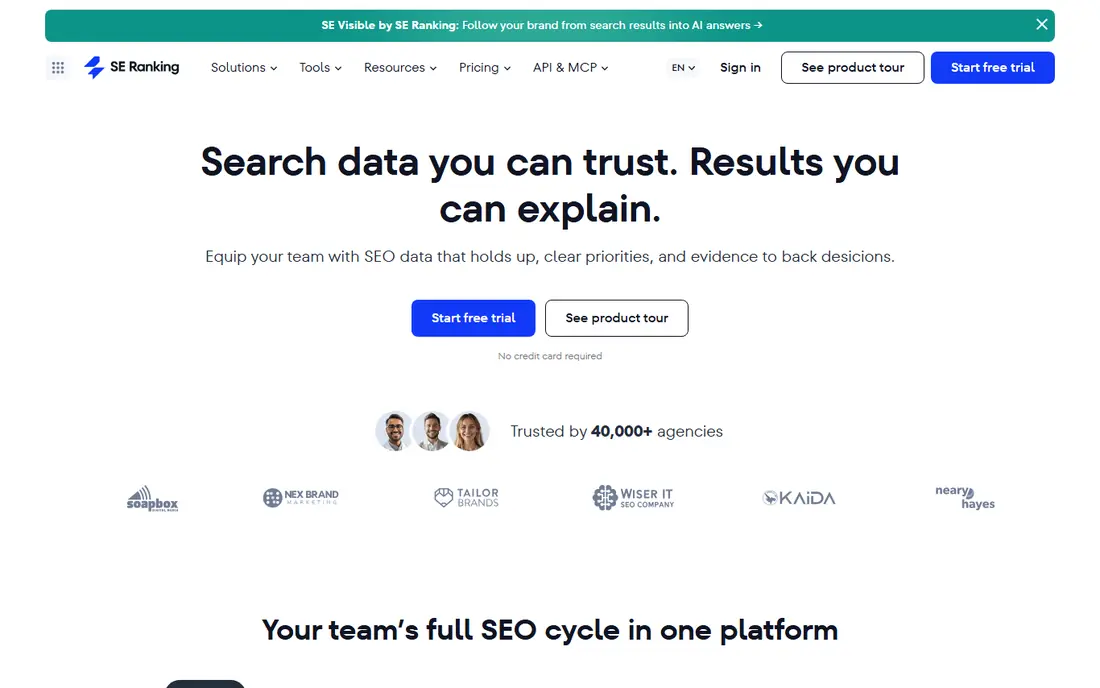
SE Ranking is a strong all-round analysis tool because it puts AI visibility next to classic SEO data. You can see a site audit issue, a classic rank change, and an AI mention change in the same workspace, which helps you judge whether a content fix actually helped AI visibility or only helped a classic rank. Agency reporting also makes it easier to share that analysis with a client in a readable form.
The limit is tiering, as with many suites in this fast-changing area. AI analysis features, prompt limits, and engine coverage vary by plan and by add-on, so check the current plan page for AI Mode specifically. For a small or mid-sized team that wants one tool for analysis across classic and AI search, SE Ranking is a practical first choice.
- AI visibility beside audits, ranks, and backlinks
- Clear reports for agencies
- Daily checks on many plans
- AI analysis depth varies by tier
- Check AI Mode inclusion on your plan
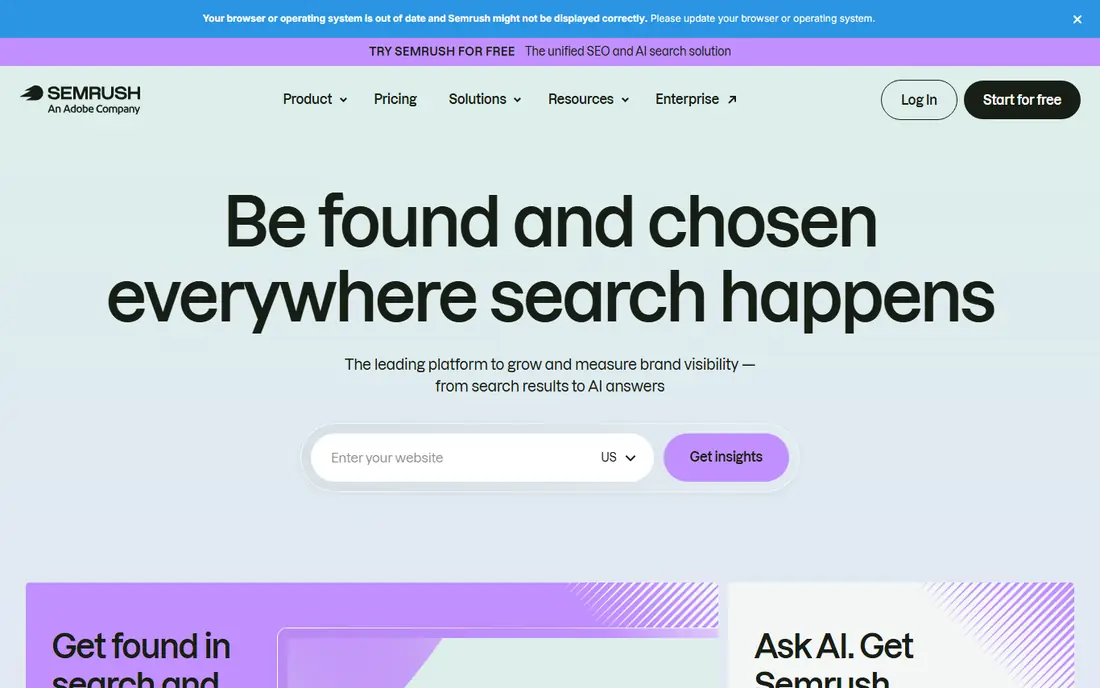
Semrush analyzes AI search as part of a much larger SEO picture. Its keyword research, content toolkit, site audit, and competitor gap tools sit beside AI visibility tools, so you can move from an AI gap to a content brief to a technical fix without exporting data between tools. That breadth suits content-led teams and agencies that publish at volume and need analysis across many pages.
Semrush is priced in tiers, and AI visibility may sit in a toolkit with its own price per domain. Check that toolkit price before you budget, and check how many domains and prompts it covers. If you already use Semrush for classic SEO, its AI analysis is a natural extension. If you only need AI analysis, a smaller tool may be simpler.
- Keyword, content, competitor, and AI tools in one suite
- Large databases
- Traffic and backlink context
- AI toolkit may need a separate price
- Large interface takes time to learn
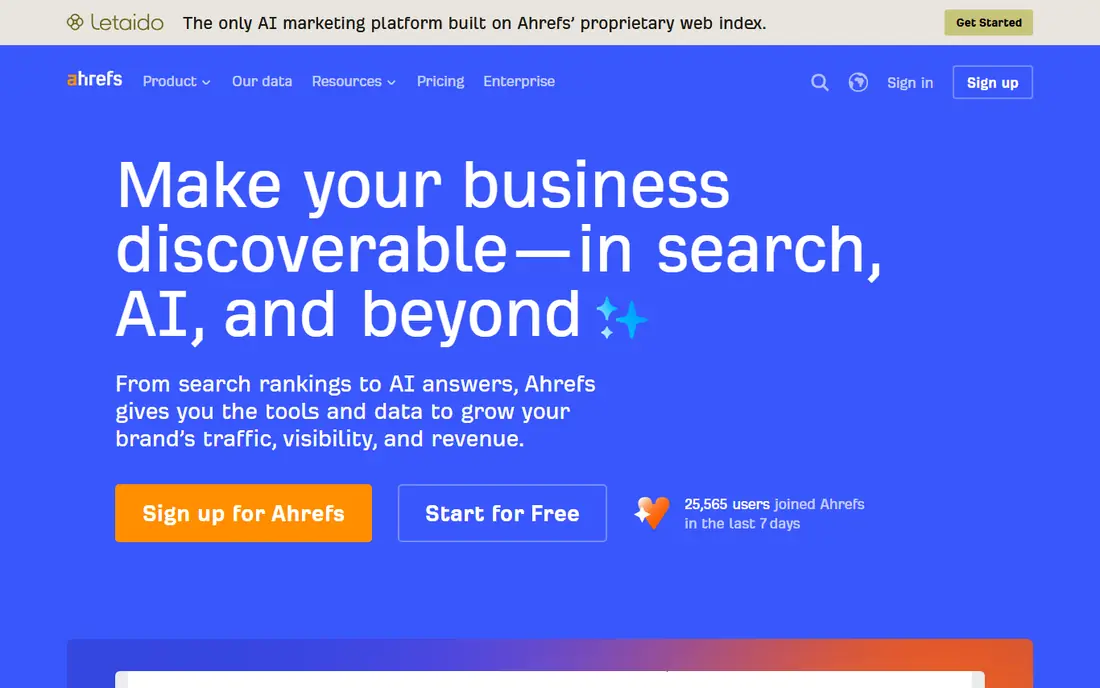
Ahrefs analyzes SEO from a link and content base, which still matters in AI search because cited pages tend to be pages that other trusted pages link to and that answer a question clearly. Its keyword tools, content explorer, and site audit help you find which pages should be cited, while Brand Radar adds AI mention analysis on top. That combination of classic strength plus AI mentions is why many SEOs keep Ahrefs active even as AI search grows.
The catch is that Brand Radar is a separate product with its own pricing, so AI analysis is not automatically included in a core Ahrefs plan. Check Brand Radar prompt limits and engine coverage, including AI Mode, before you assume full coverage. For link-led analysis with an AI layer, Ahrefs is a strong pairing.
- Independent backlink index
- Strong keyword and content analysis
- Brand Radar for AI mentions
- Brand Radar is separate
- Full platform is priced for teams that publish often
Surfer SEO analyzes content page by page, which is exactly where many AI visibility problems live. If an AI answer cites a competitor instead of you, the gap is often in how directly your page answers the prompt, how clear its headings and tables are, or which related terms it covers. Surfer scores a draft against top pages and AI-visible content, and gives writers a clear list of terms and structure to improve.
Surfer is not a full technical audit or backlink platform, so teams still need a suite for those jobs. Its strength is content analysis for writers and editors who publish often. If your AI problem is mainly content, Surfer gives you a practical workflow from analysis to a better draft, without the weight of a full enterprise suite.
- Content scoring and optimization guidance
- AI prompt tracking described on its site
- Clear editor for writers
- Focus is on-page, not full technical audits
- Price rises with higher tiers
Moz Pro analyzes SEO through authority metrics, keyword tracking, and site audits, with AI visibility dashboards described in recent guides as part of its newer features. That authority-led view helps in-house teams judge whether a page is likely to be trusted by search and AI systems, and whether a competitor gap is about links, content, or both. Reporting is clear enough for managers who do not live in SEO tools every day.
Moz Pro AI coverage should be checked per plan, since guides describe AI dashboards and tracked prompts rather than a single standard feature across all tiers. Moz also does not match Semrush or Ahrefs on raw database size in every area. For an in-house team that values clear authority analysis and readable reports, Moz Pro is a solid analysis choice.
- Authority metrics and keyword analysis
- AI visibility dashboards described in guides
- Clear reporting for in-house teams
- AI features vary by plan
- Database depth differs from Semrush and Ahrefs
Profound analyzes AI search at enterprise depth. It tracks how a brand appears across engines, breaks answers down by persona or prompt type, and helps large teams link AI visibility to content and brand work. That analysis depth matters when an executive team needs to know not just whether a brand was mentioned, but in what context, with what sentiment, and against which competitors.
Profound pricing and plan limits need direct checking, and the platform is built for larger budgets. A small site with 50 prompts will likely get the analysis it needs from SE Ranking, Semrush, or Peec AI at lower cost. A large brand with many products, regions, and agencies will benefit from Profound reporting scale.
- Deep AI answer analysis across engines
- Persona-based views
- Enterprise reporting and integrations
- Priced for larger teams
- Overkill for a small site with few prompts
Peec AI analyzes AI search prompt by prompt, which is the right level for gap work. You can see which prompts cite you, which cite competitors, and where your content is missing from an answer entirely. That gap view turns a vague goal, such as improve AI visibility, into a concrete list of pages to fix, prompts to target, and competitors to study.
Peec AI does not do full technical audits or backlink analysis, so pair it with a classic suite if you need those jobs. For analysis, its strength is focus: a small team can open Peec AI, see its top gaps, and act on them without wading through a large suite. Check prompt limits and engine coverage, including AI Mode, on the pricing page for your plan.
- Prompt-level AI visibility
- Share of voice and gap views
- Competitor citation analysis
- Specialist scope, so classic audit and link analysis need another tool
Clearscope analyzes content quality and relevance, which is a core part of AI SEO analysis. Its reports grade a draft against top-ranking and AI-visible content, suggest related terms and headings, and help writers build briefs that answer a prompt fully. Recent guides also describe AI query tracking in ChatGPT and Gemini on some plans, which links content work to AI visibility more directly.
Clearscope is content-only, so it does not replace audits, rank tracking, or link analysis. Cost per report can also add up for a small team that publishes rarely. For content teams that publish often and want a clear, writer-friendly analysis tool, Clearscope gives a focused workflow from brief to graded draft.
- Content grading and briefs based on top pages
- AI query tracking in some plans
- Clear writer guidance
- Content-only focus
- Higher cost per report for small teams
How we picked these
We compared official feature pages, pricing pages, and public reviews for tools that analyze AI search visibility, content, or site performance in October 2026. We favored tools that are available today, that name AI Mode or AI answer analysis on their sites or in recent guides, and that serve different jobs from suite analysis to content-only analysis. Where a price or AI Mode feature could not be verified on the vendor site at the time of writing, we wrote See website instead of inventing a feature or a figure. We did not claim hands-on testing.
How to analyze SEO for AI Mode
Start with prompts, not just keywords. List the questions customers actually ask, in their own words, and run those prompts in AI Mode, ChatGPT, Gemini, and Perplexity. Note which domains are cited, which pages are cited, and whether your page appears at all. That prompt set becomes your analysis baseline, and it is more useful than a keyword list alone for AI work.
Next, analyze the cited pages. Open competitor pages that AI answers cite and check how they structure an answer: direct answer near the top, clear headings, tables, lists, and sources. Compare that structure with your page. Check technical basics too, such as whether the page loads, is indexed, and is crawlable, since a page AI systems cannot access cannot be cited. Use a suite audit for those checks and a content tool for structure and coverage.
Finally, track change over four weeks. AI answers vary by prompt wording, location, and day, so a single check can mislead you. Track the same prompts on the same schedule, note citation changes, and link each change to a content or technical fix you made. That discipline turns AI SEO analysis from a one-off report into a repeatable process.
Content checks that matter most
Check whether the page answers the prompt in the first paragraph, whether headings match the questions people ask, and whether key facts are in a table or list that an AI answer can quote. Check for clear authorship, dates, and sources where relevant, since trust signals help a page get cited. Avoid vague claims and unsupported figures, since AI systems and readers both discount them.
When to use a suite versus a content tool
Use a suite when you need audits, ranks, links, and AI data together for reporting. Use a content tool when your main gap is page structure and coverage and you publish often. Many teams use both: a suite for monthly analysis and a content tool for every draft before it goes live. That pairing keeps analysis broad and writing focused.
Frequently asked questions
What is the best AI Mode SEO analysis software?
SE Ranking is a strong all-round pick, Semrush is strong for a broad suite, and Ahrefs is strong for link-led analysis. Surfer and Clearscope are strong for content analysis. The best pick depends on whether your main gap is technical, content, links, or prompt coverage.
What is the best AI Mode SEO analysis tool for content teams?
Surfer SEO and Clearscope are best for content teams because they grade drafts, build briefs, and show term and structure gaps. Pair a content tool with a suite or a prompt tracker for AI mention data, so you can see whether a better draft actually gets cited.
How is AI Mode SEO analysis different from classic SEO analysis?
Classic analysis focuses on rank position, traffic, and links for a keyword. AI Mode analysis focuses on whether an AI answer mentions or cites you for a prompt, and why a competitor page was chosen instead. Both matter, and the best analysis tools show both views side by side.
Can I analyze AI Mode SEO for free?
Google Search Console gives free first-party data on search performance, including AI surface impressions in its newer reports, but it does not give prompt-level citation analysis like paid tools. Use Search Console for trends and a trial of a paid tool for prompt and gap detail.
How often should I run AI SEO analysis?
Run a full prompt analysis monthly, and a smaller check weekly for top money prompts. AI answers change with prompt wording and model updates, so a monthly trend is more reliable than a daily reaction. Act on gaps that persist for two or more checks.
Do I need both a rank tracker and an analysis tool?
Often, yes, but many suites combine both. A rank tracker tells you where you appear, while an analysis tool tells you why and what to fix. If your suite already includes AI tracking, audits, and content tools, you may not need a separate tracker. If it does not, add a specialist prompt tool for AI data.
Sources we checked (8)

Online Jobs is an independent blog about careers, online work, learning new skills and the tools that help people earn. More about us.
Keep reading
All posts
Best AI Overviews Analysis Software
Best AI Overviews analysis software in 2026: we compare 8 tools that track AI Overview presence, citations, links and traffic impact, with prices and limits.
Best AI Mode Tracking Software
Best AI Mode tracking software in 2026: we compare 8 tools that track brand visibility in Google AI Mode, with prices, engines, prompt limits and fees.
Best AI Mode Rank Tracking Tools
Best ai mode rank tracking tools compared for 2026: we review eight tools that track Google AI Mode, AI Overviews, and chat engine citations in one guide.