Best AI Marketing Automation Platform in 2026: 9 Platforms Compared


All-in-one CRM and marketing · Starting price: See website
How we put this together: we compare official feature and pricing pages, app store listings, privacy policies and public user reviews. Prices change, so check the provider's site before you pay.
Key takeaways
- HubSpot Marketing Hub is our pick for teams that want CRM, marketing, sales, and content in one system with AI across workflows.
- ActiveCampaign suits smaller teams that want deep email automation and AI campaign building at a lower starting price.
- Klaviyo is the strongest choice for ecommerce brands that live on email and SMS revenue.
- Brevo and Mailchimp suit lean teams that need a free or low-cost start before they scale.
- AI features vary sharply by plan, so check whether the AI tool you want is included in the tier you can actually afford.
Quick comparison
| Name | Who it suits | Starting price | Free option | |
|---|---|---|---|---|
| HubSpot Marketing Hub | All-in-one CRM and marketing | See website | Yes | Visit |
 ActiveCampaign | Deep email automation | $15 per month | No | Visit |
 Klaviyo | Ecommerce email and SMS | $20 per month | Yes | Visit |
 Brevo | Low-cost multi-channel | Free | Yes | Visit |
 Mailchimp | Simple email automation | Free | Yes | Visit |
 GetResponse | Landing pages and webinars | See website | No | Visit |
 Omnisend | Budget ecommerce automation | $11.20 per month | Yes | Visit |
 Customer.io | Event-driven messaging | $100 per month | No | Visit |
 HighLevel | Agencies and all-in-one sales | $97 per month | No | Visit |
The best AI marketing automation platforms
We compared AI campaign building, segmentation, predictive sending, CRM depth, channel coverage, and pricing transparency. A platform that looks cheap at entry can become costly once contacts, SMS credits, or AI seats are added.
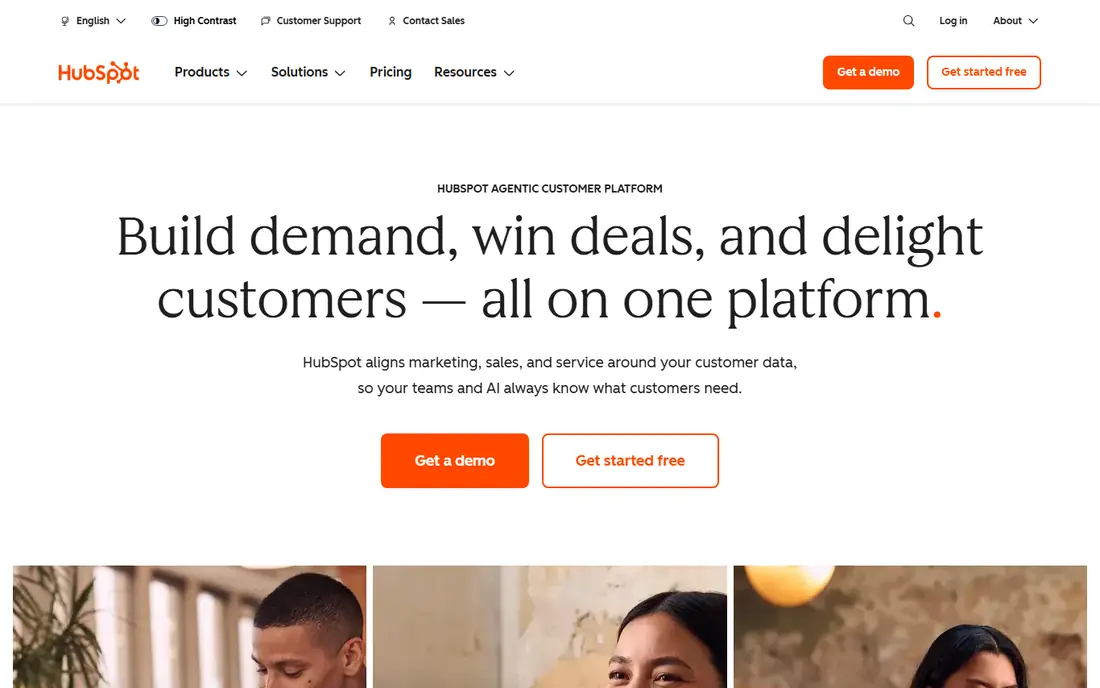
HubSpot fits teams that want one system for contacts, campaigns, sales pipelines, and content, rather than a set of separate tools. The free tier covers basic CRM and marketing tools, which makes it easy to test the workspace before paying. AI features, under the Breeze brand, assist with content, prospecting, and workflow summaries.
The honest catch is the price jump. Starter plans are modest, but Professional automation, advanced reporting, and AI depth cost far more. A small team should map the exact tier needed for its workflows before committing, and should check marketing contact limits as the list grows.
- Smart CRM at the centre
- AI tools across content, social, and prospecting
- Strong reporting and sales integration
- Professional pricing rises sharply
- Deeper automation sits behind higher tiers
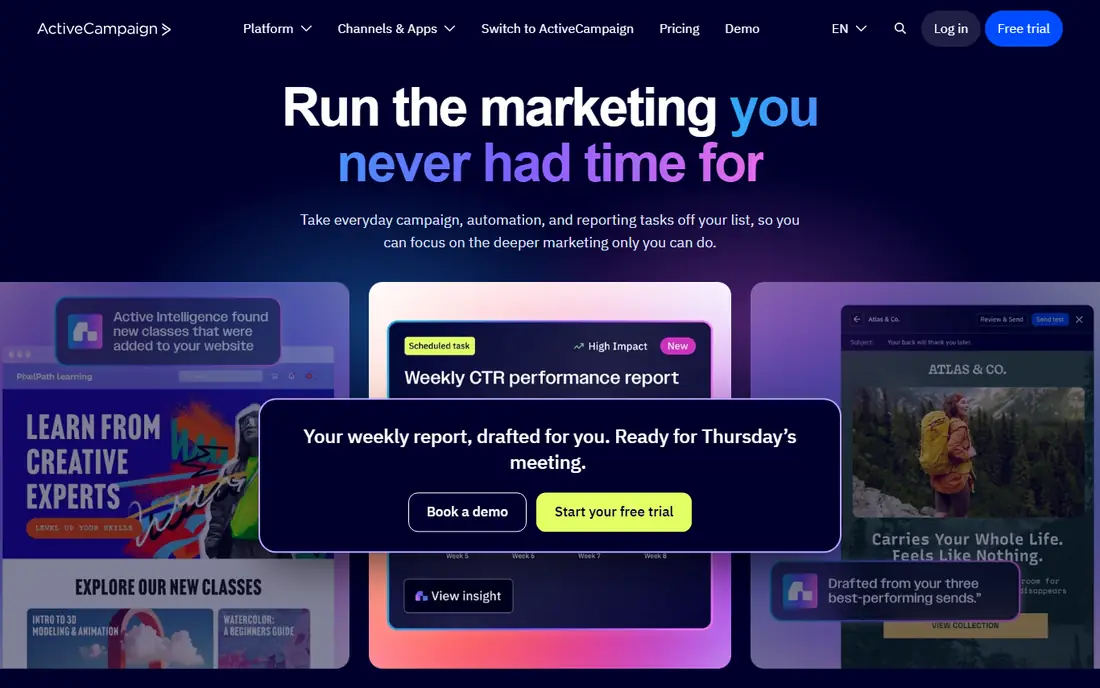
ActiveCampaign suits teams that live on email and want automation logic that goes beyond a simple welcome series. The visual builder supports conditions, splits, goals, and event tracking, while AI tools can turn a prompt into a draft campaign. Predictive sending and segmentation help tailor timing and content by contact behaviour.
The trade-off is complexity. New users may need time to learn the builder and the contact model, and there is no free plan to test at leisure. For a team that will use automation daily, that learning cost pays off quickly. For a team that sends one newsletter a month, a simpler tool may be enough.
- Visual automation builder with deep conditions
- AI campaign builder
- Built-in CRM and predictive features
- Learning curve is steeper than simpler email tools
- No permanent free plan
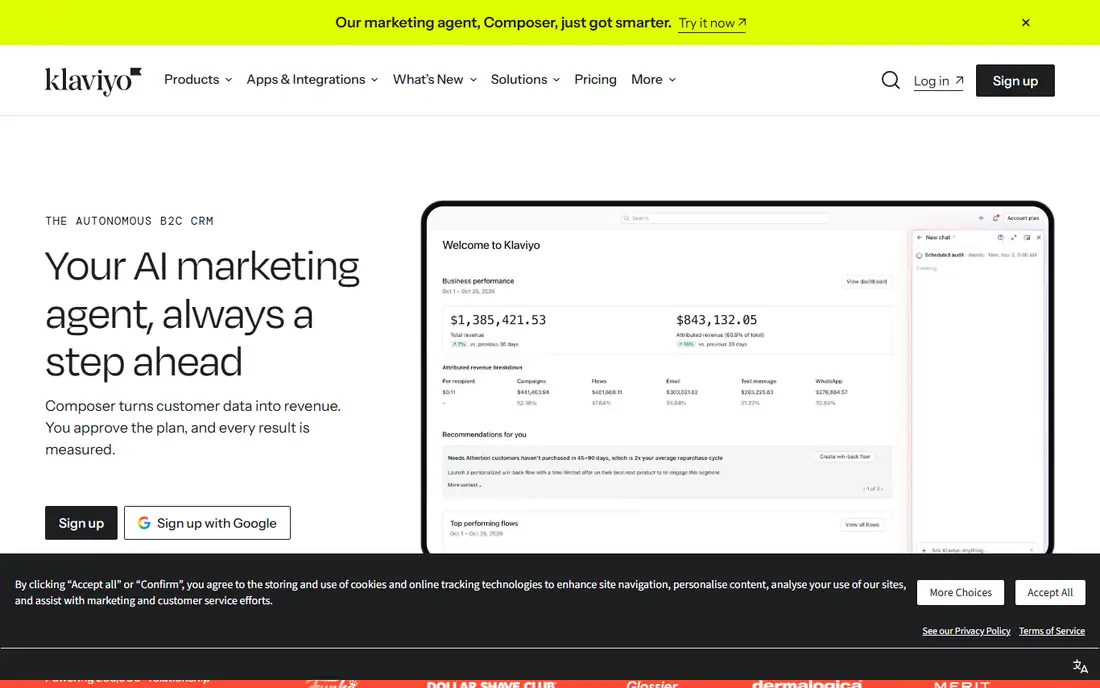
Klaviyo fits online stores that measure marketing in revenue per campaign and per flow. Abandoned cart, post-purchase, and win-back flows sit beside campaigns in one account, with product and order data driving segmentation. AI tools assist with segments, content, and send-time choices.
The catch is scaling cost. Pricing rises with active profiles, and SMS credits are a separate cost that can grow fast. A store with a large but inactive list should clean profiles before paying for a higher tier. For a growing store, the revenue tracking often justifies the bill.
- Deep Shopify and WooCommerce integration
- AI segmentation and flows
- Combined email and SMS in one platform
- Price scales with active profiles
- SMS costs add up
- Best value is ecommerce-specific
Brevo suits small teams that need several channels without paying for a large platform on day one. The free plan covers basic email sending, and paid plans scale by email volume rather than contact count in the usual model. That structure can suit a team with a large list but modest sending volume.
The limit is depth. Complex, event-driven journeys and advanced predictive tools are not Brevo's strongest area. For newsletters, basic flows, and multi-channel messages, it is a practical low-cost start. Teams that outgrow it can move to a deeper automation platform later.
- Free plan for starting out
- Email, SMS, WhatsApp, and chat in one platform
- Pricing based on email volume
- Automation depth is lighter than ActiveCampaign
- Advanced features need higher tiers
Mailchimp fits beginners and small teams that want to send a good newsletter and a few automated flows without a steep learning curve. Templates, audience tools, and a journey builder cover welcome, abandoned cart, and re-engagement basics. The free plan suits a small list testing email for the first time.
The honest catch is growth. As contacts rise, pricing climbs, and teams often find they need deeper segmentation or CRM tools elsewhere. Mailchimp is a fine starting point, but a team with complex journeys should compare ActiveCampaign or HubSpot before the list grows large.
- Easy setup and templates
- Customer journey builder with pre-built flows
- Free plan for small lists
- Automation depth lags rivals
- Price rises with contacts
- Advanced AI features vary by plan
GetResponse suits creators and small businesses that sell through landing pages, webinars, or courses. The platform combines email automation with page building and webinar hosting, so a launch can run without three separate tools. Automation flows cover welcome series, scoring, and cart recovery for stores.
The trade-off is breadth. A team that only needs email may find the extra tools distracting, and pricing should be checked for the exact list size. For a creator-led business, the combined toolkit is the reason to choose it over a pure email tool.
- Landing pages, webinars, and courses in one platform
- Automation builder
- Ecommerce integrations
- Pricing varies by list size and plan
- Interface can feel broad for email-only teams
Omnisend fits small stores that want Klaviyo-style flows without Klaviyo-style pricing at entry. Pre-built flows for welcome, abandoned cart, and post-purchase cover the highest-value automations first. The drag-and-drop builder keeps setup fast for a lean team.
The limit is scale and depth. Larger stores with complex segmentation, SMS-heavy campaigns, or advanced reporting may need Klaviyo or Customer.io. For a new or small store, Omnisend offers a strong balance of price and useful automation.
- Low starting price for ecommerce
- Pre-built automation flows
- Shopify and WooCommerce integration
- Smaller feature set than Klaviyo
- SMS and advanced reporting need higher tiers
Customer.io suits product-led teams that trigger messages from what users actually do in an app or site. Journeys can branch on events, attributes, and timing, which suits onboarding, activation, and retention flows. The platform handles email, SMS, and push from the same journey logic.
The catch is entry cost and setup. At $100 per month to start, it is not a casual newsletter tool, and good event data is required for the journeys to work well. Teams without that data pipeline should fix tracking first, or choose a simpler list-based tool.
- Strong event and behaviour-based journeys
- Email, SMS, and push in one system
- AI agent features for messaging
- Higher starting price
- Setup needs event data and technical care
HighLevel fits agencies and sales-led businesses that manage leads, follow-up, and client accounts in one place. The platform combines CRM, pipelines, funnels, email, SMS, and AI agents for replies and booking. Sub-accounts let an agency run separate client workspaces under one system.
The honest catch is scope. A solo creator who only needs email will pay for tools it never uses, and the full toolkit takes time to learn. For an agency or a team that lives on lead response speed, the combined system can replace several subscriptions at once.
- CRM, funnels, email, SMS, and AI agents in one platform
- Agency and sub-account model
- Strong automation for lead follow-up
- Higher starting price
- Learning curve for the full toolkit
- Best value for agencies and sales-led teams
How we picked these
We compared official pricing pages, AI feature pages, automation documentation, and public reviews, and we kept only platforms that are live with real AI-assisted marketing features in 2026. We favoured clear automation depth, CRM quality, channel coverage, and pricing that a reader can verify. We also noted where AI features are limited to higher tiers, since that changes the real cost of an AI platform.
We did not treat every AI label as equal. Some tools offer AI writing help, while others offer AI campaign building, predictive sending, or autonomous agents. The write-ups name the type of AI help each platform offers, so readers can compare like with like.
What to check before you choose
Start with the journey you need, not the AI label. List the three automations that will earn their keep first, then check which tier includes them.
Contacts, volume, and credits
Check whether pricing is based on contacts, active profiles, email volume, or seats, since each model scales differently. Add SMS credits, AI seats, and add-on costs to the monthly total. A platform that looks cheap for 1,000 contacts can look very different at 20,000.
CRM and data quality
Check how contacts, events, and purchase data flow into the platform. A strong automation builder is weak if the data behind it is messy or incomplete. Clean the list, set up event tracking, and test a journey with a small segment before a full launch.
AI limits and oversight
Check what AI can do on your tier: draft content, build a campaign, choose send time, or act on its own. Keep a human review step for customer-facing messages, especially for pricing, claims, and compliance topics. AI should speed up drafting, not remove accountability for what is sent.
Frequently asked questions
What is the best AI marketing automation platform?
HubSpot Marketing Hub is the best AI marketing automation platform for teams that want CRM, marketing, and sales in one system. ActiveCampaign is better for smaller teams that want deep email automation at a lower starting price. Klaviyo is best for ecommerce brands focused on email and SMS revenue.
What are the best AI marketing automation tools for small businesses?
ActiveCampaign, Brevo, Mailchimp, and Omnisend are the best AI marketing automation tools for most small businesses. Brevo and Mailchimp offer free starts, Omnisend suits small stores, and ActiveCampaign suits teams that need deeper automation. Choose by the journeys you will actually run, not by the longest feature list.
What are the best AI tools for marketing automation in ecommerce?
Klaviyo and Omnisend are the strongest ecommerce choices here, thanks to store integration and pre-built revenue flows. Klaviyo offers deeper segmentation and reporting for larger stores, while Omnisend offers a lower entry price for smaller stores. Both support email and SMS from one platform.
How much does AI marketing automation software cost?
Entry prices in this list range from free plans to $100 per month for Customer.io and $97 per month for HighLevel, with HubSpot Professional far higher. The true cost depends on contacts, email volume, SMS use, and tier. Check the vendor pricing page for your list size before budgeting.
Does HubSpot or ActiveCampaign have better AI automation?
HubSpot offers broader AI across CRM, content, social, and prospecting, which suits teams already on HubSpot. ActiveCampaign offers stronger AI campaign building and predictive automation at a lower starting price for email-led teams. The better choice depends on whether you need an all-in-one system or deep email automation.
Can AI marketing automation replace a marketing team?
No, AI marketing automation can draft content, build flows, and suggest segments, but it cannot set strategy, check claims, or own customer relationships. Keep human review on customer-facing messages and on any automation that affects pricing or promises. The best results come from AI speed plus human judgment.
Sources we checked (9)

Online Jobs is an independent blog about careers, online work, learning new skills and the tools that help people earn. More about us.
Keep reading
All posts
Best Tools for AI Mode
Compare the best tools for AI Mode visibility, from Google Search Console to Semrush, Ahrefs Brand Radar, Peec AI, and Otterly, with prices and limits.
Best SEO Reporting Software
Best SEO reporting software compared for 2026: AgencyAnalytics, Semrush, Ahrefs, SE Ranking and more for agencies, clients and in-house teams in the US.
Best PPC Tools
We compared the best PPC tools in 2026, from Google Ads and Semrush to Optmyzr, WordStream and SpyFu, for agencies, in-house teams and small businesses.