Best AI Brand Visibility Optimization Tools in 2026: 8 Tools Compared

How we put this together: we compare official feature and pricing pages, app store listings, privacy policies and public user reviews. Prices change, so check the provider's site before you pay.
Key takeaways
- Profound is the deepest enterprise option, with broad engine coverage and content tools that act on tracking data.
- Otterly is the best budget entry point for small teams that want to start monitoring AI answers without enterprise pricing.
- Peec AI and AthenaHQ suit mid-market teams that need competitor tracking and multi-engine coverage on a self-serve plan.
- Scrunch, Goodie, and Evertune add different strengths, from crawler analytics to content agents and published methods.
- No tool guarantees a citation, so buy for measurement and content action, not for a promised ranking.
Quick comparison
| Name | Who it suits | Starting price | Free option | |
|---|---|---|---|---|
 Profound | Enterprise depth and content action | See website | Free trial | Visit |
 Peec AI | Competitive positioning and agencies | $95 per month | Free trial | Visit |
 Otterly.AI | Budget monitoring for small teams | $29 per month | Free trial | Visit |
 Scrunch AI | Crawler analytics and technical teams | $250 per month | Free trial | Visit |
 AthenaHQ | Broad self-serve coverage | $295 per month | Yes | Visit |
 Goodie | Brands wanting agents and attribution | $295 per month | No | Visit |
 Evertune | Published method and prompt credits | $60 per month | No | Visit |
 Rankscale | Many engines on credit pricing | $99 per month | Free trial | Visit |
The best AI brand visibility optimization tools
AI search now answers questions directly, which means a brand can lose traffic even when its website still ranks. These tools track how often AI engines mention, cite, and recommend a brand, and the better ones turn that data into content work. Coverage, prompt limits, and pricing models differ sharply, so match the tool to your team size and budget.
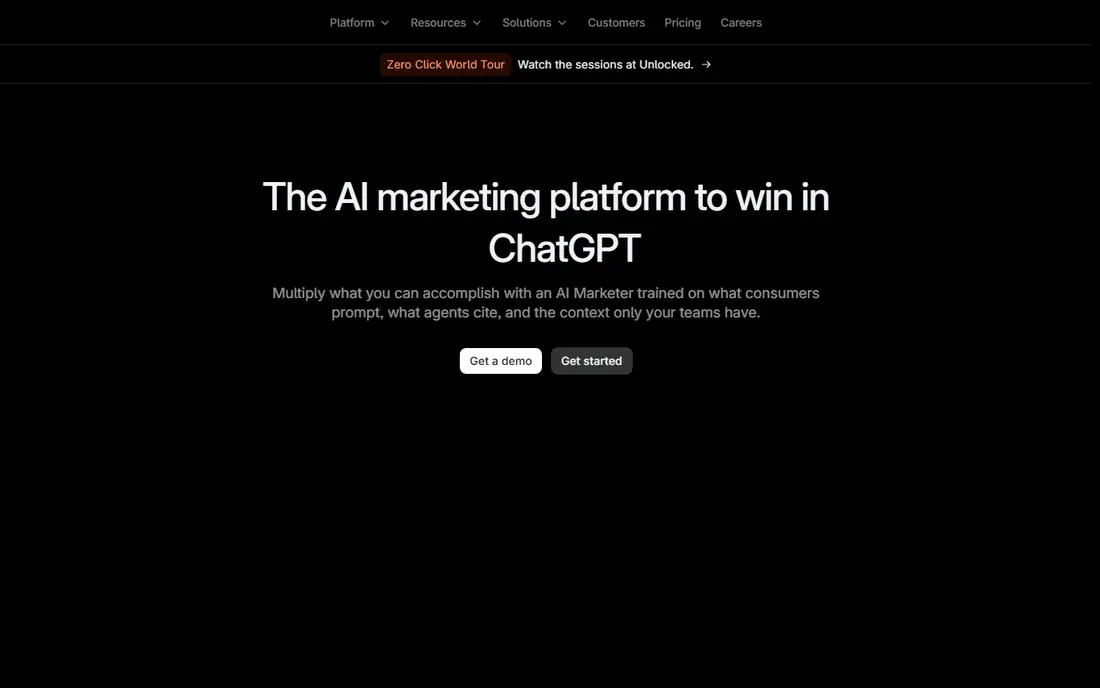
Profound is the most complete platform in this category for large brands. On enterprise plans it tracks up to nine answer engines, including ChatGPT, Perplexity, Google AI Overviews, Google AI Mode, Gemini, Claude, Copilot, Grok, and DeepSeek, and it connects crawler activity to analytics through integrations with common hosting and analytics tools. That breadth matters when a brand is mentioned differently across engines.
The platform also goes beyond tracking. Credit-based content agents draft AI-ready content and optimization recommendations based on what the tracking data shows, which closes the gap between measurement and action. The catch is price and packaging, since enterprise pricing is custom and entry plans cover fewer engines. Large teams with a real AI search budget will get the most from Profound.
- Broad engine coverage on enterprise plans
- Citation and prompt volume data
- Content agents that draft fixes
- Enterprise pricing is custom
- Entry plans cover fewer engines
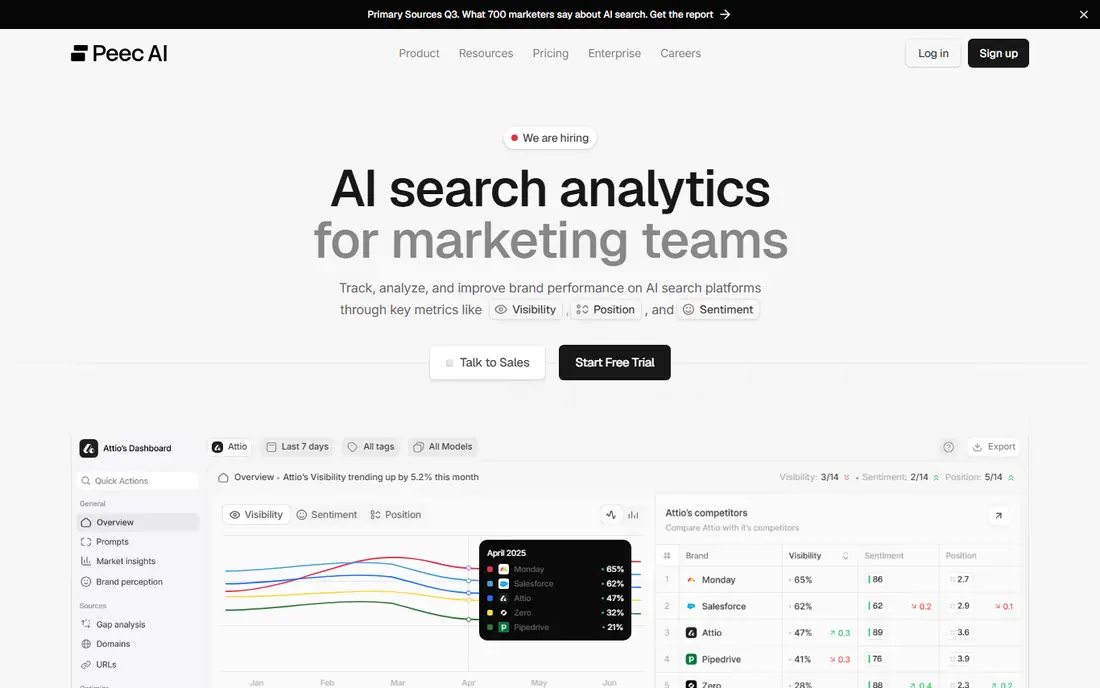
Peec AI is built around a simple question, which is how your brand compares with competitors in AI answers. It tracks prompts across major models, shows source and citation patterns, and supports multi-market tracking for brands that operate in more than one country. Agency plans add multi-client workspaces, which suits firms reporting AI visibility to several clients.
Entry pricing starts at $95 per month for a limited prompt set and a subset of models, with full coverage on higher tiers. That structure is fair for a mid-market team testing the category, but a buyer who needs every engine on day one should price the higher plan before signing. For competitive benchmarking, Peec is one of the strongest self-serve options.
- Strong competitor tracking
- Multi-market tracking
- Unlimited users on many plans
- Entry plan covers a subset of models
- Full engine coverage needs higher tiers
Otterly.AI is the best starting point for a small team that wants real AI visibility data without an enterprise contract. The Lite plan starts at $29 per month and covers core engines with a small prompt set, plus Google AI surfaces that matter for many brands. A free trial with no card required lets you test the data on your own brand before paying.
The limits are clear. Entry prompt counts are small, and some engines are add-ons, so a growing brand will outgrow Lite quickly. Otterly also lacks the content agents and deep crawler analytics of larger platforms. As a first monitor that proves whether AI search matters for your brand, it is hard to beat on price.
- Lowest entry price here
- Covers core engines
- Unlimited workspaces on some plans
- Fewer engines than enterprise tools
- Prompt limits are tight on the entry plan
Scrunch AI appeals to technical teams because it treats AI visibility as a data problem, not just a dashboard. It tracks brand presence across seven or more engines, analyzes citations, and connects AI crawler behavior to site performance, which helps teams fix the pages that AI engines actually read. Entry pricing is published, with a Starter plan around $250 per month billed annually.
That price puts Scrunch above budget tools, and its depth suits teams that will act on crawler data rather than just read reports. Smaller brands that only need a monthly mention check will find Otterly cheaper. For a mid-size or enterprise team with developers and SEOs working together, Scrunch is a strong pick.
- Strong crawler and citation analytics
- Broad engine coverage
- Published entry pricing
- Higher entry price than budget tools
- Technical focus may suit larger teams best
AthenaHQ offers broad engine coverage on a credit-based model, with a free Essential plan that lets a team test the data before paying. The Starter plan at $295 per month includes thousands of credits, where one credit equals one answer, and covers many engines including Claude. That breadth on a self-serve plan is rare at this price point.
The catch is credit math. Prompt volume, engine count, and tracking frequency all consume credits, so a team with many prompts can burn through a plan faster than expected. Price your real prompt set before signing, and use the free plan to validate the data quality. For larger teams that want broad coverage without an enterprise sales cycle, AthenaHQ is a credible option.
- Broad engine coverage
- Credit-based plans
- Free Essential plan for testing
- Starter price is high for small teams
- Credit math needs care at scale
Goodie pairs visibility tracking with agents that turn findings into action lists, which suits brands that want a plan, not just a chart. It tracks major engines, surfaces citation and sentiment patterns, and adds attribution features that help connect AI visibility to traffic and outcomes. Entry pricing starts at $295 per month for a defined prompt set and one brand.
The absence of a free plan means you should use a demo or trial terms carefully before committing, and the entry price rules it out for solo founders. For a brand team that will work through action lists every week, Goodie offers a clearer path from data to content than a tracking-only tool.
- Content agents and action lists
- Attribution features
- Broad engine coverage
- No free plan
- Entry price is high for small brands
Evertune stands out because it publishes its method, which matters in a category where every vendor claims to measure the same thing differently. Entry pricing at $60 per month billed annually includes thousands of prompt credits across up to five engines, making it one of the cheaper ways to get sustained monitoring. That suits larger advertisers and communications teams that need a defensible number.
The trade-off is depth on entry tiers and the lack of a free plan. Evertune is less of a content creation tool than Profound or Goodie, so teams that want agents to draft fixes will need another tool. For measurement-first buyers who value method and price, Evertune is a strong choice.
- Published method for credibility
- Prompt credits at a lower entry price
- Up to five engines
- No free plan
- Smaller prompt depth than enterprise tools on entry tiers
Rankscale suits SEO teams moving into AI search because it combines a wide engine list with credit-based pricing and an API. The Pro plan at $99 per month includes a large credit allowance, and higher plans add more engines and volume. That flexibility helps teams that track many prompts across many engines without paying enterprise prices.
Credit pricing is also the catch, since prompt count, engine count, and frequency all affect consumption, and comparing Rankscale with prompt-based tools takes care. A free trial and a no-signup analysis tool help validate the data first. For SEO-led teams that want broad coverage on a flexible plan, Rankscale deserves a shortlist spot.
- Wide engine list
- Credit-based Pro plan
- API and integrations for SEO teams
- Credit pricing can be confusing
- Enterprise features need higher plans
How we picked these
We compared official feature pages, pricing pages, and documentation, along with current pricing summaries checked in October 2026. Only tools that exist and work today for AI brand visibility made the list, and we favored tools with published pricing or a clear trial path. Prices that vary by plan, credits, or annual billing are shown as listed, and where a vendor does not publish a price we used See website.
How to buy without overpaying
Start with a prompt set, not a tool. List the questions your buyers actually ask, plus the competitor comparisons they run, and count how many prompts you need across how many engines. That count decides whether a $29 plan, a $95 plan, or a $295 plan fits, and it stops you from paying for engine coverage you will never read.
Next, check what the tool counts. Some tools price by prompt, others by answer or credit, and tracking frequency changes the total fast. Run a trial on your own brand and two competitors, and check whether citations match what you see when you ask the same questions directly. Finally, ask who will act on the data, since a dashboard nobody opens is wasted spend even at a low price.
What these tools cannot do
No visibility tool can guarantee that an AI engine will cite or recommend your brand. Citations depend on your content, your reputation across the web, and the engine itself, all of which change. Use these tools to measure, find gaps, and guide content work, and treat any vendor promise of a guaranteed ranking with skepticism.
Frequently asked questions
What is the best AI brand visibility optimization software?
Profound is the deepest enterprise option, while Peec AI and AthenaHQ suit mid-market teams on self-serve plans. Small teams should start with Otterly, and measurement-first buyers should compare Evertune and Rankscale.
How do AI brand visibility tools work?
They run a set of prompts through AI engines such as ChatGPT, Perplexity, and Gemini, then record whether your brand is mentioned, cited, or recommended, and how that compares with competitors. Better tools also show which pages were cited and what content gaps to fix.
What is the cheapest AI visibility tool?
Otterly starts at $29 per month, and Evertune starts at $60 per month billed annually. AthenaHQ also offers a free Essential plan with limited credits, which is useful for testing before paying.
Can these tools improve my AI search visibility?
They can guide improvement by showing which prompts you miss, which pages get cited, and what competitors do differently. Actual improvement still depends on publishing clear, citable content and earning mentions across the web.
How many AI engines should I track?
Track the engines your buyers actually use, which for most brands means ChatGPT, Perplexity, Google AI Overviews, and Gemini first. Add Claude, Copilot, and others only when your audience or market makes them relevant.
Sources we checked (8)

Online Jobs is an independent blog about careers, online work, learning new skills and the tools that help people earn. More about us.
Keep reading
All posts
n8n Alternatives
n8n alternatives compared for 2026, with Zapier, Make, Activepieces, and more, covering visual builders, code steps, self-hosting, and pricing models.

ZoomInfo Alternatives
The best ZoomInfo alternatives in 2026, compared on price, free plans, data coverage, and which tool fits small teams or large sales teams best in detail.
Workday Alternatives
We compared the best workday alternatives for HR, payroll, and global hiring, from BambooHR and Gusto to Rippling, Deel, and HiBob for growing teams in 2026.