Best AI Apps for Learning English in 2026: 8 Apps Compared

How we put this together: we compare official feature and pricing pages, app store listings, privacy policies and public user reviews. Prices change, so check the provider's site before you pay.
Key takeaways
- Start with your weakest skill, because speaking, pronunciation, grammar and vocabulary need different apps, and no single app does all four equally well.
- Duolingo suits a daily habit and vocabulary, while ELSA Speak suits pronunciation work and Speak suits open conversation practice.
- A free plan is useful for testing, but speaking feedback, unlimited lessons and AI conversation usually sit on paid plans.
- Check whether the app gives feedback on your actual speech, or only asks you to repeat phrases, because that difference decides speaking progress.
- Combine an app with real listening and reading, because an app alone will not build fluency without exposure to natural English.
Quick comparison
| Name | Who it suits | Starting price | Free option | |
|---|---|---|---|---|
 Duolingo | Daily habit and vocabulary | See website | Yes | Visit |
 ELSA Speak | Pronunciation and accent work | $11.99 per month | Yes | Visit |
 Speak | Open AI conversation practice | $17.99 per month | Free trial | Visit |
 Babbel | Structured grammar and dialogues | See website | Free trial | Visit |
 Busuu | Short lessons with community feedback | See website | Yes | Visit |
 TalkPal | Budget AI tutor across topics | $9.99 per month | Yes | Visit |
 Praktika | Avatar role-play for beginners | See website | Free trial | Visit |
 Loora | Coach-style spoken practice | See website | Free trial | Visit |
The best ai apps for learning english list
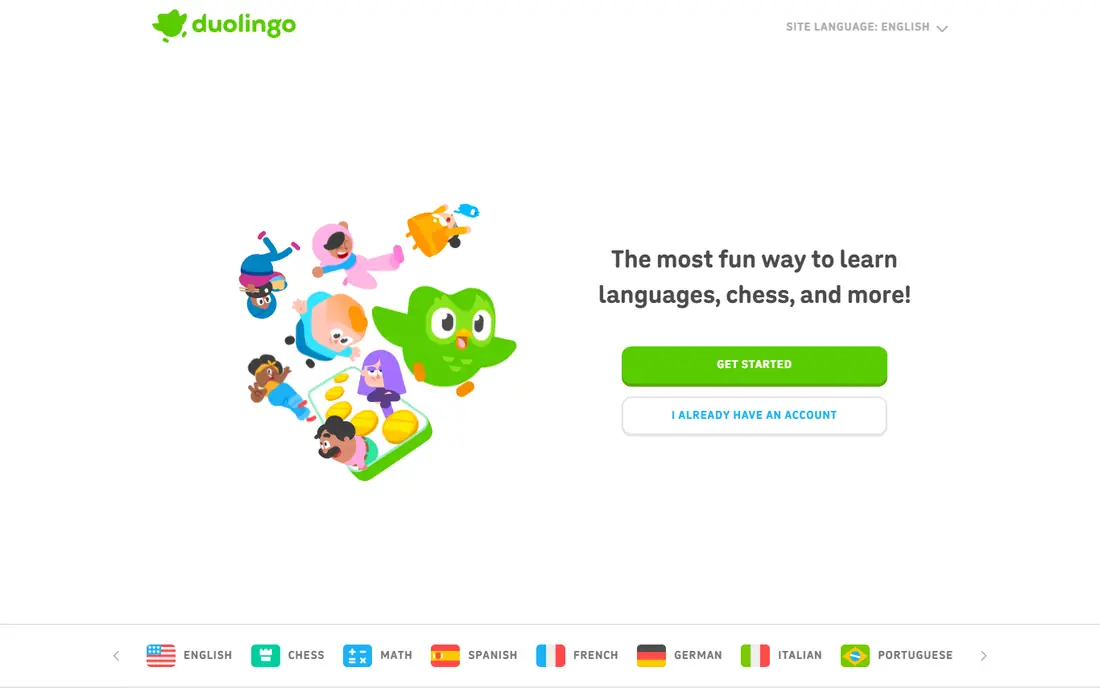
Duolingo is the easiest way to start learning English and keep going every day. Its short lessons cover vocabulary, grammar, listening and basic speaking, with streaks, levels and rewards that help learners return daily. The free plan is genuinely usable, which makes it a good first app for beginners who are not yet sure how much they will study.
The limit is depth for speaking. Duolingo teaches useful language and builds a habit, but it does not give the detailed pronunciation feedback of ELSA Speak, nor the open conversation practice of Speak. Its AI features, including role-play and video calls in higher tiers, add conversation, but they cost extra. Duolingo fits best as a daily foundation, paired with a speaking app if speaking is your main goal.
- Free core lessons
- Short gamified sessions that build a daily habit
- Wide range of topics and levels
- Speaking feedback is limited compared with specialist apps
- AI conversation features sit on higher tiers
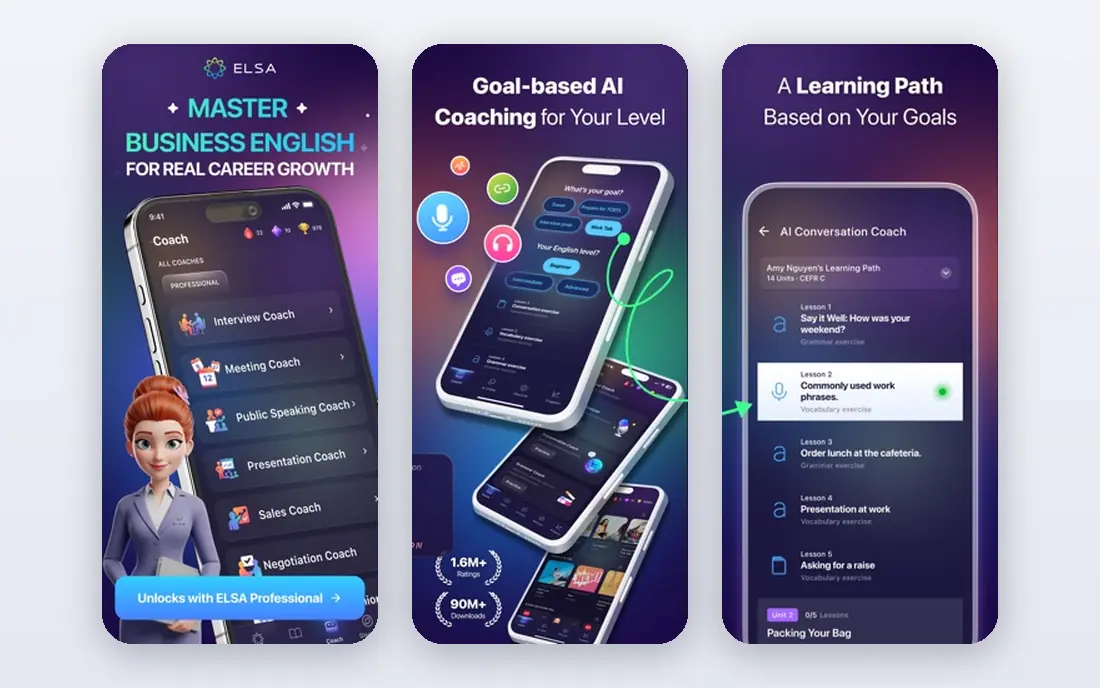
ELSA Speak is the specialist choice for pronunciation. It listens to your speech, compares it with native speaker models and gives feedback on specific sounds, word stress and intonation, rather than only marking an answer right or wrong. That detail helps learners who are understood in writing but struggle to be understood when speaking, and it helps with common sound pairs that cause confusion.
The trade-off is scope. ELSA Speak does not try to teach full grammar courses or wide vocabulary in the same way as Duolingo or Babbel, so most learners will use it alongside another app. Its free plan is limited, and the best pronunciation paths need a subscription. For a learner whose main goal is clearer speech, ELSA Speak is the strongest single pick in this list.
- Detailed feedback on individual sounds, stress and intonation
- Structured pronunciation lessons
- English-focused content
- Narrower than general apps for grammar and vocabulary
- Full features need a paid plan
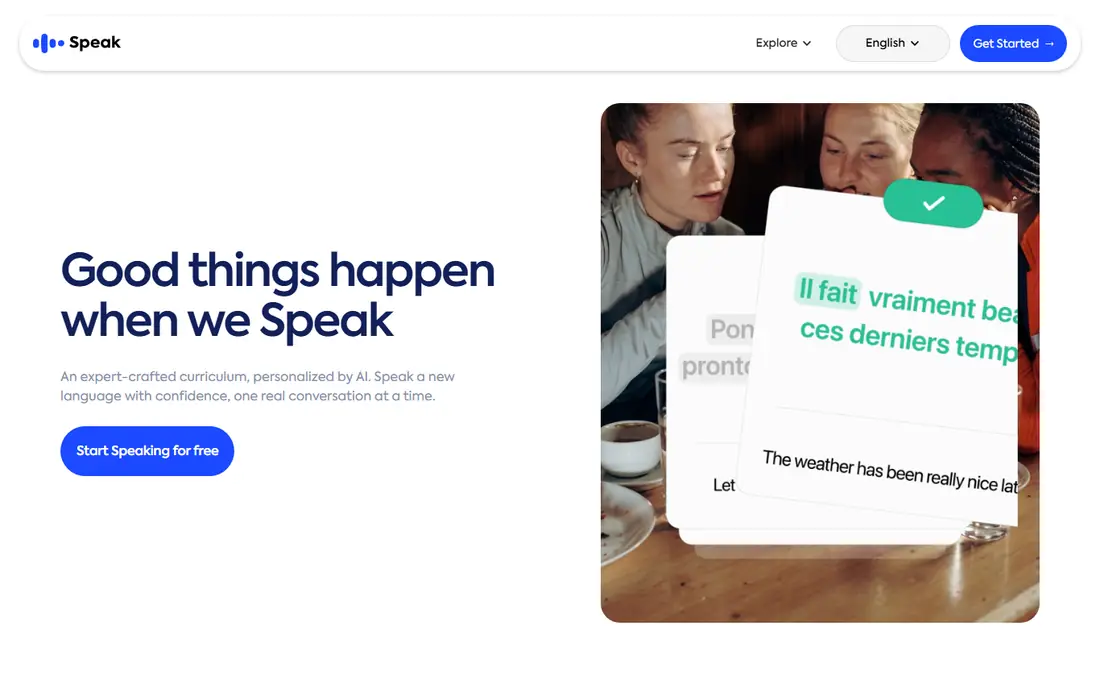
Speak is built around talking. Instead of only completing set exercises, you have open conversations with an AI tutor about everyday topics, work situations or travel, and you receive feedback on mistakes and better phrasing. That format suits learners who already know basic English but need confidence and fluency in speaking, because it forces you to produce language rather than only recognise it.
The drawback is price and structure. Speak costs more than Duolingo or TalkPal, and it offers a trial rather than a free plan, so you need to test it quickly. Learners who need a structured grammar course may also want a second app. Speak fits best for intermediate learners who want regular speaking practice without booking a live tutor for every session.
- Open-ended AI conversation
- Feedback on grammar and vocabulary during talks
- Speaking-first design
- Higher price than budget apps
- No free plan, only a trial
- Less structured grammar teaching
Babbel suits learners who want a clear course structure rather than only games or open chat. Its lessons build grammar and vocabulary through dialogues based on real situations, such as work, travel and daily life, with explanations that show why a form is used. Review sessions help move new words into longer-term memory, which matters for learners who forget vocabulary quickly.
The limit is AI depth. Babbel has added voice-led speaking practice, but its AI conversation features are not as central as in Speak or Loora, and some features are app-only. Babbel fits best for learners who like a planned course and want to understand grammar, with speaking practice added through a second app if needed.
- Structured courses with real-life dialogues
- Grammar explanations in context
- Review and speaking exercises
- AI speaking features are newer and app-only in some cases
- No full free plan
Busuu combines short structured lessons with feedback from a community of learners, including native speakers who can correct written and spoken exercises. That human feedback is a useful complement to AI scoring, because it can explain natural phrasing that a model might miss. Its lessons are organised by level, so a learner can follow a clear path from beginner to intermediate and beyond.
The trade-off is that Busuu is not primarily an AI tutor. Its AI and personalisation features are lighter than in Speak, ELSA Speak or Praktika, and the free plan covers only part of the course. Busuu fits best for learners who want structured lessons plus human corrections, and who are comfortable paying for the full course.
- Short CEFR-levelled lessons
- Community corrections from other learners
- Study plans and review tools
- AI features are less central than in specialist apps
- Full lessons need a paid plan
TalkPal is a budget AI tutor that lets you practise English through role-play, debates, calls and chat, with feedback on grammar and vocabulary. Its low annual price makes it an accessible way to get regular AI conversation without paying for a premium speaking app. The range of modes also helps learners who get bored with one exercise type, because they can switch from a job interview role-play to a debate or a casual chat.
The free tier is small, with only a short daily practice amount, so serious learners will need the paid plan. Feedback quality also varies by mode, and TalkPal does not match ELSA Speak for detailed pronunciation work. It fits best as a low-cost AI tutor for learners who want varied conversation practice on a budget.
- Low entry price
- Role-play, debate and call modes
- Covers many languages besides English
- Free tier is limited to a short daily amount
- Feedback depth varies by mode
Praktika uses avatar tutors to make speaking practice feel less like a test and more like a conversation. Beginners can practise everyday scenarios, such as ordering food, asking for directions or talking about work, with an avatar that responds naturally and gives feedback. That lower-pressure format helps learners who feel shy speaking English with a real person.
The limit is level. Advanced learners who need complex discussion, professional language or exam preparation may find Praktika too simple, and pricing is shown mainly inside the app rather than on a clear web pricing page. Praktika fits best for beginners and lower-intermediate learners who want to build speaking confidence through role-play.
- Avatar tutors make role-play less intimidating
- Conversation scenarios for everyday life
- Beginner-friendly design
- Pricing is mainly in the app
- Less suitable for advanced learners who need complex discussion
Loora is a coach-style AI app for spoken English, with free-form conversation and feedback on fluency, grammar and vocabulary. It suits learners who want a tutor-like experience focused on speaking, rather than a course of set lessons. Sessions feel like talking with a coach who listens, corrects and keeps the conversation moving, which helps build fluency over time.
The drawback is pricing clarity, because Loora pricing varies by app store and plan, and the app is mainly mobile. Learners who prefer studying on a computer may find that limiting. Loora fits best for learners who mainly study on a phone and want regular spoken practice with a coach-style tutor.
- Coach-style free-form conversation
- Feedback on fluency, grammar and vocabulary
- Focused on spoken English
- Pricing varies by platform and plan
- Mainly mobile, with limited web access
How we picked these
We compared official feature pages, pricing pages and app-store listings for each app, and we checked that each product is a current English learning offering in October 2026. We favoured apps with English-specific content, speech recognition or conversation practice, and a free plan or trial so learners can test the app before paying. We also weighed fit for different levels, because a beginner app can be poor value for an advanced learner, and the reverse is also true.
We did not claim hands-on testing for every product. Where pricing varied by region, platform or billing period, we marked it as See website, so you can confirm the current figure in your app store before you subscribe.
What to check before you pay
Start with your main weakness. If people struggle to understand you, choose a pronunciation app first. If you understand English but freeze when speaking, choose a conversation app first. If you lack vocabulary and grammar, choose a structured course first. Buying the wrong type of app is the most common waste in this category.
Test speech feedback on your own voice
Use a free plan or trial to speak, not only to read. Check whether feedback names the sounds or grammar points you missed, or only gives a general score. General scores feel encouraging, but specific feedback is what helps you improve. Test with sentences you actually use at work or in daily life, not only with app examples.
Check lesson length and daily time
An app that needs 30 minutes a day will fail if you only have 10 minutes. Check lesson length, offline access and whether progress saves across phone and web. A short daily habit you keep is worth more than a long course you abandon after a week.
Avoid paying for two apps that do the same job
Many learners buy Duolingo, Babbel and Busuu together, then use only one. Pick one structured app, plus one speaking or pronunciation app if speaking is a goal, and use both for at least two weeks before adding a third. Cancel the one you do not use, rather than keeping it for a future plan that never starts.
Frequently asked questions
What is the best AI app for learning English?
There is no single best app for every learner, because the right choice depends on your level and weakest skill. Duolingo suits a daily habit, ELSA Speak suits pronunciation, Speak suits open conversation, and Babbel suits structured grammar. Start with your main goal, then shortlist two apps and test them for a week.
What is the best AI tool for learning English speaking?
Speak and Loora suit open spoken practice, while ELSA Speak suits pronunciation detail and Praktika suits beginner role-play. For speaking fluency, an app that lets you talk freely and gives feedback on real sentences is more useful than an app that only asks you to repeat phrases. Pair speaking practice with listening to natural English each day.
What is the best AI English learning app for beginners?
Duolingo and Praktika suit beginners best, because Duolingo builds vocabulary and grammar through short lessons, and Praktika builds speaking confidence through avatar role-play. Beginners should start with short daily sessions and add pronunciation work with ELSA Speak once basic vocabulary is in place.
Is Duolingo good for learning English?
Duolingo is good for building a daily habit, vocabulary and basic grammar, and its free plan is genuinely usable. It is less strong for detailed speaking feedback and advanced conversation, so learners who need speaking fluency should pair it with a speaking app such as Speak, Loora or TalkPal.
Can AI apps replace a human English teacher?
AI apps can replace much of the practice, feedback and habit-building that a teacher provides, but they do not fully replace a human teacher for complex discussion, exam strategy or personalised correction. Many learners do best with an app for daily practice plus occasional human lessons for speaking confidence and feedback on real-life language use.
How much do AI English apps cost?
Entry prices in this list range from free plans for Duolingo, ELSA Speak, Busuu and TalkPal to $9.99 per month for TalkPal, $11.99 per month for ELSA Speak and $17.99 per month for Speak, with other apps priced in the app store or on their websites. Check billing period carefully, because annual prices look lower per month than monthly prices.
Sources we checked (8)

Online Jobs is an independent blog about careers, online work, learning new skills and the tools that help people earn. More about us.
Keep reading
All posts
Best Vocabulary Apps
We compare 8 vocabulary apps in 2026, free and paid, for English learners, students, and test prep, with honest notes on what each one does best for daily use.
Best Udemy Alternatives
Explore the best Udemy alternatives for 2026, including Coursera, Skillshare, and LinkedIn Learning, with pricing, certificates, and who each platform suits.
Best Tools for Virtual Tutoring
Compare the best tools for virtual tutoring, from one-to-one tutor marketplaces to free self-paced learning, with pricing, subjects and honest limits.