Best AI Agent for Customer Service in 2026: 8 Agents Compared


Digital-first teams wanting fast deployment · Starting price: $29 per seat per month
How we put this together: we compare official feature and pricing pages, app store listings, privacy policies and public user reviews. Prices change, so check the provider's site before you pay.
Key takeaways
- Helpdesk-native agents are fastest to start, because they already know your tickets, articles, and customer history.
- Per-resolution pricing suits variable volume, while enterprise agents use quote-based contracts with setup and platform fees.
- Intercom Fin and Zendesk offer the clearest published AI pricing, while Sierra, Decagon, and Ada are quote-only.
- Handoff quality matters more than resolution claims, because a bad handoff creates a second, angrier ticket.
Quick comparison
| Name | Who it suits | Starting price | Free option | |
|---|---|---|---|---|
| Intercom Fin | Digital-first teams wanting fast deployment | $29 per seat per month | Free trial | Visit |
 Zendesk AI Agents | Teams already on Zendesk | $55 per agent per month | Free trial | Visit |
 Salesforce Agentforce | Firms standardized on Salesforce | See website | Free trial | Visit |
 Freshworks Freddy AI Agent | Budget teams on Freshdesk | $19 per agent per month | Free trial | Visit |
 HubSpot Customer Agent | Teams already on HubSpot | See website | Free trial | Visit |
 Ada | High-volume multilingual support | See website | No | Visit |
 Decagon | High-volume consumer brands | See website | No | Visit |
 Sierra | Large brands wanting branded agents | See website | No | Visit |
The best AI agent for customer service
An AI customer service agent answers customer questions, takes actions such as checking an order, and hands off to a human when it cannot resolve an issue. Modern agents understand intent, use help content, and work across chat, email, and voice, unlike old rule-based chatbots. The eight agents below cover helpdesk-native options and standalone enterprise platforms.
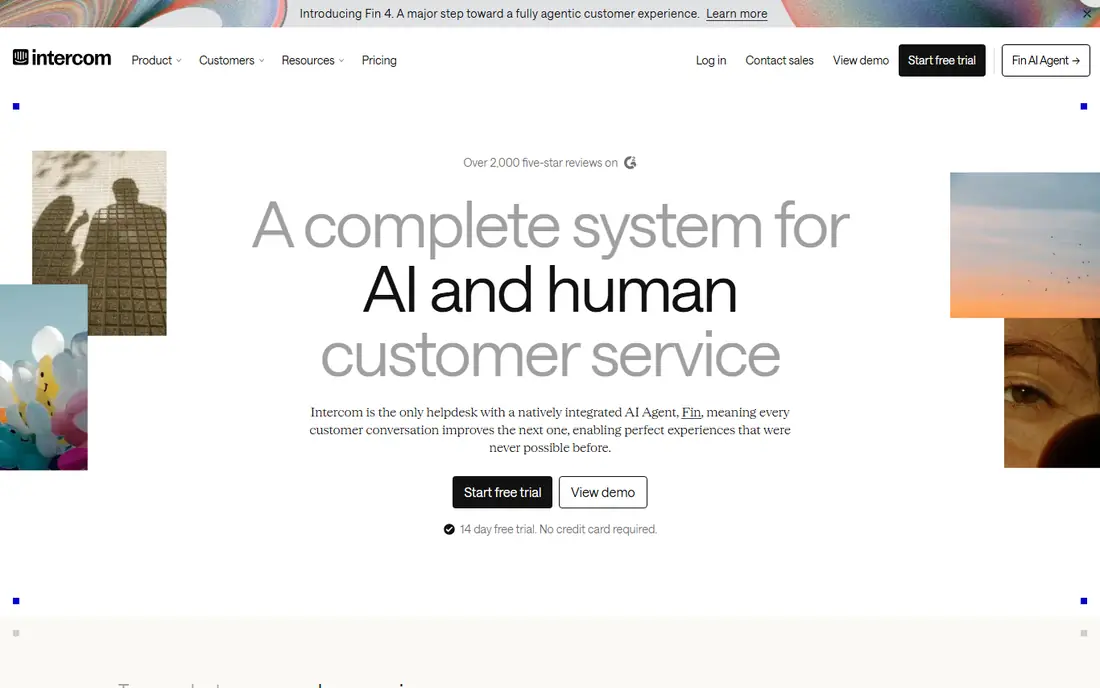
Intercom Fin is an AI-first agent that resolves common questions in chat and email, then hands off with full context when a human is needed. Pricing combines seats from $29 per month billed annually with $0.99 per Fin resolution, which makes costs easy to model at a given ticket volume. Fin can run on Intercom or on another helpdesk, which helps teams that do not want to switch platforms.
The catch is total cost at scale. Seat fees plus per-resolution fees add up for large teams, and Fin Voice requires a custom plan. For a digital-first team that wants to go live in days or weeks, Fin offers the clearest published pricing and the fastest path. Pilot it on real tickets before committing to a volume estimate.
- Fast to deploy
- $0.99 per resolved outcome
- Works on Intercom or other helpdesks
- Seat fees add to per-resolution costs
- Voice features need a custom plan
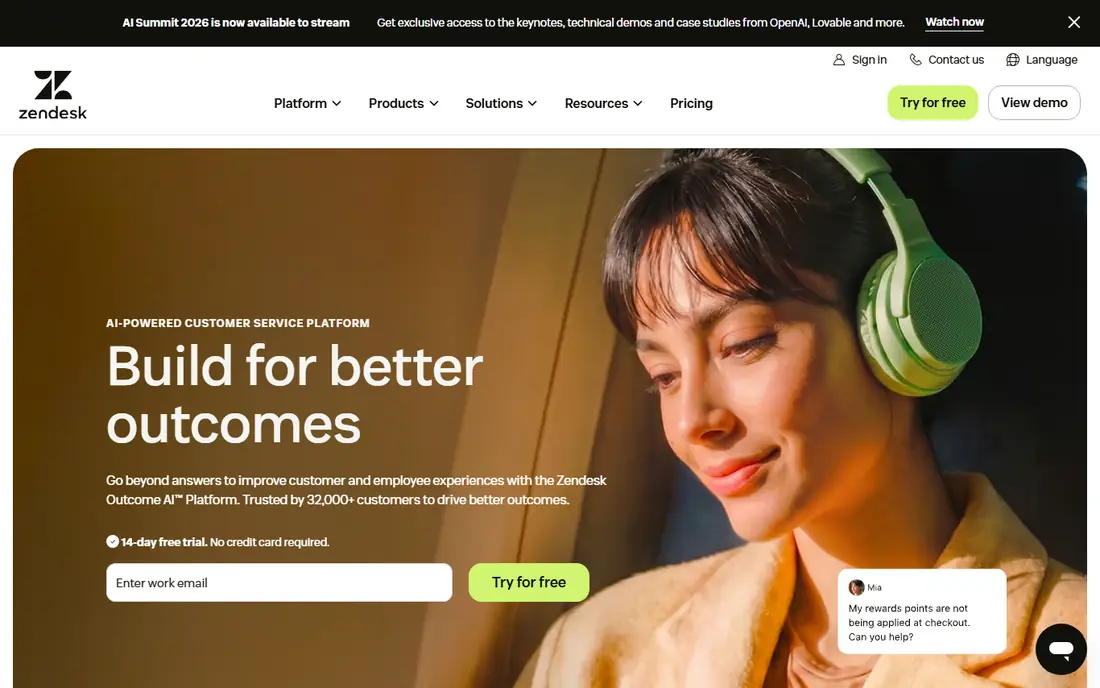
Zendesk AI Agents are built into Zendesk, so they use tickets, help center articles, and customer history without a separate integration project. Suite Team starts at $55 per agent per month billed annually, with a small resolution allowance, then $1.50 per automated resolution on a committed plan or $2.00 pay-as-you-go. That structure suits teams already paying for Zendesk.
The total bill needs care, because Suite seats plus resolution fees can exceed a simple per-agent price. Teams should model monthly resolutions, not just seats, before choosing a plan. For a Zendesk shop, though, the native fit saves integration time and keeps handoffs inside one system, which is worth real money.
- Native to Zendesk
- Resolution allowance on some plans
- Strong ticket and article integration
- AI resolutions cost extra beyond the allowance
- Suite seats add to the bill
Salesforce Agentforce is the AI agent for firms already running Service Cloud, with agents that can check records, update cases, and take actions inside Salesforce. Published comparisons list a rate around $2 per conversation, though total cost depends on Data Cloud and other Salesforce usage. For a Salesforce-standard firm, that native data access is a major advantage.
Agentforce is less attractive outside Salesforce, because its value comes from CRM data and workflows already in the platform. Firms should model conversation volume and Data Cloud costs before committing, since consumption pricing can surprise teams used to seat pricing. For a Salesforce firm, Agentforce is the natural first agent to test.
- Native to Service Cloud
- Action-taking across Salesforce data
- Voice and chat channels
- Pricing is consumption-based and needs modelling
- Best value inside Salesforce
Freshworks Freddy AI Agent brings AI support to Freshdesk at a lower entry price than Zendesk or Intercom, with Growth starting at $19 per agent per month billed annually. AI sessions are sold in packs, with extra sessions priced per batch, which suits teams with predictable volume. A free program for small teams has also been reported, though terms should be checked on the vendor site.
Session counting is the catch. Teams must track how many AI sessions they use and price extra packs into the budget. Higher tiers add features that budget teams may want later. For a Freshdesk team that wants AI without enterprise pricing, Freddy is a practical and affordable start.
- Low entry price
- Session packs for AI use
- Native to Freshdesk
- Session limits need watching
- Deeper features sit on higher tiers
HubSpot Customer Agent answers customer questions using HubSpot knowledge base content and CRM data, then hands off to human agents inside HubSpot. Published comparisons note a rate around $0.50 per resolved conversation on a credits model, with monthly credit allowances varying by plan. That native fit suits teams already running support in HubSpot.
Credits and plan details need checking, because the headline rate alone does not show total cost. Teams outside HubSpot will get less value, since the agent is built around HubSpot data. For a HubSpot shop, Customer Agent is worth a pilot, especially for repetitive questions that already have good help articles.
- Native to HubSpot CRM
- Uses HubSpot knowledge base
- Credits-based resolutions
- Pricing and credits need careful checking
- Best value inside HubSpot
Ada is a standalone AI agent platform built for high-volume digital support, with no-code tools for support teams to build and tune agents. Multilingual support is a strength, which suits global brands with customers in many languages. Agents work across chat and voice, with integrations to common helpdesks and systems.
Ada is quote-only, so small teams will find it hard to price without a sales conversation. Implementation typically takes weeks, with tuning for ticket mix and language needs. For a mid-market or enterprise team with high volume and many languages, Ada offers automation depth that helpdesk-native agents may not match.
- No-code agent building
- Strong multilingual support
- High-volume automation
- Quote-only pricing
- Implementation takes weeks, not days
Decagon builds AI agents for high-volume consumer brands, covering chat, voice, and email with agents that support teams can shape in natural language. Its agents can take actions inside connected systems, not just answer questions, which suits brands with order, account, and booking workflows. Enterprise integrations support large, complex stacks.
Pricing is quote-only, with platform fees and per-conversation or per-resolution terms set by contract. That makes Decagon a poor fit for small teams, but a strong candidate for large brands with the volume to justify an enterprise deal. Run a pilot on real conversations and compare contract definitions carefully before signing.
- Strong chat, voice, and email agents
- Natural language agent controls
- Enterprise integrations
- Quote-only enterprise contracts
- Setup and platform fees apply
Sierra builds branded AI agents for large firms, with a focus on voice and chat experiences that sound like the brand, not like a generic bot. It offers an Agent SDK for developers alongside a studio for non-developers, plus outcome-based pricing options tied to resolutions or business results. That blend suits firms that want a custom agent experience.
Sierra is an enterprise purchase, quote-only, with implementation that can run 6 to 12 weeks for deep integrations. Small teams should not expect a self-serve signup. For a large brand that treats support as part of its identity and has time to build, Sierra offers the most custom agent in this guide.
- Branded voice and chat agents
- Outcome-based pricing options
- Developer tools plus studio
- Quote-only and services-led
- Implementation can run 6 to 12 weeks
How we picked these
We compared official feature pages, pricing pages, and public comparisons for AI customer service agents in 2026. We favored agents that resolve real tickets, take actions in connected systems, and hand off to humans with context, rather than simple FAQ bots. We included helpdesk-native and standalone options, because starting point matters: a Zendesk team and a standalone enterprise team need different agents. Prices shown are vendor-published where available, and we wrote See website where pricing is quote-based or consumption-based.
How to buy an AI agent without overpaying
Start with your ticket mix, not a vendor demo. Pull your last three months of tickets, group them by topic, and count how many are repetitive and answerable from help articles. That share is your realistic automation ceiling. A vendor that promises a single resolution rate without seeing your tickets is guessing, so ask for a pilot on your real conversations instead.
Model total cost, not headline cost
Per-resolution, per-conversation, seat, and platform fees combine in different ways. Model a low, medium, and high month for each vendor, including seats, resolutions, sessions, and any platform fee. A $0.99 resolution looks cheap until volume triples in a holiday month. A quote-based platform looks expensive until it replaces several point tools. Compare annual totals at your real volume, not monthly headlines.
Test handoffs, actions, and guardrails
A good agent knows when to stop and hand off, with a summary the human can use without asking the customer to repeat everything. Test handoffs for billing disputes, account changes, and angry customers, not just easy questions. Check what actions the agent can take, such as refunds or order changes, and what approvals it needs. Set guardrails for sensitive topics early, and review agent answers weekly during the first month.
Start narrow, then expand
Launch on one channel and one ticket type, such as order status or password resets, then expand to the next type only when resolution and satisfaction hold up. Narrow launches make it easy to measure impact and fix bad answers quickly. Broad launches hide problems across many topics and make tuning harder. Track resolution rate, handoff quality, and customer satisfaction together, because a high resolution rate with low satisfaction is not a win.
Frequently asked questions
What is the best AI agent for customer service?
Intercom Fin is best for fast deployment with published pricing, Zendesk AI Agents are best for Zendesk teams, and Salesforce Agentforce is best for Salesforce firms. Ada, Decagon, and Sierra suit large brands with high volume and custom needs. Pick by your helpdesk, volume, and channel mix.
What are the best AI agents for customer service right now?
The leading options in this guide are Intercom Fin, Zendesk AI Agents, Salesforce Agentforce, Freshworks Freddy, HubSpot Customer Agent, Ada, Decagon, and Sierra. Helpdesk-native agents lead for small and mid-size teams, while standalone platforms lead for enterprise brands. All eight are actively sold and supported in 2026.
How much do AI customer service agents cost?
Intercom Fin costs $0.99 per resolution plus seats from $29 per month, Zendesk charges $1.50 to $2.00 per resolution plus Suite seats from $55, and Salesforce lists around $2 per conversation. Freshworks starts at $19 per agent per month plus session packs. Ada, Decagon, and Sierra are quote-only enterprise contracts.
Will an AI agent replace my support team?
For most firms, no. AI agents absorb repetitive tier-one volume, such as order status and password resets, so human agents can focus on complex cases. Teams usually redeploy staff to trickier queues or handle growth without hiring, rather than cutting headcount. Handoff quality matters more than headcount math.
How long does it take to launch an AI customer service agent?
Intercom Fin and other helpdesk-native agents can go live in days to weeks for simple use cases. Mid-market platforms such as Ada typically take a few weeks. Enterprise deployments with deep integrations, such as Sierra or Decagon, usually run 6 to 12 weeks. Start narrow to launch faster and learn sooner.
Can an AI agent work with my existing helpdesk?
Yes, in many cases. Intercom Fin can run on other helpdesks, Zendesk and Freshworks agents are native to their platforms, and standalone agents such as Ada and Decagon integrate with common helpdesks. Check the exact integration for your helpdesk version before buying, and test handoffs during a pilot.
Sources we checked (8)

Online Jobs is an independent blog about careers, online work, learning new skills and the tools that help people earn. More about us.
Keep reading
All posts
n8n Alternatives
n8n alternatives compared for 2026, with Zapier, Make, Activepieces, and more, covering visual builders, code steps, self-hosting, and pricing models.

ZoomInfo Alternatives
The best ZoomInfo alternatives in 2026, compared on price, free plans, data coverage, and which tool fits small teams or large sales teams best in detail.
Yotpo Alternatives
Find cheaper alternatives to Yotpo for reviews and loyalty, with Judge.me, Loox, Stamped, and more compared for Shopify stores in 2026, all in one guide.