Best Agency Recruiting Software in 2026: 8 Tools Compared


Mature staffing ATS and CRM · Starting price: $99 per user per month
How we put this together: we compare official feature and pricing pages, app store listings, privacy policies and public user reviews. Prices change, so check the provider's site before you pay.
Key takeaways
- Bullhorn is the mature staffing standard, with ATS and CRM in one system and published Starter pricing from $99 per user per month.
- Recruit CRM suits agencies that want clients, candidates, outreach and billing in one system, from $95 per user per month on annual billing.
- Manatal is the budget pick for small agencies, from $15 per user per month, with simpler agency CRM features.
- Per-user pricing dominates this market, so the total for a ten-recruiter team is very different from the headline per-user price.
- Check add-on costs for automation, multiposting, messaging and analytics before you sign, since those features often sit above the base plan.
Quick comparison
| Name | Who it suits | Starting price | Free option | |
|---|---|---|---|---|
| Bullhorn | Mature staffing ATS and CRM | $99 per user per month | No | Visit |
 Recruit CRM | Agency ATS, CRM and billing | $95 per user per month | Free trial | Visit |
 Manatal | Budget small agency ATS | $15 per user per month | Free trial | Visit |
 JobDiva | Large staffing firms | See website | No | Visit |
 Vincere | Midsize agencies with CRM depth | See website | No | Visit |
 Loxo | Sourcing-led agencies | See website | No | Visit |
 Ceipal | AI-led staffing automation | See website | No | Visit |
 Crelate | Agency ATS and CRM with portals | $99 per user per month | Free trial | Visit |
The best agency recruiting software
We compared official pricing pages and product pages for the best recruiting software for agencies, and we focused on agency work, not in-house hiring. An agency tool must handle clients and candidates together, track placements and splits, manage outreach, and keep a searchable database that survives staff turnover. A general HR tool can track applicants, but it will not handle client pipelines, submissions and billing in the same way. The eight tools below are built for agencies, and each one fits a different team size and budget.
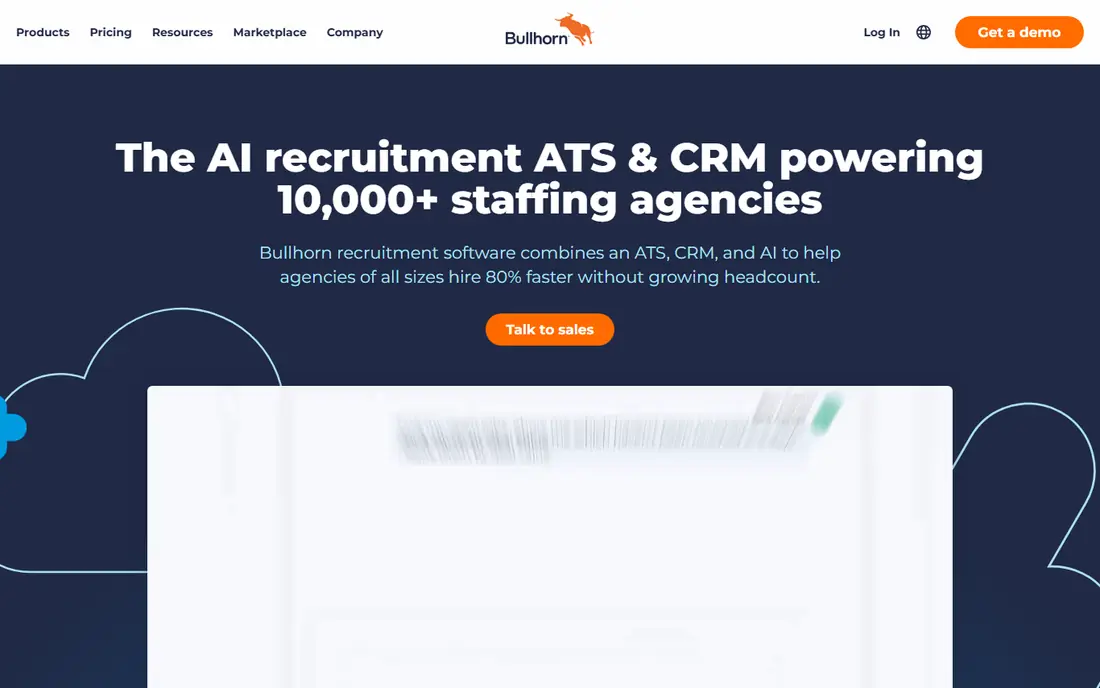
Bullhorn is the standard many staffing firms compare everything else against, because it combines applicant tracking and client relationship management in a system built for staffing workflows. Starter is listed at $99 per user per month for one to two users, with applicant tracking, resume parsing, client management and job posting with a career portal. Core, at $165 per user per month, adds custom fields and workflows, LinkedIn integrations and the app marketplace, while Pro and Max add AI search, matching and automation on a quote basis.
The catch is total cost. Higher tiers, automation, search and match, analytics, onboarding and messaging are separate modules or quote-based tiers, so the headline Starter price is not the full Bullhorn bill for a growing agency. Bullhorn also suits staffing firms more than in-house teams, and smaller agencies should budget for add-ons as they grow. For a firm that wants a mature, deeply integrated staffing platform and can pay for it, Bullhorn remains the benchmark.
- Deep staffing ATS and CRM in one system
- Large integration marketplace
- Published small-agency pricing
- Higher tiers and add-ons are quote-based
- Total cost rises with modules
- No free trial in the usual sense
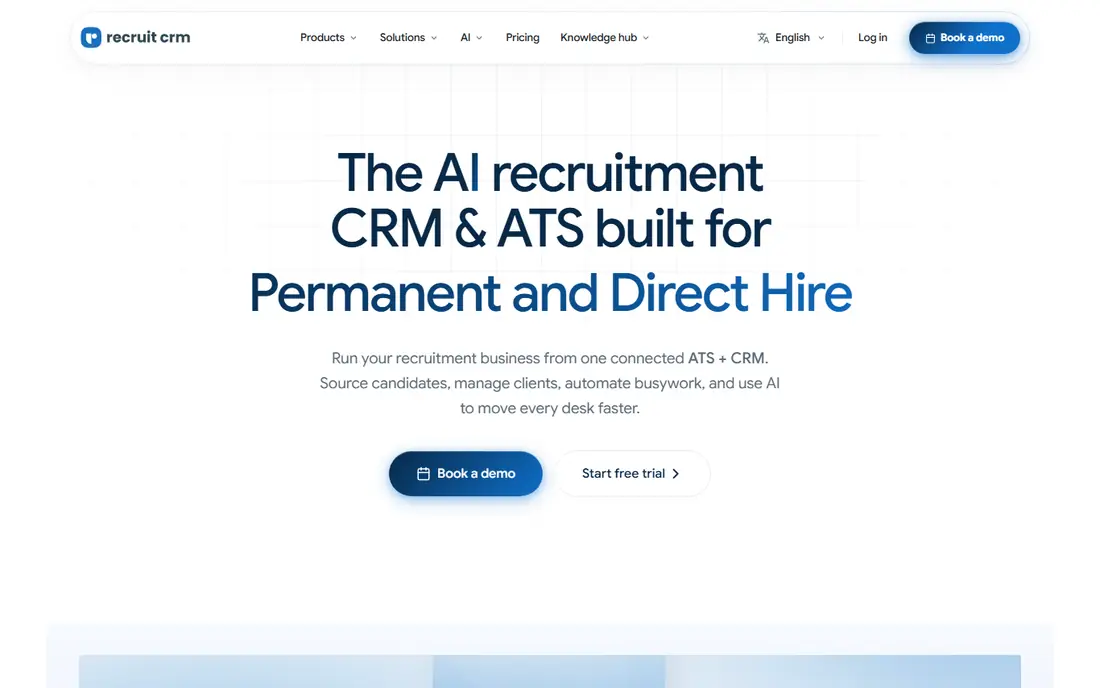
Recruit CRM is built for agencies from the start, with candidates, clients and jobs in one place, plus placements, splits, timesheets and invoicing for contract staffing. Pro is listed at $95 per user per month on annual billing, Business at $135 and Enterprise at $215, with a 30-day free trial that is longer than most rivals offer. A Chrome extension pulls profiles from LinkedIn and other sources into the database, and newer AI agents handle field parsing, submissions, CV formatting and email replies.
The limits are add-ons and caps. Workflow automation, multiposting, LinkedIn messaging and advanced analytics cost extra below Enterprise, and Pro caps AI matching at two matches per job with one email sequence, so a busy agency may need Business or Enterprise to get the full workflow. Reviewers also note duplicate records and imperfect CV parsing, which means data hygiene still needs human checks. For an agency that wants one system for clients, outreach and billing, Recruit CRM is a strong contender.
- Clients, candidates, outreach and billing in one system
- Timesheets and invoicing for contract staffing
- 30-day trial
- Many power features are paid add-ons below Enterprise
- AI matching caps apply on lower plans
- Credits add to the bill
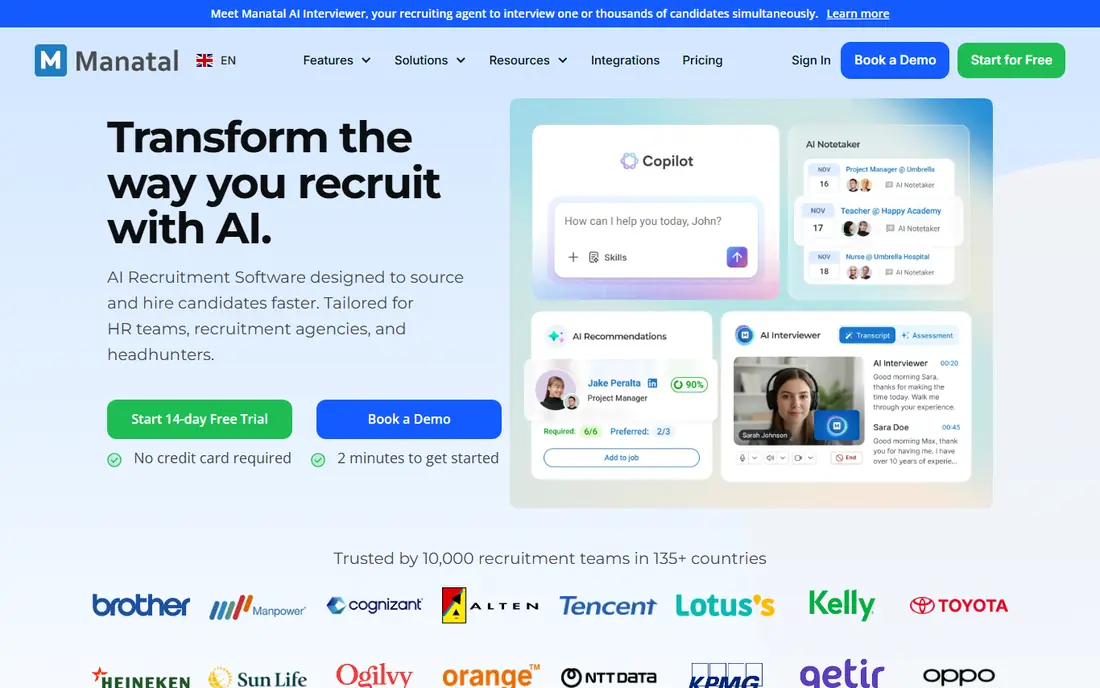
Manatal is the budget pick for a small agency or headhunting team that wants AI-assisted recruiting without a $95 per user bill. Professional is listed at $15 per user per month on annual billing, Enterprise at $35 and Enterprise Plus at $55, with a 14-day free trial. It offers AI screening and scoring, a branded career page, candidate enrichment and job board distribution, which covers the core sourcing and tracking work for a small team.
The trade-off is scale and agency depth. Professional is capped at 15 jobs and 10,000 candidates in the summaries we checked, and workflow automation starts at Enterprise, while API access and some AI integrations need Enterprise Plus. Agency CRM features are simpler than Bullhorn or Recruit CRM, so a firm that lives on client pipelines, splits and contract billing may outgrow Manatal. For a small agency that needs affordable AI ATS coverage, Manatal is hard to beat on price.
- Lowest entry price here
- AI screening and scoring
- Wide job board reach
- Branded career page
- Professional caps jobs and candidates
- Automation and API access need higher tiers
- Agency CRM is simpler
JobDiva suits large staffing firms that run high-volume searches across a large candidate database and need staffing-specific workflows, vendor management and reporting. Its search is built for recruiters who need to find candidates fast across millions of records, with Boolean and semantic options, and its workflows cover submissions, placements and client management for firms with many recruiters and clients. That scale is the reason large firms stay with it for years.
The limits are price transparency and design. JobDiva uses quote-based pricing, so budgeting needs a sales conversation based on users and volume, and some users find the interface dated compared with newer tools such as Manatal or Loxo. Implementation and training also need planning for a large team, since the depth that helps at scale can overwhelm a small agency. For a large staffing firm, JobDiva's search and scale are strong. For a small agency, start with Manatal or Recruit CRM.
- Very strong search across large databases
- Staffing-specific workflows
- Vendor management tools
- Quote-based pricing
- Interface feels dated to some users
- Implementation needs planning
Vincere is built for midsize recruitment agencies that want CRM depth alongside ATS tracking, with business development, client pipelines and reporting that help a firm grow clients as well as candidates. It covers the full placement cycle, from sourcing and shortlisting to placements and invoicing, with dashboards that show recruiter activity, pipeline health and revenue signals. That CRM focus helps agencies that sell as much as they source, which is common in executive search and specialist staffing.
The trade-off is price and learning curve. Vincere uses quote-based pricing, so the total depends on users, modules and contract length, and new recruiters need time to learn the CRM workflows and reporting. Smaller agencies may find the platform more than they need, while midsize firms with a sales-led model will use more of it. For an agency that wants CRM and ATS in one mature system, Vincere deserves a demo alongside Bullhorn and Recruit CRM.
- Strong CRM and business development tools
- Good reporting
- Built for recruitment agencies
- Quote-based pricing
- Learning curve for new recruiters
- Some features need higher tiers
Loxo suits agencies that win work through outbound sourcing, with tools for finding candidates, enriching profiles, running outreach sequences and tracking replies in one system. Its AI matching and automation help a sourcing-led team move faster, and the unified ATS and CRM keeps client and candidate data together, so a recruiter can see the full history of a placement without switching tools. That outbound focus is a clear difference from tools built mainly for inbound applicants.
The limits are price and data quality. Loxo uses quote-based pricing, so budgeting needs a demo and a quote, and sourcing data, like all sourcing databases, can include outdated profiles or bounced emails, so human verification still matters. An agency that mainly handles inbound applications may not use Loxo's sourcing depth, while an outbound-led agency will get the most value. For a sourcing-first team, Loxo is a strong alternative to Bullhorn and JobDiva.
- Strong sourcing and outreach tools
- AI matching and automation
- Unified ATS and CRM
- Quote-based pricing
- Sourcing data quality varies
- Best value for outbound-led teams
Ceipal is built for staffing firms that want AI automation across the placement cycle, from sourcing and screening to engagement and workforce management. It offers ATS, CRM, vendor management and onboarding tools, with AI features that help recruiters prioritise candidates, automate outreach and reduce manual data entry. That automation focus suits firms handling high volumes, where small time savings per placement add up across hundreds of roles.
The catch is setup and price. Ceipal uses quote-based pricing, and automation only works well when the underlying candidate data is clean and the workflows are set up carefully, so a team that rushes implementation will see weaker results. Small agencies may also find the platform deeper than they need, with modules they will not use. For a staffing firm that wants AI-led automation at scale, Ceipal is a serious contender. For a small agency, start with a simpler tool and add automation later.
- AI automation across sourcing, screening and engagement
- Staffing workflows
- Workforce management options
- Quote-based pricing
- Automation needs setup and data hygiene
- Depth can overwhelm small teams
Crelate suits agencies that want a full ATS and CRM with client portals, a branded job portal and strong reporting, without moving to a quote-only enterprise platform. Business for recruiting agencies is listed at $99 per user per month on annual billing, with full sales and recruitment CRM, premium resume parsing, basic client portals and advanced reports. Business Plus, at $144 per user per month, adds premium portals, automation and sequencing, and increased storage and limits.
The limits are tier steps and per-user maths. Automation, premium portals and some integrations sit on Business Plus, so the $99 entry price is not the full bill for a firm that needs those features, and a ten-recruiter team pays ten times the per-user price. That is still clearer than a quote-only platform, and the free trial helps a team test the portals and reporting before committing. For an agency that values client portals and reporting, Crelate is a strong mid-market choice.
- Full ATS and CRM with client portals
- Branded job portal
- Strong reporting
- Free trial available
- Business Plus costs more for automation and portals
- Some features need higher tiers
- Per-user costs add up
How we picked these
We compared official pricing pages and product pages, and we kept only tools built for agencies, with client and candidate tracking, placements and outreach, rather than general HR software. We checked whether pricing is published or quote-based, whether a free trial exists, and whether billing, portals and automation are included or add-ons. We did not claim hands-on testing, and we treated third-party pricing summaries as a check on vendor pages. Pricing varies by users, modules and contract length, so ask for a full quote that includes add-ons before you sign.
What to check before you buy
Start with your placement workflow, not the feature list. Map a real role from client brief to shortlist to placement to invoice, and check each step in the tool: sourcing, parsing, outreach, interview scheduling, submission, placement, splits and invoicing. A tool that handles sourcing well but leaves billing to a spreadsheet will still create manual work at the end of every placement.
Pricing, add-ons and data migration
Ask for the total price for your team size, including automation, multiposting, messaging, analytics and any per-record or credit charges. Check contract length, user minimums and what happens to your data if you leave, since a candidate database is an agency asset. Plan migration time, including deduplication and parsing checks, since a messy import will undermine even the best tool.
AI, compliance and candidate experience
AI matching and screening can speed up shortlisting, but they can also encode bias if the training data or filters are not checked, so audit AI suggestions and keep human review in the loop. Check data protection, consent and retention controls, especially for candidates in different regions, and test the candidate experience on a phone, including applications, messages and interview scheduling. A tool that frustrates candidates will cost placements, however strong its internal features are.
Frequently asked questions
What is the best recruiting agency software for small agencies?
Manatal is the cheapest strong pick for small agencies, from $15 per user per month, while Recruit CRM suits a small agency that needs billing and client pipelines from $95 per user per month. Bullhorn Starter, at $99 per user per month, suits a small staffing firm that wants the mature staffing standard. Trial two tools on one real role before you commit.
What is the best recruiting software for agencies with billing and payroll?
Recruit CRM is the clearest pick for agencies that want placements, splits, timesheets and invoicing in one system, while Bullhorn and Crelate also cover placements and client management with add-on billing options. Check whether timesheets, invoicing and contractor payroll are included or need a separate provider, since that changes the total cost.
How much does agency recruiting software cost per user?
Published prices in this list run from $15 per user per month for Manatal to $99 per user per month for Bullhorn Starter and Crelate Business, with Recruit CRM at $95 per user per month on annual billing. Quote-based tools such as JobDiva, Vincere, Loxo and Ceipal need a sales quote, and add-ons for automation and messaging can raise the total further.
What is the difference between an ATS and a CRM for agencies?
An ATS tracks candidates and jobs through hiring stages, while a CRM tracks clients, sales pipelines and relationships. Agency software combines both, so a recruiter can see a candidate, a client, a job, submissions and placements in one record. A general ATS without agency CRM will leave client work to a separate system.
Do agency recruiting tools include job board posting?
Most agency tools include job posting, but multiposting to many boards often costs extra or uses credits, and the board count varies by plan. Check which boards are included, whether LinkedIn integrations are included, and whether multiposting sits on a higher tier before you budget for sourcing.
Can I migrate my candidate database to a new recruiting tool?
Yes, most agency tools offer import and migration support, but the quality depends on data cleanliness, parsing and deduplication. Ask about import formats, duplicate handling, parsing accuracy and migration help in the quote, and test the import on a sample before you move the full database. Keep a backup of the original data until the new system is proven.
Sources we checked (8)

Online Jobs is an independent blog about careers, online work, learning new skills and the tools that help people earn. More about us.
Keep reading
All posts
n8n Alternatives
n8n alternatives compared for 2026, with Zapier, Make, Activepieces, and more, covering visual builders, code steps, self-hosting, and pricing models.

ZoomInfo Alternatives
The best ZoomInfo alternatives in 2026, compared on price, free plans, data coverage, and which tool fits small teams or large sales teams best in detail.
Yotpo Alternatives
Find cheaper alternatives to Yotpo for reviews and loyalty, with Judge.me, Loox, Stamped, and more compared for Shopify stores in 2026, all in one guide.