Best Alternatives to Scala in 2026: 9 Languages Compared


JVM teams that want concise code without Scala complexity · Starting price: Free
How we put this together: we compare official feature and pricing pages, app store listings, privacy policies and public user reviews. Prices change, so check the provider's site before you pay.
Key takeaways
- Kotlin is our pick for most Scala teams that want to stay on the JVM, because it keeps concise code with simpler tooling and wider hiring.
- Java suits teams that want stability, long-term support, and the largest JVM hiring pool.
- Clojure is the closest functional alternative on the JVM, while Haskell and Elixir suit teams that want stronger functional purity or fault tolerance.
- Go and Rust suit backend teams that need simple deployment or high performance outside the JVM.
- Scala alternatives differ most in ecosystem, hiring, and learning curve, so pick the language your team can maintain for years, not only the one that looks elegant.
Quick comparison
| Name | Who it suits | Starting price | Free option | |
|---|---|---|---|---|
| Kotlin | JVM teams that want concise code without Scala complexity | Free | Yes | Visit |
 Java | Large teams that need stability and hiring scale | Free | Yes | Visit |
 Clojure | Functional programming teams staying on the JVM | Free | Yes | Visit |
 Haskell | Pure functional programming and strong types | Free | Yes | Visit |
 Go | Simple, fast backend services and cloud tools | Free | Yes | Visit |
 Rust | High-performance systems and safe concurrency | Free | Yes | Visit |
 Elixir | Fault-tolerant, concurrent web systems | Free | Yes | Visit |
 F# | Functional programming on .NET | Free | Yes | Visit |
 Python | Fast development, scripting, and data work | Free | Yes | Visit |
The best alternatives to Scala
Scala mixes object-oriented and functional programming on the JVM, with a powerful type system. Teams leave it for different reasons: hiring, tooling, build times, or a wish for simpler code. The languages below cover those reasons in different ways. Some stay on the JVM, some keep functional ideas in a new ecosystem, and some trade functional depth for simplicity or speed. We compared official docs and ecosystem features for each language.
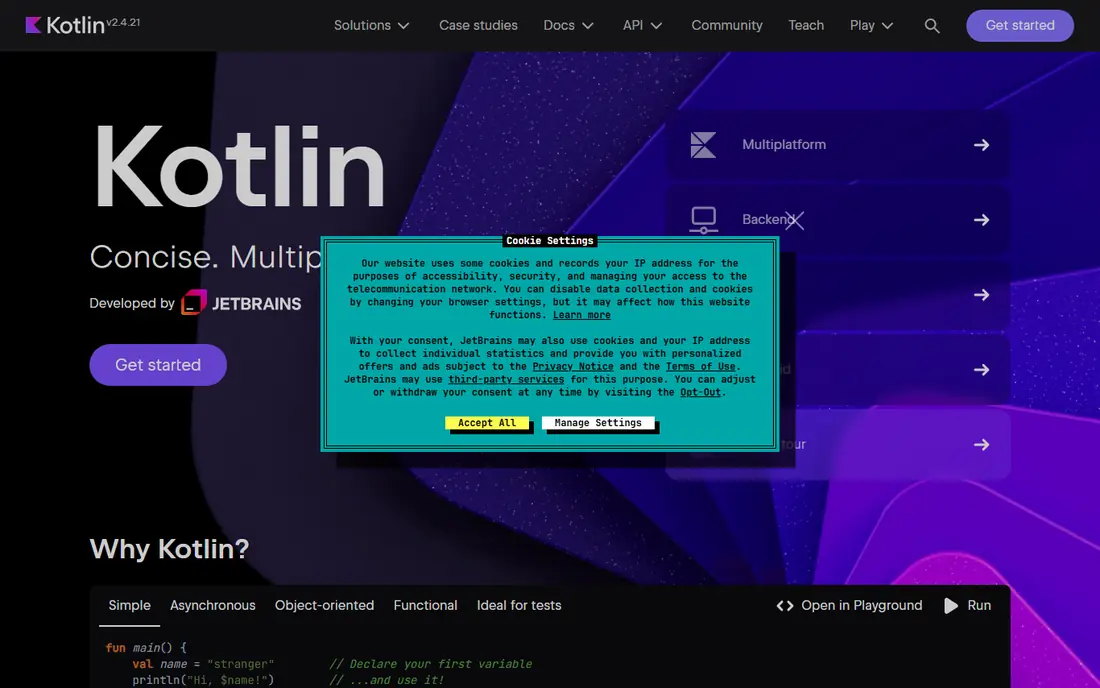
Kotlin is the most natural Scala alternative for a JVM team. It runs on the JVM, works with Java libraries, and offers concise syntax, null safety, and coroutines for concurrent work. Teams moving from Scala often find Kotlin easier to hire for and easier to onboard, since the language is smaller and its tooling is polished.
The trade is functional depth. Kotlin supports functional style, but it does not match Scala for advanced type-level programming or certain functional libraries. Most backend teams will not miss those features, and they will gain faster onboarding and clearer code. If you want to stay on the JVM with less friction, Kotlin is our first pick.
- Concise, readable code on the JVM
- Strong tooling and Android support
- Growing hiring pool
- Less functional depth than Scala
- Some advanced type features are simpler by design
Java is the safe Scala alternative when stability matters more than conciseness. Modern Java has improved with records, pattern matching, sealed classes, and virtual threads, which close much of the gap with newer JVM languages. The ecosystem is huge, tooling is mature, and hiring is easier than for any other JVM language.
The cost is verbosity. Java code is usually longer than equivalent Scala or Kotlin code, and its functional support is more limited by design. For a large team, a long-lived system, or a regulated industry, that trade is often worth it. If your team already knows the JVM and wants the lowest-risk move from Scala, Java is the straightforward choice.
- Largest JVM ecosystem and hiring pool
- Long-term support releases
- Mature tooling and libraries
- More verbose than Scala or Kotlin
- Functional style is more limited
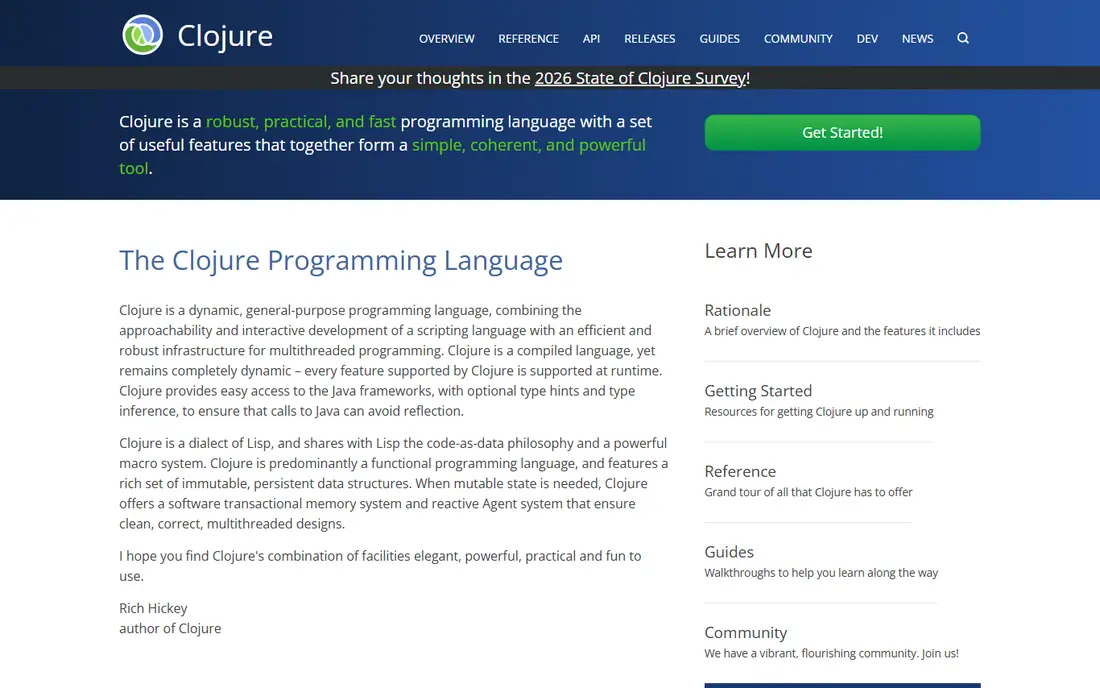
Clojure is the closest functional alternative to Scala on the JVM. It is a Lisp dialect that runs on the JVM, uses immutable data, and encourages a REPL-driven workflow where you test functions interactively. That style suits data processing, backend services, and teams that value simplicity and interactive development.
The barrier is syntax and hiring. Lisp parentheses put off some developers, and the hiring pool is smaller than Kotlin or Java. Tooling is good but less mainstream. If your team values functional ideas above all and wants to stay on the JVM, Clojure preserves that spirit better than Kotlin or Java. If hiring speed matters most, Kotlin is the safer move.
- Lisp-style functional programming on the JVM
- Interactive REPL workflow
- Immutable data by default
- Smaller hiring pool
- Lisp syntax is unfamiliar to many developers
Haskell is the purest functional alternative here. It uses lazy evaluation, strong static types, and pure functions, which help catch errors early and reason about code clearly. For a team that left Scala because it wanted more functional discipline, Haskell offers that discipline in full.
The cost is learning and ecosystem. Haskell takes longer to learn than Kotlin or Go, and its industry use is narrower, so hiring and library choice can be harder. It suits research, finance, compiler work, and teams that already value functional programming deeply. For a typical backend team, Haskell is more of a learning investment than a drop-in Scala replacement.
- Pure functions and strong static types
- Powerful type system
- Good for learning functional concepts deeply
- Steep learning curve
- Smaller industry hiring pool and fewer mainstream libraries
Go suits a Scala team that wants simplicity over expressiveness. It has a small language, fast compile times, and a strong standard library for web servers and cloud tools. Deployment is simple, since a Go program often ships as one binary. That combination makes Go popular for microservices, APIs, and infrastructure tools.
The trade is language power. Go lacks the advanced type features and functional depth of Scala, and its error handling is explicit rather than elegant. Teams that value clear, maintainable services over clever abstractions often prefer that trade. If your Scala system is really a set of backend services, Go can simplify the whole stack.
- Simple language with fast builds
- Strong standard library for servers
- Easy deployment as one binary
- Less expressive type system
- Functional style is limited
Rust is the pick when performance and safety matter most. It gives systems-level control with memory safety enforced by its ownership model, so it suits databases, engines, command-line tools, and performance-critical services. Its package manager and tooling are also strong, which helps a team adopt it in a structured way.
The learning curve is real. Ownership and borrowing take time to master, and early development is slower than in Go or Python. Rust is not a direct Scala replacement for a typical web backend, but it is an excellent choice when a Scala team needs a systems language. Use it for performance-critical parts first, rather than rewriting a whole JVM system at once.
- Memory safety without a garbage collector
- Strong performance
- Good concurrency model
- Steep learning curve, especially ownership
- Slower initial development than Go or Python
Elixir runs on the Erlang virtual machine and uses the actor model, where lightweight processes handle work independently and can restart after failure. That design suits chat systems, real-time apps, and services that must stay up under load. The Phoenix framework gives Elixir a clear web story, much like Rails does for Ruby.
The ecosystem is smaller than the JVM world, so hiring and library choice take more effort. Elixir syntax is also functional and may feel unfamiliar to an object-oriented team. If your Scala system needs high concurrency and fault tolerance, Elixir is a strong alternative. If you need broad enterprise libraries, a JVM language fits better.
- Actor model for concurrency
- Fault tolerance built in
- Phoenix framework for web apps
- Smaller hiring pool
- Ecosystem is narrower than JVM or Python
F# brings functional programming to .NET, with concise syntax, type inference, and good interop with C# libraries. It suits a team that is moving from Scala to the Microsoft ecosystem, or a team that already uses .NET and wants functional style without leaving it. F# works well for data processing, web services, and domain modeling.
The limit is ecosystem focus. F# is smaller than C# within .NET, and it does not reuse JVM libraries, so a Scala team would need to rebuild integrations. Hiring is also narrower. If your future is .NET, F# is a natural functional pick. If your future stays on the JVM, Kotlin or Clojure will preserve more of your existing investment.
- Concise functional code on .NET
- Good interop with C# libraries
- Strong type inference
- Smaller community than C#
- .NET focus limits JVM reuse
Python is the pragmatic Scala alternative when speed of development matters most. Its syntax is readable, its library ecosystem covers data, web, automation, and AI, and hiring is easy. A team can prototype quickly, build APIs with frameworks, and handle data pipelines without the build and type complexity of Scala.
The trade is runtime speed and type safety. Python is slower than compiled languages, and dynamic typing means tests and type hints matter more for large systems. For a backend that needs high throughput, Go or a JVM language may be better. For data work, scripting, and fast product development, Python is often the most productive Scala alternative.
- Very readable syntax
- Huge library ecosystem
- Strong for data, AI, and automation
- Slower runtime than compiled languages
- Dynamic typing needs tests and discipline
How we picked these
We compared official language docs and ecosystem pages, and we focused on JVM fit, functional style, hiring, tooling, and typical use. We included JVM languages, functional languages, and pragmatic backend languages, because Scala alternatives differ by what a team values most. We did not claim hands-on testing, and we avoided performance claims that depend on a specific workload, since language speed varies with code, runtime, and hardware.
How to choose the right Scala alternative
Start with your platform, not the language alone. If your libraries, deployment, and team skills are JVM-based, Kotlin or Java preserve the most value. If functional purity matters more than platform, Clojure keeps you on the JVM while Haskell moves you to a purer model. If concurrency or performance drives the move, Elixir, Go, or Rust may matter more than JVM fit.
Check hiring and maintenance honestly
Ask how many developers you can hire, how long onboarding takes, and whether your team can maintain the code in three years. A beautiful language that only one person understands is a risk. A simpler language with a larger hiring pool often wins for a business system, even if it feels less elegant at first.
Migrate in slices, not in one rewrite
Do not rewrite a whole Scala system at once. Start with a new service, a bounded module, or a data pipeline in the new language, and learn its tooling, testing, and deployment there. Keep the Scala system running while the new slice proves itself. A slice migration gives you real evidence before you commit the whole codebase.
Frequently asked questions
What is the best Scala alternative for JVM teams?
Kotlin is our pick for most JVM teams, because it offers concise code, strong tooling, and a growing hiring pool on the same platform. Java is the safer choice for very large or long-lived systems. Clojure suits JVM teams that want to keep a strong functional style.
Are there Scala alternatives that are also functional languages?
Yes. Clojure offers functional programming on the JVM, Haskell offers pure functional programming, Elixir offers functional concurrency, and F# offers functional programming on .NET. Each keeps functional ideas but differs in platform, hiring, and learning curve, so match the language to your ecosystem first.
Which Scala alternative is easiest to learn?
Go and Python are usually easiest to learn, because both languages are small and readable. Kotlin is also approachable for a JVM team. Haskell and Rust take longer, due to their type systems and ownership rules. Ease of learning should be weighed against long-term maintenance and hiring.
Is Kotlin better than Scala?
Kotlin is simpler and easier to hire for, while Scala offers deeper functional and type-level features. For most backend teams, Kotlin simplicity is a benefit. For teams that use Scala advanced features heavily, Kotlin may feel limiting. The better language depends on whether your team needs that depth or prefers simpler, more maintainable code.
Should I move from Scala to Java or Kotlin?
Move to Kotlin if you want concise code and modern tooling while staying on the JVM. Move to Java if you want maximum stability, hiring scale, and long-term support. Both are valid moves, and a slice migration will show which one your team actually enjoys maintaining before you commit fully.
Sources we checked (9)

Online Jobs is an independent blog about careers, online work, learning new skills and the tools that help people earn. More about us.
Keep reading
All posts
Top 10 Offshore Software Development Companies
We compared the top offshore software development companies in 2026 on services, hiring models, and startup versus enterprise fit, so you can shortlist well.

Flutter Alternatives
Looking for flutter alternatives? We compare 8 cross platform frameworks, from React Native to Kotlin Multiplatform, to help you pick the right stack.
Best low code platform
Best low code platform and apps compared for business apps, internal tools, and customer portals, from enterprise suites to founder-friendly builders.