Best Wealth Management Apps in 2026: 9 Apps Compared

How we put this together: we compare official feature and pricing pages, app store listings, privacy policies and public user reviews. Prices change, so check the provider's site before you pay.
Key takeaways
- The best wealth management app depends on whether you want fully automated investing, occasional human advice, or a dedicated planner.
- Betterment and Wealthfront offer the lowest-cost automated route at 0.25% per year, while Vanguard Personal Advisor adds human advice at about 0.30% per year.
- Schwab Intelligent Portfolios charges no advisory fee, but it holds a cash allocation that carries an opportunity cost, so free does not mean costless.
- Account minimums matter: Fidelity Go and Betterment are accessible with little or no minimum, while Vanguard Personal Advisor needs $50,000.
- This is not financial advice, and no service here can promise returns; compare fees, minimums, and the level of human help you actually want.
Quick comparison
| Name | Who it suits | Starting price | Free option | |
|---|---|---|---|---|
 Betterment | Low-cost automated investing | 0.25% per year | No | Visit |
 Wealthfront | Automated investing with tax tools | 0.25% per year | No | Visit |
 Vanguard Personal Advisor | Human advice plus automation | 0.30% per year | No | Visit |
 Schwab Intelligent Portfolios | No advisory fee investing | No advisory fee | No | Visit |
 Fidelity Go | Beginners at Fidelity | Free under $25,000 | Yes | Visit |
 SoFi Automated Investing | Automated investing with banking | 0.25% per year | No | Visit |
 Facet | Flat-fee human planning | See website | No | Visit |
 Merrill Guided Investing | Bank-linked guided investing | 0.45% per year | No | Visit |
 Ellevest | Goal-based planning | See website | No | Visit |
The best wealth management apps
Wealth management apps fall into two groups: robo-advisors that invest automatically for a percentage fee, and hybrid services that add human planners for a higher fee or a flat annual price. The right choice depends on how much help you want, how much you have to invest, and whether you value a low fee over a phone call with a planner. This is not financial advice, and investing carries risk, including loss of capital.
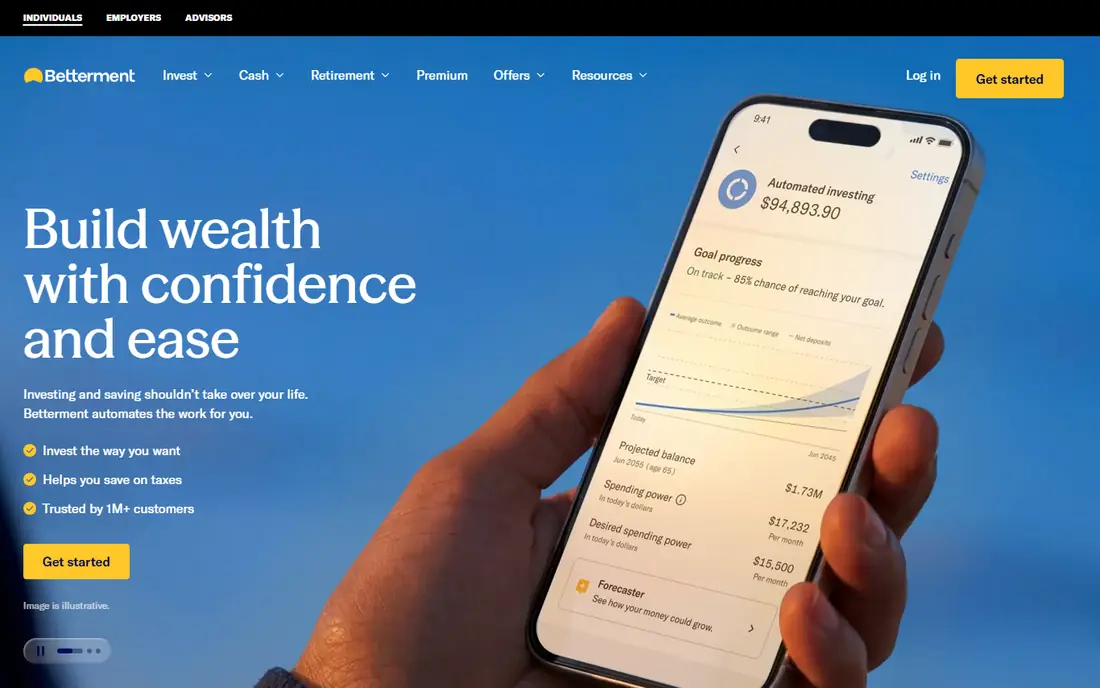
Betterment is our pick for most people who want automated investing at a low cost. You answer questions about goals, timeline, and risk tolerance, and Betterment builds and rebalances a diversified portfolio, with tax-loss harvesting available on eligible taxable accounts. Goal-based tools help you plan separately for retirement, a house deposit, or other targets, rather than treating all your money as one pot.
The main limit is human help. The base digital plan is automated, and access to human advisors comes through Premium, which costs 0.65% per year and requires a $100,000 balance in many listings. A $5 monthly fee can also apply to smaller accounts instead of the percentage fee. If you want a planner to call, Vanguard Personal Advisor or Facet may fit better, but for hands-off investing, Betterment is hard to beat on price.
- Low 0.25% annual fee for digital investing
- Goal-based planning tools
- Tax-loss harvesting on eligible accounts
- Human advice needs the Premium tier at a higher fee
- $5 monthly fee can apply to smaller balances
- No dedicated planner on the base plan
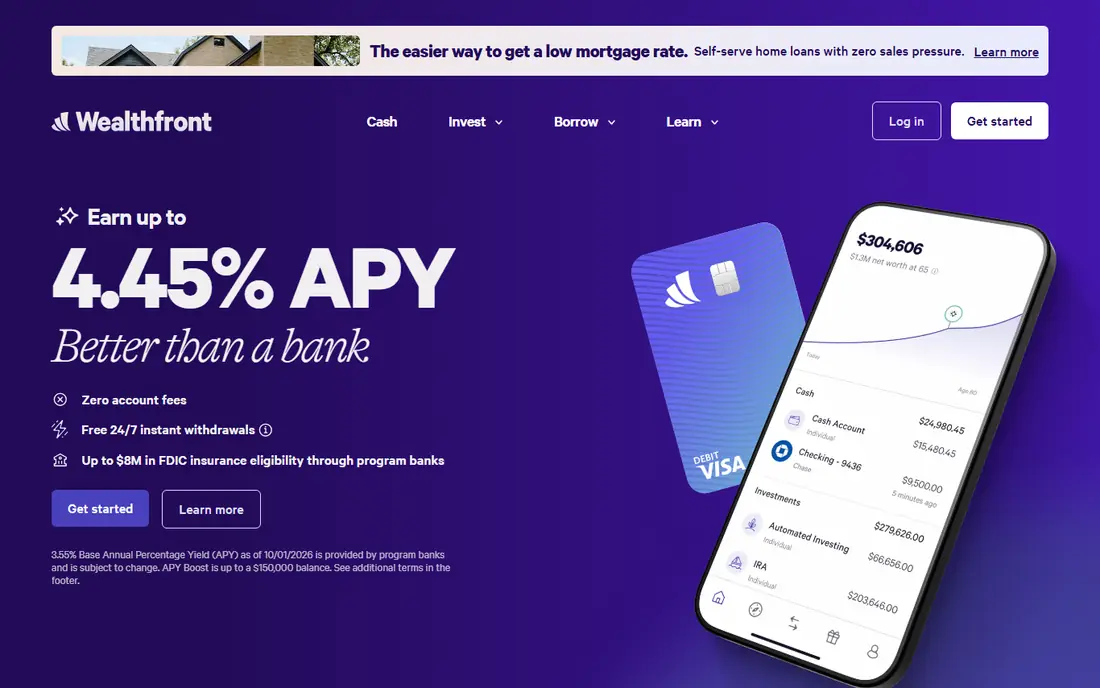
Wealthfront is the closest rival to Betterment, and it wins for investors who care most about tax efficiency. The automated investing service charges 0.25% per year, rebalances automatically, and offers tax-loss harvesting on eligible accounts, with direct indexing available at higher balances. Its planning software is also genuinely useful for modelling retirement and other goals without booking a call.
The trade-off is human contact. Wealthfront does not offer a dedicated human advisor in the way Vanguard Personal Advisor does, so investors who want to talk through a complex decision may feel underserved. The $500 minimum for automated investing is modest, but it is higher than Betterment's low entry point.
- 0.25% annual advisory fee
- Strong tax-loss harvesting and direct indexing at higher balances
- Useful financial planning tools
- No dedicated human financial advisor
- $500 minimum for automated investing in many listings
- Planning tools are software-led
Vanguard Personal Advisor
Who it suits: Human advice plus automation

Vanguard Personal Advisor is the best hybrid option for investors who want a person involved without paying a traditional 1% advisory fee. You get a financial plan and access to advisors, while Vanguard's low-cost funds keep underlying fund costs down. The advisory fee is about 0.30% per year, which is only slightly above the robo-advisors, for a service that adds human guidance.
The $50,000 minimum is the main barrier, and a dedicated planner, rather than advisor access when needed, requires the Select tier at $500,000 enrolled in many listings. Tax filing is not part of the published offering, so you will still need a separate tax preparer. If you meet the minimum and want human advice at a low fee, this is the first service to shortlist.
- Human advisor access alongside automated investing
- Low-cost Vanguard funds
- About 0.30% annual advisory fee
- $50,000 minimum
- Dedicated planner needs the Select tier at $500,000
- Advice scope is narrower than a full private wealth firm
Schwab Intelligent Portfolios
Who it suits: No advisory fee investing
Schwab Intelligent Portfolios is the cheapest headline option here, because the base service charges no advisory fee. You answer questions about goals and risk, Schwab builds a diversified ETF portfolio, and rebalancing is automatic. For existing Schwab customers, integration with brokerage and banking accounts is a real convenience, and the $5,000 minimum is accessible.
Free is not the same as costless. The portfolios hold a cash allocation, and Schwab earns from that cash, so the money sitting in cash is not invested in markets and may earn less over time. That opportunity cost can exceed a 0.25% fee for some investors, so compare total expected cost, not just the advisory fee line. Human advice comes through Premium, at $30 per month plus a $300 setup fee, with a $25,000 minimum.
- No advisory fee on the base service
- $5,000 minimum
- Broad Schwab platform and banking integration
- Required cash allocation carries an opportunity cost
- Tax-loss harvesting needs $50,000 and enrolment
- Human advice needs Premium
Fidelity Go is the best starting point for a new investor who already uses, or plans to use, Fidelity. There is no advisory fee on balances under $25,000, no opening minimum, and about $10 is needed to begin investing, which removes almost every barrier to starting. Coaching calls become available at higher balances, and the service sits inside Fidelity's broader platform for retirement and brokerage accounts.
The fee rises to 0.35% per year at $25,000 and above, which is higher than Betterment or Wealthfront, so long-term cost should be compared once your balance grows. Tax-loss harvesting is available only for eligible taxable accounts at higher balances. For a beginner, though, the free start and the Fidelity ecosystem make Fidelity Go an easy first step.
- No advisory fee on balances under $25,000
- Low $10 needed to start investing
- Coaching calls at higher balances
- 0.35% fee applies at $25,000 and above
- Tax-loss harvesting needs higher balances
- Less customisation than self-directed Fidelity accounts
SoFi Automated Investing
Who it suits: Automated investing with banking
SoFi Automated Investing suits SoFi customers who want investing beside banking, loans, and other accounts in one app. You answer questions about goals and risk, SoFi builds a diversified portfolio, and rebalancing is automatic, all for a 0.25% annual advisory fee in many listings.
The limit is human help and planning depth. SoFi does not offer a dedicated human advisor in the way Vanguard Personal Advisor does, and its planning tools are narrower than a hybrid service. If you already use SoFi for banking, the integration is a genuine convenience. If you want a planner to call, or you do not use SoFi elsewhere, Betterment or Wealthfront will give you a similar fee with a longer track record as a standalone investing service.
- 0.25% annual advisory fee
- Integrates with SoFi banking and other accounts
- Automatic rebalancing
- No dedicated human financial advisor
- Planning tools are narrower than hybrid services
- Less established as a standalone wealth manager than Vanguard
Facet suits high earners and people with complex planning needs who prefer a flat annual fee to a percentage of assets. You work with a planner team on retirement, tax, estate, and insurance questions, with investment management included, and published plans have listed annual prices in the low thousands of dollars. That model can be cheaper than a 1% fee once assets grow large, and it aligns the planner's pay with advice rather than asset gathering.
For a small balance, the flat fee is costly relative to a 0.25% robo-advisor, so Facet only makes sense when planning complexity justifies it. Published prices have also changed over time, so we list starting price as See website and recommend confirming the current annual price for the tier that matches your needs before you commit.
- Dedicated planner team rather than a percentage fee alone
- Flat annual pricing in published plans
- Tax partner options on higher tiers
- Annual cost is high for small balances
- No account minimum does not mean low cost
- Investment management is part of a broader planning service
Merrill Guided Investing is a good fit for Bank of America customers who want investing tied to their banking. The guided service builds and manages a portfolio for a 0.45% annual fee, with an advisor-guided tier at a higher rate that adds access to a Merrill advisor. Integration with checking, savings, and credit accounts makes transfers and a full financial picture simpler than using a separate provider.
The fee is higher than Betterment, Wealthfront, or Vanguard Personal Advisor, and the portfolios are less customisable than a self-directed Merrill brokerage account. If you already bank with Bank of America and value one login and one relationship, that convenience may justify the premium. If cost is your main driver, the robo-advisors will be cheaper.
- Guided portfolios with optional advisor access
- Integration with Bank of America accounts
- Established firm backing
- 0.45% fee is higher than robo-advisors
- Advisor-guided tier costs more
- Less flexible than self-directed Merrill accounts
Ellevest is distinct in this list because its planning explicitly accounts for factors that affect many women's finances, such as longer lifespans and career breaks, rather than using a one-size-fits-all retirement model. Goal-based portfolios, career coaching, and financial planning tools sit beside investing, which suits people who want planning and investing in one place.
Pricing has changed several times, with monthly and percentage models both used in the past, so we list it as See website and recommend checking the current plan before you compare it on price. The feature range is also narrower than Betterment or Fidelity. For readers who value its planning approach, that focus is a strength; for readers who only want the lowest fee, a robo-advisor will be cheaper.
- Planning built around women's financial lives, including career breaks and longer lifespans
- Goal-based portfolios
- Human coaching options
- Pricing has changed over time, so check the current plan
- Smaller fund and feature range than larger rivals
- No dedicated planner on base plans
How we picked these
We compared official pricing pages, fee disclosures, and public plan documentation, favouring services that publish fees and minimums clearly and are available to US investors in 2026. We included automated, hybrid, and flat-fee services so readers can compare cost models honestly, rather than ranking only by headline fee. We did not claim hands-on testing, and we used See website where pricing had changed recently or depended on tier. This is not financial advice, and fees and minimums change, so confirm the current terms before you open an account.
Choosing the right wealth management app
Start with how much help you want. If you are comfortable with automation and want the lowest fee, Betterment or Wealthfront will serve you well. If you want to talk to a human about a plan, Vanguard Personal Advisor offers that at a modest premium, while Facet suits complex planning at a flat fee. If you already bank or invest with Schwab, Fidelity, or Merrill, staying inside that ecosystem can be worth a slightly higher fee for simplicity.
Fees, minimums, and total cost
Compare total cost, not just the advisory fee. Add underlying fund expenses, any cash drag from required cash allocations, and subscription or premium charges, then model the cost at your actual balance. A 0.25% fee on $100,000 is $250 a year, while a flat $2,600 fee is far higher at that balance but may be cheaper at $1 million than a 1% fee. Minimums matter too: a service you cannot join is not a bargain, however low its fee looks.
Risk, taxes, and expectations
No wealth management app can promise returns, and any service that implies guaranteed gains should be avoided. Investing involves risk, and portfolio values fall as well as rise. Tax-loss harvesting can help in taxable accounts, but it is not available on every plan or balance, and it does not turn a bad portfolio into a good one. Set realistic expectations, keep an emergency fund outside your investment account, and review your plan once a year or after a major life change rather than reacting to every market move.
Frequently asked questions
What is the best wealth management app for beginners?
Fidelity Go is the easiest start, with no advisory fee under $25,000 and about $10 needed to begin investing. Betterment is a close second for beginners who want goal-based planning at 0.25% per year. Both let you start small and learn as your balance grows, without a large minimum.
What is the best wealth management platform for human advice?
Vanguard Personal Advisor offers human advice at about 0.30% per year with a $50,000 minimum, which is the lowest-cost hybrid option in this list. Facet offers a dedicated planner team at a flat annual fee, which suits complex planning needs. Choose Vanguard for low-cost advice, and Facet when planning complexity matters more than asset size.
How much do wealth management apps charge?
Automated services charge around 0.25% per year, hybrid services around 0.30% to 0.45%, and flat-fee planners charge an annual amount in the low thousands of dollars. Schwab Intelligent Portfolios charges no advisory fee but holds cash that carries an opportunity cost. Always add fund expenses to the advisory fee for a true total cost.
Is a robo-advisor better than a human financial advisor?
Neither is better for everyone. A robo-advisor is cheaper and well suited to straightforward, long-term investing. A human advisor helps more with complex decisions such as retirement timing, tax planning, estate questions, and behaviour during market falls. Many investors use a hybrid service to get automation plus human help at a moderate fee.
Do wealth management apps guarantee returns?
No. No legitimate service can promise returns, and investing carries risk, including the possible loss of capital. A good service manages risk, diversifies, keeps fees low, and helps you stay invested through market ups and downs, but it cannot remove market risk. This article is not financial advice, and you should consider your own goals and risk tolerance before investing.
What is the minimum to start with a wealth management app?
It ranges from no minimum at Betterment and Fidelity Go, to $500 at Wealthfront, $5,000 at Schwab, and $50,000 at Vanguard Personal Advisor, with $100,000 at some private wealth services. Check the current minimum on the provider's site, because minimums change, and some services waive them for certain account types.
Sources we checked (9)
- https://www.betterment.com
- https://www.wealthfront.com
- https://investor.vanguard.com/advice/personal-advisor
- https://www.schwab.com/intelligent-portfolios
- https://www.fidelity.com/managed-accounts/fidelity-go
- https://www.sofi.com
- https://facet.com
- https://www.ml.com/guided-investing
- https://www.ellevest.com

Online Jobs is an independent blog about careers, online work, learning new skills and the tools that help people earn. More about us.
Keep reading
All posts
Top AI Financial Software
Searching for top AI financial software? We compared 9 AI finance tools for AP, spend, close, forecasting and bookkeeping to help teams choose wisely.
Quicken Alternatives
Compare the best quicken alternatives for Mac, Windows, and small business owners, from Monarch Money and YNAB to Copilot, Tiller, and Banktivity in 2026.
QuickBooks Online Alternatives
Looking for quickbooks online alternatives? We compared 8 accounting tools on invoicing, bank feeds, payroll, pricing and fit for small businesses today.