Best Rent Collection App in 2026: 8 Apps Compared

How we put this together: we compare official feature and pricing pages, app store listings, privacy policies and public user reviews. Prices change, so check the provider's site before you pay.
Key takeaways
- Avail, Baselane, TurboTenant, and Innago let small landlords collect rent for free, though tenants may pay small payment fees.
- RentRedi and TenantCloud give predictable flat pricing for landlords who want one price no matter how many units they add.
- Buildium and AppFolio suit professional managers who also need accounting, owner portals, maintenance, and reporting.
- Check who pays card and bank fees, how long payouts take, and if late fees and partial payments are handled automatically.
- This is general information only, not legal or tax advice, and local rent rules vary, so check your state and city rules before you set fees.
Quick comparison
| Name | Who it suits | Starting price | Free option | |
|---|---|---|---|---|
 Avail | Free start for independent landlords | Free | Yes | Visit |
 Baselane | Banking and bookkeeping plus rent | Free | Yes | Visit |
 RentRedi | Flat price for unlimited units | $12 per month | No | Visit |
 Buildium | Full property management | $62 per month | Free trial | Visit |
 AppFolio | Larger portfolios and managers | $1.49 per unit per month | No | Visit |
 TurboTenant | Free core tools for beginners | Free | Yes | Visit |
 Innago | Free rent collection | Free | Yes | Visit |
 TenantCloud | Low flat fee with accounting | $15 per month | No | Visit |
The best rent collection app
A good rent collection app should make it easy for tenants to pay, easy for you to track who paid, and clear about fees and payout timing. The apps below range from free tools for one or two units to full platforms for professional managers. We compared official pricing pages and feature pages, and we focused on rent payments, fees, late fees, leases, and bookkeeping, since those features affect landlords every month.
Avail is a strong free starting point for independent landlords. The free plan covers rent collection, online leases, tenant screening options, and maintenance requests, which is more than many free tools offer. Tenants can pay online, landlords get reminders and payment tracking, and late fees can be set automatically, which cuts the awkward follow-up messages at the start of the month.
The trade-off is fees and payout speed. On the free plan, tenants pay a small fee for bank payments, and faster payouts sit on the paid Unlimited Plus plan. For a landlord with a few units, that trade is often worth it, but check the current fee details on the vendor site before you ask tenants to sign up. If you want a free, capable start, Avail is a good first pick.
- Free plan for core rent collection
- Online leases and tenant screening
- Automatic late fees and reminders
- Tenants pay a small fee on free plan bank payments
- Faster payouts need a paid plan

Baselane suits landlords who want rent, banking, and bookkeeping together. You can collect rent, hold funds in a dedicated account, and tag income and expenses by property, which makes tax time much simpler. The free Core plan covers rent collection and basic bookkeeping, and the paid Smart plan adds more automation and reporting for growing portfolios.
The main limit is focus. Baselane is built for US landlords, and its banking features will not suit everyone outside that market. Payouts can also take a few business days, so plan cash flow around that timing. If clean books matter as much as rent collection, Baselane is one of the best combined tools here.
- Free banking and bookkeeping in one place
- Rent collection with late fees
- Property-level income tracking
- Banking features are US-focused
- Some advanced features need a paid plan
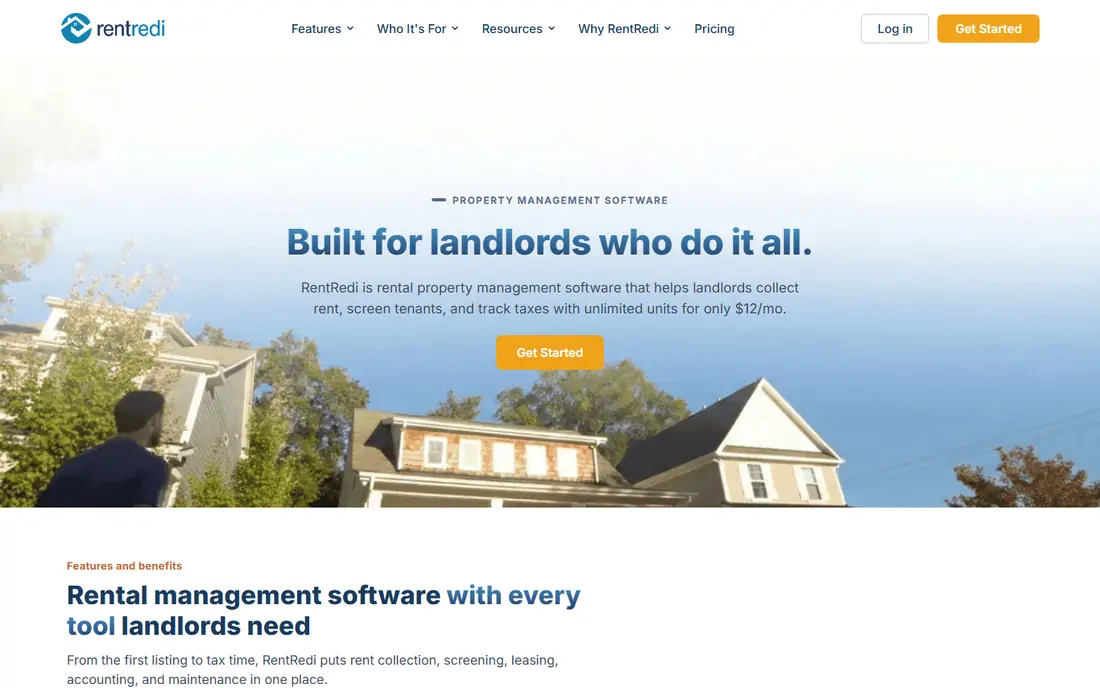
RentRedi is the predictable-price pick. One flat monthly price covers unlimited units on the main plan, which helps landlords who are growing and do not want per-unit costs to climb with every new property. Tenants can pay by bank, card, or cash at retail stores, which helps tenants without a bank account, and the app can block partial payments so a tenant cannot pay part of the rent and create a dispute.
There is no permanent free plan, so you pay from the start, and some advanced features sit on higher tiers. The mobile app and tenant portal are straightforward, which helps tenants pay on time. If you want one flat price and cash payment options, RentRedi is a strong choice.
- Flat price for unlimited units
- Tenants can pay by cash at retail stores
- Blocks partial payments
- No permanent free plan
- Some features need higher tiers
Buildium is for landlords and managers who need more than rent collection. It combines accounting, leases, maintenance requests, owner portals, and reporting in one platform, so a growing portfolio can be run without stitching several tools together. Rent payments, late fees, and owner statements flow into the same system, which saves time at month end and tax time.
The price reflects that breadth. At $62 per month to start, Buildium is overkill for a single unit, and new users will need time to learn the full system. A free trial helps you test it with real data before committing. If you manage several properties or work for owners, Buildium is a professional-grade pick.
- Full accounting and owner portals
- Maintenance and leasing tools
- Scales to larger portfolios
- Costly for one or two units
- Learning curve for new managers
AppFolio suits property managers with larger portfolios who need automation at scale. Leasing, screening, rent collection, maintenance, accounting, and owner reporting live in one system, and automation can handle reminders, late fees, and routine messages. That scale is why many professional managers choose AppFolio once a portfolio grows beyond what a simple rent app can handle.
The cost structure is the barrier for small landlords. Pricing is per unit with a minimum unit count, so the monthly total is much higher than a free or flat-rate tool. Setup also takes time, since you need to configure portals, accounting, and workflows properly. If you manage 50 units or more, AppFolio is worth a demo. If you manage a few units, start with a free tool instead.
- Strong automation for large portfolios
- Owner and resident portals
- Built-in screening and leasing
- Minimum unit count and higher total cost
- Setup takes time
TurboTenant is a friendly free option for new landlords. The free plan covers rental listings, applications, screening options, leases, and rent collection, so a first-time landlord can run a unit without paying a monthly fee. Setup is quick, the tenant portal is simple, and the app guides you through the main steps of listing and leasing.
As with other free tools, tenants pay small fees for payments on the free plan, and payouts can take several days. Paid plans remove some tenant fees and add features, so check if the paid cost is worth it for your unit count. For a beginner who wants one free place to list, lease, and collect rent, TurboTenant is a solid pick.
- Free listings, screening, leases, and rent
- Easy setup for new landlords
- Tenant portal
- Tenants pay fees on free plan payments
- Payouts can take several days
Innago is another free option that keeps rent collection simple. Landlords can collect rent, manage leases, handle maintenance requests, and track payments without a monthly fee, which suits owners with a small number of units. The interface is straightforward, and tenants can pay online without a complex portal to learn.
Advanced accounting and reporting are lighter than Buildium or AppFolio, so larger managers may outgrow Innago. Tenant payment fees can also apply depending on payment method, so check the current fee page. If free rent collection with basic management tools is the goal, Innago is a clean and capable choice.
- Free for landlords
- Rent, leases, and maintenance in one app
- Simple tenant payments
- Fewer advanced accounting features
- Tenant payment fees may apply
TenantCloud gives small landlords a low flat fee with accounting built in. For $15 per month billed annually on the Starter plan, you get rent collection, leases, maintenance, and accounting tools that help at tax time. That combination is useful if you want more than payments but do not want to pay Buildium prices yet.
There is no permanent free plan, and payout timing varies by payment method, so check those details before you rely on a fast payout. The app is less polished than some rivals, but the feature set for the price is strong. If you want flat pricing plus accounting, TenantCloud is a good middle ground between free tools and full management platforms.
- Low flat monthly price
- Accounting and reporting included
- Online payments and leases
- No permanent free plan
- Payout timing varies by method
How we picked these
We compared official pricing pages and feature pages for rent collection apps that are available today in the US, and we favoured tools that cover online payments, late fees, leases, and payment tracking. We included free tools, flat-rate tools, and full management platforms so landlords with one unit and managers with many units can both find a fit. We did not claim hands-on testing, and we used current published pricing summaries where vendor pricing was not fully clear, with See website reserved for enterprise quotes.
What to check before you choose a rent app
Start with fees and who pays them. Bank payments are usually cheap, card payments cost more, and some apps charge the landlord while others pass the fee to the tenant. That choice affects tenant goodwill as much as your costs, so be clear about it in the lease and in the tenant welcome message. Also check payout timing, since a five-day wait can matter for mortgage and bill timing.
Next, check late fees, partial payments, and reminders. Good apps let you set late fees, send automatic reminders before rent is due, and block partial payments if your lease requires full payment. Those features prevent many disputes and save you from chasing payments by text each month. Also check if the app offers rent reporting to credit bureaus, since that can help responsible tenants build credit.
Finally, test the tenant experience yourself. Sign up as a test tenant, pay a test amount if possible, and see how clear the process feels. If payment is confusing, tenants will pay late for reasons that have nothing to do with money. A clear portal, simple payment options, and good support matter more than a long feature list, especially for a first rental.
Frequently asked questions
What is the best free rent collection app?
Avail, Baselane, TurboTenant, and Innago all offer free plans for landlords, with different mixes of leases, screening, and bookkeeping. Avail and TurboTenant are best for beginners, while Baselane suits landlords who also want banking and bookkeeping.
What is the best app for rent collection for small landlords?
For one to five units, Avail or TurboTenant are strong free starting points, and RentRedi or TenantCloud suit landlords who want flat pricing as they grow. Choose based on fees, payout speed, and if you need accounting built in.
How long does it take to receive rent through an app?
Payout timing varies by app and payment method, from one to seven business days in many cases. Bank payments are often slower than card payments, so check the payout timing on the vendor site and plan mortgage payments around it.
Can tenants pay rent with a credit card?
Yes, most rent apps accept cards as well as bank payments, but card fees are higher than bank fees. Some apps pass card fees to tenants, while others charge landlords, so check who pays before you enable card payments.
Do rent collection apps handle late fees automatically?
Many apps let you set late fees and automatic reminders, including Avail, Baselane, RentRedi, and Buildium. Set the fee terms in the lease first, since local rules limit what fees you can charge and when you can apply them.
Sources we checked (8)

Online Jobs is an independent blog about careers, online work, learning new skills and the tools that help people earn. More about us.
Keep reading
All posts
Best Tenant Screening Services
Compare the best tenant screening services for landlords in 2026, with credit, criminal, and eviction checks, pricing per screening, and FCRA notes for all.
Best Realtor App to Use
Compare the best realtor app to use in 2026, from Zillow and Realtor.com to Redfin and Homes.com, for listings, tours, freshness, and agent contact help.

Best House Hunting Apps
Compare the best house hunting apps in 2026, from Zillow and Redfin to Realtor.com and Trulia, with alerts, tours and value estimates explained for buyers.