Best Recurring Payment Platform in 2026: 8 Platforms Compared


Stripe-based SaaS billing · Starting price: 0.7% of billing volume
How we put this together: we compare official feature and pricing pages, app store listings, privacy policies and public user reviews. Prices change, so check the provider's site before you pay.
Key takeaways
- Stripe Billing suits companies already processing payments on Stripe and wanting a low-friction start.
- Paddle suits small global sellers that want a merchant of record to handle tax and compliance.
- Chargebee and Recurly suit SaaS companies that need many gateways and flexible billing models.
- Zuora and Maxio suit larger SaaS firms with complex revenue recognition and enterprise billing needs.
Quick comparison
| Name | Who it suits | Starting price | Free option | |
|---|---|---|---|---|
| Stripe Billing | Stripe-based SaaS billing | 0.7% of billing volume | No | Visit |
 Chargebee | Flexible SaaS billing across gateways | See website | Free trial | Visit |
 Paddle | Global sellers needing a merchant of record | 5% + $0.50 per transaction | No | Visit |
 Recurly | SaaS dunning and recovery | See website | No | Visit |
 Zuora | Enterprise subscription billing | See website | No | Visit |
 Maxio | Finance-first B2B SaaS billing | $599 per month | No | Visit |
 Zoho Subscriptions | Budget SaaS billing in Zoho | See website | Free trial | Visit |
 ReCharge | Subscription ecommerce | See website | No | Visit |
The best recurring payment platform
We compared recurring payment platforms, billing services, and software on subscription handling, payment gateways, dunning and failed payment recovery, tax handling, and how clearly each vendor prices its service. The eight options below cover self-serve SaaS, global sales, and enterprise billing.

Stripe Billing is the natural pick for a company that already takes payments through Stripe. It fits stripe-based saas billing well, and it is worth shortlisting if that description matches your situation.
It handles subscriptions, trials, proration, and usage billing inside the same system as payments, which keeps reconciliation simple. That strength matters most when the team reviewing the bill is not the same team running the system, because both groups need the same numbers in plain form.
The catch is lock-in: it works with Stripe processing, so companies that need many gateways or a separate processor should look elsewhere. Before you commit, ask for a trial on your own data, check how support responds, and confirm what happens when you outgrow the entry tier.
- Strong developer tools
- Subscription and usage billing
- Wide payment method support
- Stripe-only processing
- Percentage fee adds up at high volume

Chargebee suits a SaaS company that needs flexible pricing across many payment gateways. It fits flexible saas billing across gateways well, and it is worth shortlisting if that description matches your situation.
It supports seat, usage, and hybrid models, connects to many gateways, and includes dunning tools to recover failed payments. In day to day use, the value shows up in fewer surprises, clearer ownership, and less time spent chasing down why a number moved.
The catch is pricing clarity: plans and add-ons are often quoted, so ask for a total that includes gateways, dunning, and any revenue tools. Before you sign, test it with a small group, read the renewal terms, and confirm the features you need are in the plan you are buying, not a higher tier.
- Many payment gateways
- Flexible seat and usage pricing
- Dunning and revenue tools
- Pricing is quoted for many plans
- Revenue recognition is a separate product
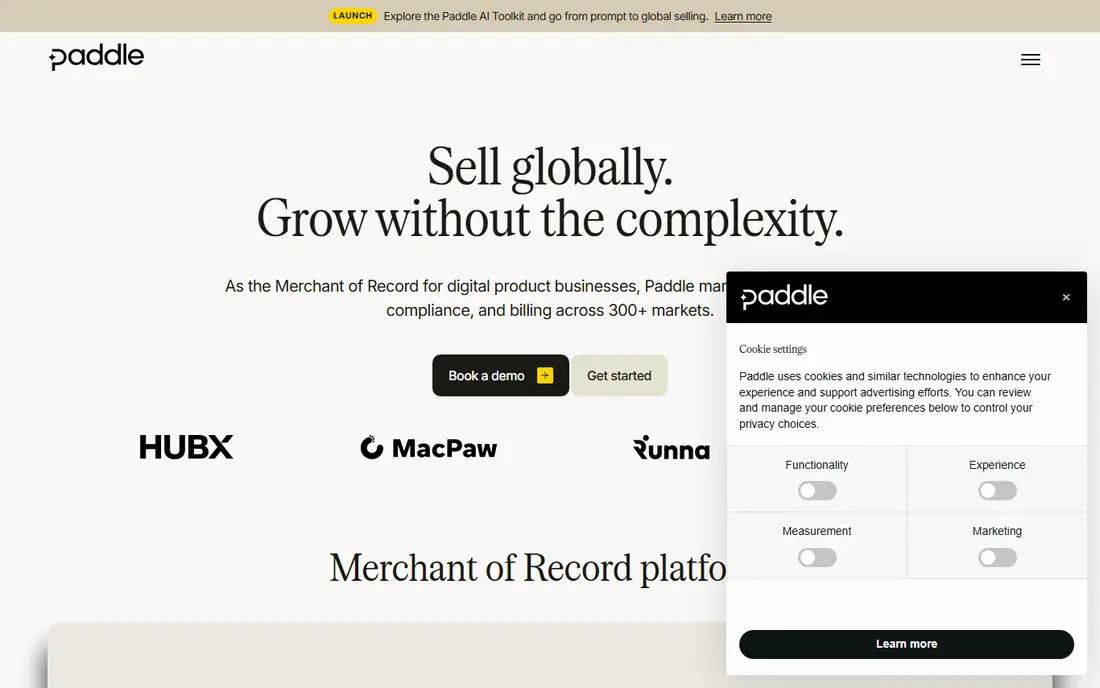
Paddle suits a small global seller that would rather hand tax, compliance, and checkout to a merchant of record. It fits global sellers needing a merchant of record well, and it is worth shortlisting if that description matches your situation.
Its all-in fee covers payments, billing, global tax handling, fraud protection, and buyer support, which saves a lean team a lot of operational work. For a busy team, the practical benefit is less manual work and a clearer record of what changed and why.
The catch is margin: the percentage fee is high once volume grows, so larger sellers should compare it with a direct processor plus tax tool. Before you commit, run a short pilot, compare the total cost with add-ons included, and check how easy it is to export your data later.
- Merchant of record handling for global tax
- Checkout and billing in one service
- No monthly fee model
- Percentage fee is high at scale
- Less control than a direct processor setup
Recurly suits a SaaS company where failed payments and involuntary churn are a real revenue leak. It fits saas dunning and recovery well, and it is worth shortlisting if that description matches your situation.
Its dunning and recovery tools, plus gateway flexibility, help teams recover payments that a basic billing setup would lose. That strength matters most when the team reviewing the bill is not the same team running the system, because both groups need the same numbers in plain form.
The catch is price transparency: plans are quoted, so compare the total with dunning, analytics, and gateway fees included. Before you commit, ask for a trial on your own data, check how support responds, and confirm what happens when you outgrow the entry tier.
- Gateway-agnostic subscription billing
- Strong dunning and churn recovery
- Analytics
- Pricing is quoted
- Setup needs care for complex pricing models
Zuora suits a large company with complex subscriptions, multi-entity billing, and strict revenue recognition needs. It fits enterprise subscription billing well, and it is worth shortlisting if that description matches your situation.
It handles long contracts, amendments, and revenue schedules that simpler billing tools struggle with, and it supports large sales-led organisations. In day to day use, the value shows up in fewer surprises, clearer ownership, and less time spent chasing down why a number moved.
The catch is scale: pricing and implementation suit enterprises, and a small SaaS firm will find it heavier than it needs. Before you sign, test it with a small group, read the renewal terms, and confirm the features you need are in the plan you are buying, not a higher tier.
- Deep subscription and revenue recognition
- Multi-entity support
- CPQ for complex deals
- Enterprise pricing and implementation
- Overkill for small SaaS firms
Maxio suits a B2B SaaS firm where finance needs billing and revenue recognition in one place. It fits finance-first b2b saas billing well, and it is worth shortlisting if that description matches your situation.
Its Grow plan bundles billing with revenue tools up to a stated monthly billing level, which helps finance teams close books with fewer workarounds. For a busy team, the practical benefit is less manual work and a clearer record of what changed and why.
The catch is entry price: the monthly starting price is higher than self-serve tools, so it fits firms with real billing volume. Before you commit, run a short pilot, compare the total cost with add-ons included, and check how easy it is to export your data later.
- Billing plus revenue recognition
- SaaS metrics
- Usage and contract billing
- Starting price suits mid-size SaaS, not tiny startups
- Advanced tiers are quoted
Zoho Subscriptions suits a small SaaS or service firm that already uses Zoho tools and wants simple recurring billing. It fits budget saas billing in zoho well, and it is worth shortlisting if that description matches your situation.
It handles plans, customers, invoices, and payments without a large enterprise setup, and it fits a tight budget. That strength matters most when the team reviewing the bill is not the same team running the system, because both groups need the same numbers in plain form.
The catch is depth: firms with complex usage billing, multi-entity needs, or advanced revenue recognition will outgrow it. Before you commit, ask for a trial on your own data, check how support responds, and confirm what happens when you outgrow the entry tier.
- Low-cost subscription billing
- Zoho suite links
- Simple plan and customer handling
- Fewer advanced enterprise features than Zuora or Maxio
- Gateway range is narrower
ReCharge suits an ecommerce store that sells subscriptions for physical products. It fits subscription ecommerce well, and it is worth shortlisting if that description matches your situation.
Its tools handle subscription management, retention offers, and customer portals in a way that fits online stores better than generic SaaS billing. In day to day use, the value shows up in fewer surprises, clearer ownership, and less time spent chasing down why a number moved.
The catch is fit: a B2B SaaS company with seat and usage pricing should shortlist Stripe, Chargebee, or Recurly instead. Before you sign, test it with a small group, read the renewal terms, and confirm the features you need are in the plan you are buying, not a higher tier.
- Subscription tools for ecommerce stores
- Churn and retention features
- Shopify focus
- Ecommerce focus means it is less suited to pure B2B SaaS
- Pricing is quoted for many plans
How we picked these
We compared official product pages, pricing pages, and public documentation, and we checked that each homepage loads and matches the product named. We favoured platforms that are actively sold in 2026, that handle recurring billing as a core job, and that explain fees, gateways, and dunning plainly. Where a vendor does not publish a simple price, we wrote See website rather than repeating a third-party estimate as a list price. Payment processing fees are separate from billing platform fees for many tools, so buyers should add both together.
Choosing a recurring payment platform that will not eat your margin
Start with how you sell. Self-serve SaaS, sales-led contracts, usage billing, and physical subscriptions need different billing strengths, and a tool built for one can struggle with another. Next, add up the full cost: platform fee, processing fee, gateway fees, tax tool fees, and any revenue recognition add-on. A low platform fee with a high processing percentage can cost more than a higher platform fee with better recovery. Check dunning carefully, since failed payment recovery is often worth more than a small price difference. Finally, confirm tax handling, refunds, proration, and data export before you migrate, because moving billing systems later is far harder than choosing well now.
Frequently asked questions
What is the best recurring payment platform?
The best recurring payment platform depends on how you sell. Stripe Billing leads for Stripe-based SaaS, Paddle leads for global merchant-of-record sales, Chargebee and Recurly lead for gateway-flexible SaaS, and Zuora leads for enterprise billing.
What is the best recurring billing service for SaaS?
For SaaS, Stripe Billing, Chargebee, Recurly, and Maxio are the strongest shortlist in this group. Choose Stripe for simplicity on Stripe, Chargebee or Recurly for gateway flexibility, and Maxio when finance needs revenue recognition alongside billing.
What is the best platform for recurring payments for small businesses?
Small businesses often do best with Stripe Billing for low-friction SaaS billing, Paddle for global sales without tax overhead, or Zoho Subscriptions for a low-cost start. Compare processing fees as well as platform fees before deciding.
How much does recurring billing software cost?
Costs range from percentage-only models such as Paddle, to usage percentages such as Stripe Billing, to monthly plans such as Maxio, to quoted enterprise contracts such as Zuora. Always compare the total, including processing and add-ons.
What is dunning, and why does it matter?
Dunning is the set of retries, reminders, and payment updates used when a recurring payment fails. Good dunning recovers revenue that would otherwise be lost to expired cards or bank declines, and it is a key reason to choose a dedicated billing platform.
Sources we checked (8)

Online Jobs is an independent blog about careers, online work, learning new skills and the tools that help people earn. More about us.
Keep reading
All posts
Wise Alternatives
Compare the best Wise alternatives in 2026, from Revolut and Remitly to OFX and Xe, with fees, speed, cash pickup options, and honest trade-offs today.

Top AI Financial Software
Searching for top AI financial software? We compared 9 AI finance tools for AP, spend, close, forecasting and bookkeeping to help teams choose wisely.

Quicken Alternatives
Compare the best quicken alternatives for Mac, Windows, and small business owners, from Monarch Money and YNAB to Copilot, Tiller, and Banktivity in 2026.