Best Real Estate Apps for Investors in 2026: 9 Apps Compared


Desk research and list building · Starting price: $99 per month
How we put this together: we compare official feature and pricing pages, app store listings, privacy policies and public user reviews. Prices change, so check the provider's site before you pay.
Key takeaways
- PropStream suits desk research with MLS data, comps and list building in one subscription.
- DealMachine suits investors who find deals by driving neighborhoods and tagging properties.
- BatchLeads suits high-volume outreach with contact data included in plans.
- Stessa and RentRedi suit landlords who need rental bookkeeping and tenant tools after purchase.
- This is not financial advice. Real estate investing carries risk, and no app can promise returns.
Quick comparison
| Name | Who it suits | Starting price | Free option | |
|---|---|---|---|---|
| PropStream | Desk research and list building | $99 per month | Free trial | Visit |
 DealMachine | Driving for dollars | $99 per month | Yes | Visit |
 BatchLeads | High-volume lead lists | $119 per month | Free trial | Visit |
 PropertyRadar | Market monitoring and alerts | $119 per month | Free trial | Visit |
 REsimpli | Investor CRM and operations | $249 per month | Free trial | Visit |
 Privy | MLS-based deal finding | $78 per month | No | Visit |
 DealCheck | Fast deal analysis | Free | Yes | Visit |
 Stessa | Rental bookkeeping | Free | Yes | Visit |
 Roofstock | Buying rental properties online | See website | Yes | Visit |
The best real estate apps for investors
Real estate investing apps fall into three jobs: finding deals, analyzing numbers, and managing rentals after purchase. No single app does all three well, so most investors use one deal tool plus one management tool. This is not financial advice. Investing carries risk, including loss of capital, and past deals do not guarantee future results.
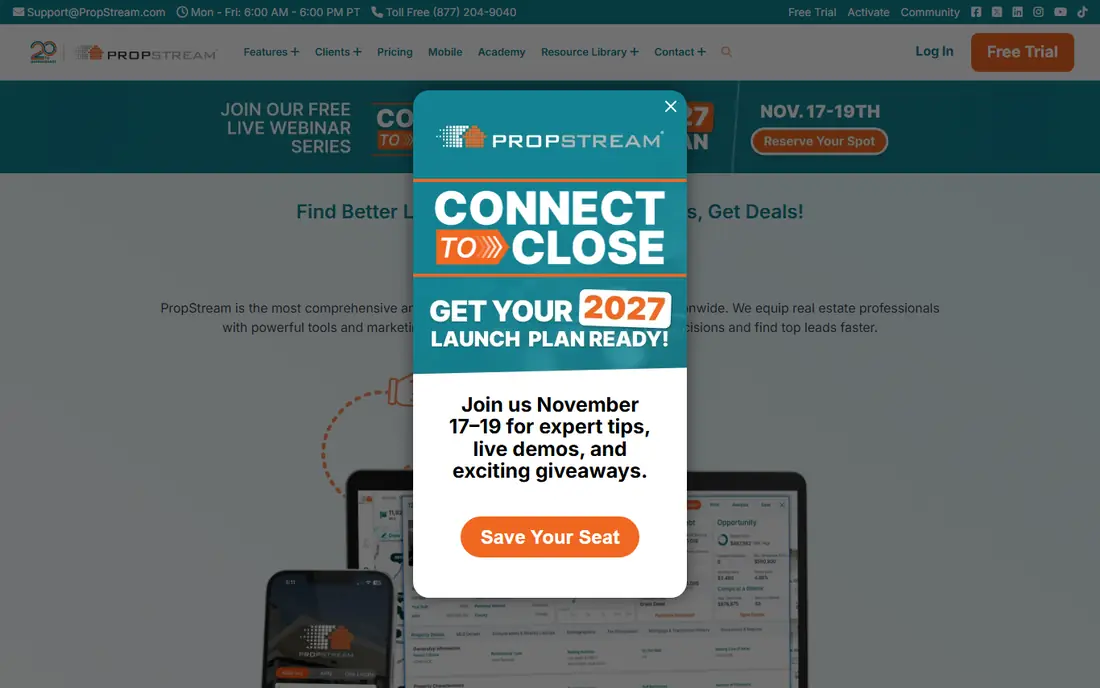
PropStream is a research-first tool for investors who build lists at a desk. It combines nationwide property data, MLS comps, county records and lead filters, with deal calculators and direct mail in the same subscription. Recent listings show pricing from $99 per month, with a 7-day trial and 50 free leads in some listings.
Skip tracing is the main extra cost. On lower tiers it costs about 12 cents per contact in recent listings, while higher tiers include it through PropStream Connect. New investors should also allow time to learn filtering and comping, since data alone does not make a deal good. For serious list building, PropStream remains a benchmark.
- MLS data and comps
- 120-plus lead filters
- Direct mail and calculators built in
- Skip tracing costs extra on lower tiers
- Learning curve for new investors
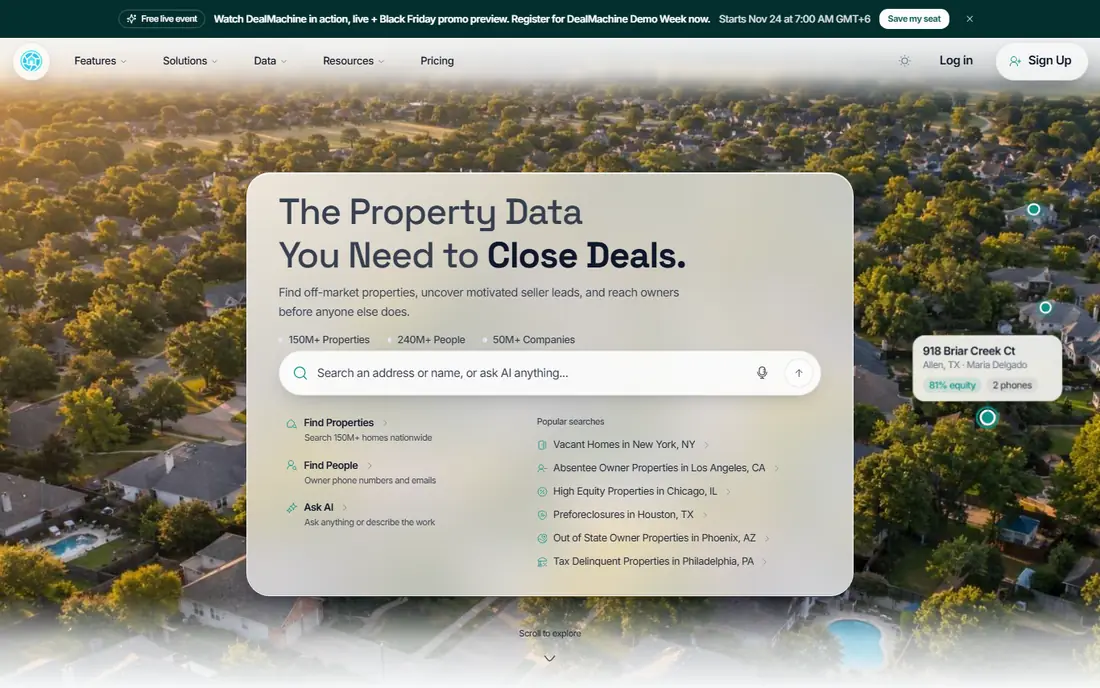
DealMachine is built for investors who find deals by driving neighborhoods. The mobile app lets you tag properties, add photos and notes, pull owner details and start outreach from the car. Recent listings show pricing from $99 per seat per month, with a free browsing account where contact details are locked until paid.
The trade-off is depth. For pure desk research and MLS comps, PropStream offers more data in one place. DealMachine wins when the lead source is the street, not a spreadsheet. If you spend evenings driving target areas, the app design alone can justify the subscription.
- Strong driving app
- Owner data by credit
- AI search and outreach tools
- Less data depth than PropStream
- No full built-in dialer on basic plans
BatchLeads suits investors who call and text large lists. Owner phones and emails are included on every plan in recent listings, with 10,000 leads a month on Growth, and list stacking helps clean and combine lists. Pricing starts from $119 per month in recent listings, with a 7-day trial.
Note that PropStream acquired BatchLeads in 2025, so the two products now sit under the same parent company, even though they are still sold separately. That matters less for daily use than for long-term pricing, but it is worth knowing when comparing them as rivals. For high-volume outreach, BatchLeads is still a strong pick.
- Contact data included on plans
- List stacking
- Texting and outreach tools
- Higher entry price
- Now under the same parent as PropStream
PropertyRadar suits investors who watch a market closely and act when something changes. It offers detailed search criteria, property alerts and trigger events such as new listings, equity changes and owner events. Recent listings show pricing from $119 per month, or $99 per month billed annually, with a short trial.
The app is less of an all-in-one CRM than REsimpli, and a dialer costs extra. Its value is monitoring: an investor farming one or two areas can spot opportunities early and follow up before a property becomes widely marketed. For local farming, PropertyRadar is a focused, capable tool.
- 300-plus search criteria
- Trigger alerts
- Equity and owner data
- Higher entry price
- Dialer is an add-on
REsimpli is a CRM-first platform for established investor teams. It combines lead management, list pulling, skip tracing, calling, texting, email, eSign and accounting in one system, with KPI dashboards for team performance. Recent listings show Solo pricing from $249 per month billed annually, with a 14-day trial.
That price is too high for a beginner testing the market, and setup needs real time. For a team already closing deals and struggling with scattered spreadsheets and tools, REsimpli can replace several subscriptions and give managers a clear view of pipeline. Solo investors should start cheaper and upgrade when volume justifies it.
- Full investor CRM
- Dialer, SMS and email
- Accounting and KPI dashboards
- High price for solo beginners
- Setup takes time
Privy helps investors find deals using MLS data, with comps and search tools designed for investors rather than retail buyers. Recent listings show pricing from $78 per month on annual billing. That makes it cheaper than PropStream or DealMachine for investors who mainly need MLS-based deal analysis.
Coverage is the key check. MLS availability varies by area, so investors should confirm Privy covers their target markets before paying. Outreach tools are also lighter than BatchLeads. For MLS-driven deal finding in covered areas, Privy is a focused and affordable option.
- MLS-based comps and deal finding
- Investor-focused search
- Clear workflow
- Coverage depends on MLS areas
- Less outreach depth than BatchLeads
DealCheck answers a different question from the tools above: does this deal make sense on the numbers. It analyzes rental and flip deals, estimates cash flow and returns, and produces reports that can be shared with partners or lenders. A free tier exists, with paid plans from $10 per month in recent listings.
DealCheck does not find leads, so it pairs with a data tool like PropStream or DealMachine. Its value is speed and clarity: an investor can test many deals quickly and avoid spending time on properties that fail basic math. Every investor, beginner or experienced, benefits from a separate analysis step.
- Fast rental and flip analysis
- Reports for partners
- Free tier available
- Not a lead source
- Advanced features need paid plans
Stessa is for landlords after purchase. It tracks rental income and expenses, organizes properties and produces reports useful at tax time. A free tier exists, with paid plans from $12 per month in recent listings. For a landlord with a few rentals, the free tier covers the core bookkeeping job.
Stessa does not find deals or analyze flips, so it complements rather than replaces a deal tool. Its strength is simplicity: owners can see cash flow by property without a full accounting system. For rental investors who want clean books without spreadsheet work, Stessa is an easy recommendation.
- Free rental bookkeeping
- Income and expense tracking
- Tax-ready reports
- Not a deal-finding tool
- Higher tiers needed for advanced features
Roofstock is a marketplace for buying single-family rental properties, many already tenant-occupied, with inspection reports, valuation data and management options. It suits investors who want to buy remotely or who prefer an existing rental over a renovation project. Browsing is free, and pricing for services varies by transaction.
The honest limit is that a marketplace listing does not remove risk. Local rents, taxes, maintenance and management quality still decide whether a property performs, and inventory varies by market. Investors should verify numbers independently and budget for vacancies and repairs. For remote rental buying, Roofstock is a useful starting point, not a guarantee.
- Marketplace for tenant-occupied rentals
- Inspection and valuation data
- Remote buying support
- Property choice varies by market
- Returns depend on local conditions and management
How we picked these
We compared vendor pages and recent investor software comparisons from October 2026, and kept only apps that are live and truly serve real estate investors. We covered deal finding, analysis, CRM and rental management, because investors need different tools at different stages. Where pricing was not published, we wrote See website, and we did not treat any app as a promise of returns.
How to choose the right app
Start with your strategy. Wholesalers need lead data and outreach, flippers need analysis and project tracking, and landlords need bookkeeping and tenant tools. Buying every tool at once wastes money. Pick one deal tool that fits how you actually find properties, whether that is driving, list building or MLS search, and one analysis or management tool for after you find a deal.
Test with real properties in your market. Check data coverage, skip tracing costs, comp quality and export options before committing to a yearly plan. Finally, run the numbers yourself. An app can estimate cash flow, but taxes, insurance, repairs and vacancies vary, so confirm key figures with local sources before making an offer.
Frequently asked questions
What is the best app for real estate investing?
For deal finding, PropStream suits desk research and DealMachine suits driving for dollars. For analysis, DealCheck is a strong low-cost choice, and for rental management, Stessa is a strong free starting point. The best app depends on strategy, market and whether you are buying, flipping or holding rentals.
What is the best real estate investor software?
Investor software is not one product. Deal tools like PropStream, BatchLeads and PropertyRadar find leads, REsimpli manages operations, and Stessa manages rentals. Most active investors use two or three tools together, each for the job it does best.
Are real estate investing apps worth the cost?
They can be, when they save time on research, outreach or bookkeeping, but they do not create deals on their own. A $99 monthly tool is only worth it if you use it weekly and it leads to analyzed, real opportunities. Start with a free tier or trial, track use for a month, and cancel tools you do not open.
Is real estate investing risky?
Yes. Property values can fall, tenants can leave, repairs can exceed budgets, and financing costs can change. No app can remove those risks. Research local markets, keep reserves for vacancies and repairs, and seek independent professional advice for large purchases.
Can beginners use these apps?
Yes, with care. Free tiers from DealCheck and Stessa let beginners learn analysis and bookkeeping without cost, and Propwire offers free property search in some listings. Beginners should learn local market basics first, start with small, well-analyzed deals, and avoid paying for advanced tools before they have a clear strategy.
Sources we checked (9)

Online Jobs is an independent blog about careers, online work, learning new skills and the tools that help people earn. More about us.
Keep reading
All posts
Wise Alternatives
Compare the best Wise alternatives in 2026, from Revolut and Remitly to OFX and Xe, with fees, speed, cash pickup options, and honest trade-offs today.

Top AI Financial Software
Searching for top AI financial software? We compared 9 AI finance tools for AP, spend, close, forecasting and bookkeeping to help teams choose wisely.

Quicken Alternatives
Compare the best quicken alternatives for Mac, Windows, and small business owners, from Monarch Money and YNAB to Copilot, Tiller, and Banktivity in 2026.