Best Real Estate Accounting Software in 2026: 8 Tools Compared

How we put this together: we compare official feature and pricing pages, app store listings, privacy policies and public user reviews. Prices change, so check the provider's site before you pay.
Key takeaways
- Stessa is the best free starting point for a landlord who mainly needs income and expense tracking across rentals.
- Buildium and AppFolio suit management companies that need owner statements, trust accounting, and reporting at scale.
- RentRedi gives self-managing landlords one flat rate with accounting, leasing, screening, and maintenance included.
- TenantCloud is cheap at a small lease count, but lease caps can force an upgrade as a portfolio grows.
- This is not financial advice, and tax rules vary by state and situation, so check tax reports with your own accountant before filing.
Quick comparison
| Name | Who it suits | Starting price | Free option | |
|---|---|---|---|---|
 Stessa | Landlords who want free rental bookkeeping | Free | Yes | Visit |
 Buildium | Growing management companies | $62 per month | No | Visit |
 AppFolio | Large management companies | See website | No | Visit |
 DoorLoop | Small to mid-sized managers who want a modern platform | See website | No | Visit |
 RentRedi | Self-managing landlords who want one flat rate | $12 per month | No | Visit |
 TenantCloud | Budget landlords with a small lease count | $15 per month | No | Visit |
 REI Hub | Investors who want double-entry rental accounting | See website | Yes | Visit |
 Baselane | Landlords who want banking and bookkeeping together | Free | Yes | Visit |
The best real estate accounting software
Real estate accounting is different from general bookkeeping because income and costs must be tracked by property, unit, tenant, and owner. Rent, fees, repairs, and mortgages all need to land in the right place, or tax time becomes a long cleanup job. The tools below handle that property-level view, with varying depth for landlords, investors, and management companies.
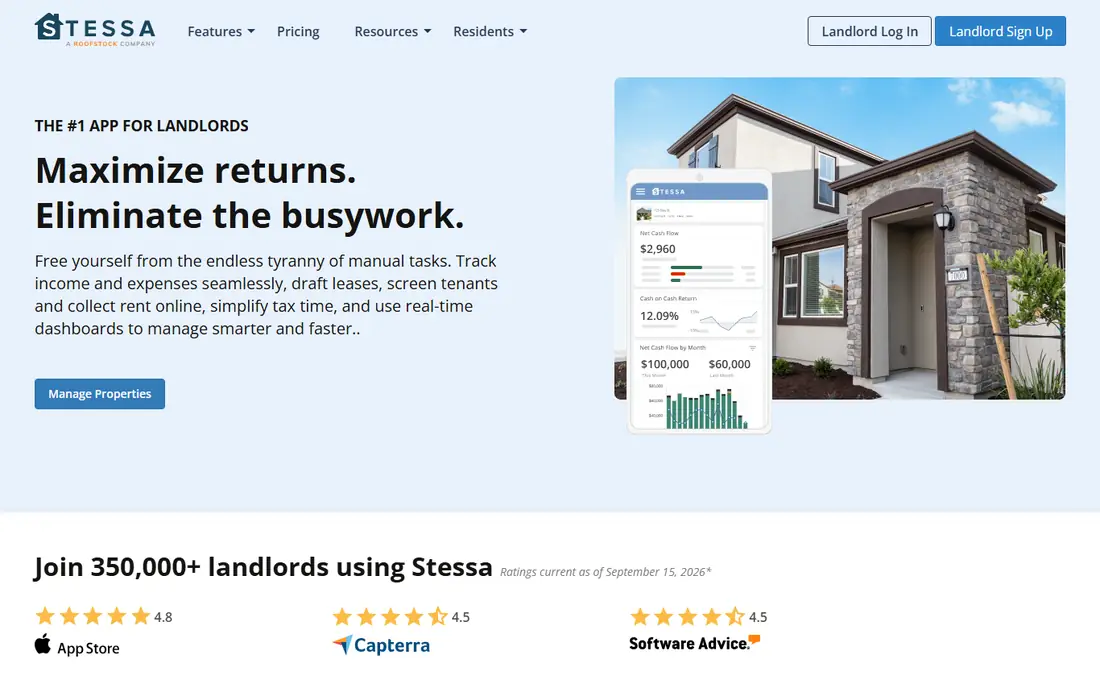
Stessa is built around one job: show how each rental property performs. The free Essentials tier covers unlimited properties, automatic transaction imports, basic financial reports, and online rent collection. That makes it a strong first tool for an investor who tracks rentals in a spreadsheet and wants cleaner books without a monthly bill.
The limits appear when you need more than basic tracking. Schedule E reporting, expanded tools, and unlimited receipt scans sit on paid Manage and Pro tiers, priced from $12 per month billed annually for Manage and $28 per month billed annually for Pro. Stessa also lacks a tenant app, so landlords who want tenants to pay and log maintenance in one place may prefer RentRedi or DoorLoop.
- Free Essentials tier
- Automatic bank feeds
- Portfolio income and expense reports
- No tenant app
- Paid tiers needed for Schedule E and unlimited receipt scans
- No direct QuickBooks link
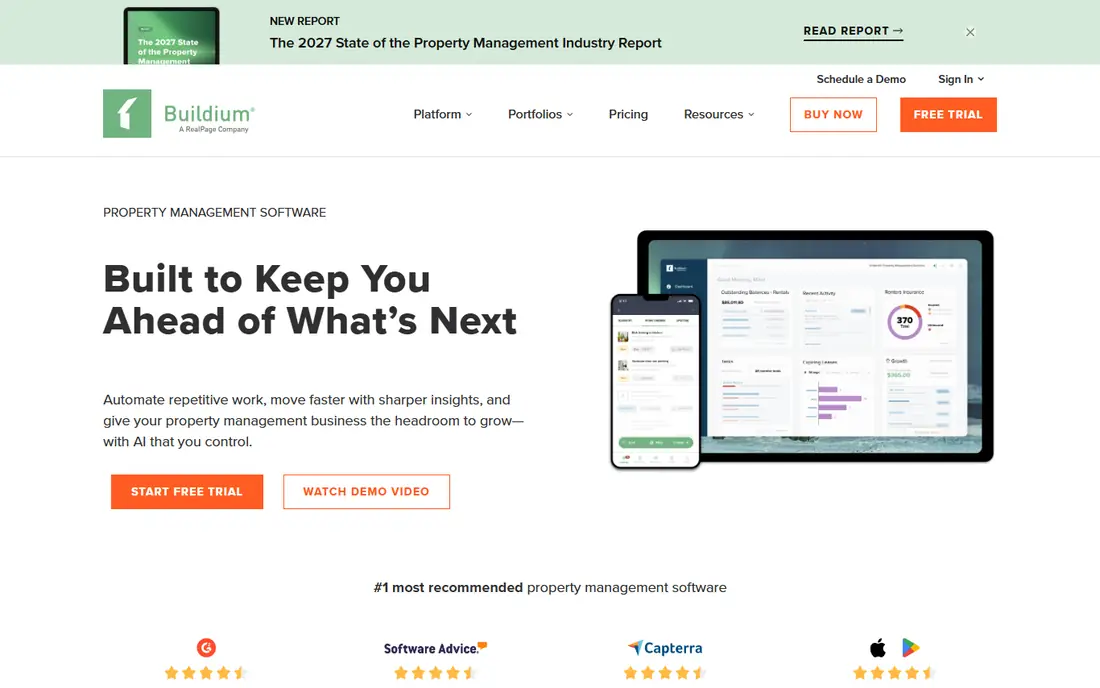
Buildium is a full management platform with accounting at its core. It offers a general ledger, bank reconciliation, owner statements, trust accounting support, and 1099 filing tools, alongside leasing, maintenance, and resident portals. That depth suits a company managing rentals for other owners, where clean owner reporting is part of the service.
Pricing starts at $62 per month for Essential, $192 per month for Growth, and $400 per month for Premium, with prices rising by unit count. Transaction fees also differ by tier, so a busy portfolio should model the total monthly cost, not just the plan price. For a single landlord with two rentals, Buildium is more system than needed. For a growing manager, the structure is the point.
- Full property accounting with bank reconciliation
- Owner statements
- Leasing and maintenance in one system
- No free plan
- Price rises with unit count
- Transaction fees vary by plan
AppFolio serves management companies with larger portfolios across single-family, multifamily, student, and commercial properties. Its accounting covers rent rolls, owner statements, bank reconciliation, and reporting, tied to leasing, maintenance, and resident communication. Automation helps large teams handle renewals, notices, and payment follow-up without adding staff for each new block of units.
The barrier is size and price. AppFolio pricing is quoted, and public reports describe a 50-unit minimum on core tiers, which puts it out of reach for most self-managing landlords. Smaller operators should compare Buildium or DoorLoop first. Larger firms that already manage hundreds of units will get more value from AppFolio's scale and automation.
- Accounting, leasing, and maintenance at scale
- Owner portals
- Automation and reporting for large portfolios
- Quote-based pricing
- 50-unit minimum on core tiers in public reports
- More than small landlords need
DoorLoop brings accounting, leasing, maintenance, payments, and portals into a modern interface that new staff can learn quickly. Every plan includes core accounting, so a manager does not have to upgrade just to reconcile a bank account or produce an owner statement. Guided onboarding also helps small teams get running without a long setup project.
Pricing needs care because DoorLoop now lists per-unit plans with monthly minimums, starting at a $199 per month minimum on its entry plan in its current pricing page. That changes the math for a very small portfolio compared with older flat-rate plans. Check the current minimum for your unit count, and compare payment fees and screening costs before you commit.
- Accounting on every plan
- Leasing, payments, and maintenance together
- Owner and tenant portals
- Pricing model has changed to per-unit plans with monthly minimums
- No free plan
RentRedi charges $12 per month billed annually, $20 per month on a six-month term, or $29.95 per month billed monthly, with the same features on every term. That flat rate includes accounting, profit and loss by property, Schedule E summaries, listings, tenant screening, rent collection, and maintenance tracking. For a landlord who hates tier math, that simplicity is a real benefit.
The trade-off is scale. RentRedi is built for self-managing landlords and smaller managers, not for a large management company with complex trust accounting and multi-entity reporting. If your portfolio grows past that stage, Buildium or AppFolio will fit better. For most independent landlords, RentRedi covers the daily work at a predictable price.
- One flat rate with no lease cap
- Full accounting on every term
- Tenant app and maintenance tools included
- No free plan
- Rent payout timing can take a few business days
- Fewer enterprise reporting tools
TenantCloud starts at $15 per month billed annually for Starter, covering up to 10 leases, with Growth and Pro tiers for larger lease counts. It includes accounting, bank reconciliation, listings, online payments, and tenant screening options, which makes it a strong value choice for a landlord with a handful of rentals.
The catch is the lease cap. Starter covers 10 leases, and once you pass that count you must move up, so the cost can rise faster than a flat-rate rival as you add tenants. Tax preparation reports and 1099 tools also sit on higher tiers. Count your active leases, not just your properties, before you judge TenantCloud against RentRedi.
- Low entry price
- Accounting, listings, and screening in one place
- Free trial
- Plans are capped by active leases
- Higher tiers needed for tax reports and team accounts
- Payment fees apply
REI Hub is accounting-first software for real estate investors. It uses double-entry bookkeeping designed for rentals, so income, expenses, loans, and owner draws stay in proper accounts by property. That structure helps investors who want books their accountant can trust, without paying for a full management system they do not use.
The limit is scope. REI Hub does not replace a management platform: it has no tenant portal, leasing workflow, or maintenance system. Pair it with a rent collection tool if you need those features, or choose it alone if your main need is clean, property-level books and tax-ready reports. Check the current free and paid tier limits on its pricing page before you import a full year of transactions.
- Double-entry accounting built for rentals
- Property-level reports
- Free tier for basic use
- Not a full management platform
- No leasing or tenant portals
- Paid tiers needed for full features
Baselane combines a landlord banking account with bookkeeping, rent collection, and expense tracking. Rent and expenses flow into one view, which cuts the manual matching that eats time at month end. The free Core plan covers basic banking and bookkeeping, while the paid Smart tier adds more advanced reporting and tools.
The drawback is that Baselane is not a full property management platform. It will not replace leasing, screening, and maintenance workflows for a management company. For an independent landlord who wants banking and books in one place, that focus is helpful. For a manager with outside owners, Buildium or AppFolio still offers stronger owner reporting.
- Free Core plan
- Landlord banking with bookkeeping
- Rent collection and expense tracking
- Paid Smart tier needed for advanced tools
- Banking features suit US landlords
- Fewer management tools than Buildium
How we picked these
We compared official feature and pricing pages for tools that track income and expenses by property, not just by bank account. We kept tools that support rent tracking, property-level reports, and tax-related summaries, and we noted where accounting is part of a wider management platform versus a standalone bookkeeping tool. Prices are starting prices from vendor pages or public vendor pricing where noted, and we used See website where pricing is quoted or varies by portfolio size.
How to choose real estate accounting software
Start by counting properties, units, leases, and owners. A landlord with three rentals needs different software from a manager with thirty owners. Flat-rate tools win when you have many units, per-unit tools can win when you have very few, and lease-capped tools can surprise you when tenant turnover rises. Model the cost at twice your current size so a cheap tool today does not become the most expensive tool next year.
Next, check the reports you actually need. At minimum, you want profit and loss by property, a rent roll, expense categories that match your tax filing, and owner statements if you manage for others. Test bank feeds with your real bank, because a feed that misses transactions forces manual entry and defeats the purpose of the software. Also check how the tool handles security deposits, partial payments, and late fees, since those edge cases cause the most bookkeeping errors.
Finally, keep your accountant in the loop. Ask which reports they want, whether they prefer a specific export format, and whether the tool's Schedule E summary matches how they file. This article is not tax advice, and tax treatment varies by entity type and state. Good software gives your accountant clean data, but it does not replace professional advice on deductions, depreciation, or entity structure.
Frequently asked questions
What is the best accounting software for real estate?
For a self-managing landlord, Stessa for free bookkeeping and RentRedi for an all-in-one flat rate are strong picks. For a management company, Buildium suits growing firms and AppFolio suits larger portfolios. The best choice depends on whether you manage for other owners, how many units you run, and which reports your accountant needs.
What is the best real estate accounting software for small landlords?
Stessa Essentials is a good free start for income and expense tracking, and RentRedi at $12 per month billed annually adds leasing, screening, and maintenance at one flat rate. TenantCloud is also cheap at a small lease count. Avoid paying for enterprise management features until your portfolio actually needs them.
Can real estate accounting software help with taxes?
Yes, most tools on this list produce property-level profit and loss reports and tax summaries, and some offer Schedule E support. They help by keeping income and expenses categorized all year, so tax time is a review rather than a rebuild. This is not tax advice, so confirm deductions and filing details with your accountant.
Do I still need QuickBooks if I use real estate software?
Not always. Tools like Buildium, AppFolio, and RentRedi include property accounting, so many landlords drop a general ledger. Some investors still use QuickBooks because their accountant prefers it, or because they run other businesses in the same system. If you keep QuickBooks, check whether your real estate tool syncs with it or only exports reports.
What is the difference between Stessa and Buildium?
Stessa focuses on investor bookkeeping and portfolio performance, with a free tier for basic tracking. Buildium is a full management platform with owner statements, trust accounting, leasing, and maintenance for companies managing for clients. Stessa suits an owner tracking their own rentals, while Buildium suits a manager serving many owners.
How much should real estate accounting software cost?
Free tools cover basic bookkeeping, flat-rate tools run from about $12 per month, and management platforms start at $62 per month for Buildium and rise with units. Enterprise pricing is quoted. Add screening fees, payment processing, and any per-transaction charges to get the true monthly total.
Sources we checked (8)

Online Jobs is an independent blog about careers, online work, learning new skills and the tools that help people earn. More about us.
Keep reading
All posts
Wise Alternatives
Compare the best Wise alternatives in 2026, from Revolut and Remitly to OFX and Xe, with fees, speed, cash pickup options, and honest trade-offs today.

Top AI Financial Software
Searching for top AI financial software? We compared 9 AI finance tools for AP, spend, close, forecasting and bookkeeping to help teams choose wisely.
Quicken Alternatives
Compare the best quicken alternatives for Mac, Windows, and small business owners, from Monarch Money and YNAB to Copilot, Tiller, and Banktivity in 2026.