Best Meditation Apps for Mental Health in 2026: 9 Apps Compared
 Online Jobs·Updated Oct 26, 2026·12 min read


Meditation plus coaching and therapy options · Starting price: $12.99 per month
How we put this together: we compare official feature and pricing pages, app store listings, privacy policies and public user reviews. Prices change, so check the provider's site before you pay.
Key takeaways
- Headspace goes furthest beyond meditation. Its App Store listing describes access to licensed therapists, mental health coaches and an AI companion called Ebb, alongside guided meditations, and it lists $12.99 per month or $69.99 per year after a 14-day trial.
- You can get a serious meditation practice for free. Medito is run by a nonprofit with "no paywalls, no ads," Smiling Mind has stayed free for over 12 years, and the VA's Mindfulness Coach is free for anyone.
- Insight Timer has the biggest free library we found (its homepage claims 360,000 tracks), with an optional Premium plan listed on the App Store at $9.99 per month or $59.99 per year.
- Waking Up and Happier Meditation are the most teaching-focused apps. Waking Up offers a free scholarship to anyone who cannot afford it.
- No app replaces a therapist or doctor. If you are in crisis in the US, call or text 988.
Quick comparison
| Name | Who it suits | Starting price | Free option | |
|---|---|---|---|---|
| Headspace | Meditation plus coaching and therapy options | $12.99 per month | Free trial (14 days) | Visit |
 Calm | Sleep and stress relief | See website | Yes | Visit |
 Insight Timer | The largest free library | Free | Yes | Visit |
 Happier Meditation | Practical, skeptic-friendly teaching | See website | Free trial | Visit |
 Waking Up | Deeper understanding of meditation | See website | Free trial (7 days) | Visit |
 Balance | A personalized daily plan | $11.99 per month | Free trial | Visit |
 Medito | Completely free, no ads | Free | Yes | Visit |
 Smiling Mind | Families and kids | Free | Yes | Visit |
 Mindfulness Coach | Veterans and structured self-guided training | Free | Yes | Visit |
The best meditation apps for mental health
Health note: these apps are wellness tools, not medical treatment. They can help with everyday stress, sleep and anxious thoughts, but if you have a diagnosed condition, talk to a qualified professional, and if you are in crisis in the US, call or text 988 for the Suicide and Crisis Lifeline.
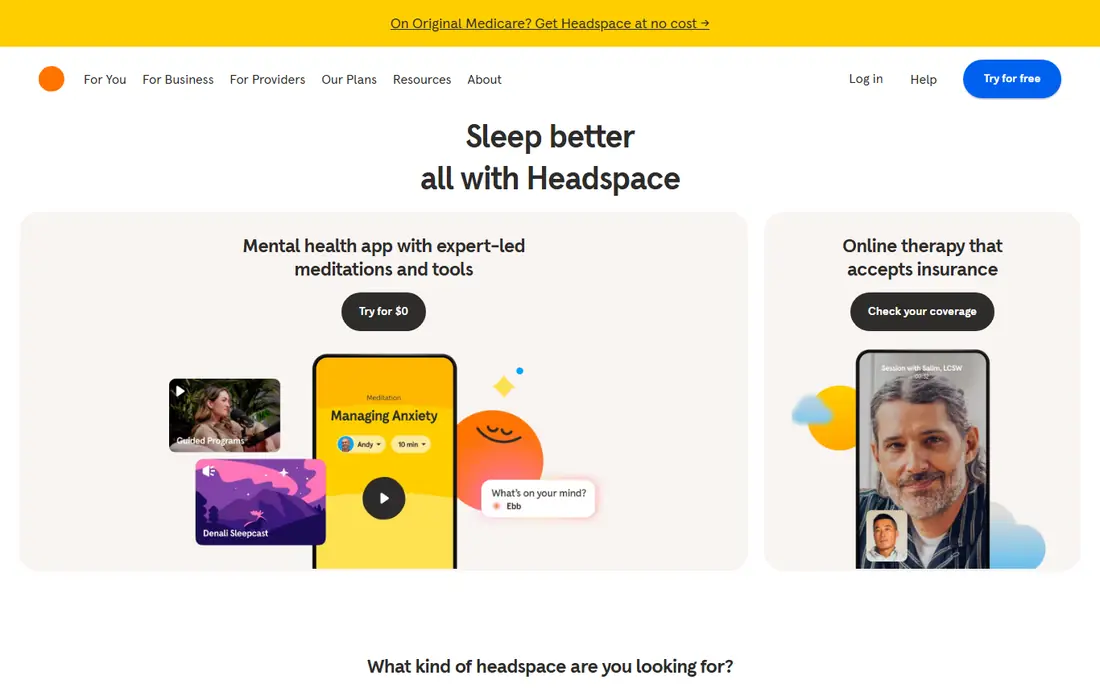
Headspace is the app we would suggest to someone who wants to start with meditation but may need more support later. Its App Store listing describes daily meditations, breathwork for anxiety and courses for building skills, plus access to licensed therapists, mental health coaches and Ebb, an AI companion.
That mix is the real difference. If you start with a stress course and realize you want to talk to someone, you can move to coaching or therapy without changing apps. Headspace says its therapy partners with major insurers, and that sessions could cost as little as $0 with some plans.
On price, the US App Store lists a monthly subscription at $12.99 and an annual subscription at $69.99, and Headspace's site offers a 14-day free trial. Once the trial ends, very little remains free, so set a reminder if you only want to test it.
- Clear, beginner-friendly guided courses
- Optional mental health coaching and therapy in the same app
- Works on iPhone, iPad, Mac, Apple Watch and Vision Pro
- No real free tier after the trial
- Coaching and therapy are separate services with their own costs
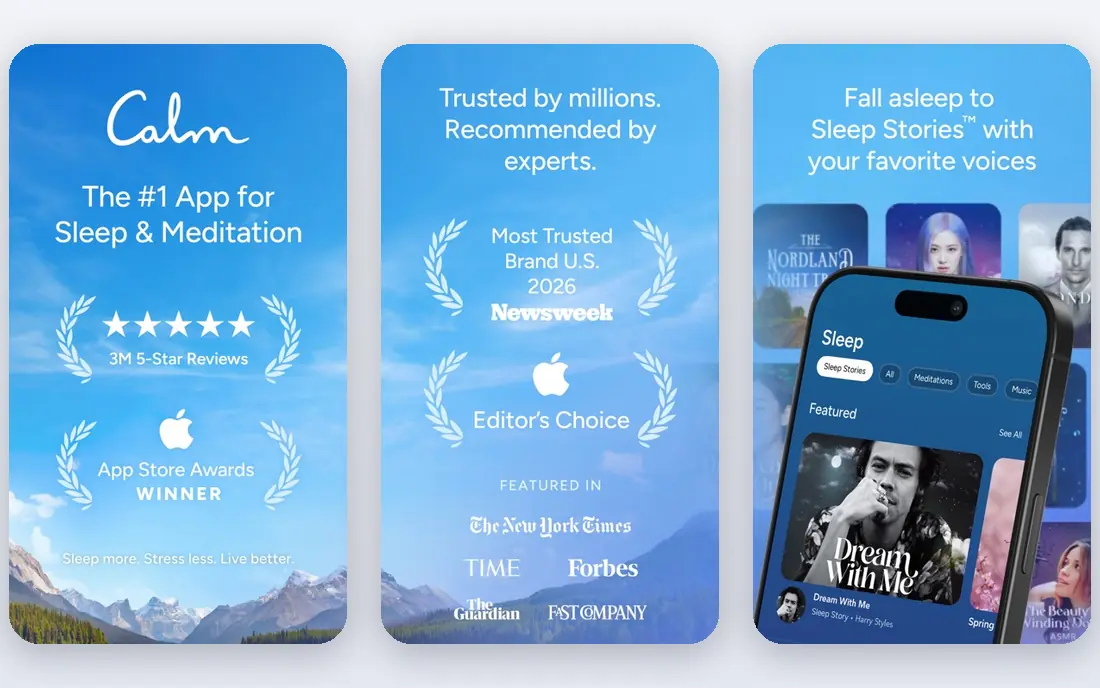
Calm is the sleep specialist on this list. The App Store listing highlights more than 100 exclusive Sleep Stories, narrated by names like Matthew McConaughey and Stephen Fry, plus sleep music, soundscapes and programs for insomnia. If racing thoughts at bedtime are your main problem, Calm is a strong first try.
It also covers daytime anxiety with guided meditations for every level, breathing exercises and a quick-start breathing feature on Apple Watch. Calm says there are never any ads and some programs and features are free forever, though most of the library is behind the subscription.
We could not confirm one single current price on Calm's site. The US App Store shows several Calm Premium options, the highest of which is $79.99, so check the price shown in your app before starting a trial.
- Over 100 exclusive Sleep Stories
- No ads, with some programs free forever
- Rated 4.8 from about 2 million App Store ratings
- Most content needs a subscription
- Pricing varies between the website and app stores
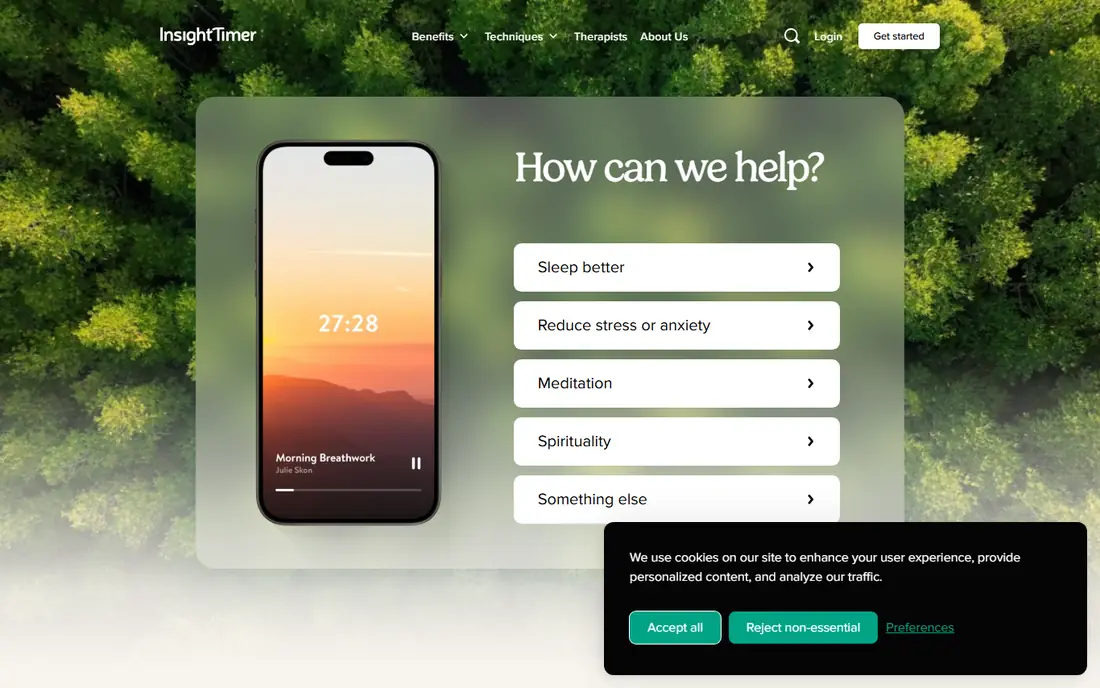
Insight Timer is the best free meditation app for people who want variety. Its homepage calls it the world's largest library of free guided meditations, with 360,000 tracks, and the App Store listing says more than 100 new free practices are added every day.
The free tier is genuinely generous: guided meditations, breathwork, yoga, sleep content, music and community groups for beginners and for many faith and secular traditions. The App Store listing shows a 4.9 rating from about 448,000 reviews.
The trade-off is choice overload. With thousands of teachers, quality and style vary a lot, and some reviewers say the app's organization makes it hard to find courses again. The optional Premium plan adds courses and offline listening and is listed at $9.99 per month or $59.99 per year on the US App Store.
- Thousands of free guided meditations, breathwork and yoga sessions
- Huge range of teachers and traditions
- Premium is optional at $9.99 per month or $59.99 per year
- So much content that it can be hard to choose
- Offline listening and courses require Premium
Happier Meditation, formerly Ten Percent Happier, is built for people who are curious about meditation but allergic to anything that sounds too mystical. The company says it started in 2014 and collaborated with Dan Harris, author of the book 10% Happier, to build an app of curated meditations and lessons.
Its newer approach is personalization. You check in each month with your goals, and the app suggests meditations and courses to match, while nudging you to try new things. The teaching style is down-to-earth and practical, which suits busy people dealing with stress at work.
Pricing is the weak spot. The US App Store lists several plans, including an annual membership at $99.99, which is more than Headspace's annual price. Try the free trial and see whether the teachers click for you before committing.
- Grew out of Dan Harris's book 10% Happier
- Personalized recommendations based on monthly check-ins
- Rated 4.8 from about 143,000 App Store ratings
- Subscription is pricier than some rivals
- Smaller library than Insight Timer
Waking Up is for people who want to understand what meditation is doing, not just follow a calming voice. The app was created by neuroscientist and author Sam Harris, and its site describes more than 100 teachers, including meditators, scientists, philosophers and poets.
The structure starts with an introductory course, then branches into theory, conversations and practices from several traditions. It is rated 4.9 from about 43,000 ratings on the US App Store.
Waking Up is sold as an annual subscription after a 7-day trial, and its site mentions a money-back guarantee. One thing we like: the App Store listing says it is "free for anyone who can't afford it," through a scholarship you request by email. The catch is tone. If you want quick stress relief rather than big ideas about the mind, a simpler app will feel lighter.
- In-depth introductory course by Sam Harris
- More than 100 teachers, scientists and philosophers
- Free scholarship for anyone who cannot afford it
- Annual subscription only after the trial
- Philosophical style is not for everyone
Balance, from The Mind Company (which also makes a popular brain-training app), builds a personalized program for you. Each day you answer a few questions about how you are feeling, and the app adjusts the meditation it gives you. For someone who freezes when faced with a huge library, that guidance is helpful.
The program covers stress, sleep, focus and mood. The App Store listing shows a 4.9 rating from about 121,000 reviews, which is unusually high.
After the free trial, the App Store listing says Balance costs $11.99 per month or $69.99 per year for US customers. The listing we checked is marked "Only for iPhone," so iPad users should check compatibility first.
- Adapts each session based on your answers
- Covers stress, sleep, focus and mood
- Rated 4.9 from about 121,000 App Store ratings
- IPhone only on the App Store listing we checked
- Full program requires a subscription
Medito is the app we recommend to anyone who wants a full meditation app without paying anything. It is run by the Medito Foundation, a nonprofit whose site promises "no paywalls, no ads, no exceptions." There is no premium tier at all.
The app includes guided meditations, sleep stories, courses and breathing exercises, and the foundation says it has reached more than 4.1 million people in over 190 countries. Its code is public under an open-source license, which also signals a respect for privacy that many commercial apps do not match.
The trade-off is scale. Medito does not have celebrity narrators or tens of thousands of tracks. For a daily practice, though, it covers the essentials well, and it is free forever by design.
- Every meditation, course and feature is free
- No ads, no trials and no premium tier
- Open source under the AGPL license
- Smaller and simpler than big commercial apps
- Relies on donations to keep going
Smiling Mind is a not-for-profit from Australia, and its app has stayed free for individuals and families for more than 12 years. It is designed for all ages, which makes it one of the better choices for parents who want to meditate with their children.
The app focuses on what the organization calls mental fitness: short, structured programs on sleep, stress and building habits, plus collections for kids, such as a six-session program on perseverance and teamwork.
Some of Smiling Mind's school and community programs are aimed at Australia, so US users mainly get the app itself. For experienced meditators it may feel basic, but for families it is a safe, ad-free and free starting point.
- Free for individuals and families for over 12 years
- Run by a not-for-profit organization
- Programs designed for kids and adults
- Australian organization, so some school programs are local to Australia
- Less content for advanced meditators
Mindfulness Coach
Who it suits: Veterans and structured self-guided training
Mindfulness Coach was created by the US Department of Veterans Affairs' National Center for PTSD. It is designed for veterans and service members, but anyone can use it. The VA describes a gradual, self-guided training program, a library of information about mindfulness and 12 audio-guided exercises, with more available as free downloads.
It also includes goal setting, a mindfulness mastery assessment to track progress, reminders, and links to support and crisis resources. That last point matters for mental health: help is a tap away.
The VA is clear that the app can be used on its own or alongside professional care, but it does not replace treatment for PTSD or other mental health conditions. The design is plain, but it is free and comes from a clinical research center.
- Free app from the VA's National Center for PTSD
- Gradual, step-by-step training program
- Includes progress tracking and crisis resources
- Simple design compared with commercial apps
- Smaller library, with 12 core audio exercises
How we picked these
We compared each app's official website and its US App Store listing in October 2026, checking what is free, what each subscription costs, the content offered for stress, anxiety and sleep, and any mental health support beyond meditation. We favored apps with no ads, clear pricing and a track record, and we included several fully free options from nonprofits and public bodies.
We did not test these apps as a clinical study, and we do not claim any app treats a mental health condition. Where an app's price varied between its website and app store listings, we say so instead of guessing.
How to choose a meditation app for your mental health
Decide what you need help with
For sleep, Calm's Sleep Stories and sleep music are a strong match. For daily stress, Headspace, Balance or Happier Meditation offer guided courses. For variety on a zero budget, Insight Timer or Medito.
Check what happens after the free trial
Most paid apps start with a trial and then charge automatically. Set a reminder a few days before it ends, and cancel through the same store you subscribed in.
Look at privacy
Meditation apps can hold sensitive details about your mood and sleep. Read the privacy policy, turn off optional tracking, and prefer apps without ads. Medito's nonprofit, open-source model is the most privacy-friendly option on this list.
Know when an app is not enough
If anxiety or low mood is affecting work, relationships or sleep for weeks, a meditation app is not enough on its own. Talk to your doctor or a licensed therapist. Headspace offers therapy and coaching inside its app, and many insurance plans cover therapy.
Frequently asked questions
Which meditation app is best for anxiety?
Headspace and Calm both have dedicated anxiety content and breathing exercises, and Headspace adds coaching and therapy options if you need more support. On a budget, Insight Timer and Medito have free anxiety meditations. If anxiety is severe or persistent, speak to a professional as well.
Is there a completely free meditation app?
Yes. Medito is completely free with no ads and no premium tier, Smiling Mind is free for individuals and families, and the VA's Mindfulness Coach is free for anyone. Insight Timer is also free for most of its content, with an optional paid plan.
Is Headspace or Calm better for mental health?
Headspace is better if you want structured courses and the option to move into coaching or therapy within the same app. Calm is better if sleep is your main problem, thanks to its Sleep Stories and sleep music. Both offer free trials, so you can test each before paying.
Can meditation apps replace therapy?
No. Meditation apps can help with everyday stress and sleep, but they are not a substitute for diagnosis or treatment. The VA, which notes that mindfulness has been shown to help with stress and anxiety, says its own Mindfulness Coach app does not replace professional treatment.
How long should I meditate each day to notice a difference?
Most apps start with sessions of a few minutes. Consistency matters more than length, so a short daily session is a better start than an occasional long one. Increase the time once the habit feels easy.
Sources we checked (16)
- https://www.headspace.com/subscriptions
- https://apps.apple.com/us/app/headspace-sleep-meditation/id493145008
- https://www.calm.com/
- https://apps.apple.com/us/app/calm/id571800810
- https://insighttimer.com/
- https://apps.apple.com/us/app/insight-timer-meditate-sleep/id337472899
- https://www.meditatehappier.com/
- https://apps.apple.com/us/app/happier-meditation/id992210239
- https://www.wakingup.com/
- https://apps.apple.com/us/app/waking-up-meditation-wisdom/id1307736395
- https://themindcompany.com/apps/balance
- https://apps.apple.com/us/app/balance-meditation-sleep/id1361356590
- https://meditofoundation.org/
- https://www.smilingmind.com.au/
- https://www.smilingmind.com.au/smiling-mind-app
- https://mobile.va.gov/app/mindfulness-coach
Online Jobs is an independent blog about careers, online work, learning new skills and the tools that help people earn. More about us.
Keep reading
All posts
Best Web Scraping Tools
Compare the best web scraping tools in 2026, from no-code Octoparse and Browse AI to Apify, Firecrawl, Bright Data, Zyte, ScraperAPI and free Scrapy, with prices.
Best Tools to Find Company Decision Makers
The best tools to find company decision makers in 2026: LinkedIn Sales Navigator, Apollo, ZoomInfo, Lusha, Hunter and more, with real prices and free plans.
Best Task Management Apps
Find the best task management app in 2026. We compare Todoist, TickTick, Asana, Trello, ClickUp, monday.com and more on price, free plans and team features.