Best IRA Companies in 2026: 9 Companies Compared

How we put this together: we compare official feature and pricing pages, app store listings, privacy policies and public user reviews. Prices change, so check the provider's site before you pay.
Key takeaways
- Fidelity is our pick for most IRA savers, because it combines $0 account minimums, $0 stock and ETF commissions, and a wide fund range.
- Charles Schwab is a close second for beginners who want branches, research, and a $0 minimum alongside strong service.
- Vanguard suits low-cost index investors who are happy with ETFs and a smaller set of trading tools.
- Betterment and Wealthfront suit hands-off savers who want an automated portfolio and retirement planning.
- This is not financial advice. IRA tax rules, contribution limits, and investment risks depend on your situation, so check current IRS rules and consider professional advice before opening an account.
Quick comparison
| Name | Who it suits | Starting price | Free option | |
|---|---|---|---|---|
 Fidelity | Best overall IRA provider | Free | Yes | Visit |
 Charles Schwab | Beginners and full service | Free | Yes | Visit |
 Vanguard | Low-cost index investing | Free | Yes | Visit |
 SoFi | App-first IRA with automation | Free | Yes | Visit |
 Robinhood | Low-cost trading in an IRA | Free | Yes | Visit |
 Betterment | Hands-off automated IRA | See website | Yes | Visit |
 Wealthfront | Automated investing and planning | See website | Yes | Visit |
 Merrill | IRA inside Bank of America | Free | Yes | Visit |
 E*TRADE | Self-directed IRA trading | Free | Yes | Visit |
The best ira companies
An IRA is a tax-advantaged retirement account, not an investment itself. You open the account with a provider, then choose investments inside it, such as index funds, ETFs, or individual stocks. Traditional IRAs may offer tax-deductible contributions, while Roth IRAs use after-tax contributions with tax-free qualified withdrawals in retirement. Rules on eligibility, limits, and withdrawals change, so confirm current IRS guidance before you contribute.
This is not financial advice, and investing involves risk, including possible loss of principal. The companies below are compared on account fees, minimums, investment choice, and service, not on promised returns, because no provider can guarantee investment performance.
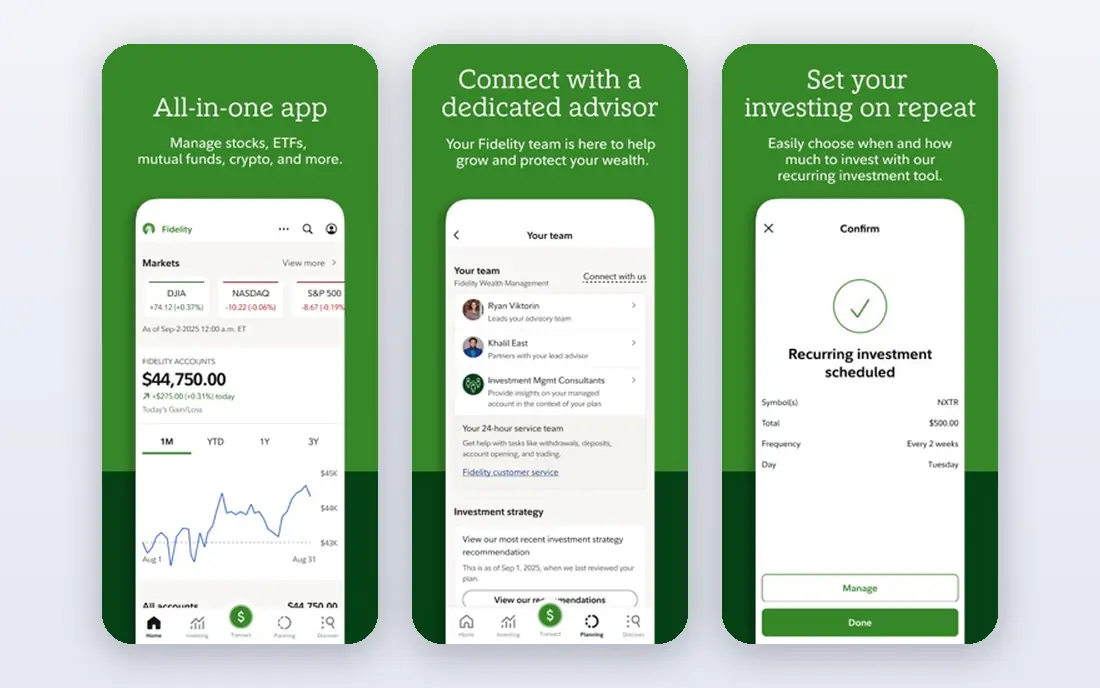
Fidelity is our pick for most IRA savers because it removes the common barriers. There is $0 minimum to open an IRA, $0 commission on online stock and ETF trades, and a broad fund lineup that includes low-cost index funds and target-date funds for hands-off savers. Its planning tools help you model retirement goals, and its research covers funds, ETFs, and stocks in depth.
The breadth is also the learning curve. A beginner opening Fidelity will see many menus, account types, and fund choices, so start with a single diversified fund or a target-date fund if you want simplicity. Check fund expense ratios, because those ongoing costs matter more over decades than a $0 commission. For most savers, though, Fidelity offers the widest choice at the lowest friction.
- $0 account minimum and $0 commissions on stocks and ETFs
- Wide range of index funds, ETFs, and target-date funds
- Strong research and planning tools
- Platform has many features, which can overwhelm beginners
- Some funds and advice services carry their own fees
- Cash sweep options need checking
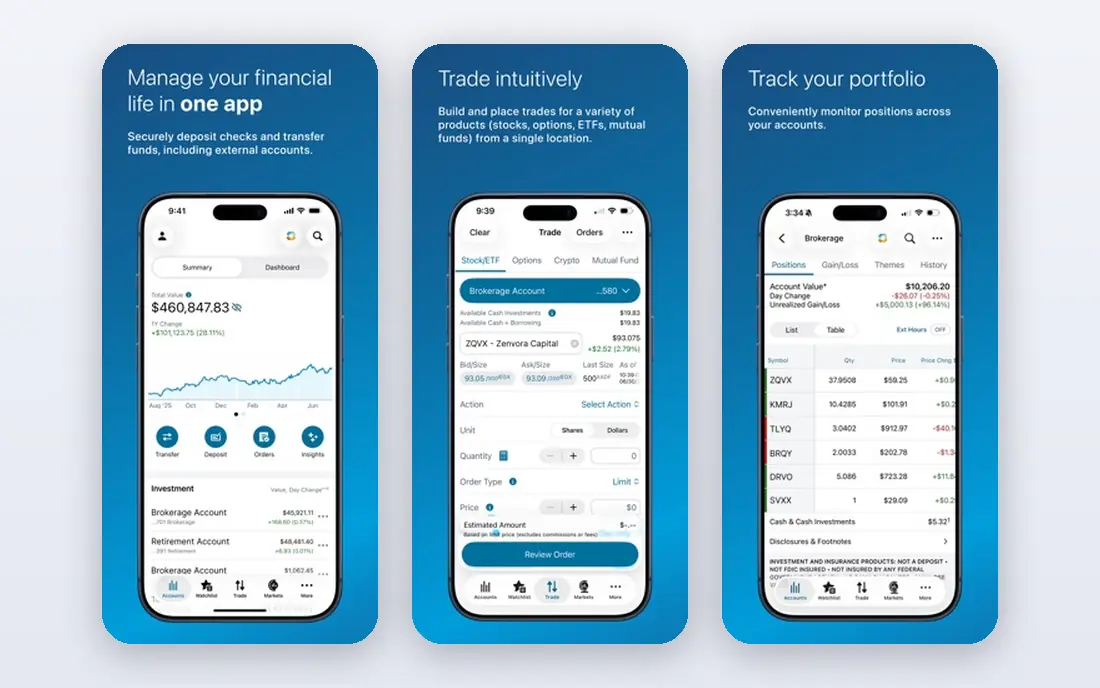
Charles Schwab is a close second and the best pick if you want in-person help. It offers $0 minimums, $0 stock and ETF commissions, and a branch network alongside phone and online support, which suits savers who prefer to talk through an account opening or a rollover. Its education materials are clear, and its index funds are competitively priced.
Managed investing through Schwab Intelligent Portfolios needs a higher minimum than opening a self-directed IRA, so hands-off savers with a small starting balance should check that threshold first. For a self-directed IRA, Schwab matches Fidelity on the basics, and the choice between them often comes down to which platform you find easier to use.
- $0 account minimum and $0 commissions on stocks and ETFs
- Branch network plus phone support
- Strong research and education for beginners
- Some index mutual funds have small minimums
- Managed portfolio service needs a higher minimum
- Platform can feel large for simple savers
Vanguard built its reputation on low-cost index investing, and that remains its strength. You can open an IRA with $0, buy Vanguard ETFs with no minimum beyond the share price, and use a target-date fund for a diversified, automatically adjusting portfolio. For a saver who wants to keep costs low and avoid frequent trading, Vanguard is hard to fault.
The catch is fund minimums. While ETFs have no fund minimum, many Vanguard mutual funds still require $1,000 to $3,000, so small savers should start with ETFs or check the current minimum for the exact fund they want. Vanguard trading tools are also simpler than rivals, which is fine for long-term investors but less suited to active traders.
- $0 to open an IRA
- Renowned low-cost index funds and ETFs
- Target-date funds for hands-off retirement saving
- Many classic mutual funds still have $1,000 to $3,000 minimums
- Trading tools are simpler than Fidelity or Schwab
- Service is mainly online and phone
SoFi suits savers who want to manage an IRA mainly from a phone. It offers no account minimum and no annual fee for its IRA, self-directed stock and ETF investing, and an automated portfolio option for hands-off savers. The app is clean, account opening is quick, and the wider SoFi platform covers banking and lending alongside investing.
Research and fund choice are thinner than at Fidelity, Schwab, or Vanguard, so active investors may feel limited. The automated option also carries an advisory fee, so check the current rate before choosing it over a self-directed index fund. For a simple, app-first IRA, SoFi is a credible and low-friction choice.
- No account minimum and no annual fee on its IRA
- App-first experience
- Automated portfolios available alongside self-directed investing
- Investment research is thinner than Fidelity or Schwab
- Automated portfolio fee applies on the robo option
- Fewer branches for in-person help
Robinhood is the trading-first option in this list. It offers $0 commissions, a simple app, and an IRA with a match offer on eligible contributions for some plans, subject to terms and holding periods. For a saver who wants to pick individual stocks and ETFs inside an IRA at low cost, it is easy to use.
Read the match terms carefully, because eligibility, caps, and holding requirements affect whether the match is worth it for you. Robinhood also offers less retirement planning, fund research, and advice than Fidelity or Schwab. Choose it for self-directed trading, not as a replacement for a planning-led provider if you want guidance.
- $0 commissions on stocks and ETFs
- Simple app for self-directed investing
- IRA match offer on some plans, subject to terms
- Research and planning tools are thinner than full-service brokers
- Match terms and eligibility need careful reading
- Not suited to hands-off fund investors
Betterment is the hands-off pick for savers who do not want to choose funds. You answer questions about goals and risk, Betterment builds and rebalances an ETF portfolio, and its planning tools show whether you are on track for retirement. The Digital plan has no account minimum, which makes it easy to start.
The cost is an advisory fee, with a monthly fee for small balances that do not meet recurring deposit conditions, so check the current fee schedule for your balance. You also give up direct stock picking, because Betterment manages portfolios, not individual trades. For a saver who wants automation and planning without fund research, that trade is worthwhile.
- Automated ETF portfolios with rebalancing
- Retirement planning and goal projections
- No account minimum on the Digital plan
- Advisory fee applies, with a monthly fee for small balances without recurring deposits
- No direct stock picking
- Premium advice needs a high minimum
Wealthfront is similar to Betterment in purpose: automated investing for people who want a managed portfolio without choosing funds. It offers rebalancing, tax-loss harvesting where eligible, and planning tools that project retirement outcomes. Its interface is clean, and its automated approach suits long-term savers who prefer to set a plan and leave it alone.
An advisory fee applies, and automated investing needs a minimum balance, so small savers should check the current threshold. Like Betterment, Wealthfront manages portfolios rather than offering direct stock picking. Choose between Betterment and Wealthfront on fee, planning tools, and which interface you prefer, because their core job is the same.
- Automated ETF portfolios with rebalancing and tax-loss harvesting where eligible
- Clear planning tools
- Low minimum for automated investing
- Advisory fee applies
- Minimum balance for automated investing
- No direct stock trading inside the managed portfolio
Merrill, from Bank of America, suits savers who already bank with Bank of America and want investing in the same ecosystem. It offers a self-directed IRA with $0 minimum, no annual fee listed, and $0 stock and ETF commissions, plus a guided investing option for hands-off savers. Preferred Rewards links can add benefits for banking customers, subject to eligibility.
If you do not bank with Bank of America, Merrill offers less reason to choose it over Fidelity or Schwab, because its core IRA terms are similar. Full advice also costs extra. For existing Bank of America customers who want one login for banking and retirement saving, Merrill is a convenient and competitive choice.
- $0 account minimum and no annual fee listed for its IRA
- $0 commissions on stocks and ETFs
- Rewards link for Bank of America customers
- Full-service advice costs extra
- Platform is best for existing Bank of America customers
- Fund and service fees vary by choice
E*TRADE, from Morgan Stanley, closes the list as a strong self-directed option. It offers $0 minimum, no annual fee, and $0 stock and ETF commissions, alongside trading tools and research that suit active investors. Its IRA covers Traditional, Roth, Rollover, and SEP types, so it fits most retirement situations.
For a saver who only wants a single target-date fund and no trading, ETRADE platform depth is more than needed, and Fidelity or Vanguard may feel simpler. For a saver who wants to trade stocks and ETFs inside an IRA with strong tools, ETRADE is a credible alternative to Fidelity and Schwab.
- $0 account minimum and no annual fee
- $0 commissions on stocks and ETFs
- Strong trading tools and research for active investors
- Fund minimums and service fees vary
- Platform can feel complex for pure retirement savers
- Managed portfolios are a separate service
How we picked these
We compared official fee schedules, account minimums, and investment options, and we checked that each provider homepage loads and belongs to the company named. We favoured providers that are actively offering IRAs in the US, with clear $0 or low minimums, broad investment choice, and either self-directed or automated options. Where a fee varies by balance, plan, or service, we wrote See website or Free for the account itself rather than presenting a single fee as universal. This article is general information, not financial advice.
How to choose between a Roth and a Traditional IRA
The core difference is tax timing. Traditional IRA contributions may be tax-deductible in the year you contribute, subject to income and workplace plan rules, and withdrawals in retirement are generally taxed. Roth IRA contributions use after-tax money, and qualified withdrawals in retirement are generally tax-free, subject to age and holding rules. Neither is universally better, because the answer depends on your current tax rate, expected retirement tax rate, and eligibility.
Check current IRS contribution limits and income phase-outs before you contribute, because they change by tax year and filing status. Also consider whether you need a rollover IRA for an old workplace plan, a SEP IRA for self-employment income, or a simple target-date fund to avoid choosing investments yourself. If you are unsure, consider speaking to a qualified tax or financial professional, especially before a large contribution or a Roth conversion, because conversions can create a tax bill.
Frequently asked questions
What is the best IRA company?
Fidelity is our pick for most savers, because it offers $0 minimums, $0 stock and ETF commissions, and a wide fund range. Charles Schwab is a close second for beginners who want branches and service, and Vanguard is the pick for low-cost index investors. The best provider is the one whose platform you will actually use and keep funding.
What is the best Roth IRA company?
Fidelity, Charles Schwab, and Vanguard all offer strong Roth IRAs with $0 minimums to open and $0 stock and ETF commissions. Betterment and Wealthfront suit hands-off Roth savers who want automated portfolios. Choose by whether you want self-directed investing, automated management, or in-person help.
What is the best IRA company for beginners?
Charles Schwab and Fidelity both suit beginners, with $0 minimums, clear education materials, and target-date funds for hands-off saving. Schwab adds branches for in-person help, while Fidelity adds a wider research platform. Start with a single diversified fund or a target-date fund if you do not want to pick investments yourself.
How much money do I need to open an IRA?
Many providers in this list, including Fidelity, Schwab, Vanguard, SoFi, and E*TRADE, allow $0 to open an IRA. Some mutual funds still have minimums, often $1,000 to $3,000 at Vanguard, but ETFs have no fund minimum beyond the share price. You can start with a small amount and add contributions over time, subject to IRS limits.
Is this financial advice?
No. This article is general information about IRA providers, fees, and features, not personal financial advice. Investing involves risk, including possible loss, and tax rules depend on your income, filing status, and workplace plan. Check current IRS rules and consider professional advice before opening, funding, or converting an IRA.
Can I have more than one IRA?
Yes, you can hold multiple IRAs, including both Traditional and Roth accounts, subject to combined annual contribution limits across your IRAs. Having multiple accounts can make sense for a rollover and a new Roth, but it also adds paperwork. Check IRS limits for your tax year before contributing to more than one account.
Sources we checked (9)

Online Jobs is an independent blog about careers, online work, learning new skills and the tools that help people earn. More about us.
Keep reading
All posts
Top AI Financial Software
Searching for top AI financial software? We compared 9 AI finance tools for AP, spend, close, forecasting and bookkeeping to help teams choose wisely.
Quicken Alternatives
Compare the best quicken alternatives for Mac, Windows, and small business owners, from Monarch Money and YNAB to Copilot, Tiller, and Banktivity in 2026.
GoFundMe Alternatives
Looking for GoFundMe alternatives? We compared 8 fundraising platforms on fees, campaign types, donor tools and who each platform suits best in 2026 today.