Best Financial Planning Software in 2026: 9 Tools Compared

How we put this together: we compare official feature and pricing pages, app store listings, privacy policies and public user reviews. Prices change, so check the provider's site before you pay.
Key takeaways
- Advisor tools and household tools solve different problems, so start by deciding who the plan is for, not which logo looks best.
- RightCapital offers the clearest published advisor pricing, starting at $1,800 per year, while eMoney and several rivals keep pricing behind a sales conversation.
- Household planners such as Monarch Money and Boldin cost far less than advisor platforms and cover retirement projections without a professional license.
- A plan is only as good as its inputs, so account linking, tax modeling, and scenario testing matter more than a polished dashboard.
- This is not financial advice. Any tool here helps you model outcomes, but it does not replace advice tailored to your own situation.
Quick comparison
| Name | Who it suits | Starting price | Free option | |
|---|---|---|---|---|
 eMoney Advisor | Large advisor firms | See website | Free trial | Visit |
 RightCapital | Independent advisors | $1,800 per year | Free trial | Visit |
 MoneyGuidePro | Goal-based advisor planning | $2,400 per year | Free trial | Visit |
 Orion Planning | Advisors using Orion | See website | No | Visit |
 Advyzon | Advisors wanting planning plus CRM | See website | Free trial | Visit |
 Boldin | Retirement planning for households | See website | Yes | Visit |
 Monarch Money | Household money dashboards | $99.99 per year | Free trial | Visit |
 ProjectionLab | Detailed retirement scenarios | See website | Yes | Visit |
 Quicken Simplifi | Simple tracking and projections | $5.99 per month | Free trial | Visit |
The best financial planning software
We compared advisor platforms and household planners side by side, because the phrase best financial planning software covers both. Advisor tools focus on client plans, compliance, and firm workflows. Household tools focus on one family, its accounts, and its retirement date. The picks below cover both sides, with pricing taken from vendor pages and recent published comparisons where vendors do not publish a price.
eMoney Advisor is the heavyweight in this group, built for firms that plan for many households with complex holdings, businesses, and estate needs. Its cash flow engine handles detailed income, expense, tax, and distribution assumptions, and the client portal gives clients a single place to see accounts, documents, and plan updates. Firms that already run on its ecosystem tend to stay, because moving years of plans is painful.
The catch is cost and complexity. eMoney does not publish prices on its site, and published comparisons put its Pro tier above $4,000 per year, so small firms should get a quote before falling in love with the feature list. Smaller practices may also find the depth more than they need, since a simpler tool can produce a clear plan faster. Choose eMoney when your clients have layered needs and your team can use the depth every week.
- Deep cash flow planning
- Strong client portal
- Broad integrations with custodians and CRMs
- Pricing is not published
- Setup and training take real time
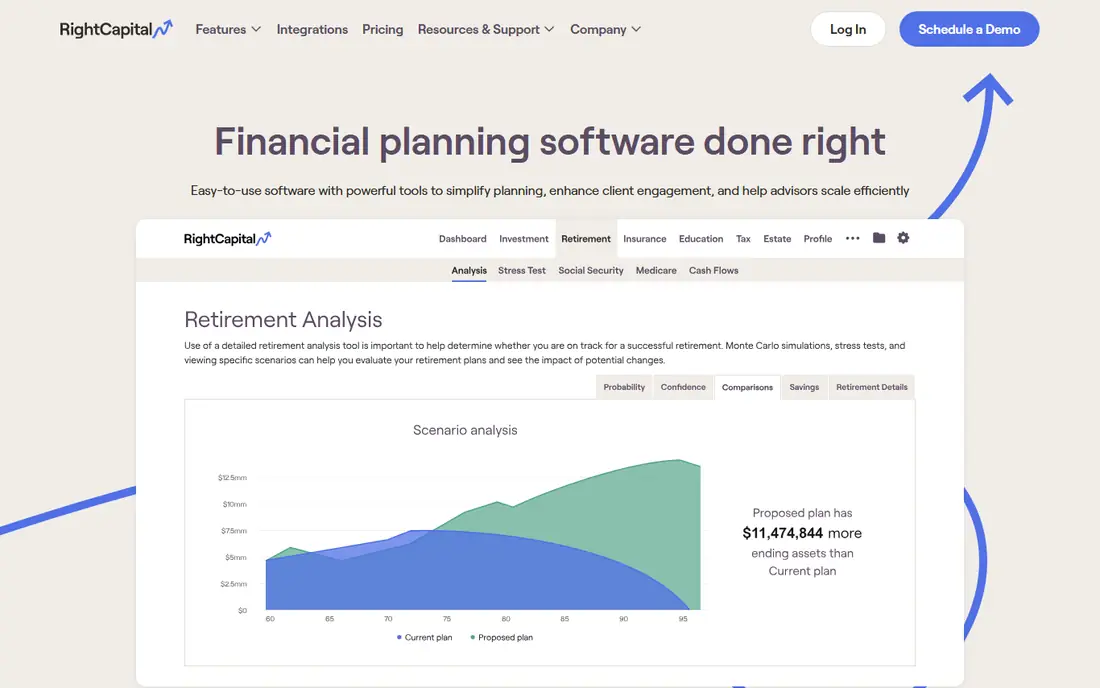
RightCapital has become the default shortlist pick for independent advisors, and published pricing is a large part of the reason. The Basic tier starts at $1,800 per year, Premium at $2,520, and Platinum at $3,060, with account aggregation and extra modules affecting the final figure. Plans are easy for clients to follow, with visual maps of cash flow, goals, and retirement income that work well in live meetings.
The trade-off is that RightCapital is less configurable than eMoney for very large firms with unusual workflows. Advisors who need heavy customization or a long list of niche integrations may hit limits. For a solo advisor or a small team that wants a modern client experience without a long sales negotiation, RightCapital is our pick for most people in the advisor group.
- Clear published pricing
- Clean client visuals
- Goals-based and cash flow planning in one place
- Some advanced modules sit on higher tiers
- Enterprise firms may want deeper customization

MoneyGuidePro, now part of Envestnet, built its reputation on goal-based planning: define the goals, test whether the money lasts, and show the probability of success in plain terms. That framing suits clients who think in life goals rather than spreadsheets, and its retirement, Social Security, and insurance modules are solid. Published comparisons put the base plan at $2,000 per year plus $400 for account aggregation, or $2,400 in total.
The downside is the add-on structure, which makes the true price harder to compare at a glance. Higher tiers add cash flow and estate planning, so a firm that needs the full set pays more. The interface also feels less modern than RightCapital. Still, for advisors whose process starts with goals and probability, MoneyGuidePro remains a credible, widely used choice.
- Strong goal-based planning
- Well known among advisors
- Good retirement and insurance analysis
- Some features cost extra
- Interface feels older than newer rivals
Orion Planning makes the most sense for firms already running Orion for portfolio management and reporting. When planning sits next to real portfolio data, advisors spend less time re-entering holdings and more time talking through scenarios. The reporting side is a genuine strength, since plan outputs can sit beside performance reports clients already receive.
Outside that ecosystem, the case weakens. Pricing is quote-based, and a firm that does not use Orion elsewhere may find a standalone planner simpler and cheaper. Treat Orion Planning as a strong consolidation pick for Orion firms, and as a harder sell for everyone else.
- Ties planning to portfolio data
- Useful inside the Orion ecosystem
- Strong reporting options
- Pricing is not published
- Less appealing outside Orion
Advyzon takes a different approach by bundling financial planning with a CRM, billing, and document storage in one subscription. For a small firm, that bundle can replace several tools and keep client data in one place, which is worth more than any single feature. The planning tools cover goals, cash flow, and retirement scenarios well enough for most client meetings.
The honest limit is depth. Advisors with very complex estate or tax cases may still want eMoney or MoneyGuidePro beside it. Pricing is not published, so ask for a full quote that includes every module you need. Advyzon fits firms that value one system over best-in-class depth in each separate tool.
- Planning combined with CRM and billing
- Good value for small firms
- Modern interface
- Planning depth trails the specialists
- Pricing requires a quote
Boldin, formerly NewRetirement, is the strongest household pick for people who want to model retirement properly. It handles income sources, taxes, Roth conversions, housing moves, and spending changes, then shows how each choice affects the long-term plan. The free tier lets households start without paying, and the paid Planner tier adds deeper modeling and support.
The catch is that Boldin asks users to enter a fair amount of detail to get good answers, and casual users may prefer a simpler dashboard. It is also a modeling tool, not a source of personal advice, so big decisions still deserve a conversation with a qualified professional. For households approaching retirement, Boldin gives the most control for the money.
- Detailed retirement modeling
- Scenario testing
- Built for households, not advisors
- Paid tier pricing is not always obvious
- Learning curve for new planners
Monarch Money is the best household dashboard in this list for people who want budgeting, investments, and net worth in one clean view. It syncs bank, credit card, and investment accounts, supports flexible budgets for uneven spending, and lets couples or households share with different levels of access. At $99.99 per year, or $14.99 per month, it sits in the middle of the household range.
The weakness is the trial. Seven days is short for a tool that proves itself over a full month of transactions, so use the trial actively and import everything on day one. Monarch is less of a deep retirement modeler than Boldin or ProjectionLab, but as a daily money home base, it is the easiest to live with.
- Polished all-in-one dashboard
- Flexible budgets
- Investment and net worth tracking
- No permanent free tier
- 7-day trial is short
ProjectionLab appeals to people who enjoy testing what-if questions in detail. Users can model account types, tax brackets, contribution changes, and spending shocks, then compare scenarios side by side. The free tier gives a real taste of the modeling, which helps before paying for the full version.
Beginners should expect a learning curve. ProjectionLab assumes users know terms like Roth conversion and required minimum distributions, or are willing to learn them. It is a strong second tool beside a dashboard like Monarch, and a good primary tool for households that already think in scenarios.
- Fine-grained scenario controls
- Tax and account modeling
- Popular with planning enthusiasts
- Depth can overwhelm beginners
- Paid pricing sits behind the site
Quicken Simplifi is the budget pick for households that want tracking plus a forward look at cash flow. The regular price is $5.99 per month billed annually, or $71.88 per year, though first-year offers often run lower. It builds a spending plan, projects upcoming balances, watches subscriptions, and tracks investments at a basic level.
Simplifi is not a deep retirement planner, and its budgeting is a plan to check rather than a method that coaches new habits. Promo pricing also means buyers should budget for the renewal rate, not the intro rate. For households that want a capable, low-cost tracker with projections, Simplifi is hard to beat.
- Low regular price
- Clear cash flow projections
- Subscription and bill tracking
- No permanent free tier
- Promo pricing makes renewal price easy to miss
How we picked these
We compared official feature pages, pricing pages, and published advisor comparisons, then favored tools that are actively sold and supported in 2026 and that truly fit either advisor planning or household planning. Where a vendor does not publish a price, we wrote See website rather than guessing, and we flagged add-on costs where published comparisons show them. We did not claim hands-on testing we did not do, and we treated ease of use, planning depth, and total cost as equal parts of the judgment.
What to check before you pay
Start with the user, not the feature list. Advisor firms should list their must-have workflows first, such as cash flow planning, estate documents, or CRM links, then shortlist only tools that cover all of them. Households should decide whether they need a daily dashboard, a retirement model, or both, since one tool rarely does both jobs equally well.
Price the whole setup, not the headline tier. Advisor tools often charge extra for account aggregation, extra users, or advanced modules, and household tools run intro offers that rise at renewal. Ask for the renewal price in writing, and check whether a free trial covers the features you actually need.
Finally, test with real data. Import your accounts, build one realistic scenario, and show the output to the person who will use it, whether that is a client or a partner. If the plan is hard to explain in a meeting or at the kitchen table, the tool is wrong, no matter how deep its engine runs. This is not financial advice, and major decisions deserve input from a qualified professional.
Frequently asked questions
What is the best financial planning software for advisors?
RightCapital is our pick for most independent advisors because its pricing is published, its client visuals are clear, and it covers goals-based and cash flow planning in one tool. Larger firms with complex cases should also quote eMoney Advisor and MoneyGuidePro before deciding.
What is the best financial planning app for households?
Monarch Money is the best all-around household dashboard, while Boldin is the stronger pick for detailed retirement modeling. Many households pair a dashboard for daily money with a planner for retirement questions, rather than forcing one tool to do both jobs.
How much does financial planning software cost?
Household tools typically cost from free to about $100 per year, while advisor platforms often start near $1,800 per year and rise with users and modules. Always check renewal pricing and add-on fees, since intro offers and aggregation charges change the total.
Is financial planning software the same as budgeting software?
No. Budgeting software tracks monthly spending, while planning software projects decades ahead, testing retirement income, taxes, and major life changes. Some tools do both, but most lean clearly toward one job.
Do I need an advisor to use financial planning software?
No, household tools are built for direct use, and many people plan successfully with them. An advisor adds value when taxes, estate plans, or business finances get complex, or when you want a professional to review the assumptions behind the plan.
Can financial planning software replace professional advice?
No. Software models outcomes based on the assumptions you enter, and small changes in returns, taxes, or lifespan can shift results a lot. Use it to prepare questions and test ideas, then confirm big decisions with a qualified professional.
Sources we checked (9)

Online Jobs is an independent blog about careers, online work, learning new skills and the tools that help people earn. More about us.
Keep reading
All posts
Top AI Financial Software
Searching for top AI financial software? We compared 9 AI finance tools for AP, spend, close, forecasting and bookkeeping to help teams choose wisely.

Quicken Alternatives
Compare the best quicken alternatives for Mac, Windows, and small business owners, from Monarch Money and YNAB to Copilot, Tiller, and Banktivity in 2026.

GoFundMe Alternatives
Looking for GoFundMe alternatives? We compared 8 fundraising platforms on fees, campaign types, donor tools and who each platform suits best in 2026 today.