Best App for Buying Stocks in 2026: 9 Products Compared

How we put this together: we compare official feature and pricing pages, app store listings, privacy policies and public user reviews. Prices change, so check the provider's site before you pay.
Key takeaways
- Fidelity is our pick for most US investors, pairing $0 stock and ETF trades with deep research and retirement accounts.
- Charles Schwab suits active traders who want thinkorswim, while Robinhood suits beginners who want the simplest mobile experience.
- Webull stands out for options traders, since it charges $0 options contract fees in many cases.
- Vanguard remains the best home for long-term index fund investors, even though its app trails rivals for active trading.
- This is not financial advice. Trading carries risk, and the cheapest app is not the best app if its tools push you toward trades you do not understand.
Quick comparison
| Name | Who it suits | Starting price | Free option | |
|---|---|---|---|---|
 Fidelity | Best overall | Free | Yes | Visit |
 Charles Schwab | Active traders | Free | Yes | Visit |
 Robinhood | Simple mobile trading | Free | Yes | Visit |
 Webull | Low-cost options | Free | Yes | Visit |
 E*TRADE | Options and research | Free | Yes | Visit |
 Vanguard | Long-term index investing | Free | Yes | Visit |
 Interactive Brokers | Global and advanced trading | Free | Yes | Visit |
 SoFi Invest | Banking plus investing | Free | Yes | Visit |
 Public | Social and fractional investing | Free | Yes | Visit |
The best app for buying stocks
Every major US broker now charges $0 commission on online stock and ETF trades, so the real differences are research, retirement accounts, fractional shares, options fees, and how hard the app pushes you to trade. The nine apps below cover beginners, long-term investors, and active traders.
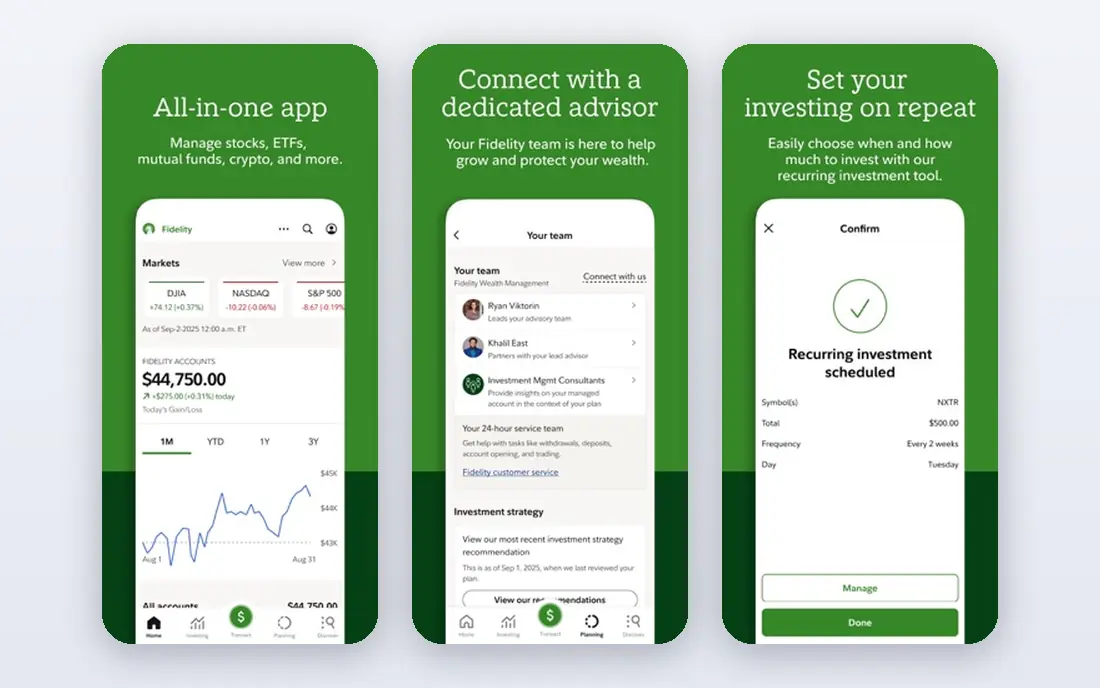
Fidelity is the strongest all-round starting point for most US investors. You get $0 commissions on US stocks and ETFs, fractional shares from $1, and a full range of retirement accounts including IRAs, plus research tools that go well beyond a price chart. Customer support is widely regarded as strong, which matters when money is involved.
The main downside is density. Fidelity's app and website carry a lot of features, and a brand-new investor may feel overwhelmed at first. That is a good problem to have, though, since the same account can grow with you from a first index fund to a full retirement plan without switching brokers.
- $0 stock and ETF trades
- Fractional shares from $1
- Strong research and retirement accounts
- Interface packs in a lot for first-time investors
- Cash management features take time to learn
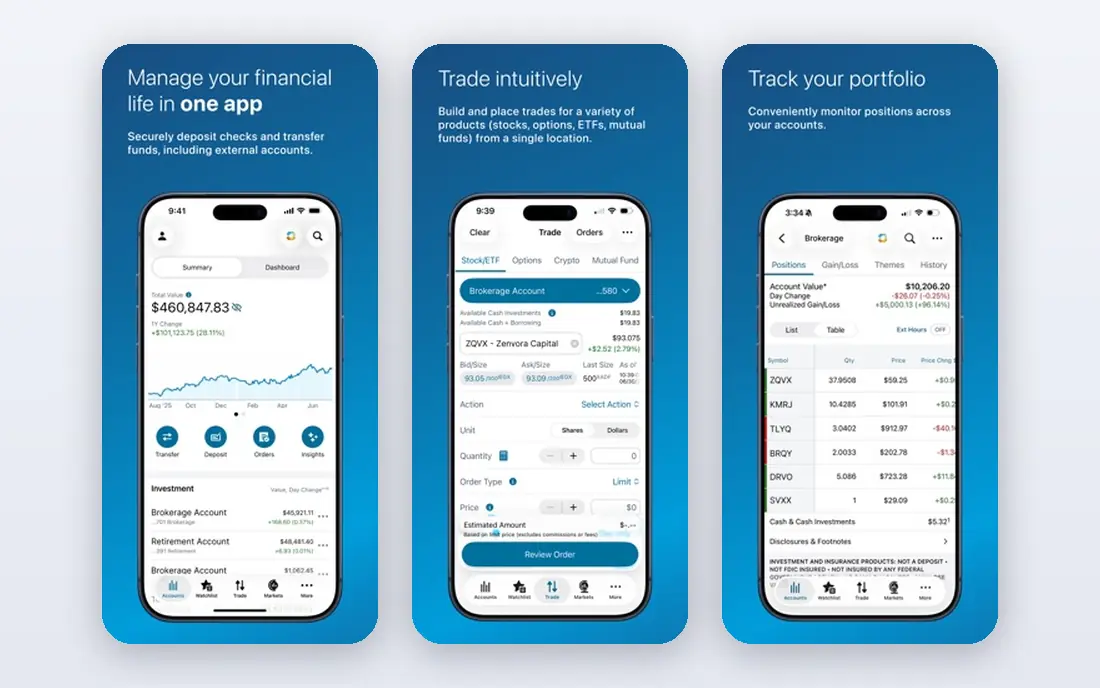
Charles Schwab pairs $0 stock and ETF trades with thinkorswim, one of the most capable trading platforms available to retail investors. Advanced charting, screeners, and options tools make it a natural home for active traders, while retirement accounts and advisor access suit long-term savers too.
Options traders should note the $0.65 per contract fee, which is standard but higher than Webull or Robinhood. The two-app setup can also confuse newcomers, since Schwab's main app and thinkorswim feel different. If you want serious tools with full-service support behind them, Schwab is a close second to Fidelity.
- $0 stock and ETF trades
- Thinkorswim platform for advanced charting
- Strong branch and phone support
- Options cost $0.65 per contract
- App experience varies between Schwab and thinkorswim
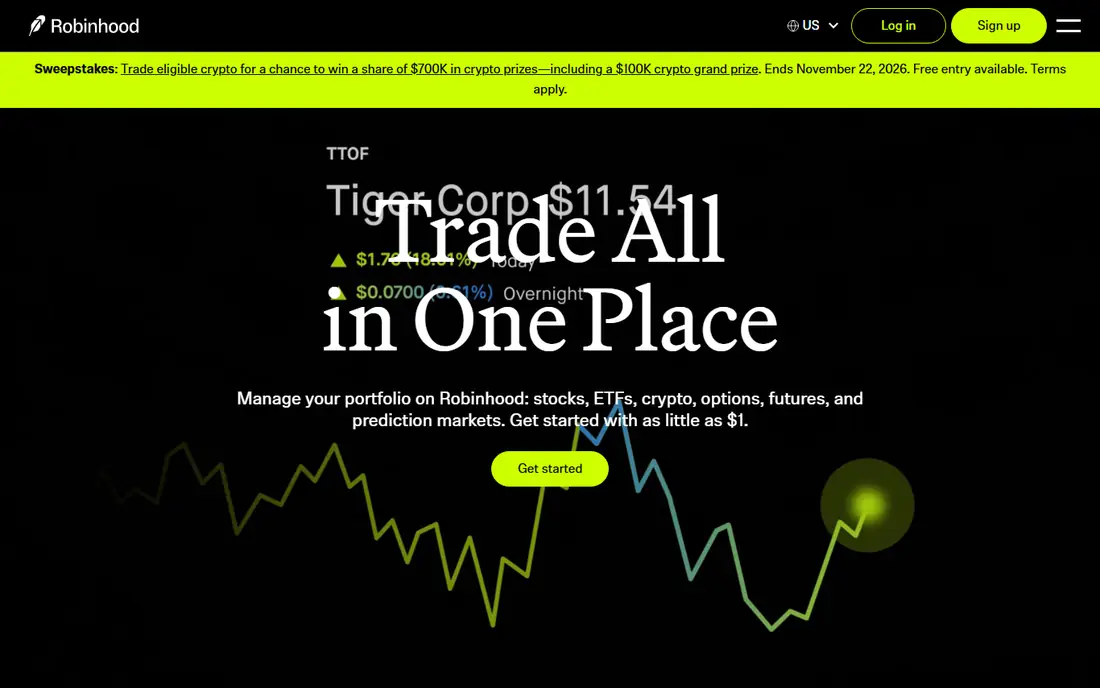
Robinhood remains the most mobile-first option, with $0 commissions across stocks, ETFs, and options, no options contract fee, and fractional shares from $1. Onboarding is fast, the interface is clean, and it covers stocks, ETFs, options, and crypto in one app. For a beginner who wants to place a first trade without a learning curve, it is the easiest start.
The trade is depth. Research, retirement planning tools, and advisor access are thinner than at Fidelity or Schwab, and the $100 fee for a full account transfer out is the highest on this list. Robinhood suits simple, mobile-first investing. Investors who want deep research should pair it with outside reading or pick a fuller broker.
- Simplest mobile experience
- $0 stock, ETF, and options trades
- Fractional shares from $1
- Research tools are thinner than Fidelity or Schwab
- $100 full account transfer-out fee
Webull suits beginners who want room to grow into active trading. It charges $0 on stocks, ETFs, and options, includes free paper trading so you can practice with fake money before risking real dollars, and offers advanced charting with dozens of technical indicators. The mobile and desktop apps feel built for traders rather than adapted from a website.
Support is thinner than at Schwab or Fidelity, and there is no branch network to walk into. Webull also charges $75 for a full account transfer out. If low options costs and strong charting matter to you, and you are comfortable learning on your own, Webull is a strong pick.
- $0 stock, ETF, and options trades
- Free paper trading
- Advanced charting and technical tools
- No full-service advisor support
- Transfer-out fee of $75 for a full account move
ETRADE, now part of Morgan Stanley, pairs $0 stock and ETF trades with the Power ETRADE platform and research from Morgan Stanley analysts. The options tools are capable, the educational library is solid, and the app covers banking alongside investing. It is a good middle ground between a simple app and a pro platform.
Options cost $0.65 per contract, dropping to $0.50 for active traders, and a full transfer out costs $75. E*TRADE suits investors who want strong research and options tools without moving to a specialist active-trader broker. Beginners may find the platform choices a little confusing at first, but the core app is straightforward.
- $0 stock and ETF trades
- Power E*TRADE platform
- Morgan Stanley research access
- Options cost $0.65 per contract, $0.50 for active traders
- Transfer-out fee of $75
Vanguard is still the best home for long-term index fund investors. Its own index funds carry very low expense ratios, $0 commissions apply to most US stocks and ETFs, and IRA setup is simple. If your plan is to buy broad index funds regularly and hold them for years, Vanguard's low costs compound in your favor.
The app is the weak point. Active traders will find charting, screeners, and order types basic compared with Schwab or Webull, and customer service wait times draw complaints. Vanguard is not the app for frequent trading. It is the app for a patient plan executed at low cost, and for that job it remains hard to beat.
- $0 trades on most US stocks and ETFs
- Very low-cost index funds
- Simple IRA setup
- App trails rivals for active trading
- Research and charting tools are basic
Interactive Brokers is the choice for international access and serious traders. Its Lite plan offers $0 US stock and ETF commissions, while the platform reaches more than 170 markets in dozens of currencies, with professional tools, algorithmic trading support, and competitive margin rates. No other app on this list matches its global reach.
That power comes with complexity. The platforms assume you know what you are doing, and beginners can feel lost. If you trade internationally, use advanced order types, or need low margin rates, Interactive Brokers is the professional pick. If you buy one index fund a month, a simpler broker fits better.
- Access to 170 plus global markets
- IBKR Lite offers $0 US stock and ETF trades
- Low margin rates
- Platform complexity overwhelms beginners
- Research and support assume experience
SoFi Invest suits people who want banking and investing in one place. It charges $0 on stock and ETF trades, offers both active investing from $5 and automated investing from $50, and sits alongside checking, savings, and loans in the same app. For a beginner who would rather not pick stocks at all, the automated option builds a diversified portfolio for you.
Research and trading tools are basic compared with Schwab or Webull, and advanced traders will outgrow it. SoFi's strength is convenience: one app for money in, money invested, and money borrowed, with a clean interface. If that simplicity appeals to you, it is a solid starting broker.
- $0 stock and ETF trades
- Banking, loans, and investing in one app
- Automated investing option
- Research tools are basic
- Active investing starts at $5, automated at $50
Public combines $0 stock and ETF trades with fractional investing, a high-yield cash account, and access to bonds and Treasuries alongside stocks. Its social feed lets you see what other investors are discussing, and its research tools include AI-assisted summaries that help beginners understand a company before buying.
The social side is a double-edged sword. Following other investors can teach you, but it can also nudge you toward trades you have not researched yourself. Treat the feed as a starting point for your own reading, not as advice. For a beginner who wants stocks, bonds, and cash in one modern app, Public is a friendly pick.
- $0 stock and ETF trades
- Fractional shares
- Bond and Treasury accounts alongside stocks
- Smaller research library than big brokers
- Social features can encourage copycat trading
How we picked these
We compared official fee schedules, account features, and app store listings for US brokers that offer commission-free stock and ETF trading to retail investors. We checked options fees, fractional share minimums, retirement account availability, research depth, and transfer-out fees, since those are the costs that actually differ once commissions hit zero. Prices and fees change, so confirm the current schedule on the broker's site before opening an account.
Choosing the right stock app
Start with how you actually invest, not with which app looks best in screenshots. A frequent trader and a monthly index buyer need different tools.
If you are just starting out
Fidelity is the safest all-round pick, Robinhood is the simplest mobile start, and SoFi Invest suits people who want banking and investing together. All three charge $0 on stocks and ETFs, so pick based on whether you want research depth, simplicity, or an all-in-one app. Open one account, fund it with an amount you can afford to leave invested, and learn the app before adding complexity.
If you trade often or use options
Schwab with thinkorswim, Webull, and E*TRADE are the stronger choices, with Webull winning on options contract fees. Compare margin rates, order types, and charting before you commit, and check the transfer-out fee, since switching brokers later has a real cost. Remember that frequent trading raises costs through spreads and taxes even when commissions are zero.
If you invest for the long term
Vanguard is the natural home for low-cost index funds, while Fidelity and Schwab both offer excellent IRAs and retirement planning tools. Set up automatic contributions, keep fees low, and resist the urge to check prices daily. This is not financial advice, and if you need guidance for your situation, talk to a qualified financial advisor before making large decisions.
Frequently asked questions
What is the best app to buy stocks?
Fidelity is our pick for most US investors, since it combines $0 stock and ETF trades with strong research and retirement accounts. Robinhood is simpler for pure mobile beginners, Schwab suits active traders, and Vanguard suits long-term index investors.
What is the best app for trading stocks for beginners?
Robinhood has the simplest interface, while Fidelity offers more research and support for the same $0 commission. Beginners who want automation should look at SoFi Invest, and beginners who want to practice first should try Webull's free paper trading before using real money.
Which stock app is best for buying and selling stocks?
The best app depends on how often you trade. Fidelity and Schwab suit regular traders who want research and advanced platforms, Webull suits options traders on cost, and Robinhood suits occasional mobile trades. All charge $0 on US stock and ETF trades, so compare options fees and tools instead.
Are stock trading apps safe?
Major US brokers are regulated and client accounts carry SIPC protection up to its limits, but that protection covers broker failure, not market losses. Your investments can still fall in value, and trading carries risk. Use strong passwords, two-factor authentication, and only invest money you can afford to leave invested.
Do I need money to start buying stocks?
Most apps on this list have no account minimum, and fractional shares let you start from $1 at Fidelity and Robinhood or $5 at SoFi Invest for active investing. Small starts are fine for learning, but keep fees, taxes, and your emergency fund in mind before investing larger sums.
Can I buy stocks outside the US with these apps?
Interactive Brokers offers the widest international access, with more than 170 markets. Most other apps focus on US stocks and ETFs, with some international exposure through US-listed ETFs. Check the broker's market list before opening an account if international stocks matter to you.
Sources we checked (9)

Online Jobs is an independent blog about careers, online work, learning new skills and the tools that help people earn. More about us.
Keep reading
All posts
Who Is the Best Company to Get Travel Insurance
Compare the best travel insurance companies, including World Nomads, Allianz Travel, SafetyWing and AXA, with coverage types, limits and who each suits.
Top AI Financial Software
Searching for top AI financial software? We compared 9 AI finance tools for AP, spend, close, forecasting and bookkeeping to help teams choose wisely.
Quicken Alternatives
Compare the best quicken alternatives for Mac, Windows, and small business owners, from Monarch Money and YNAB to Copilot, Tiller, and Banktivity in 2026.