Best AML KYC Software in 2026: 8 Tools Compared


Sanctions, PEP, and adverse media screening · Starting price: See website
How we put this together: we compare official feature and pricing pages, app store listings, privacy policies and public user reviews. Prices change, so check the provider's site before you pay.
Key takeaways
- The best AML KYC software combines identity verification with sanctions, politically exposed person, and adverse media screening in one workflow.
- Sumsub and Veriff publish per-check prices, while most enterprise tools in this list quote on request, so budget for a sales conversation.
- Banks with high volumes should weigh data coverage and case management more than a low headline price, because failed checks cost time and customers.
- Smaller fintechs often do better starting with a published-price tool and moving to a custom plan only when volume or regulation demands it.
Quick comparison
| Name | Who it suits | Starting price | Free option | |
|---|---|---|---|---|
| ComplyAdvantage | Sanctions, PEP, and adverse media screening | See website | No | Visit |
 Sumsub | KYC, KYB, and AML in one platform | $1.35 per verification | Free trial | Visit |
 Veriff | Transparent self-serve identity verification | $0.80 per verification | Free trial | Visit |
 Onfido | Document verification for large fintechs | See website | No | Visit |
 Alloy | US onboarding decisions and orchestration | See website | No | Visit |
 Trulioo | Global identity data and business verification | See website | No | Visit |
 SEON | Fraud and AML signals from device and behaviour data | See website | Free trial | Visit |
 Jumio | Biometric verification for high-risk onboarding | See website | No | Visit |
The best AML KYC software
We compared official feature pages, pricing pages, and public documentation for tools that handle both anti-money laundering checks and know-your-customer verification. This is not financial advice, and no tool on its own makes a firm compliant. Compliance still depends on your policies, risk appetite, and local rules.
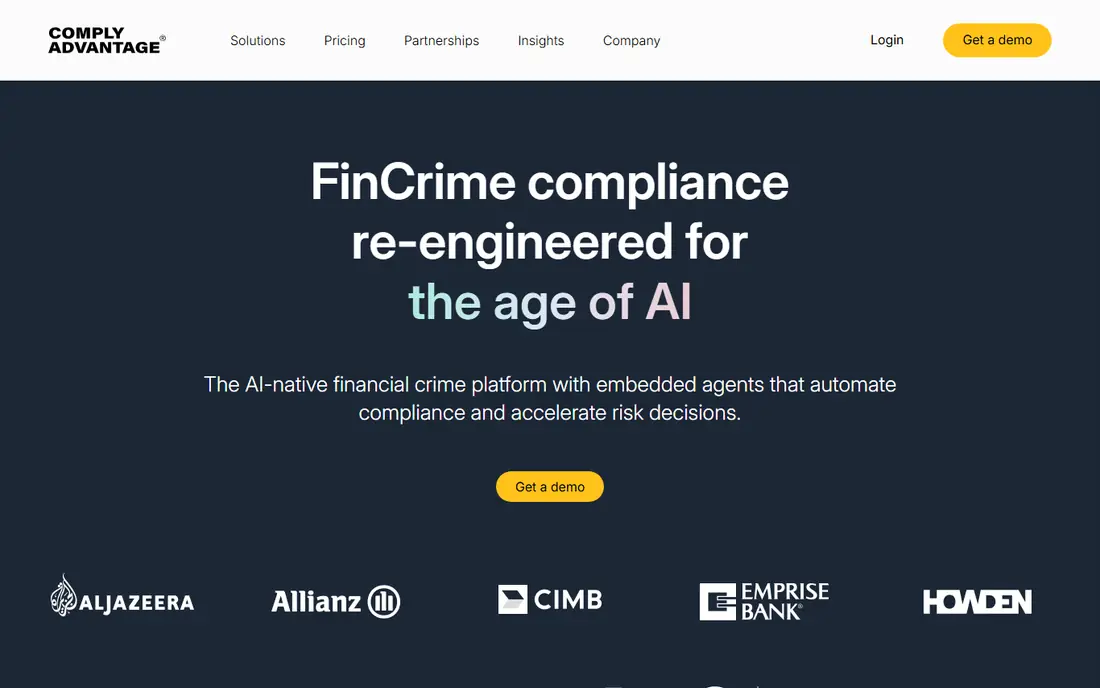
ComplyAdvantage is best known for screening. It checks customers against sanctions lists, watchlists, politically exposed persons, and adverse media, then keeps watching those profiles over time. That ongoing monitoring matters because a customer who is clean at onboarding can appear on a list later, and a manual recheck would miss that change.
The catch is scope and cost. Screening is its core strength, so firms that also need deep document verification may pair it with another tool or buy a wider plan. Ask for a clear quote based on entity volume, screening frequency, and whether transaction monitoring is included, because those choices change the price.
- Broad sanctions and watchlist coverage
- Ongoing monitoring
- Transaction monitoring on higher plans
- No free plan
- Pricing is not fully published for every tier
- Smaller firms may find setup heavy

Sumsub suits platforms that want one vendor for identity checks and AML screening. Its Basic plan starts at $1.35 per verification with a $149 monthly minimum, and its Compliance plan adds AML screening and ongoing monitoring at $1.85 per verification with a $299 minimum. That published pricing makes it easier to model costs before a sales call.
The trade-off is that the entry plans do not cover everything. Business verification, transaction monitoring, and fraud prevention sit on the custom plan, so a firm with complex needs should price that version, not the Basic version. The 14-day trial with 50 checks is a useful way to measure pass rates on your own traffic.
- Published pricing
- ID verification plus AML screening
- Reusable verification for returning users
- Monthly minimums apply
- Business verification sits on the custom plan
- Transaction monitoring is not in the entry tiers

Veriff publishes its self-serve tiers, which is rare in this market. Essential starts at $0.80 per verification with a $49 monthly minimum, and higher tiers add more features at $1.39 and $1.89 per verification. For a small team, that low floor is a real advantage over vendors that only quote custom deals.
The detail to watch is add-on pricing. PEP and sanctions screening is an extra charge per verification, so the headline rate is not the full AML cost. If you need that screening on every check, add it to the comparison before you decide, and use the trial to test document coverage for your main customer countries.
- Published tiers with monthly minimums
- Document and biometric checks
- Add-on screening available
- PEP and sanctions screening costs extra
- Enterprise pricing is quoted
- Some advanced features sit on higher tiers
Onfido, now part of Entrust identity verification, focuses on proving that a person matches their document. It uses document checks, facial comparison, and fraud signals to catch forged or mismatched identities. That makes it a natural fit for banks, marketplaces, and sharing platforms that onboard many users from a phone.
Because pricing is quoted, you should go in with volume numbers and a list of required checks. Ask which checks are included in the base rate and which are charged as extras, and confirm support hours and data retention terms. The product is strong, but the buying process takes longer than a self-serve signup.
- Strong document and biometric checks
- Large SDK and integration library
- Suited to high-volume onboarding
- Pricing is quoted on request
- No published free tier
- Now trades under the Entrust brand, which can confuse buyers
Alloy takes a different angle. Rather than selling a single check, it lets a firm pull data from many sources, set rules, and decide whether to approve, review, or reject an applicant. That orchestration helps banks that already buy data from several vendors and need one place to run the decision.
The downside is fit. If you only need basic identity verification, Alloy can be more than you need, and its quoted pricing reflects an enterprise sale. It shines when onboarding rules differ by product, risk level, or state, and when a compliance team wants to change those rules without rebuilding the whole flow.
- Connects many data sources in one decision flow
- Good for banks and fintechs
- Case and workflow tools
- Pricing is quoted
- Best suited to US-focused firms
- Smaller firms may not need its full orchestration
Trulioo is built for firms that operate across borders. It verifies people and businesses against data sources in many countries, checks a large set of ID document types, and screens against thousands of watchlists. For a firm onboarding customers in several regions, that breadth can reduce the number of local vendors needed.
The honest catch is the buying and building experience. Pricing is quoted on request, and teams should expect integration work rather than a simple plug-in signup. If your main market is one country, a simpler tool may be faster. If your customers are spread across many countries, Trulioo is worth the longer evaluation.
- Very broad country and data-source coverage
- Strong for KYB
- Large watchlist screening set
- No published pricing
- More of a data API than a polished no-code flow
- Integration work may be needed
SEON looks at signals that a document check alone can miss, such as device fingerprints, email and phone history, and behaviour patterns. That helps catch synthetic identities and account-takeover attempts before they reach a full KYC flow. It is a useful layer for fintechs and crypto firms where fraud and AML risk overlap.
Do not treat it as a complete KYC product by itself. Most regulated firms will still need document verification and sanctions screening from another tool or a wider SEON plan. Test it on your own traffic during the trial, and check how its risk scores fit your existing review queue.
- Device and behaviour signals
- Useful for spotting fake accounts
- API-first design
- Not a full document-verification replacement on its own
- Pricing varies by volume
- Best paired with an ID check
Jumio combines document verification with biometric comparison and liveness detection, which checks that the person in front of the camera is real and present. That matters for high-risk onboarding, such as financial accounts, where a stolen photo or video should not pass. Its global coverage also helps firms with customers in many countries.
The price conversation is the main hurdle. Jumio quotes on request, so small firms should compare its total cost against published-price tools and confirm what is included per check. For a bank or a high-risk platform, the added fraud protection may justify the cost. For a low-risk signup flow, it may be more than needed.
- Biometric and liveness checks
- Global ID coverage
- Fraud detection features
- Pricing is quoted
- May be priced above entry-level tools
- Integration planning is needed for complex flows
How we picked these
We started from official product and pricing pages, app and API documentation, and public vendor statements, and we kept only tools that are still offered in 2026 and that cover AML screening, KYC verification, or both. We favoured tools with clear coverage, published documentation, and a track record with banks or fintechs, and we noted where pricing is quoted rather than published. We did not claim hands-on testing, and we did not invent prices, user counts, or awards. Where a vendor does not publish a price, we wrote See website.
What to check before you buy
Start with your regulator and your risk. A bank, a crypto exchange, and a marketplace face different rules, and the right tool is the one that covers your required checks in your main countries. List those checks first, then ask each vendor to map its product to that list in writing.
Match the pricing model to your volume
Per-check pricing suits variable volume, while monthly minimums suit steady volume. A low per-check rate with a high minimum can cost more than a higher rate with no minimum if your volume is low. Run your last three months of onboarding numbers through each model before signing.
Test pass rates on real documents
A tool that works well in one country can struggle with documents from another. Run a trial with real document types from your top five customer countries, and measure both pass rates and false rejections. A high rejection rate creates support work and lost customers, even if the fraud catch rate looks good.
Check data handling and audit trails
Ask where data is stored, how long it is kept, and what audit trail the tool leaves for regulators. Case management, screening history, and clear reasons for each decision make audits far easier. If a vendor cannot explain its data retention in plain terms, treat that as a warning sign.
Frequently asked questions
What is the best AML software for banks?
For banks, ComplyAdvantage and Trulioo are strong starting points because of screening breadth and global coverage, while Alloy suits banks that need to orchestrate many data sources. The best choice still depends on your regulator, your countries, and whether you need transaction monitoring as well as screening.
What is the best AML KYC software for a small fintech?
Sumsub and Veriff are often easier for a small fintech to evaluate because they publish prices and offer trials. Start with the plan that includes the screening you actually need, and check the monthly minimum against your real onboarding volume before committing.
Is AML software the same as KYC software?
No, although many vendors sell both. KYC software verifies identity at onboarding, while AML software screens for sanctions, politically exposed persons, and suspicious activity, and monitors customers over time. Most regulated firms need both, which is why combined platforms are common.
How much does AML KYC software cost?
Costs vary widely, from under $1 per verification on published self-serve tiers to custom enterprise deals for high-volume banks. Monthly minimums, add-on screening, and transaction monitoring can change the total a lot, so compare the full basket of checks, not just the headline rate.
Can one tool make my firm compliant?
No. Software supports compliance, but your policies, staff training, risk assessments, and regulator filings still matter. Use the tool to run checks and keep records, and keep a compliance owner responsible for decisions and audits.
Sources we checked (8)

Online Jobs is an independent blog about careers, online work, learning new skills and the tools that help people earn. More about us.
Keep reading
All posts
Wise Alternatives
Compare the best Wise alternatives in 2026, from Revolut and Remitly to OFX and Xe, with fees, speed, cash pickup options, and honest trade-offs today.
Top AI Financial Software
Searching for top AI financial software? We compared 9 AI finance tools for AP, spend, close, forecasting and bookkeeping to help teams choose wisely.
Quicken Alternatives
Compare the best quicken alternatives for Mac, Windows, and small business owners, from Monarch Money and YNAB to Copilot, Tiller, and Banktivity in 2026.