Best AI SEO Rank Tracking Software in 2026: 9 Products Compared


All round value plus AI tracking · Starting price: See website
How we put this together: we compare official feature and pricing pages, app store listings, privacy policies and public user reviews. Prices change, so check the provider's site before you pay.
Key takeaways
- SE Ranking offers the best balance of daily rank tracking, AI visibility and price for most small teams and agencies.
- AccuRanker leads on speed and on demand refresh for teams that track many keywords and need fresh data often.
- Semrush and Ahrefs suit teams that want rank tracking inside a full SEO suite, rather than a standalone tracker.
- AI visibility is now an add-on or a separate module in many tools, so check what is included in the base price before you compare.
Quick comparison
| Name | Who it suits | Starting price | Free option | |
|---|---|---|---|---|
| SE Ranking | All round value plus AI tracking | See website | Free trial | Visit |
 Semrush | Full SEO suite with AI visibility | See website | Free trial | Visit |
 Ahrefs | Backlink led SEO with rank tracking | See website | Free trial | Visit |
 AccuRanker | Fast accurate tracking at scale | See website | Free trial | Visit |
 Nightwatch | Local and geo targeted tracking | See website | Free trial | Visit |
 Wincher | Lean daily tracking for small teams | See website | Free trial | Visit |
 Serpstat | Suite plus rank tracking on a budget | See website | Free trial | Visit |
 Advanced Web Ranking | Deep reporting for agencies | See website | Free trial | Visit |
 Google Search Console | Free first party baseline | Free | Yes | Visit |
The best AI SEO rank tracking software
Rank tracking used to mean one number per keyword in Google. In 2026 that number still matters, but AI answers now sit above many results and change what a ranking is worth. The tools below track classic Google rankings first, and add AI visibility, SERP features and competitor data in different ways. This guide focuses on that classic tracking job, with AI features judged as part of the package.
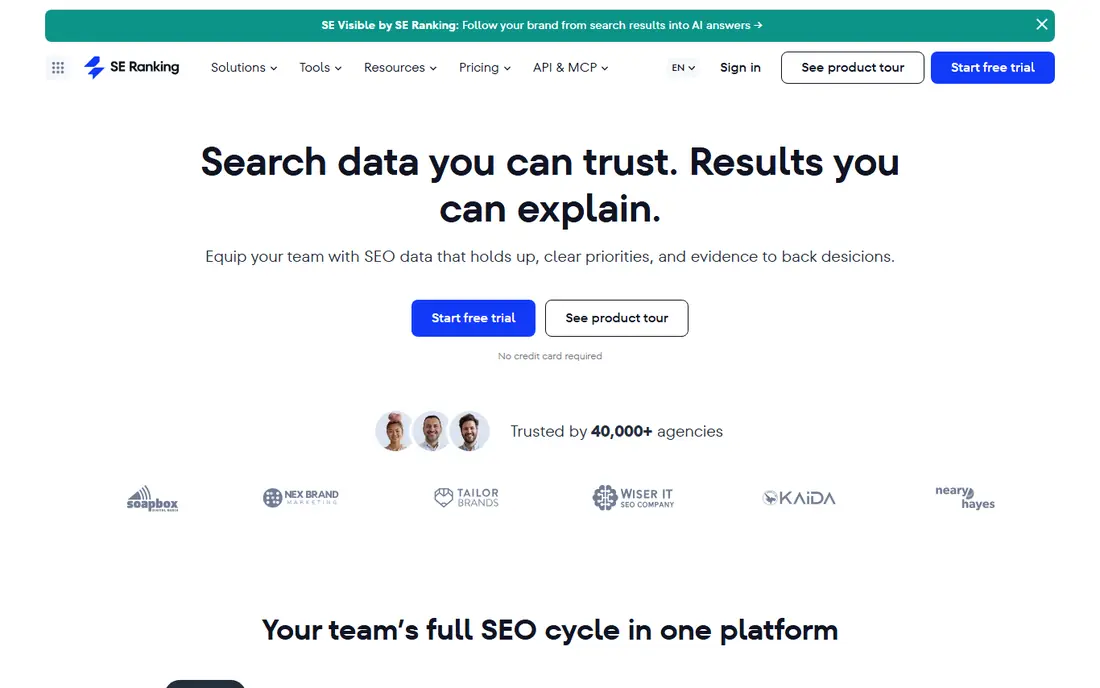
SE Ranking is a full SEO platform that includes rank tracking, site audits, backlink checks and competitor research, with AI search tracking added as a modern layer. Teams can track daily positions, watch SERP features such as AI Overviews, and compare their visibility with competitors in the same project. That breadth at a mid market price is why SE Ranking suits many agencies and in house teams.
The main point to check is pricing structure. Base plans and AI search add-ons are priced separately in some cases, so the total for AI tracking can be higher than the headline plan price. Even with that extra cost, SE Ranking often undercuts larger suites for a similar keyword volume. For a team that wants one tool for classic and AI aware tracking, it is a strong first choice.
- Daily rankings plus AI Overviews and AI search tools
- Full SEO suite
- Clear agency reporting
- AI search features cost extra on some plans
- Interface can feel busy
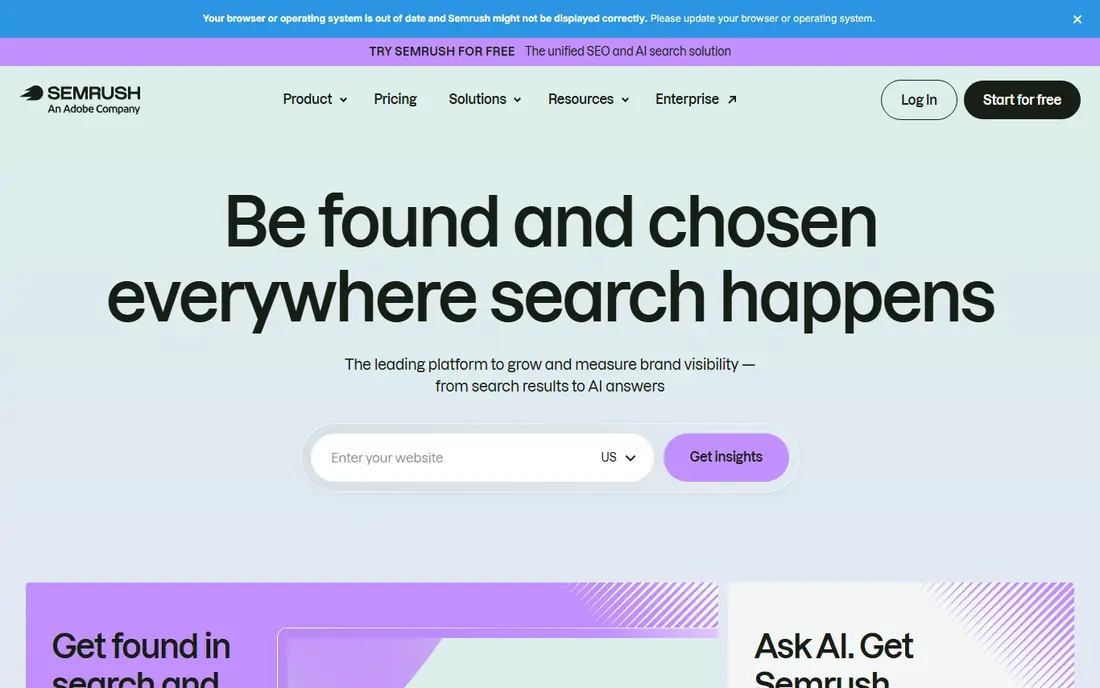
Semrush is less a rank tracker and more a complete SEO and marketing suite that includes rank tracking. Position tracking covers daily rankings, SERP features and competitor movement, while the AI visibility toolkit tracks how a brand appears in AI answers from Google, ChatGPT, Perplexity and Gemini. Teams that already use Semrush for keyword research and audits get AI tracking without learning a new tool.
Cost is the main drawback. The base suite is already a significant subscription, and AI visibility adds to it, so a team that only needs rank tracking may pay for features it never uses. Semrush fits best when rank tracking is one part of a wider SEO, content and paid search programme, and when one platform for all of that work is worth the price.
- Very broad SEO and PPC data
- AI visibility toolkit
- Strong competitor research
- Higher price for full access
- AI toolkit is an add-on cost
Ahrefs is best known for backlink and keyword research, but its Rank Tracker is a capable tool for teams that want rankings alongside link and content data. It tracks positions, SERP features and competitor movement, and Brand Radar adds AI mention tracking for brands that want to watch how AI systems cite them. That combination suits SEO teams that treat links, content and rankings as one workflow.
Rank update frequency is a point to check. Standard plans update weekly rather than daily, which is fine for long term SEO but less useful for teams that need daily movement during a campaign or a site migration. Ahrefs is a strong pick for SEO led teams, and a weaker pick for a team that only needs fast daily rank checks.
- Deep backlink and keyword data
- Rank Tracker for core keywords
- Brand Radar for AI mentions
- Rank updates are weekly on some plans
- AI brand tracking sits on higher tiers
AccuRanker focuses on doing one job very well: accurate rank tracking at scale, with on demand refresh when a team needs a fresh check right now. Agencies that report to many clients value that speed, since a ranking question in a client meeting can be answered with a live check rather than yesterday's data. Reporting, segmentation and API access are built for that agency workflow.
The price reflects that focus, and AccuRanker is not a full SEO suite with audits and backlink tools at the same depth as Semrush. Teams that need only rank tracking may still find it worth the cost for accuracy and speed, while teams that need a suite should pair it with another tool or choose SE Ranking instead. For high volume tracking, AccuRanker is hard to beat.
- On demand rank refresh
- Daily tracking
- Strong agency reporting and API
- Higher starting price
- Less of a full SEO suite than Semrush or Ahrefs
Nightwatch is a rank tracker built for teams that care about where a ranking appears, not only whether it appears. Its geo grid reports show rankings across a city or region, which helps local businesses and multi location brands see whether they rank in each area they serve. Daily tracking, on demand checks and AI tracking on current tiers add to its value for local SEO.
National or global teams that do not need local grids may find other tools offer more suite features for the same price. Nightwatch also scales in cost with keyword and location volume, so a large multi location programme needs a careful quote. For local SEO, it is one of the clearest choices on this list.
- Geo grid tracking for local SEO
- Daily and on demand updates
- AI tracking included on tiers
- Less suited to enterprise suite buyers
- Pricing rises with keyword volume
Wincher keeps rank tracking simple. It offers daily updates, competitor tracking and straightforward reports without the complexity of a full suite, and it allows many websites on a plan, which helps freelancers and small agencies. That simplicity is a strength for a small team that wants to check rankings each morning and move on to other work.
AI visibility is more limited than in SE Ranking or dedicated AI tools, so teams that need deep AI answer tracking should look at the next article in this series or at SE Ranking. Wincher fits best as a lean, affordable daily tracker for classic Google rankings, with enough competitor and reporting features for small client work.
- Daily updates on all plans
- Unlimited websites on plans
- Simple interface
- Limited AI visibility compared with dedicated AI tools
- Smaller suite
Serpstat is a full SEO suite at a lower price point than Semrush or Ahrefs, with rank tracking, keyword research, backlink analysis and site audits in one subscription. That makes it a practical choice for smaller teams and agencies that want suite features without a premium suite price. Rank tracking covers daily positions and competitor comparison in the usual way.
AI features are less central than in SE Ranking, and brand monitoring for AI answers sits on higher plans. Teams whose main need is classic rank tracking plus general SEO research will be well served. Teams whose main need is AI visibility should compare dedicated AI trackers before committing to Serpstat as their only tool.
- Keyword, backlink and audit tools plus tracking
- Lower price than larger suites
- Team plans
- AI brand monitoring sits on higher plans
- Interface takes time to learn
Advanced Web Ranking is a long running rank tracker aimed at agencies and data heavy SEO teams. Its strength is reporting depth: rankings can be sliced by search engine, location, device and SERP feature, and white label reports can be built for clients. It also tracks AI engine visibility in current versions, which keeps it relevant as search changes.
The interface is more technical than SE Ranking or Wincher, and new users should expect a learning period. It is not the best pick for a beginner who wants a simple daily chart. For an agency that lives in rank data and needs flexible, client ready reporting, Advanced Web Ranking remains a serious option.
- Very flexible reports and data views
- Strong SERP feature tracking
- White label reporting
- Interface feels technical
- Less of a modern AI suite
Google Search Console is not a replacement for a rank tracker, but every SEO team should use it alongside one. It shows real clicks, impressions and average position from Google itself, plus the queries that brought visitors to a site. That first party data helps check whether a third party tracker matches reality, and it is free.
Its limits are clear. Search Console does not track competitors, does not show daily rank for a chosen keyword list in the same way, and has a data delay. It also does not track AI answers. Use it as the baseline truth for your own site, and use a paid tracker for competitor, location and AI visibility work.
- Free first party Google data
- Shows clicks, impressions and queries
- Essential for technical SEO
- No competitor tracking
- Data delay
- No AI answer tracking
How we picked these
We compared tools that track Google rankings daily or weekly, are live in October 2026, and are used by SEO teams and agencies rather than only by hobby bloggers. We weighed update frequency, location and device controls, SERP feature coverage, AI visibility, competitor tracking, reporting and price per keyword volume. Tools that only tracked AI answers without classic rank tracking were left for the companion article on AI Overview tracking.
We treated vendor claims about accuracy with care, since no tracker sees exactly what every searcher sees. Location, personalisation and device all change results, so a good tracker is one that is consistent, transparent about its method, and useful for trends over time. Prices were marked as See website where plans, add-ons and keyword limits make a single starting price misleading.
What to check before you buy a rank tracker
Start with keyword volume and locations. Count the keywords you will actually track, including local variants, and check the plan that covers that volume. A cheap plan that only covers a few hundred keywords will force an upgrade in the first month. Next, check update frequency and whether on demand refresh is included or charged extra.
Then check AI coverage in detail. Ask which AI surfaces are tracked, whether AI tracking is included or an add-on, and how prompts are chosen. A tool that tracks only AI Overviews is different from one that tracks ChatGPT, Perplexity and AI Mode as well. Finally, test reporting with a real client or stakeholder in mind. A tracker that produces a report your team can actually use each week is worth more than one with a longer feature list.
Frequently asked questions
What is the best AI SEO rank tracking tool?
SE Ranking is the best balance for most teams, since it combines daily rank tracking with AI search tools and agency reporting at a mid market price. AccuRanker is better for speed at scale, while Semrush and Ahrefs are better for teams that want a full SEO suite. Match the tool to keyword volume, AI needs and budget.
How is AI rank tracking different from classic rank tracking?
Classic rank tracking measures your position in the ten blue links on Google. AI rank tracking measures whether your brand or content appears in AI answers, AI Overviews and chat responses, and how often you are cited. Both matter now, since an AI answer can take clicks even when your classic ranking stays the same.
Do I still need classic rank tracking if AI answers are growing?
Yes, classic rankings still drive traffic, inform content work and show whether technical SEO is working. AI tracking adds a new layer, but it does not replace position, click and impression data from Google. Most teams need both views in one report to explain traffic changes to stakeholders.
How often should rank data update?
Daily updates suit active campaigns, site migrations and agency reporting. Weekly updates can be enough for long term content SEO where rankings move slowly. On demand refresh is useful when you need a fresh check after a site change or before a client meeting, but it should not be the only update method.
What is the best free rank tracking tool?
Google Search Console is the best free baseline, since it shows real Google clicks and impressions for your own site. It does not track competitors or AI answers, so most teams pair it with a paid tracker. Free trials from SE Ranking, Wincher and others let you test paid tracking before committing.
How many keywords should I track?
Track the keywords that drive business value, not every keyword you can think of. Start with core service and product terms, local variants where relevant, and a small set of competitor terms. A focused list of a few hundred well chosen keywords gives clearer reporting than thousands of low value terms.
Sources we checked (9)

Online Jobs is an independent blog about careers, online work, learning new skills and the tools that help people earn. More about us.
Keep reading
All posts
Best Search Visibility Software
Looking for the best search visibility software? We compared 9 tools for rank tracking, keyword research, audits and AI search visibility in 2026 today.
Best Enterprise SEO Tools
We compared the best enterprise SEO tools on rank tracking, crawling, backlinks, content tools, integrations and enterprise controls for large sites and teams.

ZoomInfo Alternatives
The best ZoomInfo alternatives in 2026, compared on price, free plans, data coverage, and which tool fits small teams or large sales teams best in detail.