Best AI Investing Apps in 2026: 8 Apps Compared

How we put this together: we compare official feature and pricing pages, app store listings, privacy policies and public user reviews. Prices change, so check the provider's site before you pay.
Key takeaways
- Magnifi suits investors who want plain-language portfolio analysis linked to their real brokerage accounts.
- Danelfin suits research-led stock pickers who want a probability-based score with explained drivers, not just a buy list.
- Trading-focused apps such as Trade Ideas and TrendSpider suit active traders, while Magnifi and Danelfin suit longer-term research.
- AI scores are research inputs, not guarantees: always check filings, valuation, and news before acting on any signal.
- This is not financial advice; investing carries risk, including loss of money.
Quick comparison
| Name | Who it suits | Starting price | Free option | |
|---|---|---|---|---|
 Magnifi | Conversational portfolio research | $8.25 per month | Yes | Visit |
 Danelfin | Probability-based stock and ETF scores | $29 per month | Yes | Visit |
 Streetbeat | AI-assisted managed investing | $9.99 per month | Free trial | Visit |
 Trade Ideas | AI scans for active traders | $89 per month | Free trial | Visit |
 TrendSpider | Chart automation and backtesting | See website | Free trial | Visit |
 Tickeron | Pattern signals and AI trading bots | See website | Yes | Visit |
 AltIndex | Alternative-data stock research | $29 per month | Yes | Visit |
 Kavout | Fundamentals-based stock scoring | See website | Yes | Visit |
The best AI investing apps
AI investing apps fall into three groups: research assistants that explain portfolios, scoring tools that rank stocks, and trading tools that scan markets for setups. We compared official pricing pages, app store listings, and feature pages for apps that are actively sold in 2026, and we kept only tools with a clear, current product. Prices change often in this category, so check the vendor's pricing page before subscribing.
This is not financial advice; investing carries risk, including loss of money. Nothing in this article is a recommendation to buy or sell any security, and past performance of a model or score does not predict future returns.
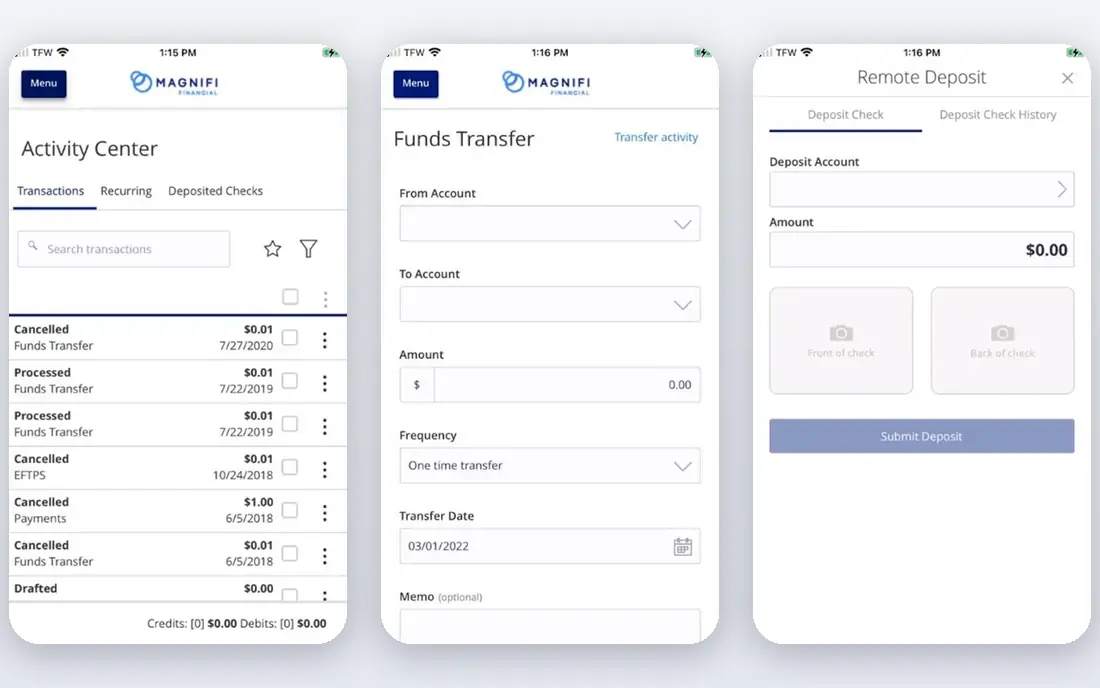
Magnifi is the easiest AI investing app to start with if you already hold stocks and funds and want to understand them better. You can ask questions in plain English, such as whether you are diversified enough, and get answers tied to your connected brokerage accounts rather than generic market commentary. Premium adds portfolio forecasting and scenario testing, so you can model a shift toward bonds or international stocks before making changes.
The catch is scope and cost. The free tier covers basic portfolio views, while Premium costs 8.25 dollars per month billed annually, or 14 dollars per month billed monthly. Magnifi also does not charge advisory fees for non-managed accounts, but funds themselves carry expenses, and any custodian may charge separately, so read the disclosures before connecting an account.
- Plain-language questions tied to your actual holdings
- Connects to major brokerages
- Portfolio forecasting and scenario testing on Premium
- Advanced analysis needs Premium
- Insight quality depends on which accounts you connect
- Not a managed advice service for everyone
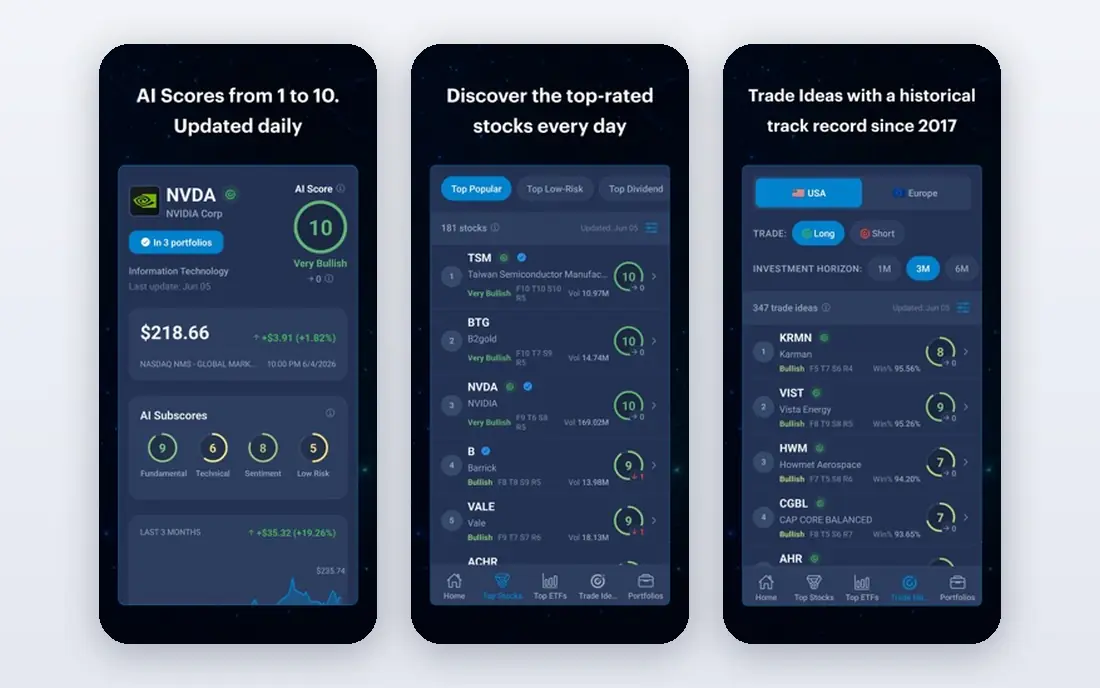
Danelfin ranks stocks and ETFs with an AI Score that estimates the probability of beating the market over a set period, and it shows the drivers behind each score, including fundamental, technical, and sentiment signals. That transparency is its main advantage over a bare buy list: you can see why a stock scores well, compare it with your own research, and track how the score changes. The free plan gives limited reports and rankings without a credit card, which is enough to test whether the method fits your process.
The honest catch is interpretation. A high score means a higher estimated probability of outperformance, not a promise, and a stock can fall in absolute terms while still beating a falling benchmark. Plus costs 29 dollars per month, with Pro and Elite tiers above it for deeper signals and exports, so casual investors should start free and only pay if they use the reports weekly.
- AI Score with explained fundamental, technical, and sentiment drivers
- Free plan to test the concept
- Broker sync on paid plans
- Paid plans are a real monthly cost for casual investors
- Scores are probabilities, not predictions
- Coverage is mainly stocks and ETFs

Streetbeat suits investors who want AI input without building every decision themselves. It combines research and managed investing features in one app, drawing on institutional-style market data, and it presents strategies in a format that beginners can follow. At 9.99 dollars per month, it is priced as an ongoing service rather than a one-off research purchase.
The trade-off is control and cost stacking. A managed approach means you accept the strategy's choices, and the subscription sits alongside any fund expenses or account fees. Check what is included in the monthly price, whether trading or management fees apply separately, and how a strategy has behaved in falling markets before committing.
- Managed strategies alongside research tools
- Institutional-style data inputs
- Simple app experience for beginners
- Monthly fee on top of any fund or account costs
- Managed strategies still carry market risk
- Less control than a self-directed research tool
Trade Ideas is a trading platform first, and its Holly AI is the reason active traders consider it. Holly runs simulated trading setups, scans the market in real time, and surfaces ideas that a human screener would take far longer to find. For day traders and swing traders who already have a risk plan, that speed and breadth can be genuinely useful.
It is not a set-and-forget investing app. The basic plan starts at 89 dollars per month, with a higher premium tier for full AI features, and the value depends entirely on how disciplined the trader is: signals without position sizing, stop rules, and loss limits will lose money quickly. Beginners should learn trading basics elsewhere before paying for a scanner of this power.
- Holly AI generates and backtests trading setups
- Real-time scanners for stocks
- Brokerage integration for active traders
- High monthly cost
- Built for active trading, not long-term investing
- Signals need discipline and risk controls to use well
TrendSpider appeals to traders who live on charts but dislike drawing every trendline by hand. It automates technical analysis, alerts, and backtesting, and its no-code strategy tools let traders test an idea across history without writing code. Multi-timeframe views help a trader check whether a short-term setup agrees with the longer trend before acting.
The catch is that automation can create false confidence. A backtest that looks strong on past data may fail on live markets, and chart signals say nothing about earnings, debt, or news. We list pricing as "See website" because plans and annual billing terms vary, so compare the tier that includes the backtesting and alert limits you actually need.
- Automated trendlines, indicators, and alerts on charts
- No-code strategy testing
- Multi-timeframe analysis in one view
- Pricing varies by plan and billing term
- Learning curve for strategy tools
- Chart signals still need fundamental checks
Tickeron uses financial learning models to spot chart patterns and generate signals, and it sells access through individual AI bots tuned to different assets and styles. That marketplace model lets a trader pick a bot for trend following, mean reversion, or another approach, rather than buying one fixed system. A limited free tier lets new users see the signal format before paying.
Its risk is choice overload and stacking costs. Each bot carries its own price, so subscribing to several bots quickly adds up, and two bots can easily give conflicting signals on the same stock. Start with one bot, track its signals against your own rules for a month, and only add another if the first earns its place.
- Pattern recognition across stocks, ETFs, and other assets
- Marketplace of AI bots for different styles
- Limited free signals to try
- Bot pricing varies widely by bot
- Signal quality depends on the bot chosen
- Easy to over-subscribe to overlapping bots
AltIndex stands out by adding alternative data to traditional research: signals such as website traffic, job listings, app downloads, and social sentiment sit next to fundamental and technical analysis. For consumer and technology stocks, where customer behavior shows up online before it shows up in earnings, that extra layer can flag changes earlier than a price chart alone. Paid plans start at 29 dollars per month, with a free plan for testing.
The honest catch is noise. Alternative data moves for many reasons unrelated to a company's prospects, such as a viral post or a seasonal hiring push, so a single signal should never trigger a trade. Use AltIndex as a screening and research layer, then confirm with filings, valuation, and news before acting.
- Alternative data such as web traffic, job posts, and app usage alongside fundamentals
- Daily stock picks with breakdowns
- Free plan to test
- Alternative data is noisy and needs context
- Coverage is strongest for consumer and tech names
- Picks still need your own checks
Kavout rates stocks with its Kai Score, a machine-learning score built from fundamental and market data, aimed at investors building diversified portfolios rather than chasing daily trades. The free tier lets you check scores for stocks you already follow, which is a low-risk way to see whether a single score helps your research or just duplicates what you already know.
Its limits are depth and portfolio tools. The score breakdown is less detailed than Danelfin's, and Kavout offers limited help with rebalancing or position sizing. We list pricing as "See website" because tier details vary, so confirm the current plan before paying, and use the score as one input among several, not as a buy instruction.
- Kai Score rates stocks from fundamentals and market data
- Free tier for basic scoring
- Suits long-term portfolio building
- Pricing and tier details vary, so check the site
- Scoring is less detailed than Danelfin's driver breakdown
- Limited tools for rebalancing
How we picked these
We compared official pricing pages, app store listings, and feature pages for AI investing apps that are actively sold in 2026, and we favored tools that explain their method, show a score's drivers where possible, and offer a free tier or trial. We excluded tools with no verifiable current product, no pricing information, or claims we could not check against the vendor's own pages. Where pricing varied by plan or billing term, we wrote "See website" rather than publishing a figure that might not match your checkout.
Using AI investing apps without fooling yourself
Treat every score as a question, not an answer
When an app ranks a stock highly, ask what would change your mind: an earnings miss, a valuation stretch, a sector downturn, or a news event. If you cannot name a reason to sell, you do not have a research process, you have a following habit.
Check the drivers before the headline
A score built on momentum behaves differently from one built on earnings quality or sentiment. Read the breakdown, check whether the drivers match your time horizon, and ignore scores whose method you do not understand. An unexplained score is not research, it is marketing.
Size positions for being wrong
AI tools will be wrong often, even good ones. Keep position sizes small enough that a single wrong call does not damage your portfolio, diversify across sectors, and set a review rule, such as re-checking a holding when its score falls sharply or when fundamentals change.
Count the total cost of the tool
Add subscriptions, fund expenses, trading commissions, and taxes on gains. A 29 dollar monthly research subscription costs 348 dollars a year, which needs to be earned back by better decisions, not just by more trading. If you trade more because you pay for signals, the tool may be costing you twice.
Frequently asked questions
What is the best AI investing app for beginners?
Magnifi is the friendliest starting point, because it explains your actual portfolio in plain language and offers a free tier. Danelfin also suits beginners who want to learn research, since its free plan shows how scores are built. Avoid trading scanners like Trade Ideas until you understand position sizing and risk.
Can AI investing apps predict the stock market?
No. AI tools find patterns and estimate probabilities, but markets move on news, earnings, interest rates, and sentiment that no model fully predicts. Treat scores and signals as research inputs, check them against filings and valuation, and expect many calls to be wrong.
Are AI investing apps safe?
Reputable apps use standard brokerage connections and account security, but safety also means financial risk: any investing app can lose money, and managed strategies carry market risk too. Check whether an app is a research tool or a registered adviser, read its disclosures, and never invest money you cannot afford to lose.
How much do AI investing apps cost?
Research apps here start from free tiers, with Magnifi Premium at 8.25 dollars per month billed annually, Danelfin Plus at 29 dollars per month, and AltIndex from 29 dollars per month. Trading tools cost more, with Trade Ideas from 89 dollars per month, while TrendSpider, Tickeron, and Kavout vary by plan.
Do AI investing apps replace a financial adviser?
No. They provide research, scores, and signals, but they do not know your tax position, retirement plans, debts, or risk tolerance the way an adviser should. If your situation is complex, or you are investing a large sum, get regulated advice rather than relying on an app score alone.
What is the difference between an AI stock picker and an AI portfolio app?
A stock picker ranks individual stocks, often with a score or daily list, while a portfolio app analyzes holdings you already own, checks diversification, and models changes. Many investors benefit from both: a portfolio app for what they own, and a picker for new ideas to research.
Sources we checked (8)

Online Jobs is an independent blog about careers, online work, learning new skills and the tools that help people earn. More about us.
Keep reading
All posts
Best Whole Life Insurance Companies
We compared the best whole life insurance companies on dividends, cash value, riders and financial strength, so buyers can shortlist wisely in 2026 today.
Best Trading Apps for Beginners
Compare the best trading app for beginners, with $0 stock commissions, fractional shares, education, paper trading and account types explained in 2026 now.
Best Trading App
We compared the best trading apps for beginners and active traders on fees, tools, accounts and ease of use, so you can pick a platform that fits your plan.