Best accounting software for rental properties in 2026: 8 Tools Compared

How we put this together: we compare official feature and pricing pages, app store listings, privacy policies and public user reviews. Prices change, so check the provider's site before you pay.
Key takeaways
- Stessa and Baselane both offer free starting tiers, which makes them strong first choices for landlords who want property-level income and expense tracking without a monthly fee at the start.
- Landlord Studio and REI Hub focus on smaller landlords and tax reports, including Schedule E style summaries that help at filing time.
- Buildium, RentRedi, QuickBooks Online, and Xero suit larger or more complex portfolios, because they add tenant workflows, invoicing, or general accounting depth.
- The right pick depends less on the longest feature list and more on how many units you manage, whether you collect rent in the tool, and how your accountant wants the reports.
Quick comparison
| Name | Who it suits | Starting price | Free option | |
|---|---|---|---|---|
 Stessa | Free portfolio tracking | Free | Yes | Visit |
 Baselane | Banking plus bookkeeping | Free | Yes | Visit |
 Landlord Studio | Mobile landlords | Free | Yes | Visit |
 REI Hub | Tax-ready rental reports | Free | Yes | Visit |
 Buildium | Growing property managers | $62 per month | Free trial | Visit |
 RentRedi | Flat-rate landlord tools | $12 per month | Free trial | Visit |
 QuickBooks Online | General accounting depth | $38 per month | Free trial | Visit |
 Xero | Small portfolio accounting | $25 per month | Free trial | Visit |
The best accounting software for rental properties
We compared tools that keep rent, expenses, and property performance in separate, readable records, rather than tools that only store receipts or only collect rent.
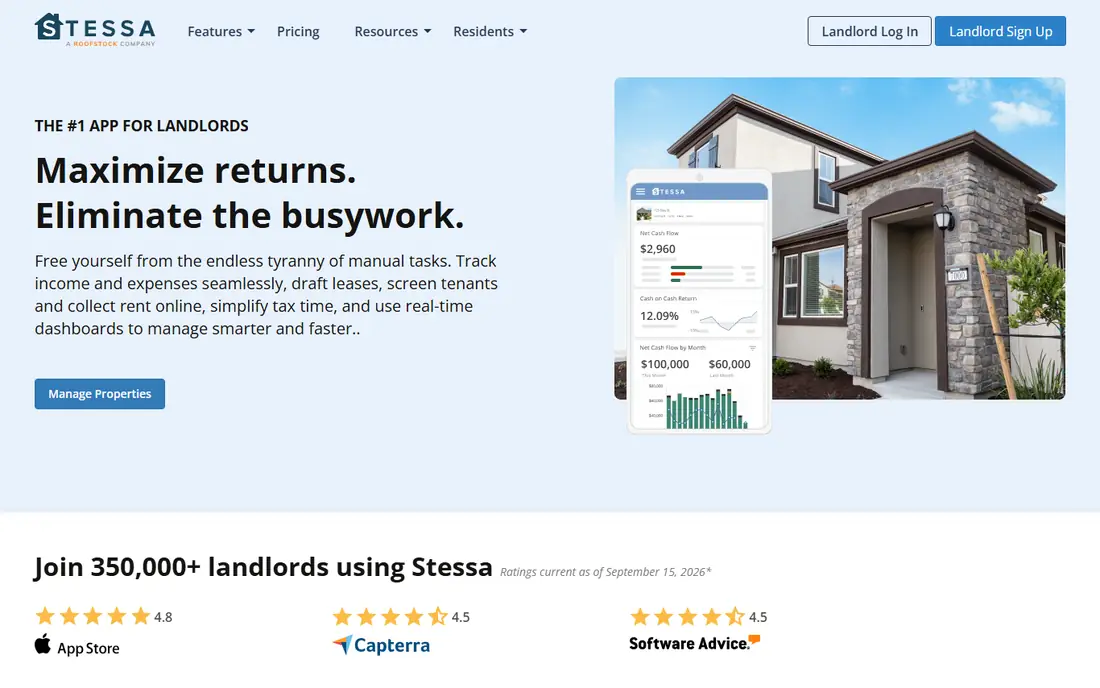
Stessa fits landlords who want a clear picture of each property without paying for tenant screening, leasing, and maintenance tools they may not use. The dashboard groups income and expenses by property, so a landlord can see which unit is producing cash flow and which one is absorbing repair costs. Bank and mortgage connections, where supported, reduce manual entry, and the reports are organised in a way that an accountant can follow without a separate spreadsheet. The honest catch is scope. Stessa is strongest as a tracking and reporting tool, not as a replacement for a full management platform. Landlords who need tenant portals, screening, and work-order tracking for many units may still need another tool alongside it. For a small portfolio, though, the free tier covers the core job well, and the paid upgrades make sense only once the reporting needs grow.
- Free starting tier
- Property-level income and expense tracking
- Tax-ready reports for landlords
- Paid plans are needed for some advanced reports
- Not a full property management suite

Baselane suits landlords who want rent collection and bookkeeping in the same place. When rent arrives through the platform, the transaction can be matched to the right property and tenant, which cuts down on end-of-month matching work. The banking side is useful for landlords who keep rental money separate from personal money, because it makes the separation visible rather than something to reconstruct later. The trade-off is that landlords who already have a bank they like, and who do not want to move accounts, may get less benefit from the main selling point. The bookkeeping still works, but the strongest case for Baselane is the combined flow from rent payment to categorised record to report. Check the current account terms before opening anything, and confirm that the features you need are included in the free tier.
- Free starting tier
- Integrated banking and rent collection
- Bookkeeping organised by property
- Best value when you use its banking features
- Some advanced tools sit on paid plans
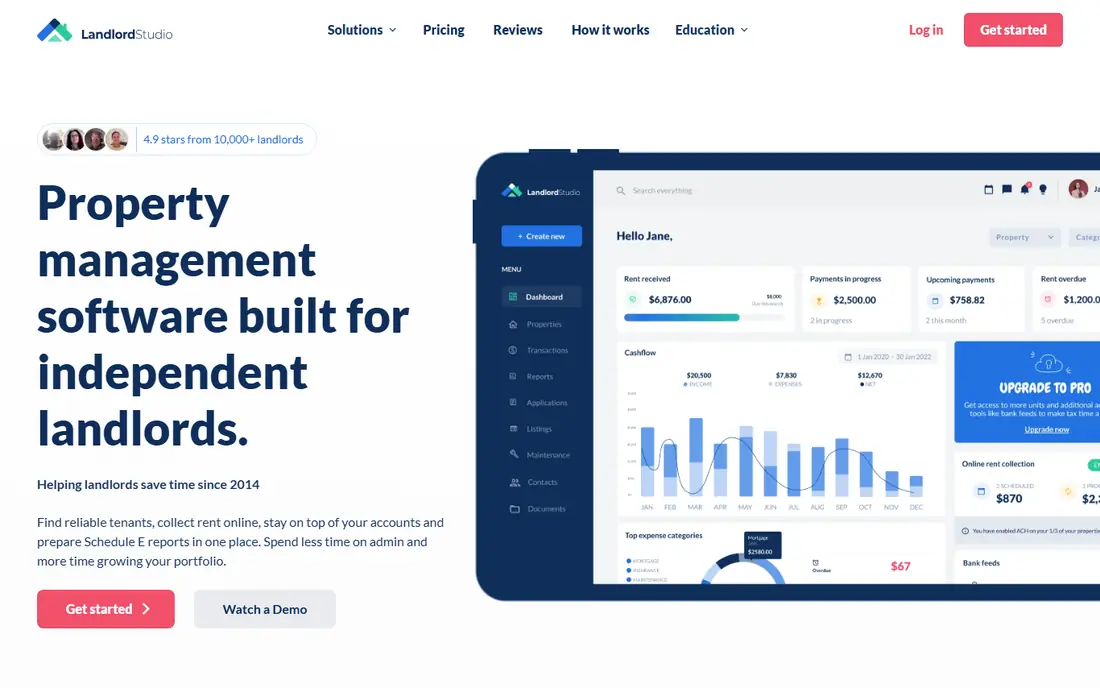
Landlord Studio is a practical choice for landlords who do most of their admin on a phone. Expenses can be logged when they happen, rent can be tracked against tenancies, and the property view keeps each unit separate. That mobile-first habit matters, because the most common bookkeeping problem for small landlords is not complex accounting, it is missing receipts and forgotten expenses. The limit to watch is scale. A landlord with one to three units will find the free tier easy to justify, while a landlord with a larger portfolio should price the paid plan before committing. The tax summaries are helpful, but they do not replace professional advice for depreciation, entity structure, or local tax rules. Use the reports as a starting point for your accountant, not as a filing decision on their own.
- Free tier for small portfolios
- Mobile expense tracking
- Tax summaries by property
- Free tier has unit limits in some listings
- Larger portfolios need a paid plan
REI Hub appeals to investors who think in terms of tax time all year, not just in April. Income and expenses are recorded by property, and the reporting is built around the categories landlords need for rental tax forms. For owners with short-term rentals as well as long-term lets, the ability to bring in booking data can save hours of manual entry, provided the connection you use is supported. The catch is that the free tier does not include everything, and landlords should check which reports are paywalled before they rely on a specific form. It is also worth confirming how the tool handles mixed portfolios, such as a property that is sometimes a long-term rental and sometimes a short-term rental. When those details are clear, REI Hub is a tidy, focused option for investors who want clean books and clean tax packets.
- Free starting tier
- Property-based accounting
- Schedule E style reporting
- Some reports require a paid plan
- Short-term rental imports vary by connection
Buildium is the step up when a landlord stops managing a handful of units and starts running a small management operation. Leases, tenants, maintenance requests, and accounting sit in one system, so a rent payment, a repair bill, and an owner statement can all trace back to the same property. That shared record is what makes owner reporting credible, because the numbers behind a statement are not assembled from three different tools. The price and setup reflect that breadth. A landlord with two units will likely find Buildium more than needed, and the learning period is longer than with a free tracker. For managers with growing unit counts, though, the cost can be justified by time saved on statements, renewals, and payment tracking. Start with a trial on a real property, and check that the accounting reports match how your accountant wants to see owner funds handled.
- Lease tracking and tenant workflows
- Accounting built for property managers
- Owner reporting
- Higher starting price than landlord-only tools
- More setup than a simple tracker
RentRedi stands out for its simple pricing idea. Instead of charging per unit, it charges a flat monthly rate, which makes budgeting easy as a portfolio grows from a few units to many. Rent collection, tenant screening, and maintenance requests are included in the core landlord workflow, so the tool covers the day-to-day jobs that often sit outside a pure accounting app. The honest limit is accounting depth. RentRedi tracks rent and expenses well for landlord use, but a landlord or accountant who needs full double-entry accounting, payroll, or complex entity reporting will still want a general accounting tool. Think of RentRedi as a landlord operations tool with solid financial tracking, rather than a full accounting system. That framing helps set the right expectation before you subscribe.
- Flat monthly pricing
- Rent collection and tenant screening
- Maintenance tracking
- Accounting depth is lighter than general accounting software
- Some features are add-ons
QuickBooks Online is the choice when a landlord wants an accounting system first and a rental tracker second. Classes or locations can separate income and expenses by property, bank feeds can pull in transactions, and invoices can handle charges beyond rent. Because many accountants already work in QuickBooks, handing over the books at year end is often simpler than with a niche tool. The setup is the catch. QuickBooks does not come pre-built for rentals in the same way as Stessa or REI Hub, so a landlord needs to set up properties, categories, and reports carefully at the start. It also does not handle trust accounting or security deposit workflows in the way a dedicated property management platform does. For landlords who manage properties for other owners, that gap matters. For landlords managing their own portfolio with an accountant, it is usually manageable.
- Full double-entry accounting
- Bank feeds and invoicing
- Widely used by accountants
- Not built only for rentals, so property setup takes care
- Trust accounting is limited
Xero gives small portfolios a clean, general accounting base with strong bank reconciliation. Transactions can be matched quickly, invoices can be sent for rent or other charges, and reports can be shared with an accountant without exporting a tangle of spreadsheets. The integration library is useful too, because landlords often connect a rent collection tool or a property app and want the accounting to stay in sync. The rental-specific work still needs attention. Xero does not automatically produce landlord tax packets in the same way as a rental-first tool, so property separation and category choices need to be set up deliberately. Landlords who are comfortable with that setup, or who have an accountant to set it up once, will get a reliable system. Landlords who want rental reports out of the box may prefer Stessa, REI Hub, or Landlord Studio first, and keep Xero for the wider business accounts.
- Clean invoicing and reconciliation
- App integrations
- Multi-currency support
- Rental-specific reports need setup or add-ons
- Pricing rises with the plan tier
How we picked these
We reviewed official feature pages, pricing pages, and app store listings for rental accounting and property management tools, and we compared how each tool handles property-level income, expenses, rent collection, and tax reports. We favoured tools that are still offered in October 2026, that clearly separate records by property, and that publish pricing or a free tier in plain terms. Public reviews helped us check common complaints, such as paywalled reports and setup time, but we did not treat review scores as proof of quality on their own. Where a price varied by source or by billing period, we used the most commonly listed starting figure and noted that plans change, so readers should confirm the live price before buying.
How to choose rental accounting software without overpaying
Start with unit count. One to three units usually need tracking and tax reports, not a full management suite, so a free tier is often enough. Four to twenty units is where rent collection, screening, and maintenance start to save real time, and a flat-rate landlord tool can pay for itself. Above that, or when you manage for other owners, owner statements and trust handling become the deciding factors, and a manager-grade platform is worth its higher price. Next, decide how your accountant will use the output. Ask which reports they want, in which format, and whether they prefer a rental-first tool or a general accounting file. A tool that produces a neat dashboard but a messy export will cost you at tax time. Also check bank connections for the banks you actually use, because a missing feed turns an automated tool back into a manual spreadsheet. Finally, trial the tool on one property with real transactions before moving the whole portfolio, and keep your old records until the new reports reconcile.
Frequently asked questions
What is the best accounting software for rental properties?
The best choice depends on portfolio size. Stessa and Baselane are strong free starting points for small landlords, REI Hub and Landlord Studio are strong for tax-focused tracking, and Buildium suits managers who need tenant and owner workflows. QuickBooks Online and Xero suit landlords who want general accounting depth and already work with an accountant in those systems.
What is the best software for rental property accounting for beginners?
A free, rental-first tool is usually the best beginner step, because it separates income and expenses by property without requiring accounting setup. Stessa is a common first pick for that reason, with Landlord Studio close behind for landlords who work mainly on a phone. Start with one property, connect the bank account you use for rent, and check the monthly report before adding more units.
What is the best bookkeeping software for rental properties?
Bookkeeping for rentals means consistent categorisation, not just storing receipts. Tools that support bank feeds, property-level categories, and monthly reconciliation will keep books cleaner than a manual spreadsheet. QuickBooks Online and Xero offer the deepest bookkeeping, while Stessa, Baselane, and REI Hub offer bookkeeping shaped specifically around rental categories and tax reports.
Is there best free accounting software for rental properties?
Yes, several tools offer free tiers, including Stessa, Baselane, Landlord Studio, and REI Hub, though each limits some advanced reports or unit counts on the free plan. Free does not mean unlimited, so check which reports, connections, and properties are included before you rely on the free tier for tax filing. For very simple portfolios, a free tier can be enough for a full year of records.
Should landlords use property management accounting software or general accounting software?
Use a rental-first tool if your main need is property-level rent, expenses, and tax reports. Use general accounting software if you also run a wider business, need payroll or full double-entry books, or your accountant already works in QuickBooks or Xero. Many landlords use both, with a rental tool for operations and a general tool for the business accounts, provided the two do not double-count the same income.
Do I need an accountant if I use rental accounting software?
Software helps organise records, but it does not decide tax treatment, depreciation, or entity structure for you. This guide is general information only, not tax advice, and landlords with complex portfolios, multiple entities, or unusual transactions should check the reports with a qualified accountant or tax professional before filing.
Sources we checked (8)

Online Jobs is an independent blog about careers, online work, learning new skills and the tools that help people earn. More about us.
Keep reading
All posts
Top AI Financial Software
Searching for top AI financial software? We compared 9 AI finance tools for AP, spend, close, forecasting and bookkeeping to help teams choose wisely.

Quicken Alternatives
Compare the best quicken alternatives for Mac, Windows, and small business owners, from Monarch Money and YNAB to Copilot, Tiller, and Banktivity in 2026.

GoFundMe Alternatives
Looking for GoFundMe alternatives? We compared 8 fundraising platforms on fees, campaign types, donor tools and who each platform suits best in 2026 today.