Best Accounting Software for Real Estate Investors in 2026: 9 Tools Compared

How we put this together: we compare official feature and pricing pages, app store listings, privacy policies and public user reviews. Prices change, so check the provider's site before you pay.
Key takeaways
- Stessa is our top pick for small landlords who want free, property-level accounting without learning a general ledger system.
- REI Hub suits investors who want true double-entry books built around properties, units and tax categories.
- QuickBooks Online suits investors with mixed businesses or an accountant who already works in QuickBooks.
- Buildium and AppFolio suit managers who also need leasing, maintenance and owner reporting, not just accounting.
- Baselane suits landlords who want banking, rent collection and bookkeeping in one place, with a free core plan.
Quick comparison
| Name | Who it suits | Starting price | Free option | |
|---|---|---|---|---|
 Stessa | Free rental accounting | Free | Yes | Visit |
 REI Hub | Double-entry rental books | Free | Yes | Visit |
 QuickBooks Online | General accounting with property tracking | $38 per month | No | Visit |
 Xero | Cloud accounting with add-ons | See website | No | Visit |
 Buildium | Property managers | $62 per month | No | Visit |
 AppFolio | Larger management portfolios | See website | No | Visit |
 Landlord Studio | Self-managing landlords | Free | Yes | Visit |
 Baselane | Banking plus bookkeeping | Free | Yes | Visit |
 RentRedi | Rent collection plus accounting | $12 per month | No | Visit |
The best accounting software for real estate investors
Real estate books are different from ordinary small business books. Rent, deposits, repairs, mortgage splits and per-property profit all need to stay separate, and tax time is far easier when transactions are already tagged by property and category. We compared vendor feature pages and pricing pages, and we favoured tools that report by property, support Schedule E style categories and reduce manual entry through bank feeds.
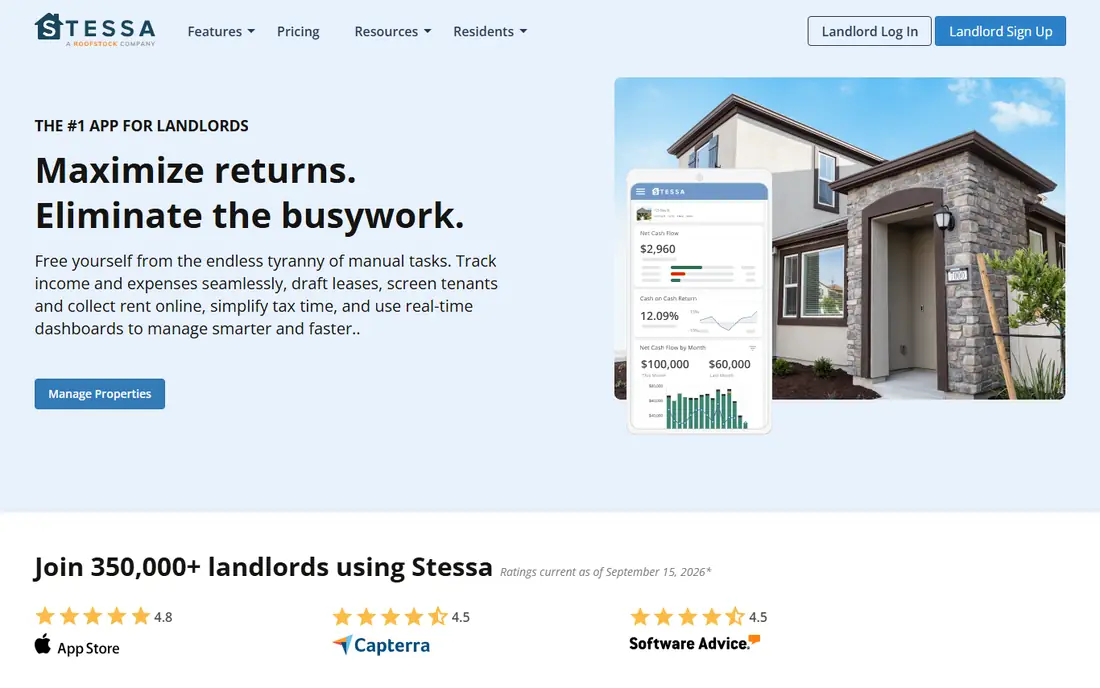
Stessa is built for landlords first, so it thinks in properties rather than in ledger accounts. Connect bank accounts, and income and expenses are categorised by property, with dashboards showing cash flow and performance for each door and for the portfolio as a whole. The free Essentials plan covers the basics well enough that many small landlords never pay, which is rare in this category.
The limit is depth. Stessa does not offer tenant screening, full maintenance workflows or a general ledger that an accountant can reshape freely, and Schedule E reporting sits on paid plans. If your main question is whether each property makes money, and you self-manage a modest portfolio, Stessa answers it clearly and cheaply. If you manage for other owners, look at Buildium or AppFolio instead.
- Free Essentials plan with unlimited properties
- Automatic bank feeds and property dashboards
- Schedule E reporting on paid plans
- No full property management suite
- Advanced reports need a paid plan

REI Hub gives investors a proper accounting system without forcing them to learn general accounting first. Its chart of accounts is built for rentals, mortgage payments split into principal, interest and taxes, and fixed assets and depreciation are tracked per property. Reports run at portfolio, property and unit level, which makes it easier to hand clean books to an accountant at tax time.
The trade-off is scope. REI Hub focuses on accounting, so rent collection and tenant tools need a separate system, and pricing rises with the number of units. For an investor who wants CPA-ready books and does their own bookkeeping, that focus is a strength. For a landlord who wants one tool for tenants and books, Landlord Studio or RentRedi may fit better.
- True double-entry accounting for rentals
- Mortgage splits and depreciation tracking
- Reports by portfolio, property and unit
- No built-in rent collection or tenant management
- Paid plans scale with unit count

QuickBooks Online is the generalist on this list, and that is both its strength and its weakness for investors. Almost any accountant can work in it, integrations cover banks, payroll and hundreds of apps, and invoicing, bills and reporting are mature. With class tracking on higher plans, an investor can separate income and expenses by property inside a full double-entry system.
The catch is that property separation is not automatic. You must set up classes or locations carefully, and the plan that gives you that detail costs more than a specialist rental tool. Investors with a mixed business, such as rentals plus a contracting or agency arm, often benefit most, because one system can hold both sides. Pure landlords may prefer a rental-first tool.
- Widely accepted by accountants
- Huge integration range
- Class tracking can separate properties on higher plans
- Property tracking needs setup and a higher plan for full class use
- Price rises with users and plans
Xero is a strong general cloud ledger with a clean interface, reliable bank feeds and an app marketplace that includes property tools. Accountants can collaborate in the same file, reports are easy to share, and the system handles invoicing, bills and reconciliation well. Investors who already use Xero for another business can keep everything in one place.
Like QuickBooks, Xero is not rental-first. Per-property profit, Schedule E style reporting and rent tracking need add-ons or disciplined tracking categories, which adds cost and setup time. If your accountant prefers Xero and your portfolio is modest, it is a sound choice. If you want rental reports out of the box, Stessa or REI Hub will get you there faster.
- Clean cloud interface and strong bank feeds
- Large app marketplace for property add-ons
- Good accountant collaboration
- Rental reporting needs add-ons or careful setup
- Pricing varies by region and plan
Buildium is aimed at property management companies rather than individual landlords. It combines accounting with leasing, online rent, maintenance tickets, owner portals and statements, so a manager can run operations and books in one place. Trust accounting and owner reporting matter here, because managers handle other people's money and must show where it went.
That breadth comes with a higher starting price and a longer setup, which is hard to justify for a landlord with a few doors. For a growing management business, though, the combined system avoids the errors that come from syncing separate tools. If you manage for owners and need scale, Buildium is a natural shortlist pick.
- Full management plus accounting in one system
- Owner portals and statements
- Trust accounting support
- Priced for managers, not small landlords
- Setup is heavier than lightweight tools
AppFolio serves larger property management portfolios with a broad platform covering marketing, leasing, resident management, maintenance and accounting. Reporting is built for scale, with portfolio views that help managers spot vacancy, arrears and maintenance trends across many units. Its mobile tools also support staff and residents in the field.
The barrier is size and price. AppFolio is quote based and generally aimed at portfolios well above a small landlord's scale, so a solo investor will find it out of reach and overpowered. A management company with dozens or hundreds of units, looking for one system to standardise operations, will get far more value from it than a small holder would.
- Deep management, leasing and accounting features
- Strong reporting for large portfolios
- Mobile tools for residents and staff
- Pricing is quote based with a minimum portfolio size
- More than most small investors need
Landlord Studio balances accounting and day-to-day landlord work in one app. The free plan covers up to 3 units, paid plans add bank feeds and fuller reporting, and the tool includes rent collection, tenant screening, listings and mileage tracking alongside income and expense tracking. A native Xero sync also helps landlords whose accountant works in Xero.
It is not a replacement for a full general ledger if your business has complex entities or commercial accounting needs, and costs rise as units grow. For a self-managing landlord who wants books, rent and tenants in one place without a steep learning curve, it is one of the most complete mid-priced options here.
- Free plan for up to 3 units
- Schedule E export and Xero sync
- Rent collection, screening and mileage tools included
- Paid plans needed for larger portfolios
- Accounting depth is lighter than a full general ledger
Baselane starts with banking rather than books. Landlords open virtual accounts per property, collect rent into them and let the transaction stream feed bookkeeping that is auto-tagged to Schedule E categories. The Core plan is free, while Smart adds advanced automation and faster rent deposits. Keeping each property's money separate by design helps investors who struggle with mixed funds.
The model works best for US landlords happy to bank through the platform, and it does not replace a full general ledger for complex businesses. For a residential landlord who wants rent, banking and basic books in one free hub, Baselane is practical and easy to start. Check the banking terms for your situation before moving all funds across.
- Free Core plan with landlord banking
- Virtual accounts per property
- Auto-tagging to Schedule E categories
- Banking-led model suits US landlords best
- General accounting depth is lighter than QuickBooks
RentRedi charges one flat rate for its full feature set, which makes budgeting simple as a portfolio grows. Tenants get a mobile app, listings reach major rental sites, and the platform now includes accounting alongside rent collection, screening and maintenance. That combination suits landlords who manage from a phone and want operations and books together.
The accounting side is newer than Stessa or REI Hub, so investors who need deep double-entry detail may still prefer a specialist. For a landlord who values a simple flat price, a strong tenant app and decent books in one system, RentRedi is a clear contender, and its annual price is competitive with the paid tiers of several rivals here.
- Flat pricing regardless of unit count
- Mobile-first tenant app and listings
- Accounting included on all terms
- Accounting suite is newer and lighter than specialist tools
- No free plan
How we picked these
We compared vendor feature pages and pricing pages for tools used by real estate investors, and we favoured tools that report by property, support tax category tagging and reduce manual entry. We did not claim hands-on testing, and we treated vendor claims as claims. Where a vendor does not publish a starting price, we list "See website" rather than repeating a third party estimate. Prices change, so check the vendor pricing page before you buy.
What to look for in accounting software for property investors
Property-level reporting
The single most important test is whether you can see profit, cash flow and expenses for one property without exporting and rebuilding a spreadsheet. Ask for a sample profit and loss by property, check how mortgage splits are handled, and confirm that deposits are kept separate from income. If a tool cannot answer those questions cleanly, it will cost you time every month.
Tax categories and accountant access
Look for Schedule E style categories, receipt storage and a tax package or export your accountant can use directly. Give your accountant access during a trial and ask what they would still need to adjust, because a tool that looks simple to you may create extra work for them. This article is general information only, not tax advice, and tax rules differ by country and situation, so confirm treatment with a qualified professional.
Rent, banking and scale
Decide whether you need rent collection and banking inside the accounting tool, or whether you already collect rent elsewhere and only need books. Specialist accounting tools suit the second case, while all-in-one landlord tools suit the first. Also check how pricing scales with units, users and entities, since a cheap plan for three doors can become expensive at thirty.
Setup effort and exit
A tool that takes a weekend to set up but saves an hour a week is a good trade, while a tool that needs a consultant for a small portfolio is not. During a trial, import a month of real transactions, reconcile one bank account and produce one tax report. Also check how you can export your full history, so your books are not trapped if you switch later.
Frequently asked questions
What is the best accounting software for property investors?
Stessa is the best starting point for small landlords, because its free plan covers property-level income, expenses and dashboards. REI Hub suits investors who want double-entry books, while QuickBooks Online suits those with a mixed business or an accountant already using it. Your portfolio size and whether you manage for others matter more than any single feature list.
Is there free accounting software for real estate investors?
Yes. Stessa, REI Hub and Baselane all offer free plans, and Landlord Studio is free for up to 3 units. Free plans usually limit advanced reports, tax exports or automation, so check what sits behind a paywall before you commit your full history to one tool.
Do I need QuickBooks for rental properties?
No, not necessarily. QuickBooks is a strong general ledger and many accountants prefer it, but rental-first tools often give clearer property reports with less setup. Choose QuickBooks if you have a mixed business or your accountant insists on it, and choose a rental tool if property reporting is your main need.
What reports should rental accounting software produce?
At minimum, look for a profit and loss by property, a cash flow statement, a rent roll or income summary, and a tax package with Schedule E style categories. Depreciation tracking and a balance sheet matter once you hold several properties or multiple entities, so check those before you outgrow a simple tool.
Can accounting software replace my accountant?
No. Software can organise transactions, categorise expenses and produce reports, but it cannot give tax advice for your situation or replace professional review. Use the tool to keep clean books through the year, then let an accountant review the tax package and confirm deductions, depreciation and entity treatment.
Sources we checked (9)

Online Jobs is an independent blog about careers, online work, learning new skills and the tools that help people earn. More about us.
Keep reading
All posts
Wise Alternatives
Compare the best Wise alternatives in 2026, from Revolut and Remitly to OFX and Xe, with fees, speed, cash pickup options, and honest trade-offs today.

Top AI Financial Software
Searching for top AI financial software? We compared 9 AI finance tools for AP, spend, close, forecasting and bookkeeping to help teams choose wisely.

Quicken Alternatives
Compare the best quicken alternatives for Mac, Windows, and small business owners, from Monarch Money and YNAB to Copilot, Tiller, and Banktivity in 2026.