Best Treasury Management Software in 2026: 9 Products Compared

How we put this together: we compare official feature and pricing pages, app store listings, privacy policies and public user reviews. Prices change, so check the provider's site before you pay.
Key takeaways
- Kyriba and FIS suit large multinationals with global cash, payments, and risk needs, but implementation takes months.
- ION Treasury suits complex financial markets and derivatives work, while SAP suits teams already running SAP finance.
- Trovata and Agicap suit mid-market teams that want faster cash visibility without a full enterprise project.
- Most enterprise treasury pricing is quote-based, so budget for implementation and bank connectivity as well as the subscription.
Quick comparison
| Name | Who it suits | Starting price | Free option | |
|---|---|---|---|---|
 Kyriba | global enterprise treasury | See website | No | Visit |
 FIS Treasury and Risk Manager | full-suite enterprise treasury | See website | No | Visit |
 ION Treasury | complex markets treasury | See website | No | Visit |
 GTreasury | integrated mid to large treasury | See website | No | Visit |
 SAP Treasury and Risk Management | SAP finance treasury | See website | No | Visit |
 Coupa Treasury | spend-linked treasury | See website | No | Visit |
 Trovata | API-first cash visibility | See website | Free trial | Visit |
 Agicap | cash forecasting for mid-market | See website | Free trial | Visit |
 Nomentia | cash and payment workflows | See website | Free trial | Visit |
The best treasury management software
Treasury software gives finance teams a single view of cash, bank accounts, payments, and risk, instead of a patchwork of spreadsheets and bank portals. Enterprise tools differ sharply from mid-market tools on price, setup time, and depth.
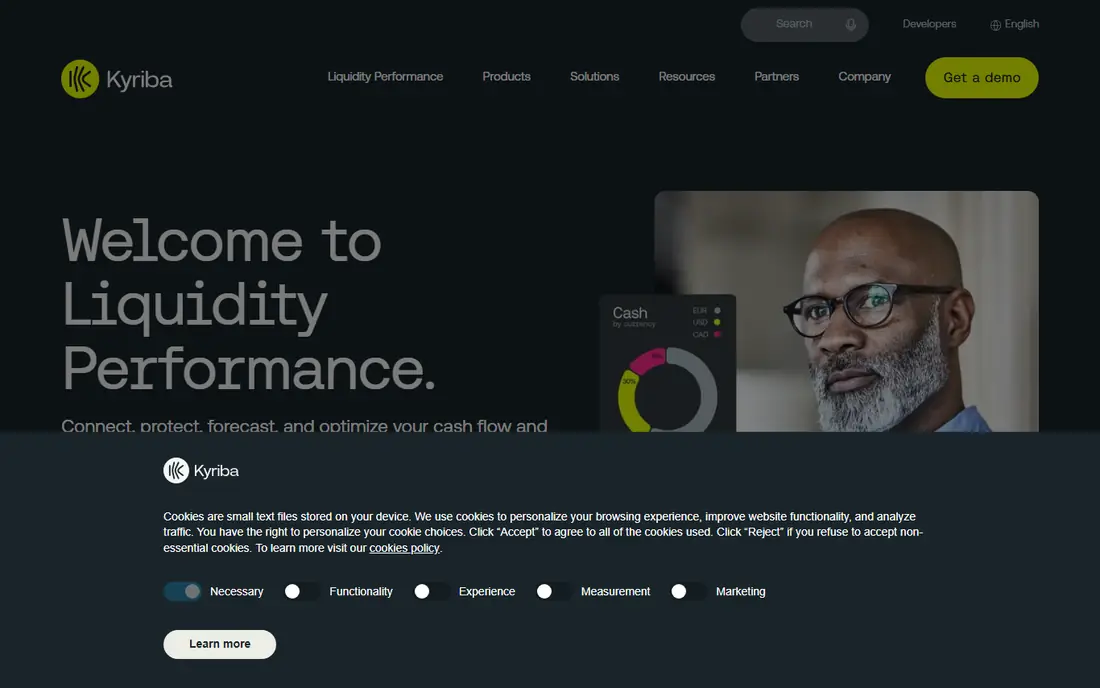
Kyriba is the first name most large treasury teams put on a shortlist. It suits multinationals managing cash across many countries and banks. Its cloud platform covers cash positioning, forecasting, payments, and FX risk, with prebuilt bank connections that reduce manual work.
The catch is enterprise pricing. Check the current plan limits and export options before you move data in, and run a small pilot with real records first. Start with the smallest plan that covers your core workflow, then upgrade only when a limit gets in the way.
- Broad bank connectivity
- Cash, payments, and risk in one cloud platform
- Working capital tools
- Enterprise pricing
- Implementation takes months
FIS Treasury and Risk Manager
Who it suits: full-suite enterprise treasury

FIS Treasury and Risk Manager covers the classic treasury ground at institutional scale. It suits large enterprises with complex treasury and risk operations. It supports cash visibility, forecasting, payments, and hedge workflows, with reporting options that suit audit and compliance needs.
The catch is large vendor contracting can be complex. Read the plan limits for seats, storage, and usage before you commit, and test it with a small real workload first. Start with the smallest plan that covers your core workflow, then upgrade only when a limit gets in the way.
- Cash, risk, and compliance coverage
- Cloud and on-prem editions
- AI-assisted workflows
- Large vendor contracting can be complex
- Setup takes time

ION Treasury is known for depth in financial markets and risk. It suits large corporates with complex FX, debt, and investment portfolios. Its portfolio includes Wallstreet Suite and related products, which suit teams that need detailed instrument and risk handling beyond basic cash management.
The catch is complex portfolio can be hard to scope. Confirm what is included at your plan level, how exports work, and what happens if you need to leave later. Start with the smallest plan that covers your core workflow, then upgrade only when a limit gets in the way.
- Deep derivatives and risk analytics
- Multiple treasury products
- Strong multi-entity support
- Complex portfolio can be hard to scope
- Enterprise cost and skills needed
GTreasury offers a broad treasury workstation without the heaviest enterprise footprint. It suits mid-market to large teams that want an integrated workstation. It combines cash management, payments, and financial risk in one view, which helps teams that currently juggle several tools and spreadsheets.
The catch is enterprise pricing still applies. Check the current plan limits and export options before you move data in, and run a small pilot with real records first. Start with the smallest plan that covers your core workflow, then upgrade only when a limit gets in the way.
- Integrated cash, payments, and risk
- Usable interface
- Good mid-market fit
- Enterprise pricing still applies
- Scope depends on modules chosen
SAP Treasury and Risk Management
Who it suits: SAP finance treasury
SAP Treasury and Risk Management makes most sense inside an SAP finance estate. It suits enterprises already running SAP S/4HANA finance. Trades, cash forecasting, payments, and accounting stay linked to the wider SAP system, which reduces reconciliation work for SAP users.
The catch is tied to SAP scope and timeline. Read the plan limits for seats, storage, and usage before you commit, and test it with a small real workload first. Start with the smallest plan that covers your core workflow, then upgrade only when a limit gets in the way.
- Native SAP finance integration
- Strong accounting and risk links
- Global compliance support
- Tied to SAP scope and timeline
- Best only for SAP shops
Coupa Treasury suits teams that already manage spend through Coupa. It suits companies that want treasury joined to procurement and spend data. It gives a shared view of cash and spend, which helps finance teams connect payment timing, supplier terms, and liquidity in one place.
The catch is best value for existing Coupa users. Confirm what is included at your plan level, how exports work, and what happens if you need to leave later. Start with the smallest plan that covers your core workflow, then upgrade only when a limit gets in the way.
- Links treasury to spend and procurement
- Unified cash view
- Cloud delivery
- Best value for existing Coupa users
- Less standalone depth in some areas
Trovata is the faster, API-first option for mid-market cash visibility. It suits mid-market finance teams replacing spreadsheet cash reporting. It connects banks through APIs, builds a consolidated cash view, and supports forecasting without the long project timeline of a traditional TMS.
The catch is less full-suite risk depth than enterprise TMS tools. Check the current plan limits and export options before you move data in, and run a small pilot with real records first. Start with the smallest plan that covers your core workflow, then upgrade only when a limit gets in the way.
- Fast bank connectivity via APIs
- Clear cash dashboards
- Quicker onboarding
- Less full-suite risk depth than enterprise TMS tools
- Pricing still enterprise-leaning
Agicap is built around rolling cash forecasts rather than static reports. It suits small and mid-sized companies that live by their cash forecast. It turns bank and operational data into forward cash views, with scenarios that help teams plan for late payments, growth, or seasonal dips.
The catch is european bank strength is greater than US depth in some cases. Read the plan limits for seats, storage, and usage before you commit, and test it with a small real workload first. Start with the smallest plan that covers your core workflow, then upgrade only when a limit gets in the way.
- Forecast-first cash management
- Broad bank connections
- Scenario planning
- European bank strength is greater than US depth in some cases
- Module scope varies
Nomentia combines cash planning with governed payment workflows. It suits finance teams that need control around cash and payments. It links forecasting inputs to approvals and posting steps, which gives auditors a clearer trail than a spreadsheet-based process.
The catch is smaller brand profile than Kyriba or FIS. Confirm what is included at your plan level, how exports work, and what happens if you need to leave later. Start with the smallest plan that covers your core workflow, then upgrade only when a limit gets in the way.
- Cash management with approvals and audit trails
- Payment workflows
- Forecasting tools
- Smaller brand profile than Kyriba or FIS
- Check local bank coverage
How we picked these
We compared official feature pages, product documentation, and public buyer guides for each platform, and checked that each one is still offered in October 2026. We weighted bank connectivity, cash visibility, forecasting, payments, risk, security, and implementation effort, because those factors drive total cost more than list price.
We also read public user reviews and vendor announcements to spot setup timelines and pricing patterns. We did not claim hands-on testing of every platform, and most enterprise prices are quote-based, so the vendor should confirm a price for your bank count, entities, and modules.
How to choose treasury management software
Treasury software is a long-term purchase, so scope it by banks, entities, and workflows, not by a demo dashboard. A careful pilot saves months of rework later.
Count banks, accounts, and entities first
List every bank, account, currency, and legal entity that must appear in the cash view. Bank connectivity is often the hardest part, so confirm which banks have prebuilt connections and which need custom setup. A tool that covers most banks out of the box will go live faster.
Separate cash visibility from full risk
Some teams only need cash, payments, and forecasting, while others need FX, debt, and hedge accounting. Buying a full risk suite for a cash-only job adds cost and training time. Choose modules for the next two years, not every possible future need.
Check payments and controls
Confirm payment approval workflows, fraud checks, audit trails, and segregation of duties. Treasury payments carry real risk, so controls matter as much as speed. Test a payment from request to bank confirmation with your actual approvers.
Budget for implementation and support
Ask for a realistic timeline, data migration scope, and training plan. Enterprise tools can take months, while mid-market tools may go live in weeks. Confirm support hours, service levels, and what happens when a bank changes its file format or API.
Frequently asked questions
What is the best treasury management software?
Kyriba suits many large multinationals, FIS and ION suit complex enterprise risk, and SAP suits SAP finance users. For mid-market cash visibility, Trovata and Agicap are faster options. The best pick depends on bank count, entities, and risk depth.
How much does treasury management software cost?
Most enterprise tools are quote-based and priced by banks, entities, users, and modules, with implementation on top. Mid-market tools publish some prices, but totals still vary by scope. Get a scoped quote that includes bank connectivity and training.
Do treasury tools offer a free plan?
Enterprise treasury tools generally do not offer free plans, though some mid-market tools offer trials or demos. A trial is useful for cash dashboards, but a full treasury pilot needs real bank data and security review, so plan for a paid evaluation.
Can treasury software replace spreadsheets?
It can replace most manual cash spreadsheets by pulling bank data automatically and building forecasts from live balances. Some ad-hoc analysis may still happen in spreadsheets, but the core cash position, payments, and approvals should move into the system for control.
How long does treasury software take to implement?
Mid-market tools may go live in weeks, while enterprise tools often take several months, depending on bank count and modules. Bank connectivity, data cleanup, and approval workflows are the usual causes of delay, so scope those early.
What is the difference between a TMS and an ERP treasury module?
A standalone TMS usually offers deeper bank connectivity, payments, and risk features across many ERPs. An ERP treasury module offers tighter integration with that ERP, but may be weaker for banks outside the ERP estate. Choose based on whether integration or bank breadth matters more.
Sources we checked (9)

Online Jobs is an independent blog about careers, online work, learning new skills and the tools that help people earn. More about us.
Keep reading
All posts
Best Credit Repair Software
We compared the best credit repair software for dispute letters, client tracking, and business use to help you pick the best credit repair app for your needs.

Best Cash Apps
Best cash apps and cash application software compared for finance teams, covering matching, payments, forecasting, and deployment. Updated in October 2026.

Best Bill.com Alternatives
Looking for bill.com alternatives? We compared 9 bill pay and AP tools on price, approvals, accounting sync and payment fees to help you pick the right one.