Best Apps for Making Friends in 2026: 8 Apps Compared


One-to-one friend matching · Starting price: Free
How we put this together: we compare official feature and pricing pages, app store listings, privacy policies and public user reviews. Prices change, so check the provider's site before you pay.
Key takeaways
- Bumble For Friends suits one-to-one friend matching, while Meetup suits people who prefer joining a group activity first.
- Peanut is the strongest pick for women connecting around motherhood and life stages, and Friender suits hobby-based matching.
- Nextdoor helps you meet actual neighbours, while Slowly suits people who prefer thoughtful written conversations before meeting.
- Prefer apps with profile verification, reporting, and blocking tools, and meet new people in public places first.
- No app can make a stranger safe. Tell a friend your plans, keep personal details private early on, and leave if a meeting feels uncomfortable.
Quick comparison
| Name | Who it suits | Starting price | Free option | |
|---|---|---|---|---|
| Bumble For Friends | One-to-one friend matching | Free | Yes | Visit |
 Meetup | Group activities and events | Free | Yes | Visit |
 Friender | Hobby-based friend matching | Free | Yes | Visit |
 Peanut | Women and mothers | Free | Yes | Visit |
 Nextdoor | Meeting neighbours | Free | Yes | Visit |
 Yubo | Younger social discovery | Free | Yes | Visit |
 Slowly | Pen-pal style letters | Free | Yes | Visit |
 Timeleft | Structured group dinners | See website | No | Visit |
The best apps for making friends
Making friends as an adult is harder than it looks, especially after a move, a job change, or a shift in routine. Friendship apps help in different ways: some match you one-to-one, some gather people around an activity, and some build community around a life stage. We compared official feature pages, app store listings, and safety policies for apps that are live and moderated in October 2026, favouring services with verification, reporting tools, and clear community rules.
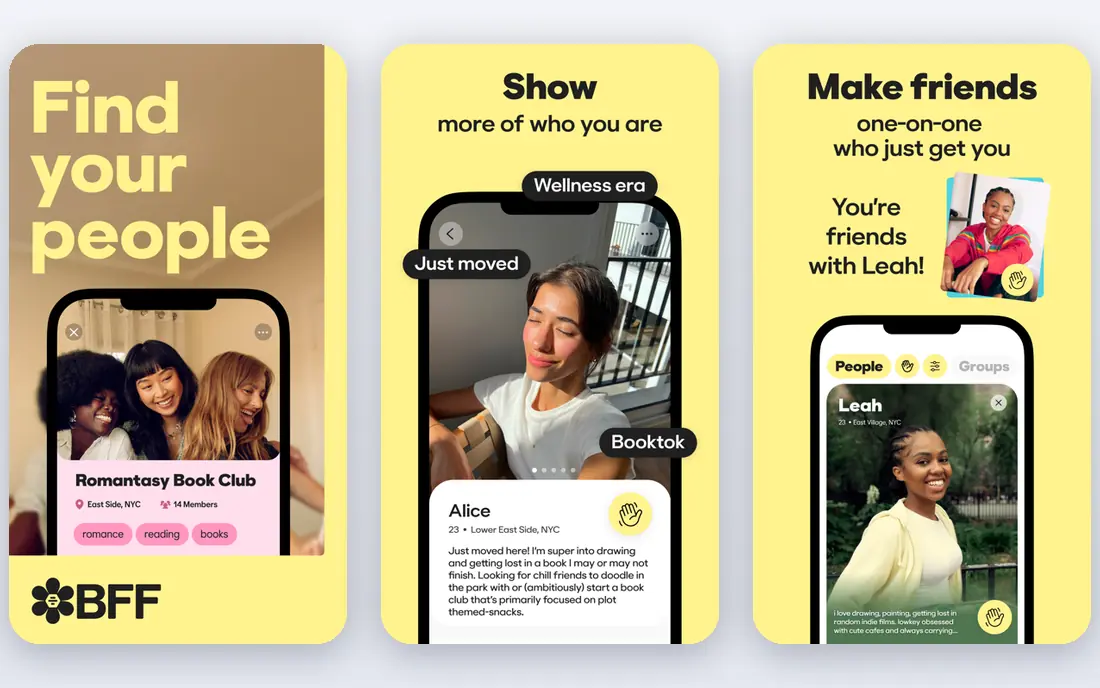
Bumble For Friends, formerly called Bumble BFF, is the friends-only mode inside the Bumble app, with profiles, interests, and location-based matching focused purely on friendship. That separation from dating matters, since it sets expectations clearly from the first message. Verification, reporting, and blocking tools carry over from the main app, which helps users feel safer starting conversations with strangers.
The common complaint is ghosting: matches that never turn into plans. Beat that by suggesting a specific, low-pressure meetup early, such as coffee or a walk, rather than chatting for weeks. Bumble For Friends works best in larger cities where the user base is dense, and it is our first pick for people who want one-to-one matching with a familiar app design.
- Friends-only mode separate from dating
- Profile verification available
- Large user base in major cities
- Matches can stall without a plan to meet
- Photo-first matching can feel shallow
- Paid features add up
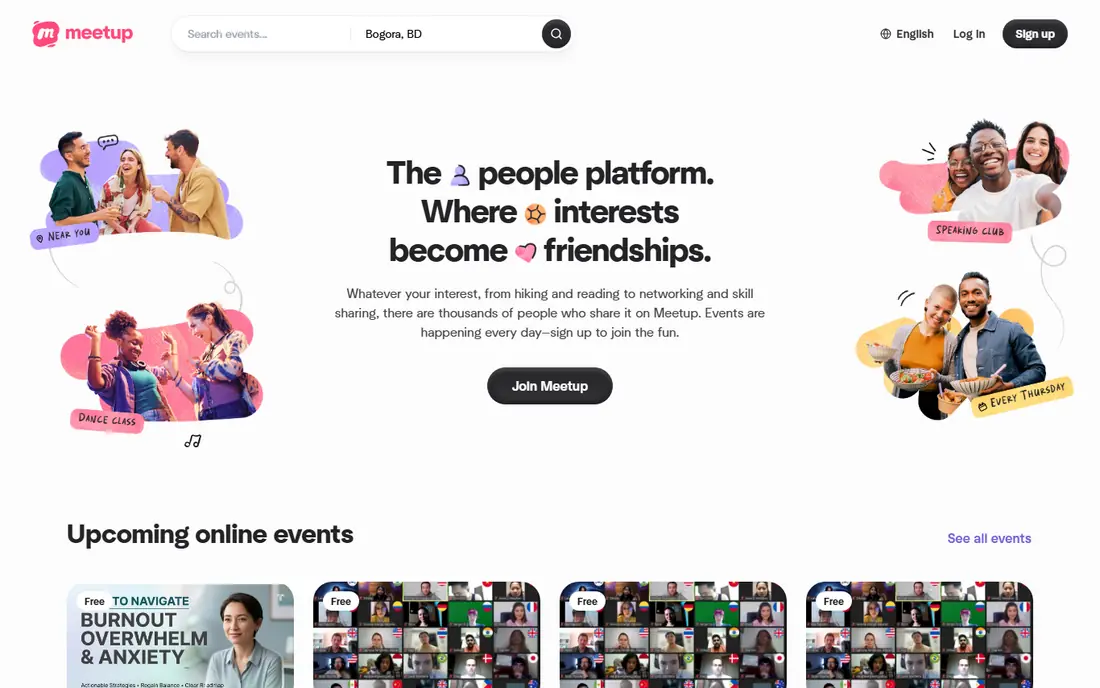
Meetup is the best choice if you prefer meeting people through a shared activity rather than through profile matching. Groups cover hiking, board games, language exchange, running, book clubs, and hundreds of other interests, and events happen in public places with a host and a group around you. That structure lowers the pressure of a one-to-one meeting, since you can join a group, take part, and talk naturally without a formal introduction.
Quality varies by organiser, so read recent event reviews and attendance numbers before you commit to a group. Some events charge a small fee to cover venue costs, which is normal and usually stated upfront. If you are new to a city, Meetup is the fastest way to build a regular social routine, and it pairs well with a matching app for closer one-to-one friendships.
- Huge range of local groups and events
- No swiping needed
- Easy to meet several people at once
- Group quality varies by organiser
- Some events charge a fee
- Attending alone takes confidence at first
Friender matches people by shared interests and activities rather than by photos alone, and it is platonic by design, which removes the dating ambiguity some users dislike on other apps. Once you match, messaging is unlimited, and the focus stays on planning something to do together, from a hike to a coffee meetup. For hobby-driven people, that activity-first approach feels more natural than endless profile browsing.
The user base is smaller than Bumble or Meetup, so results depend heavily on your city. Check how many nearby profiles appear before you invest much time, and consider pairing Friender with Meetup if your area is thin. Where Friender is active, it is one of the most genuinely friendship-focused apps available.
- Platonic by design with interest-based matching
- Unlimited messaging after matching
- Focused on shared activities
- Smaller user base than Bumble
- IOS availability has been stronger than Android
- Activity varies by city
Peanut is a community app for women, with a strong focus on motherhood, fertility, pregnancy, and life stages, though it also serves women looking for general friendship. Groups, chats, and live audio rooms let users connect around shared experiences, and the app includes verification and moderation tools to keep the community safer. For new mothers in particular, finding peers at the same stage can be genuinely supportive.
Peanut is women-only by design, so it will not suit everyone, and coverage is thinner outside larger cities. Some features sit behind paid plans, but core matching and community access are free. If you are a woman looking for friends who understand your life stage, Peanut is the most focused and supportive option on this list.
- Women-only community around motherhood and life stages
- Groups, chats, and live audio
- Verification and moderation tools
- Limited to women users by design
- Smaller in rural areas
- Some features need a paid plan
Nextdoor helps you meet the people who actually live near you, which is useful when you have just moved and want to feel at home. Local groups, events, and recommendations cover everything from running clubs to street socials, and the neighbourhood focus means meetups are close to home. Many lasting friendships start with a neighbour, and Nextdoor makes those first introductions easier.
Friendship is not Nextdoor's main product, so you will need to join groups and events actively rather than waiting for matches. Neighbourhood tone also varies, and some areas are friendlier than others. Keep your exact address private beyond what verification requires, and meet neighbours in public or group settings first. For settling into a new street or town, Nextdoor is a practical companion to Meetup.
- Connects you with real neighbours
- Local events, groups, and recommendations
- Useful for settling into a new area
- Friendship is not the main product
- Neighbourhood tone varies
- Verification needs address details
Yubo is a social discovery app popular with younger users, built around live streams, group chats, and interest-based communities rather than one-to-one matching. Users can join live rooms, swipe for friends, and chat in groups, which suits people who enjoy fast, casual social interaction. Age-based communities and verification tools aim to keep age groups separate, and users should check privacy settings carefully.
Yubo skews young, so adults over thirty may find a poor fit, and live features can feel noisy compared with Meetup or Friender. Parents should review age settings and safety tools if a teenager uses the app. For younger users looking for a lively social scene, Yubo offers more energy than a quiet matching app, but it needs the same safety habits as any social platform.
- Live social discovery and group chats
- Age-based communities
- Verification and safety tools for younger users
- Skews younger, so not suited to older users
- Live features can feel chaotic
- Moderation quality matters at scale
Slowly takes a deliberately slow approach to friendship. You write letters to pen pals matched by interests and language, and delivery time depends on distance, just like real post. That delay encourages thoughtful messages rather than quick small talk, and many users find the resulting friendships deeper than those formed through rapid swiping. Language learners also use Slowly to practise with native speakers.
Slowly will frustrate anyone who wants a local meetup this week, since it is built for written connection first and local events are not its focus. If you enjoy writing and want friendships that grow gradually, Slowly is a refreshing change from instant-message apps. It also works well alongside a local app like Meetup, covering online depth and in-person activity together.
- Thoughtful letter-style conversations
- Matches by interests and language
- No pressure to meet quickly
- Letters take time to arrive by design
- No local event features
- Not suited to users wanting fast meetups
Timeleft matches users into small groups for a shared dinner at a local restaurant, with a short personality quiz used to group compatible strangers. The structured format solves the hardest part of making friends: the first meeting. Everyone at the table is there to meet people, the venue is public, and conversation prompts help the evening along without forcing it.
Tickets cost money per dinner, and you cannot choose your tablemates, so some evenings will click better than others. Availability also varies by city and week, so check whether Timeleft runs regularly near you before relying on it. If you like the idea of a ready-made social evening without organising it yourself, Timeleft is a fun and low-effort way to meet several people at once.
- Matches you into a small dinner group with strangers
- Structured format removes awkward introductions
- Runs in many cities
- Paid tickets per dinner
- No control over who joins your table
- Availability varies by city and week
How we picked these
We compared official feature pages, app store listings, and safety policies for friendship apps that are live and moderated in October 2026. We favoured apps with profile verification, reporting and blocking tools, and clear community rules, and we included a mix of one-to-one matching, group activities, neighbourhood networks, and structured events. We left out apps that had shut down or that lacked clear moderation, since safety matters more than novelty when meeting strangers.
How to meet people safely from an app
Choose a public place for any first meeting, such as a cafe, a park event, or a group activity with other people around. Tell a friend where you are going, who you are meeting, and when you expect to be back, and keep your phone charged. Keep your home address, workplace details, and financial information private until you trust someone well, and do not share photos or details that reveal your routine. If a person pressures you to meet privately, asks for money, or makes you uncomfortable, stop contact, block the account, and report it in the app.
Turning matches into real friendships
A match is only a starting point. Suggest a specific plan within the first few messages, such as a coffee, a walk, or a group event, rather than chatting indefinitely. Follow up after a good meeting, since most new friendships fade from lack of follow-through rather than lack of liking. Join a regular group as well as matching one-to-one, because repeated contact is what turns acquaintances into friends. Give it time: a new social circle usually takes months, not weeks, to feel settled.
Frequently asked questions
What is the best app for making friends?
Bumble For Friends is the best all-round pick for one-to-one matching, while Meetup is best for joining group activities and meeting several people at once. Peanut suits women connecting around motherhood, and Friender suits hobby-based matching. Try one matching app and one group app together for the best results.
What is the best app for finding friends nearby?
Meetup and Nextdoor are the strongest local options. Meetup lists groups and events near you, while Nextdoor connects you with neighbours and local activities. Bumble For Friends also uses location matching, but its strength is one-to-one profiles rather than local events. Check which app is most active in your city before committing.
Are friend-making apps safe?
They can be, if you choose moderated apps with verification and reporting tools and follow basic safety habits. Meet in public places, tell a friend your plans, and keep personal details private early on. No app can guarantee safety, so trust your instincts, leave uncomfortable situations, and report users who pressure or harass you.
What is the best app for making friends as an adult?
Meetup works well for adults because shared activities give you a reason to meet regularly without awkward introductions. Bumble For Friends suits adults who prefer one-to-one matching, and Timeleft suits adults who want a structured dinner with strangers. Combining a regular group with one matching app usually works better than relying on a single app.
Can I make friends online without meeting in person?
Yes. Slowly builds friendships through thoughtful letters, and many Meetup and Peanut groups include online chats and communities. Online friendships can be meaningful on their own, and they can also lead to in-person meetings later when both people are comfortable. Set clear boundaries about what you share online, just as you would in person.
Is Bumble For Friends separate from dating?
Yes. Bumble For Friends is a friends-only mode inside the Bumble app, separate from the dating mode, with its own profiles and matches. That separation helps set expectations clearly, so users know they are matching for friendship. You can use the friends mode without using dating features at all.
Sources we checked (8)

Online Jobs is an independent blog about careers, online work, learning new skills and the tools that help people earn. More about us.
Keep reading
All posts
WatchCartoonOnline.io Alternatives
Compare legal WatchCartoonOnline.io alternatives for cartoons and anime, from free services to paid streaming, with honest catalog limits for every household.

Reddit Alternatives
We compared the best Reddit alternatives for 2026, from Lemmy and PieFed to Discuit, Tildes, MetaFilter, Hacker News and Discord, with community notes.

M4uFree Alternatives
Looking for m4ufree alternatives? We list legal streaming services with free and paid plans, plus the malware and legal risks of unlicensed sites today.